

This basic research sample on substance use follows a Grade 11 learner’s study of youth aged 15 to 24 in one barangay: how many smoke, vape and drink, when they start, what they know of the laws and of the places that give help, and whether the prevention activities they attend make a difference. It is the kind of study DepEd’s Preventive Drug Education Program policy, DepEd Order No. 30, s. 2018, encourages when it sets out to “Encourage PDE research for evidence-based decision-making and policy formulation” (Sec. IV, item 5). It is built around the four matters DepEd’s PDEP Curriculum Model expects Grade 9 and 10 learners to understand: data on substance use, its implications, the institutions and resources that help, and the laws. The sample goes from the root cause analysis to the dissemination plan, with the Word files, the Excel data set and a Python notebook behind every number.
This is an invented study. No barangay, school, learner or youth took part. The questionnaires, records and interviews were generated to behave like a real survey of youth in a large barangay. The laws, DepEd’s rules, the national figures and the research the paper cites are real. Use the sample to see what each part holds and how each number is computed; your study must come from your own barangay.
The Sangguniang Kabataan (SK) drew 272 youth at random from its list of 1,148 and delivered the invitations, so the learner never saw a name; 217 returned complete anonymous questionnaires. Within the past 30 days, 31.8% had drunk alcohol, 12.0% had smoked and 8.3% had vaped. Fewer than half, 45.2%, could name a place or person that gives help. Youth who had attended a barangay or SK prevention activity were more likely to know where to get help, while school activities showed no such link, and no activity went with less use. The questionnaire asks nothing about illegal drugs, for a reason Part 1 explains.
Key points
- The question: among youth aged 15 to 24 in one barangay, how common is the use of cigarettes, vapes and alcohol, at what ages does it start, what do youth know of the laws and of help, and are prevention activities associated with knowing where to get help and with less use?
- The design: a cross-sectional survey of a simple random sample, joined with the barangay’s and the rural health unit’s records for 2023 to 2025 and six key informant interviews (a convergent mixed methods design).
- The researcher: one Grade 11 learner, a member of the school’s Barkada Kontra Bisyo, with a research adviser.
- The ethics: no question on illegal drug use, no names, the SK holding its own list, parents’ consent with the youth’s co-signature for those aged 15 to 17, and a list of places that give help in every envelope.
- The statistics: shares with Wilson intervals, a weighted check, chi-square tests, Kaplan-Meier estimates of age at first use, two logistic regressions with average marginal effects, and reflexive thematic analysis, set side by side in a joint display.
- The results: current use of at least one substance 39.2%, far higher among young men (61.3%) than young women (18.0%); 60.6% had tried alcohol by 18; barangay or SK activities went with knowing where to get help, odds ratio 2.66, 95% CI [1.45, 4.87].
- The files: the proposal with its declaration and appendices, the completed paper with the dissemination plan, the questionnaire, the executive data set in Excel, and a Jupyter notebook that reproduces every statistic.
Download the sample basic research, questionnaire and data
The files are free to download. They are a teaching sample with invented records.
- The research proposal in Word (DOCX, 424 KB) and as a PDF (580 KB): 17 pages on A4 in Bookman Old Style 11 at 1.5 spacing, in nine parts from Introduction and Rationale to Appendices, with the Gantt chart, the dissemination and utilization chart, the root cause analysis, the research blueprint, and the declaration of anti-plagiarism and absence of conflict of interest.
- The completed research paper in Word (DOCX, 480 KB) and as a PDF (892 KB): 31 pages with nine tables, four figures, the dissemination and advocacy plan (its production table on a landscape page), references, and appendices.
- The questionnaire in Word (DOCX, 16 KB) and as a PDF (72 KB): 30 items in six parts, three pages.
- The plan for research dissemination, advocacy and utilization in Word (DOCX, 20 KB) and as a PDF (104 KB): the paper’s part VII as a document of its own, its production table on a landscape page.
- The executive data set in Excel (XLSX, 72 KB). Its sheets hold every completed questionnaire as a coded row; the shares and Wilson intervals, the cross-tables with their expected counts and chi-square tests, the Kaplan-Meier life tables, the knowledge items and KR-20, the response rates and the sample size, all as formulas; the logistic regression coefficients from Python with their odds ratios and intervals as formulas; the experts’ ratings and the pilot test; and the barangay’s records.
- The analysis as a Jupyter notebook (IPYNB, 32 KB). It reads the workbook from its address above and computes every statistic of the paper. Open it in Google Colab with File, Upload notebook, then Runtime, Run all.
DO 16 asks researchers to submit “an executive data set in an accessible file format (i.e. Microsoft Excel file)” with the completed paper (DepEd Order No. 16, s. 2017, Sec. V.B.vii). The workbook is one, and it names no one.
Eight basic research samples
The blog has eight complete basic research samples, and this one on substance use is the eighth. They differ in who is studied, where the data come from, and the statistics.
| Reading comprehension in Grade 3 | Teacher burnout and workload | School dropout | School feeding and attendance | Reading fluency growth | Tracer study of SHS graduates | Teachers-in-charge | This sample: substance use among youth | |
|---|---|---|---|---|---|---|---|---|
| Who | 297 Grade 3 learners in 10 schools | 418 teachers in three career stages | 10,615 junior high learners in 18 schools | 8,781 Grade 1 to 6 learners in 30 schools | 1,124 Grade 2 learners in 20 schools | 2,148 SHS graduates of six schools | 10 teachers-in-charge of small schools | 217 youth aged 15 to 24 in one barangay |
| Data | Parent questionnaire, timed reading, a test | A one-week log and five scales | School Form 2, the LIS, the enrollment form | School Form 2 and the SBFP forms | Three one-minute readings and school records | School records and a tracer questionnaire in four waves | One interview each, in English and Filipino | Anonymous questionnaire, barangay and health unit records, six interviews |
| Design | Cross-sectional: questionnaire and tests | Cross-sectional survey | Retrospective cohort | Difference-in-differences | Longitudinal, three waves | Tracer study with a two-phase follow-up | Descriptive phenomenology | Cross-sectional survey in a convergent mixed methods design |
| Statistics | Regression, mediation, bootstrap | CFA, measurement invariance, SEM | Kaplan-Meier, log-rank, Cox regression | Two-way fixed effects, event study | Mixed-effects growth curves | AAPOR rates, weighting, multinomial logistic regression | None: Colaizzi’s seven steps | Wilson intervals, chi-square, Kaplan-Meier, logistic regression, thematic analysis |
| Software | Python (statsmodels, pingouin, semopy), Excel | Python (semopy, pingouin), Excel | Python (lifelines, statsmodels), Excel | Python (linearmodels, pyfixest), Excel | Python (statsmodels MixedLM), Excel | Python (statsmodels), Excel | A spreadsheet (Excel or LibreOffice) | Python (statsmodels, SciPy), Excel |
The blog also has twelve samples of action research, each a study of an intervention in the researchers’ own class or school: Grade 3 reading, Grade 8 Mathematics, absenteeism, Grade 9 Science, the ARAL Program, students’ behavior, Grade 7 English, Grade 8 PE, Grade 8 writing, Kindergarten, Grade 10 TLE Cookery and least mastered competencies in Grade 7 Mathematics. The parts of a basic research proposal and report, and the analysis each kind of question needs, are set out in the DepEd basic research format.
Part 1. How the study was planned
What DO 30, s. 2018 and the PDEP Curriculum Model ask of research
DO 30, s. 2018 implements Section 43 of the Comprehensive Dangerous Drugs Act, which requires that instruction on drug abuse prevention cover, among others, the “Health, socio-cultural, psychological, legal and economic dimensions and implications of the drug problem” and “the services available for the treatment and rehabilitation of drug dependents” (Republic Act No. 9165, Sec. 43). Its policy covers “curriculum development and instruction, learning delivery, research and assessment” (DO 30, s. 2018, Encl., Sec. II), and its monitoring tool asks whether a school “Proposed and completed researches along PDE Program” and “Shared and utilized research findings to improve PDE Program Implementation” (Encl., Monitoring and Evaluation Tool, Part V.B).
The curriculum model that followed, DepEd Memorandum No. 025, s. 2021, sets what learners study in each grade. Grade 9 covers “Current Policies and Laws governing Substance Use” and “Substance Use Prevention Programs and Initiatives”; Grade 10 covers “Data on substance use in the Philippines”, the “Implications of substance use” (medical, social, economic, political and legal), and “Institutions and Resources for Drug Prevention and Control” (DM 025, s. 2021, Encl., Grades 9 and 10). A learner’s study of substance use in their own barangay can take these four matters as its frame: the research questions below take them up, and the joint display in Part 3 reports the results the same way. The same model counts “tobacco, alcohol, illegal drugs of abuse, inhalants and other nonmedical use of prescription medications” as substance use (Grade 5), which is why the study covers cigarettes, vapes and alcohol and not only illegal drugs. DM 025 follows the K to 12 grades; under the MATATAG curriculum, in Grades 9 and 10 since SY 2026-2027, Grade 8 MAPEH asks learners to “Evaluate interventions, laws, and policies to prevent the use of psychoactive substances.”
A learner as the researcher, and the Barkada Kontra Bisyo
The researcher is one Grade 11 learner, a member of the school’s Barkada Kontra Bisyo (BKB). DepEd now calls the peer group the “Barkada Kontra Bisyo (BKB), formerly known as Barkada Kontra Droga (BKD)” (DepEd Memorandum DM-OUOPS-2025-10-07238, November 10, 2025, Annex A); the Dangerous Drugs Board institutionalized it as the Barkada Kontra Droga program in its Board Regulation No. 5, s. 2007, “a preventive education and information program to counter the dangers and disastrous effects of drug abuse” (Sec. 3). The Grade 10 competency to formulate “an advocacy program on prevention and control of substance use for self, family, community and society” (DM 025, s. 2021, Encl., Grade 10) is what the dissemination and advocacy plan in Part 4 does.
A learner’s study is not funded under the Basic Education Research Fund, which supports “approved education research proposals of DepEd employees” (DO 16, s. 2017, Sec. V.C.i), and DO 16 does not mention learners’ studies. A schools division may still send one to its research committee, which evaluates “research proposals and other related research initiatives within the schools division to be funded by other fund sources” (Sec. V.A.iii, item 3). An adviser who has guided action research will find the same parts here; the guide to research ethics in DepEd covers the rules both share.
The root cause analysis
The proposal appends the root cause analysis behind its research problem (Appendix A). In the sample, the researcher, the adviser and five BKB members drew a fishbone of why youth in the barangay start early and seldom seek help, and checked each cause against something they could see. Choose a bone to see where each cause came from and what the study does with it.
Proposal appendix · root cause analysis
Why do young people here start early, and what can a survey measure?
Choose a bone of the fishbone to see its causes, where the researcher saw each one, and which research question takes it up. Nothing you choose is kept or sent anywhere.
Access
Stores sell single cigarettes and alcohol to minors
Seen in The group's own trips to the stores near the school; a first look at the barangay's records found no citation for selling to a minor.
In the study RQ3 asks how easy it is for someone below 18 to buy each substance; RQ1 counts citations; RQ5 asks the barangay official.
Vapes ordered online and delivered
Seen in Classmates' talk about buying vapes through online sellers.
In the study Outside the survey: asking where a respondent buys would name sellers (see the question screen). RQ5 asks the key informants.
Norms at home and in the community
Drinking at every celebration
Seen in Fiestas, birthdays and wakes in the barangay, where youth drink with adults.
In the study RQ5: the social implications, from the key informants. The survey does not ask about families.
Children sent to buy cigarettes for adults
Seen in The group's own observation at stores.
In the study RQ3 (ease of buying) and RQ5. No question asks a respondent about their parents.
Peers
Vaping seen as a trend
Seen in School talk, and the national youth tobacco survey's vaping figures.
In the study RQ2 measures vaping by age group. Friends' use is not asked: it would describe people who did not consent.
Drinking sessions as belonging in the barkada
Seen in The group's own experience of invitations to drink.
In the study Outside the study's measures; named as a limitation and left for a study with a validated peer scale.
Knowledge
Laws on sales to minors little known
Seen in A quick poll of the group: most thought a national law sets a minimum age for buying alcohol.
In the study RQ3: ten true-or-false items on the laws.
Help services unknown to youth
Seen in No one in the group could name a hotline for quitting.
In the study RQ3: where a friend could get help (open answer) and which services they know exist; RQ4 relates it to prevention activities.
Prevention activities
One-time seminars
Seen in The barangay's past activities, held once a year.
In the study RQ1 counts the barangay's activities and their attendance; RQ4 asks whether attending went with knowing where to get help, or with less use.
Focus on illegal drugs only
Seen in Seminar materials and posters about illegal drugs, none about vapes or alcohol.
In the study RQ1 (what the records track) and RQ5. DepEd's curriculum model counts tobacco and alcohol as substances too.
Services and enforcement
No citations for sales to minors
Seen in The first look at the barangay's records.
In the study RQ1: citations, 2023 to 2025.
Fear of being listed keeps users from help
Seen in A barangay health worker's remark during the group's first visit.
In the study RQ5 (key informants) and RQ3's item on accepting a person in recovery as a neighbor.
Youth start smoking, vaping and drinking early, and few know where to get help
The five research questions come from the head of the fishbone: what the records show (RQ1), how many youth use and how early they start (RQ2), what they know of the laws and of help (RQ3), whether prevention activities reach them (RQ4), and what the implications are, in the words of those who deal with them (RQ5).
The causes a survey of youth can measure without naming anyone became research questions; the rest went to the records, the interviews or the limitations. Norms at home and peer influence stay outside the survey: asking a respondent about their parents or friends describes people who never agreed to take part.
Whom to survey, and how the SK draws the sample without giving names
The study surveys youth aged 15 to 24 who live in the barangay. These are the ages in which national surveys find most first use, and the ages the SK serves: the Katipunan ng Kabataan includes residents “at least fifteen (15) but not more than thirty (30) years of age” (Republic Act No. 10742, Sec. 4), and the SK secretary keeps “all the records of the Katipunan ng Kabataan, including the list of its qualified members” (Sec. 14(a)).
The list is the natural sampling frame, but the SK’s youth profile behind it is restricted. The Department of the Interior and Local Government’s circular on youth profiling says that under the Data Privacy Act “all data shall be strictly for the National Youth Commission’s use only” (DILG Memorandum Circular No. 2022-033, item 6). The sample therefore keeps the names inside the SK: the SK adopts the survey by resolution as part of its program planning, the SK secretary draws the sample and delivers the invitations, each invitation says how the list was used, and the learner receives only sealed, anonymous questionnaires and, for each code on the list, its sex, age and whether it was returned, from a return slip the SK detaches and keeps apart from the questionnaire. The National Privacy Commission’s guidelines on consent provide that research “where the end results will be anonymized and will only disclose the general demographic of the research subjects does not require the consent of the data subject” (NPC Circular No. 2023-04, Sec. 16); the study still asks every respondent for consent, as the ethical guidelines require. The guide to the Data Privacy Act in schools covers the law’s other duties.
A barangay without a usable list has other routes, each with its own limit: a school-based survey of learners who live in the barangay misses youth out of school, who were 40.6% of the respondents here, and a house-to-house survey needs a household list the barangay may not release.
What a learner researcher should not ask
The questionnaire asks nothing about illegal drugs. The national ethical guidelines list the “Disclosure of illegal drug use” as a legal risk whose protection needs “legal safeguards to protect the confidentiality of data” (Philippine Health Research Ethics Board [PHREB], 2022, Social Research, item 30, Table 2), and tell researchers to inform participants “not to divulge information that are outside the scope of their study, and which appear to incriminate the participants” (item 39.9). A learner cannot give legal safeguards, so the barangay’s illegal drug figures come from aggregate records. Decide for each of the eight draft questions below what a learner should do with it.
The questionnaire · ethics
Would you ask it? Eight draft questions for a youth survey
For each draft question, choose what a learner researcher should do with it. The study's choice and the reason appear under it. Nothing you choose is kept or sent anywhere.
The study's choice: leave it out. An answer would disclose a criminal act. The national ethical guidelines list the disclosure of illegal drug use as a legal risk that needs legal safeguards (NEGRIHP, Social Research, item 30, Table 2), which a learner cannot give, and tell researchers to ask participants not to divulge information that appears to incriminate them (item 39.9). The study took the barangay's drug figures from aggregate records instead.
The study's choice: leave it out. An answer would disclose a criminal act. The national ethical guidelines list the disclosure of illegal drug use as a legal risk that needs legal safeguards (NEGRIHP, Social Research, item 30, Table 2), which a learner cannot give, and tell researchers to ask participants not to divulge information that appears to incriminate them (item 39.9). The study took the barangay's drug figures from aggregate records instead.
Yes: leave it out. An answer would disclose a criminal act. The national ethical guidelines list the disclosure of illegal drug use as a legal risk that needs legal safeguards (NEGRIHP, Social Research, item 30, Table 2), which a learner cannot give, and tell researchers to ask participants not to divulge information that appears to incriminate them (item 39.9). The study took the barangay's drug figures from aggregate records instead.
The study's choice: rewrite it. It has no time frame, and a yes or no hides how often. Surveys of young people count days of use in the past 30 days, which gives current use and its frequency. The study asked: "During the past 30 days, on how many days did you smoke cigarettes?"
Yes: rewrite it. It has no time frame, and a yes or no hides how often. Surveys of young people count days of use in the past 30 days, which gives current use and its frequency. The study asked: "During the past 30 days, on how many days did you smoke cigarettes?"
The study's choice: rewrite it. It has no time frame, and a yes or no hides how often. Surveys of young people count days of use in the past 30 days, which gives current use and its frequency. The study asked: "During the past 30 days, on how many days did you smoke cigarettes?"
Yes: ask as written. It is anonymous, has a time frame, and answers a research question. The vape law fines the retailer who sells to a minor, and has the DOH and the DSWD "implement appropriate intervention programs" for a minor caught using one (Republic Act No. 11900, Sec. 23(b)).
The study's choice: ask as written. It is anonymous, has a time frame, and answers a research question. The vape law fines the retailer who sells to a minor, and has the DOH and the DSWD "implement appropriate intervention programs" for a minor caught using one (Republic Act No. 11900, Sec. 23(b)).
The study's choice: ask as written. It is anonymous, has a time frame, and answers a research question. The vape law fines the retailer who sells to a minor, and has the DOH and the DSWD "implement appropriate intervention programs" for a minor caught using one (Republic Act No. 11900, Sec. 23(b)).
The study's choice: rewrite it. It names a third party who has not consented and could be reported, which is outside the study's purpose. How easy it is for minors to buy answers the research question without naming anyone. The study asked: "How easy would it be for someone below 18 to buy cigarettes in our barangay?"
Yes: rewrite it. It names a third party who has not consented and could be reported, which is outside the study's purpose. How easy it is for minors to buy answers the research question without naming anyone. The study asked: "How easy would it be for someone below 18 to buy cigarettes in our barangay?"
The study's choice: rewrite it. It names a third party who has not consented and could be reported, which is outside the study's purpose. How easy it is for minors to buy answers the research question without naming anyone. The study asked: "How easy would it be for someone below 18 to buy cigarettes in our barangay?"
The study's choice: leave it out. It invites names of people who never agreed to take part. Researchers must refrain from identifying individuals or groups when the release of information can expose them to harm or stigma (NEGRIHP, Elements of Research Ethics, item 30).
The study's choice: leave it out. It invites names of people who never agreed to take part. Researchers must refrain from identifying individuals or groups when the release of information can expose them to harm or stigma (NEGRIHP, Elements of Research Ethics, item 30).
Yes: leave it out. It invites names of people who never agreed to take part. Researchers must refrain from identifying individuals or groups when the release of information can expose them to harm or stigma (NEGRIHP, Elements of Research Ethics, item 30).
Yes: ask as written. It measures what the study needs (knowing where to get help), puts no one at risk, and every respondent leaves with the list of services in the envelope.
The study's choice: ask as written. It measures what the study needs (knowing where to get help), puts no one at risk, and every respondent leaves with the list of services in the envelope.
The study's choice: ask as written. It measures what the study needs (knowing where to get help), puts no one at risk, and every respondent leaves with the list of services in the envelope.
The study's choice: leave it out. A question on self-harm needs a stated limit of confidentiality and a concrete protocol for reporting and referral (NEGRIHP, Elements of Research Ethics, item 31), with someone trained to act on a positive answer. An anonymous paper survey by a learner cannot respond to one, and no research question needs it.
The study's choice: leave it out. A question on self-harm needs a stated limit of confidentiality and a concrete protocol for reporting and referral (NEGRIHP, Elements of Research Ethics, item 31), with someone trained to act on a positive answer. An anonymous paper survey by a learner cannot respond to one, and no research question needs it.
Yes: leave it out. A question on self-harm needs a stated limit of confidentiality and a concrete protocol for reporting and referral (NEGRIHP, Elements of Research Ethics, item 31), with someone trained to act on a positive answer. An anonymous paper survey by a learner cannot respond to one, and no research question needs it.
The study's choice: leave it out. The survey is anonymous: a questionnaire number links nothing to a person, and the SK secretary, not the learner, delivered the invitations. Personal data should be adequate and not excessive for the purpose they serve (Data Privacy Act, Republic Act No. 10173, Sec. 11).
The study's choice: leave it out. The survey is anonymous: a questionnaire number links nothing to a person, and the SK secretary, not the learner, delivered the invitations. Personal data should be adequate and not excessive for the purpose they serve (Data Privacy Act, Republic Act No. 10173, Sec. 11).
Yes: leave it out. The survey is anonymous: a questionnaire number links nothing to a person, and the SK secretary, not the learner, delivered the invitations. Personal data should be adequate and not excessive for the purpose they serve (Data Privacy Act, Republic Act No. 10173, Sec. 11).
Sample size
The proposal computes the sample for a share near 50%, the most demanding case, with a margin of error of 6 percentage points at 95% confidence, using Cochran’s formula with the finite population correction. In numbers, n0 = 1.96² × 0.5 × 0.5 ÷ 0.06² = 266.78, and n = 266.78 ÷ [1 + (266.78 − 1) ÷ 1,148] = 216.63, so 217 completed questionnaires. Expecting four in five to answer, the SK invites 272. The correction matters here because the sample is a fifth of the list; the guide to sample size and sampling gives the formula’s other uses. In the workbook, the Response sheet computes each step.
Ethics review and consent
DO 16, s. 2017 announced a DepEd research ethics committee and, “In the interim”, directs researchers to “refer to the DepEd Child Protection Policy (DO 40, s. 2012) as reference for interacting with learners” (Sec. VI.C). The national guidelines call for a full review by a research ethics committee of protocols that “involve vulnerability issues” (PHREB, 2022, The Research Ethics Review Process, item 52), and minors are among the vulnerable. A learner’s school research committee is not such a committee, so the proposal asks the Schools Division Research Committee whether one can review the protocol before data collection. Youth aged 18 to 24 consent for themselves; for those aged 15 to 17, “the minor can co-sign the consent signed by the parents” (PHREB, 2022, Research Involving Minors, item 3.2.4), and “The child’s dissent should be upheld and respected” (item 3.2.7). The guide to the approval letter for research in a school shows the letters a study needs.
The research agenda theme
The study addresses the Child Protection theme of the Basic Education Research Agenda, which names “Addiction” among its concerns and “Substance Abuse” among its specific topics, with “Prevalence”, “Factors contributing to the problem” and “Policies/ programs/ interventions” among the general topics (DepEd Order No. 39, s. 2016, Theme 2).
Part 2. The research proposal
Each part below is the proposal as submitted in December 2025, in the order of its nine parts. They are the parts of DO 16’s Annex 2 (Template A) with two changes for an unfunded learner’s study: no Cost Estimates, since no grant is asked, and an Appendices part. A proposal for a research grant keeps the Cost Estimates. The Word file has the same text with its tables, figures and signature blocks; the decision boxes and the reviewers’ names are left for the division research committee.
Research Title: Substance Use, Knowledge of Laws, and Awareness of Help Among Barangay Youth
I. Introduction and Rationale
Young Filipinos meet tobacco, vapes and alcohol long before they leave school. In the 2021 Young Adult Fertility and Sexuality Study, 29.4% of Filipinos aged 15 to 24 were currently drinking, 12.1% were currently smoking, and 19.8% had tried vaping (University of the Philippines Population Institute [UPPI], 2022c, Table 2). Among learners aged 13 to 15 in 2019, 14.1% currently used electronic cigarettes, and 37.1% of current smokers who tried to buy cigarettes were not prevented from buying because of their age (Department of Health Epidemiology Bureau, 2021). These national figures do not say what happens in any one barangay, where young people buy, drink, smoke, and look, or fail to look, for help.
The law asks schools and barangays to act together. Republic Act No. 9165 requires that instruction on drug abuse prevention and control be integrated in the curricula of all schools, including “steps to take when intervention on behalf of a drug dependent is needed, as well as the services available for the treatment and rehabilitation of drug dependents” (Sec. 43), and directs local government units to give “priority to preventive or educational programs” (Sec. 51). DepEd’s Preventive Drug Education Program (PDEP) policy aims, among others, to “Encourage PDE research for evidence-based decision-making and policy formulation” (DepEd Order [DO] No. 30, s. 2018, Sec. IV, item 5), and its monitoring tool asks whether schools “Proposed and completed researches along PDE Program” (Encl., Monitoring and Evaluation Tool, Part V.B). The PDEP Curriculum Model expects Grade 10 learners to interpret “data on substance use”, discuss “the medical, social, economic, political, and legal implications of substance use”, and identify “institutions and resources available to help people resist negative influences and to assist those who need help” (DepEd Memorandum [DM] No. 025, s. 2021, Encl., Grade 10), and Grade 9 learners to explain “the importance of existing policies and laws related to substance use” (Grade 9).
In the researcher’s barangay, these four matters (the data, the implications, the institutions and resources, and the laws) have not been examined from the side of the youth. The barangay keeps records on illegal drugs for the drug clearing program, but no record shows how many of its young people smoke, vape or drink, whether they know the laws that protect them, or whether they know where a friend could get help. A root cause analysis by the researcher and members of the school’s Barkada Kontra Bisyo (Appendix A) traced the problem to six sources: easy access, norms at home and in the community, peers, gaps in knowledge, one-time prevention activities, and services that young people do not see. A survey of youth can measure four of them without naming anyone.
This study will therefore describe substance use among youth aged 15 to 24 in the barangay, what they know of the laws and of the places that give help, and whether the prevention activities they attended in the past year go with knowing where to get help and with less use. It will join these with the barangay’s records and with the accounts of people who deal with substance use in the barangay. The results will be presented to the Barangay Anti-Drug Abuse Council (BADAC), the Sangguniang Kabataan (SK) and the school, to help them decide which prevention activities to keep, which to change, and how to make help visible to young people. The study addresses the Child Protection theme of the Basic Education Research Agenda, under the concern “Addiction” and its specific topic “Substance Abuse” (DO No. 39, s. 2016, Theme 2).
II. Literature Review
Substance Use Among Filipino Youth
National surveys agree that drinking is the most common substance use among Filipino youth and that smoking has declined. Among youth aged 15 to 24 in 2021, 60.8% had tried drinking and 29.4% were currently drinking; 24.9% had tried smoking and 12.1% were currently smoking; 19.8% had tried vaping and 2.8% were currently vaping (UPPI, 2022c, Table 2). Men drank and smoked far more than women: 42.6% of young men and 16.8% of young women were current drinkers, and 22.9% and 1.8% were current smokers (UPPI, 2022c, Table 2). Youth smoking fell from 20% in 2013 to 12% in 2021, and drinking from 41% in 2002 to 29% in 2021 (UPPI, 2022a, p. 3). Among learners aged 13 to 15 in 2019, more currently used electronic cigarettes (14.1%) than smoked cigarettes (10.0%; Department of Health Epidemiology Bureau, 2021).
Illegal drug use is far rarer and harder to measure. The Dangerous Drugs Board’s 2019 household survey put lifetime use at 5.8% and current use at 2.05% of Filipinos aged 10 to 69 (Dangerous Drugs Board [DDB], 2020, pp. 2-3), and its 2023 round reported 1.71% (DDB, 2025). The 2019 survey itself notes that “Direct questioning did not yield full cooperation from lifetime users” (DDB, 2020, p. 8). Self-reports of sensitive behavior are shaped by “both cognitive and situational factors” (Brener et al., 2003, p. 436), which is one reason this study will take illegal drug figures only from records.
When young people start matters. Youth who had ever smoked started at 16 on average, and those who had ever drunk, at 16.8 (UPPI, 2022b, pp. 38, 40). Averages taken among those who have already started understate the age of first use, because the youngest respondents, who may start later, are left out; studies of age at onset handle this with survival methods (Lenton et al., 2012). This study will use the Kaplan-Meier method for the same reason.
Laws and Policies on Substance Use
The laws treat a young user and a seller differently. Selling tobacco or vapes to anyone below 18 is unlawful, as is selling either within 100 meters of a school (Republic Act [RA] No. 9211, Secs. 9-10; RA No. 11900, Secs. 6 and 9). The vape law fines the retailer, while “If a minor is caught selling, buying or using” these products, the DOH and the Department of Social Welfare and Development “shall implement appropriate intervention programs” (RA No. 11900, Sec. 23(b)). No national law sets a minimum age for buying alcohol; local ordinances do, and under the juvenile justice law “No penalty shall be imposed on children” for violating local anti-smoking and anti-drinking ordinances (RA No. 9344, as amended by RA No. 10630, Sec. 57-A). A child fifteen years of age or under is exempt from criminal liability but is “subjected to an intervention program” (Sec. 6).
For dangerous drugs, a person apprehended and found positive for use, after a confirmatory test, faces “a minimum of six (6) months rehabilitation in a government center for the first offense”, unless also found in possession of drugs (RA No. 9165, Sec. 15); children “will not be handled or treated in the same manner as adults” (DDB Board Regulation No. 2, s. 2023, Sec. 5.2). A drug dependent may apply for treatment voluntarily, and the records of those under voluntary submission “shall be confidential and shall not be used against him for any purpose”, except to count how many times the person has submitted voluntarily (Secs. 54 and 60). In schools, a positive random drug test “shall not be a ground for expulsion or any disciplinary action against the student” (DO No. 40, s. 2017, item 55). DepEd’s school peer group for prevention, institutionalized as the Barkada Kontra Droga program in 2007 (DDB Board Regulation No. 5, s. 2007), is now called the Barkada Kontra Bisyo, “formerly known as Barkada Kontra Droga” (Department of Education [DepEd], 2025).
Institutions and Resources for Prevention and Help
Every barangay has a role. The BADAC, chaired by the Punong Barangay with the SK chairperson and the public school principal among its members, is to “Conduct regular meetings at least once a month”, “Plan, strategize, implement and evaluate programs and projects on drug abuse prevention in the barangay”, and “Refer suspected drug users to the C/MADAC and other institutions for corresponding counseling and/or rehabilitation” (Department of the Interior and Local Government [DILG] Memorandum Circular No. 2015-63, Sec. II). Its functionality is scored on ten indicators, among them a rehabilitation referral desk, advocacy campaigns, and monthly meetings (DILG & DDB, 2018, Sec. V.B.6). A barangay found to have people who use drugs is “drug-affected”; one cleared of them through the Barangay Drug Clearing Program is “drug-cleared” (DDB Board Regulation No. 4, s. 2021, Sec. 11). Persons who use drugs are screened, and those at moderate risk are referred to community-based programs; children “shall be referred to a licensed social worker” (DDB Board Regulation No. 7, s. 2019, Sec. 5). For tobacco and vapes, the DOH runs a Quitline, 1558, toll-free nationwide (DOH Cordillera Administrative Region, n.d.).
These services exist on paper and in barangays, but young people may not know them or may fear them. A study of community-based rehabilitation clients in 17 local government units found “barriers to help-seeking, including the PWUDs’ belief that they don’t need help, fear of police and incarceration, stigma and discrimination”, and that “Community acceptance, quality of care of service providers, and support of community leaders enabled both help-seeking and recovery” (Perez et al., 2025). Barangay officials who ran such programs described them as “an alternative response to the government’s approach” (Allado et al., 2019). Among young people seeking help for mental health problems, “perceived stigma and embarrassment” are among the most important barriers (Gulliver et al., 2010).
What Prevention Works
The evidence favors programs that build skills over programs that only inform. The international standards find that certain programs combining social competence and social influence “prevent tobacco use, alcohol use and drug use”, while “Programmes based on the provision of information only … were reported not to be effective” (United Nations Office on Drugs and Crime [UNODC] & WHO, 2018, p. 21). In expert consultation, programs that “use non-interactive methods, such as lecturing, as a primary delivery strategy”, “rely heavily on merely giving information, in particular to elicit fear”, or “use former drug users to provide testimony of their personal experience” were associated with no effect or with harm (p. 22). Systematic reviews agree: school programs based on social competence and social influence “showed, on average, small but consistent protective effects in preventing drug use” (Faggiano et al., 2014), and for smoking, “multimodal interventions and those with an information-only approach were similarly ineffective” (Thomas et al., 2013). Yet “Lack of knowledge about substances and consequences of their use” remains “among the main factors that increase an individual’s vulnerability” (UNODC & WHO, 2018, p. 2): knowledge is needed, though not enough.
One kind of knowledge may matter more than others. Among Filipino adolescents in a 2019 national school survey, “having been taught where to get help for drug problems” was inversely associated with current drug use (adjusted odds ratio 0.77), while being taught about drug problems was only marginally associated (Pengpid et al., 2025). A local study of a Barkada Kontra Droga program found higher knowledge scores after the program, but measured knowledge only and had no comparison group (Soriano, 2025).
Synthesis and Gap
National surveys describe Filipino youth as a whole, and program evaluations describe schools. None tells a barangay how many of its youth use which substances, at what age they begin, what they know of the laws and of the places that help, and whether its own prevention activities reach them. The evidence also suggests what to look for: activities that only inform should not be expected to change use, while knowing where to get help may be the knowledge that matters most. This study will fill that gap for one barangay.
Theoretical and Conceptual Framework
The study rests on prevention science as set out in the international standards: substance use begins where individual and environmental vulnerability factors meet, and the settings young people move through, among them “schools, workplaces, entertainment venues and media”, “may contribute to making young people more, or less, vulnerable to drug use and other risky behaviours” (UNODC & WHO, 2018, pp. 2-3). Prevention activities are expected to add knowledge, including knowledge of where to get help, and through it, with skills, to reduce use (Faggiano et al., 2014; UNODC & WHO, 2018).
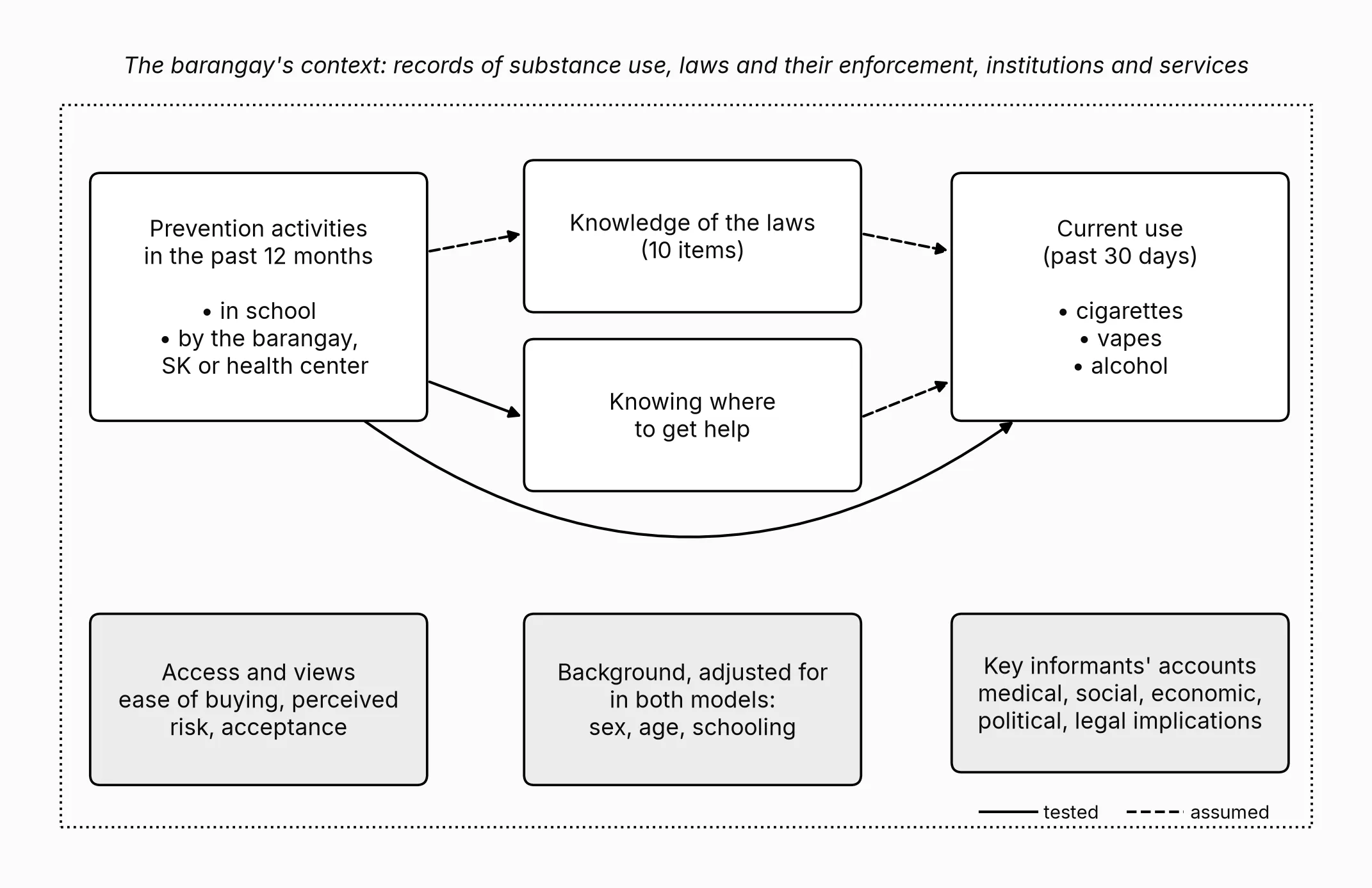
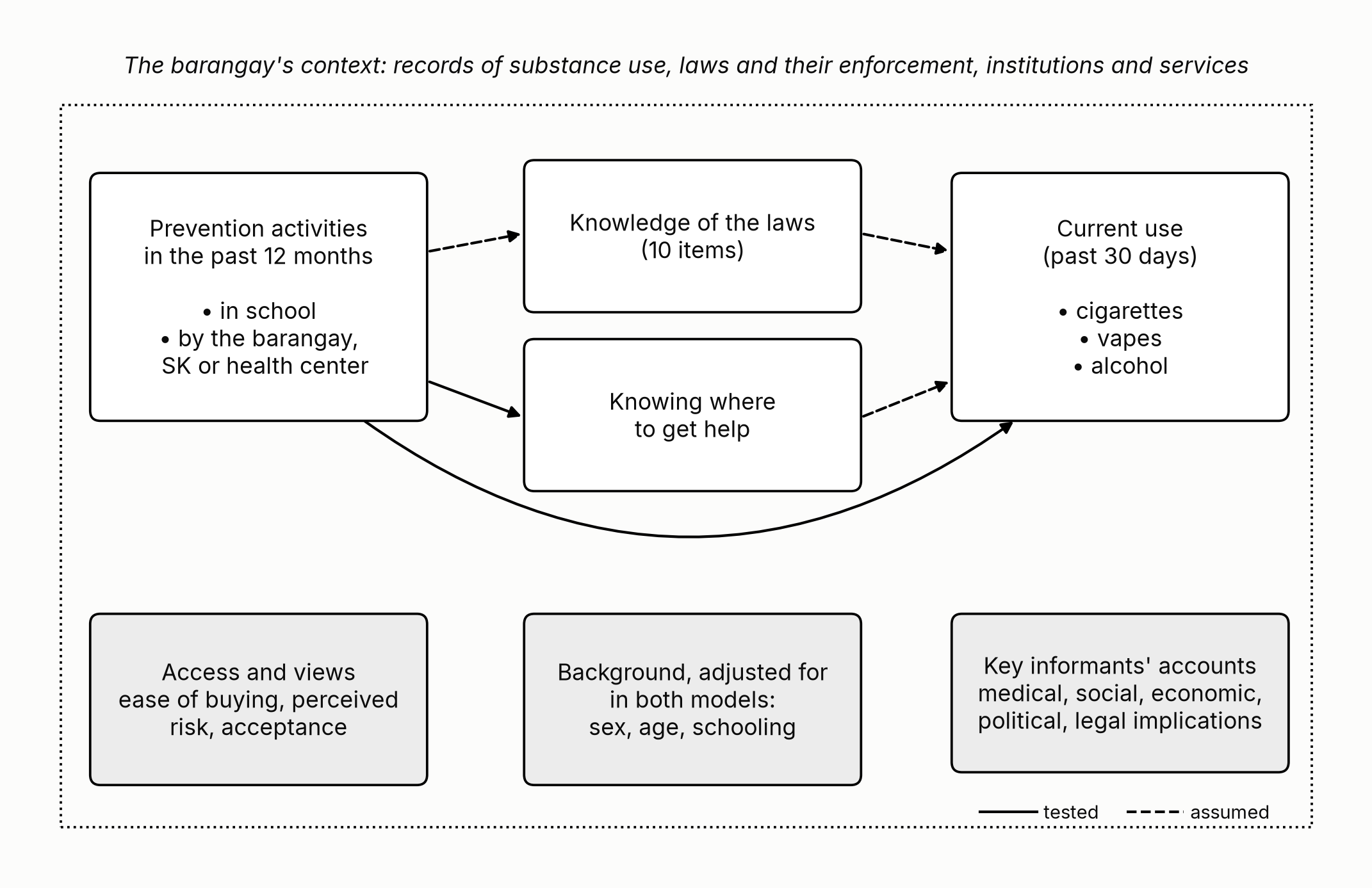
Figure 1 shows the research paradigm. Prevention activities in school and in the barangay are the independent variables; knowledge of the laws, knowing where to get help, and current use are the outcomes; sex, age and schooling are taken into account. The study tests two links (activities to knowing where to get help, and activities to current use) and describes the rest. The barangay’s records and the key informants’ accounts describe the context in which these links sit.
III. Research Questions
This study aims to describe substance use among youth aged 15 to 24 in the barangay and how prevention reaches them, with the barangay’s records and the accounts of key informants as context. Specifically, it seeks to answer the following questions:
- What do the barangay’s and the rural health unit’s records for 2023 to 2025 show about substance use and its prevention in the barangay?
- Among youth aged 15 to 24, what share have ever used, and what share currently use (past 30 days), cigarettes, vapes and alcohol; at what ages do they start; and does current use differ by sex, age group and schooling?
- How much do they know about the laws and policies on substance use and about the institutions and services that give help, and how easy do they find it for someone below 18 to buy each substance?
- Is taking part in prevention activities in school or in the barangay in the past 12 months associated with (a) knowing where to get help and (b) current use, after accounting for sex, age and schooling?
- How do key informants describe the medical, social, economic, political and legal implications of substance use in the barangay, and the gaps in its prevention?
The study will test two null hypotheses at the .05 level of significance:
H01: Taking part in prevention activities in school or in the barangay is not associated with knowing where to get help.
H02: Taking part in prevention activities in school or in the barangay is not associated with current use of cigarettes, vapes or alcohol.
IV. Scope and Limitation
The study will cover youth aged 15 to 24 who live in one barangay and are on the Katipunan ng Kabataan list kept by the SK, the barangay’s and the rural health unit’s aggregate records for calendar years 2023 to 2025, and six key informants. Data will be gathered from January to February 2026.
The survey will ask about cigarettes, vapes and alcohol only. It will not ask any respondent about their own or anyone else’s use of illegal drugs: such answers would disclose criminal acts, which a learner researcher cannot protect, so the barangay’s illegal drug figures will come from aggregate records. The findings will rest on self-reports, which may understate use. The study is cross-sectional: an association between prevention activities and an outcome will not show that the activities caused it, since youth who attend activities may differ from those who do not. Youth who moved away or were never listed by the SK will be missed. The results describe one barangay and are not meant to describe others.
V. Research Methodology
A. Sampling
The study will use three sources of data: a survey of youth, the barangay’s and the rural health unit’s records, and interviews with key informants.
Survey. The target population is the 1,148 youth aged 15 to 24 on the barangay’s Katipunan ng Kabataan (KK) list, which the SK secretary keeps (RA No. 10742, Sec. 14(a)). Youth were chosen because the national surveys show first use of these substances concentrated in these ages, and because the SK, which serves them, can act on the results. The sample size was computed for a share near 50% with a margin of error of 6 percentage points at 95% confidence, using Cochran’s (1977) formula with the finite population correction:
n0 = z²p(1 − p)/e² = (1.96)²(0.50)(0.50)/(0.06)² = 266.78; n = n0/[1 + (n0 − 1)/N] = 266.78/[1 + (266.78 − 1)/1148] = 216.63, or 217 completed questionnaires.
Expecting four in five invited youth to answer, the study will invite 272 (217 ÷ 0.80, rounded up). The SK secretary, not the researcher, will draw the simple random sample from the KK list with the spreadsheet’s random number function, deliver the invitations and consent forms, and keep the names. The study’s files will hold only each code’s sex, age and whether it was returned, which the SK secretary will provide to compare respondents with the list. The SK will approve this use of its list by resolution, as part of its youth profiling for program planning, and each invitation will say how the list was used.
Records. The study will request aggregate counts only, for 2023 to 2025: the barangay’s drug clearing status, persons from the barangay admitted to the community-based drug rehabilitation program, BADAC meetings held, barangay prevention activities and their attendance, citations for selling tobacco, vapes or alcohol to minors, and the rural health unit’s consultations of youth for alcohol-related injuries and for counseling to stop smoking or vaping.
Key informants. Six will be chosen purposively, each for a different view of substance use in the barangay: the BADAC vice-chairperson (the barangay kagawad for peace and order), a barangay health worker, the SK chairperson, a public school teacher who coordinates the school’s drug education program, a parent leader, and a nurse of the rural health unit.
B. Data Collection
Instrument. The questionnaire (Appendix B of the completed paper) has six parts: (A) sex, age and schooling; (B) ever use, age at first use, and days of use in the past 30 days of cigarettes, vapes and alcohol, with days of five or more drinks in a row, worded after the Global Youth Tobacco Survey and the Global School-based Student Health Survey; (C) prevention activities attended in the past 12 months, in school and by the barangay, the SK or the health center; (D) ten true-or-false statements on the laws and policies, with “Don’t know” allowed; (E) where a friend could get help (an open answer, coded) and which of seven services the respondent knows exist; and (F) how easy it is for someone below 18 to buy each substance, how much risk each use carries, and acceptance of a person in recovery as a neighbor. Its parts correspond to the research questions as the research blueprint shows (Appendix B). The questionnaire will be given in English and Filipino; the Filipino version will be translated by two teachers separately and reconciled by them with the adviser.
Validation and pilot test. Six experts will rate the relevance of each item from 1 (not relevant) to 4 (highly relevant): a MAPEH teacher who teaches Health, an Edukasyon sa Pagpapakatao teacher, the school’s guidance designate, a Practical Research teacher, a nurse of the rural health unit, and the municipal anti-drug abuse council’s focal person. An item’s content validity index (I-CVI) is the share of experts rating it 3 or 4; items below .78 will be revised, and the scale’s average (S-CVI/Ave) should reach .90 (Polit & Beck, 2006). The revised questionnaire will be pilot-tested with 30 youth aged 15 to 24 of a neighboring barangay, twice, two weeks apart; the knowledge items should reach a Kuder-Richardson Formula 20 (KR-20) of .70 and a test-retest correlation of .70.
Procedure. Each invited youth will receive, from the SK, a sealed envelope with an information sheet, a consent form (with a parent’s consent and the youth’s co-signature for those aged 15 to 17), the questionnaire, and a list of places and hotlines that give help. They will answer alone, seal the questionnaire in the envelope, and drop it in a locked box at the barangay hall or hand it back sealed to the researcher, who will go with an adult on scheduled Saturdays. Envelopes not returned after a week will get a reminder visit, up to three visits. Each envelope will carry a detachable return slip with the list’s code, which the SK secretary will keep apart from the sealed questionnaire, so returns can be counted by code; the researcher will number the questionnaires when opening them, and no questionnaire will carry a code. The interviews will be held at the barangay hall or the health center, with the adviser present, for about 30 minutes each, recorded with the informant’s consent; the researcher will ask about the four matters of the PDEP Curriculum Model (data, implications, institutions and resources, laws) and about gaps in prevention, and will ask informants not to name any person.
C. Ethical Issues
The study involves minors and a sensitive topic, so it will follow the DepEd Child Protection Policy, as the Research Management Guidelines direct for interactions with learners (DO No. 16, s. 2017, Sec. VI.C), and the National Ethical Guidelines for Research Involving Human Participants 2022 (Philippine Health Research Ethics Board [PHREB], 2022).
Permission and review. The proposal will be reviewed by the school’s research committee and submitted to the Schools Division Research Committee, which evaluates research proposals “within the schools division to be funded by other fund sources” (DO No. 16, s. 2017, Sec. V.A.iii, item 3). The school head will endorse the study to the Punong Barangay, and the barangay and the SK will approve the use of their records and list in writing. The national guidelines count minors among vulnerable participants and call for a full review by a research ethics committee of protocols that “involve vulnerability issues” (PHREB, 2022, Research Ethics Review Process, item 52); the adviser will ask the Schools Division Research Committee whether an ethics committee is available to review the protocol before data collection.
Consent and assent. Youth aged 18 to 24 will consent for themselves. For youth aged 15 to 17, a parent or guardian will consent and the youth will co-sign, as the guidelines provide for that age (PHREB, 2022, Research Involving Minors, item 3.2.4); a youth who declines will not take part even if the parent agrees (item 3.2.7).
No questions that incriminate. The questionnaire will not ask about illegal drug use. The national guidelines list the “Disclosure of illegal drug use” as a legal risk needing legal safeguards (PHREB, 2022, Social Research, item 30, Table 2) and tell researchers to ask participants “not to divulge information that are outside the scope of their study, and which appear to incriminate the participants” (item 39.9); the first page of the questionnaire will ask exactly that. No question will ask about family members or friends, or ask a respondent to name a store or a seller.
Anonymity and data protection. No name will be written on any questionnaire. The SK secretary will hold the names; the researcher will hold only questionnaire numbers. Answers about substance use are information about health, which the Data Privacy Act treats as sensitive personal information (RA No. 10173, Sec. 3(l)); the sealed questionnaires will be kept in a locked cabinet in the adviser’s office, encoded without any identifier, and shredded after the paper is accepted. Interview recordings will be transcribed without names and deleted after transcription.
Help and referral. Every respondent will keep a list of places and hotlines that give help: the barangay health center, the rural health unit, the school guidance office, the DOH Quitline (1558 toll-free, or 0921-203-9534 and 0977-627-7539 by mobile), and the National Center for Mental Health crisis hotline (1553 toll-free, or 0917-899-8727 and 0919-057-1553 by mobile). If an informant or a respondent discloses imminent harm, the adviser will follow a referral protocol agreed in advance with the guidance designate and the barangay health worker, and the limits of confidentiality will be stated in the consent form (PHREB, 2022, Elements of Research Ethics, item 31).
Safety of the researcher. The researcher will not go to any household alone, will not visit after 5:00 p.m., and will not discuss illegal drugs with anyone in the community.
D. Plan for Data Analysis
The study will use a convergent mixed methods design: the survey and the records (quantitative) and the interviews (qualitative) will be analyzed separately, then set side by side in a joint display (Guetterman et al., 2015). Data will be encoded in Microsoft Excel and analyzed in Python (pandas, SciPy and statsmodels); every computation will also be shown in the Excel workbook.
Research question 1. The records will be tabulated by year and described as counts; no test is needed.
Research question 2. Ever use and current use will be reported as shares with 95% Wilson score intervals, which keep close to their stated coverage far more reliably than the textbook (Wald) interval (Brown et al., 2001). Because the respondents may differ from the list in sex and age, each share will also be weighted to the list’s sex-by-age composition, and the two compared. Current use will be compared by sex, age group (15-17, 18-20, 21-24) and schooling with the chi-square test of independence, with Cramér’s V as the effect size; where an expected count falls below 5, Fisher’s exact test will be used. Age at first use will be estimated with the Kaplan-Meier method (Kaplan & Meier, 1958), counting those who have not yet used a substance until their present age, and reported as the share who had tried by ages 15 and 18.
Research question 3. Each law item will be reported as the share answering correctly (“Don’t know” counts as not correct), and the ten items as a score from 0 to 10 with its mean, standard deviation and KR-20. Knowing where to get help, the services known, ease of buying and perceived risk will be reported as shares with Wilson intervals.
Research question 4. Two binary logistic regressions will relate each outcome (naming at least one valid source of help; any current use) to school and barangay prevention activities, with sex, age and being in school as covariates. Results will be reported as odds ratios with 95% confidence intervals and as average marginal effects in percentage points, and the two activities will be tested together with a likelihood-ratio test. The model has five predictors; with about 90 or more events expected for each outcome, events per predictor will exceed 10 (Peduzzi et al., 1996).
Research question 5. The interview transcripts will be analyzed with thematic analysis in its six phases, “familiarizing yourself with your data”, “generating initial codes”, “searching for themes”, “reviewing themes”, “defining and naming themes” and “producing the report” (Braun & Clarke, 2006), in the reflexive form its authors later described (Braun & Clarke, 2019). The adviser will review the codes against the transcripts.
VI. Timetable/Gantt Chart
A check mark stands for the shaded month in the Word file.
Plan of Activities Dec 2025 Jan 2026 Feb 2026 Mar 2026 Apr 2026 May 2026 1. Review and revision of the proposal by the school research committee and the division research committee (3 weeks) ✓ 2. Letters of permission to the school head, the Punong Barangay, the SK and the rural health unit; SK resolution (2 weeks) ✓ 3. Content validation by six experts and revision of the questionnaire (2 weeks) ✓ 4. Pilot test with 30 youth of a neighboring barangay, two administrations two weeks apart (3 weeks) ✓ ✓ 5. Drawing of the sample and delivery of invitations by the SK secretary (1 week) ✓ 6. Survey data gathering, with up to three visits (5 weeks) ✓ ✓ 7. Request and tabulation of records (2 weeks) ✓ 8. Key informant interviews and transcription (3 weeks) ✓ 9. Encoding, checking and analysis of data (3 weeks) ✓ ✓ 10. Writing and review of the completed paper (3 weeks) ✓ 11. Submission of the completed paper and the executive data set (1 day) ✓
VII. Plans for Dissemination and Utilization
Dissemination & Utilization Activities Apr 2026 May 2026 Jun 2026 Jul 2026 Aug 2026 Sep 2026 1. Presentation to the BADAC at its meeting, with the records’ findings and recommendations (1 day) ✓ 2. Presentation to the SK and the youth at the Katipunan ng Kabataan assembly (1 day) ✓ 3. Leaflet and poster on where young people can get help, made with the SK and the health center (3 weeks) ✓ ✓ 4. Presentation to the school head, teachers and the Barkada Kontra Bisyo when classes resume (1 day) ✓ 5. Youth activity on the International Day Against Drug Abuse, June 26, using the findings (1 day) ✓ 6. Orientation of store owners near the school on the laws on sales to minors, with the BADAC (1 day) ✓ 7. Presentation at the school’s research forum (1 day) ✓ 8. Follow-up with the BADAC and the SK on the actions taken (1 week) ✓
VIII. References
Allado, M. A. D., Gumba, N. G. M., Melo, K. J., & Hechanova, M. R. M. (2019). A narrative analysis of the experiences of barangay officials involved in community-based drug rehabilitation. Philippine Journal of Psychology, 52(1), 39–64. https://doi.org/10.31710/pjp/0052.01.02
Braun, V., & Clarke, V. (2006). Using thematic analysis in psychology. Qualitative Research in Psychology, 3(2), 77–101. https://doi.org/10.1191/1478088706qp063oa
Braun, V., & Clarke, V. (2019). Reflecting on reflexive thematic analysis. Qualitative Research in Sport, Exercise and Health, 11(4), 589–597. https://doi.org/10.1080/2159676X.2019.1628806
Brener, N. D., Billy, J. O. G., & Grady, W. R. (2003). Assessment of factors affecting the validity of self-reported health-risk behavior among adolescents: Evidence from the scientific literature. Journal of Adolescent Health, 33(6), 436–457. https://doi.org/10.1016/S1054-139X(03)00052-1
Brown, L. D., Cai, T. T., & DasGupta, A. (2001). Interval estimation for a binomial proportion. Statistical Science, 16(2), 101–133. https://doi.org/10.1214/ss/1009213286
Cochran, W. G. (1977). Sampling techniques (3rd ed.). John Wiley & Sons.
Dangerous Drugs Board. (2007). Institutionalizing the Barkada Kontra Droga program (Board Regulation No. 5, s. 2007).
Dangerous Drugs Board. (2019). Consolidated revised rules governing access to treatment and rehabilitation programs and services (Board Regulation No. 7, s. 2019).
Dangerous Drugs Board. (2020). 2019 national household survey on the patterns and trends of drug abuse. https://www.ddb.gov.ph/images/downloads/2019_Drug_Survey_Report.pdf
Dangerous Drugs Board. (2021). Sustaining the implementation of Barangay Drug Clearing Program (BDCP) and repealing for such purpose Board Regulation No. 3, series of 2017 (Board Regulation No. 4, s. 2021).
Dangerous Drugs Board. (2023). Amending Board Regulation No. 6, series of 2019, protocol when handling children allegedly involved in dangerous drugs (Board Regulation No. 2, s. 2023).
Dangerous Drugs Board. (2025, August 13). DDB reports decline in drug users, outlines rehabilitation and prevention priorities to Congress. https://ddb.gov.ph/ddb-reports-decline-in-drug-users-outlines-rehabilitation-and-prevention-priorities-to-congress/
Department of Education. (2016). Adoption of the basic education research agenda (DepEd Order No. 39, s. 2016).
Department of Education. (2017a). Research management guidelines (DepEd Order No. 16, s. 2017).
Department of Education. (2017b). Guidelines for the conduct of random drug testing in public and private secondary schools (DepEd Order No. 40, s. 2017).
Department of Education. (2018). Preventive drug education program policy for curriculum and instruction (DepEd Order No. 30, s. 2018).
Department of Education. (2021). Preventive drug education program curriculum model (DepEd Memorandum No. 025, s. 2021).
Department of Education. (2025, November 10). Learner leadership skills development capacity building activity for School Year (S.Y.) 2025-2026 (Memorandum DM-OUOPS-2025-10-07238), Annex A.
Department of Health Cordillera Administrative Region. (n.d.). Commit to quit para sa isang healthier you. https://caro.doh.gov.ph/commit-to-quit-para-sa-isang-healthier-you/
Department of Health Epidemiology Bureau. (2021). Global Youth Tobacco Survey fact sheet: Philippines 2019. World Health Organization.
Department of the Interior and Local Government. (2015). Revitalization of the Barangay Anti-Drug Abuse Council (BADAC) and their role in drug clearing operations (Memorandum Circular No. 2015-63).
Department of the Interior and Local Government, & Dangerous Drugs Board. (2018). Implementing guidelines on the functionality and effectiveness of local anti-drug abuse councils (Joint Memorandum Circular No. 2018-01).
Faggiano, F., Minozzi, S., Versino, E., & Buscemi, D. (2014). Universal school-based prevention for illicit drug use. Cochrane Database of Systematic Reviews, 2014(12), Article CD003020. https://doi.org/10.1002/14651858.CD003020.pub3
Guetterman, T. C., Fetters, M. D., & Creswell, J. W. (2015). Integrating quantitative and qualitative results in health science mixed methods research through joint displays. Annals of Family Medicine, 13(6), 554–561. https://doi.org/10.1370/afm.1865
Gulliver, A., Griffiths, K. M., & Christensen, H. (2010). Perceived barriers and facilitators to mental health help-seeking in young people: A systematic review. BMC Psychiatry, 10, Article 113. https://doi.org/10.1186/1471-244X-10-113
Kaplan, E. L., & Meier, P. (1958). Nonparametric estimation from incomplete observations. Journal of the American Statistical Association, 53(282), 457–481. https://doi.org/10.1080/01621459.1958.10501452
Lenton, S., Liang, W., & Chikritzhs, T. (2012). Evidence of increasing age of onset of cannabis use among younger Australians. Addiction, 107(3), 650–657. https://doi.org/10.1111/j.1360-0443.2011.03673.x
Peduzzi, P., Concato, J., Kemper, E., Holford, T. R., & Feinstein, A. R. (1996). A simulation study of the number of events per variable in logistic regression analysis. Journal of Clinical Epidemiology, 49(12), 1373–1379. https://doi.org/10.1016/S0895-4356(96)00236-3
Pengpid, S., Peltzer, K., Santos, L. E., & Mallari, E. F. I. (2025). Prevalence, drug education, and other associated factors of current illicit drug use among a nationally representative sample of school-aged adolescents in the Philippines in 2019. Substance Abuse Treatment, Prevention, and Policy, 20(1), Article 22. https://doi.org/10.1186/s13011-025-00652-y
Perez, A. R., Yusay, C. T., & Hechanova, M. R. (2025). Barriers and enablers to help seeking, treatment adherence and recovery among community-based drug rehabilitation clients in the Philippines. Drugs: Education, Prevention and Policy, 32(5), 440–448. https://doi.org/10.1080/09687637.2024.2373073
Philippine Health Research Ethics Board. (2022). National ethical guidelines for research involving human participants 2022. Philippine Council for Health Research and Development.
Polit, D. F., & Beck, C. T. (2006). The content validity index: Are you sure you know what’s being reported? Critique and recommendations. Research in Nursing & Health, 29(5), 489–497. https://doi.org/10.1002/nur.20147
Republic Act No. 9165. (2002). Comprehensive Dangerous Drugs Act of 2002.
Republic Act No. 9211. (2003). Tobacco Regulation Act of 2003.
Republic Act No. 9344. (2006). Juvenile Justice and Welfare Act of 2006, as amended by Republic Act No. 10630 (2013).
Republic Act No. 10173. (2012). Data Privacy Act of 2012.
Republic Act No. 10742. (2016). Sangguniang Kabataan Reform Act of 2015, as amended by Republic Act No. 11768 (2022).
Republic Act No. 11900. (2022). Vaporized Nicotine and Non-Nicotine Products Regulation Act.
Soriano, J. R. (2025). Impact of the ‘Barkada Kontra Droga Program’ on student awareness of illegal drugs. Journal of Interdisciplinary Perspectives, 3(3). https://doi.org/10.69569/jip.2025.035
Thomas, R. E., McLellan, J., & Perera, R. (2013). School-based programmes for preventing smoking. Cochrane Database of Systematic Reviews, 2013(4), Article CD001293. https://doi.org/10.1002/14651858.CD001293.pub3
United Nations Office on Drugs and Crime, & World Health Organization. (2018). International standards on drug use prevention (2nd updated ed.). https://www.unodc.org/documents/prevention/UNODC-WHO_2018_prevention_standards_E.pdf
University of the Philippines Population Institute. (2022a). 2021 Young Adult Fertility and Sexuality Study (YAFS5): Key findings. https://www.uppi.upd.edu.ph/sites/default/files/pdf/YAFS5_Key_Findings.pdf
University of the Philippines Population Institute. (2022b). YAFS5 national dissemination forum slides [Preliminary findings]. https://www.uppi.upd.edu.ph/sites/default/files/pdf/YAFS5_National%20Dissemination_Slides_FINAL.pdf
University of the Philippines Population Institute. (2022c, December). YAFS5 regional profile: Philippines. https://www.uppi.upd.edu.ph/sites/default/files/pdf/yafs5-regional-profiles-Philippines.pdf
IX. Appendices
The appendices hold the root cause analysis (the fishbone in Part 1), the research blueprint below, the declaration of anti-plagiarism and absence of conflict of interest, and the researcher’s curriculum vitae.
Appendix B. Research Blueprint
Research question Variables or indicators Source of data Instrument (items) Analysis 1. Records, 2023 to 2025 Drug clearing status; CBDRP admissions; BADAC meetings; prevention activities and attendance; citations for sales to minors; RHU consultations Barangay and RHU records Records request form (counts only) Counts by year 2. Use and age at first use Ever and current (30-day) use of cigarettes, vapes, alcohol; five or more drinks in a row; age at first use; sex, age group, schooling Survey of youth Questionnaire, Parts A and B (items 1-13) Shares with Wilson intervals; weighted shares; chi-square, Cramér’s V; Kaplan-Meier 3. Knowledge, help, access Ten law items; knowing where to get help; services known; ease of buying; perceived risk; acceptance Survey of youth Parts D to F (items 16-30) Shares with Wilson intervals; score mean and SD; KR-20 4. Prevention activities and outcomes School and barangay activities (past 12 months); knowing where to get help; any current use Survey of youth Parts B, C, E (items 6, 9, 12, 14, 15, 26) Logistic regression: odds ratios, average marginal effects, likelihood-ratio test 5. Implications and gaps Medical, social, economic, political, legal implications; gaps in prevention Six key informants Interview guide (8 questions) Reflexive thematic analysis; joint display with RQs 1-4
The declaration is adapted from Annex 3 of DO 16, s. 2017. The researcher attests that the proposal is original and that “all deliverables and the final research study emanating from this proposal shall be of original content”, declares no conflict of interest, and undertakes to report one “which may inadvertently emerge during the conduct of my research”. A learner signs it alone.
Part 3. The completed research paper
The completed paper keeps the proposal’s Introduction and Rationale, Literature Review and Research Questions, in the past tense, and reports what was done and found. Its parts, in order: the title page, abstract and acknowledgment; I to III as above; IV Scope and Limitation; V Research Methodology (Sampling, Data Collection, Ethical Issues, Data Analysis); VI Discussion of Results and Recommendations; VII Dissemination and Advocacy Plan (Part 4 below); VIII References; and IX Appendices (the questionnaire, the interview guide, the records requested, the validation results, the executive data set, and the consent form). Annex 6 of DO 16 also asks for a Financial Report, which a study with no grant leaves out.
Title page
Substance Use, Knowledge of Laws, and Awarenessof Help Among Barangay Youth
A Basic Research
[Name of the learner researcher]Grade 11, [Name of School]
Research Adviser: [Name of the research adviser]
March 2026
Abstract
This basic research described substance use among youth aged 15 to 24 in one barangay, what they know of the laws and of the places that give help, and whether the prevention activities they attended went with knowing where to get help and with less use. The Sangguniang Kabataan drew a simple random sample of 272 from its list of 1,148 youth; 217 returned complete anonymous questionnaires (response rate 81.0%). Barangay and rural health unit records for 2023 to 2025 and interviews with six key informants gave the context. Within the past 30 days, 31.8% of youth had drunk alcohol, 12.0% had smoked cigarettes and 8.3% had used a vape; 39.2% had used at least one. Young men used far more than young women (61.3% against 18.0%). Counting everyone, 35.8% had tried alcohol by age 15 and 60.6% by 18. Youth answered a mean of 5.84 of 10 items on the laws correctly, and 45.2% could name a place or person that gives help. Youth who attended a barangay or Sangguniang Kabataan prevention activity in the past year were more likely to know where to get help (odds ratio 2.66, 95% CI [1.45, 4.87]), while school activities showed no such association; neither kind of activity was associated with current use. The records tracked illegal drugs but not tobacco, vapes or alcohol, and the anti-drug council met far less often than monthly. The key informants described a barangay that is drug-cleared but not substance-free. The barangay should add tobacco, vapes and alcohol to its prevention plan, enforce the laws on sales to minors, replace one-time seminars with skills-based sessions, and make help visible to youth.
Keywords: substance use, youth, vaping, alcohol, preventive drug education, barangay, help-seeking
IV. Scope and Limitation
The study covered youth aged 15 to 24 who lived in one barangay and were on the Katipunan ng Kabataan list kept by the Sangguniang Kabataan (SK), the barangay’s and the rural health unit’s aggregate records for calendar years 2023 to 2025, and six key informants. The survey was conducted from January 24 to February 21, 2026, and the interviews from February 7 to 21, 2026.
The survey asked about cigarettes, vapes and alcohol only. It asked no respondent about their own or anyone else’s use of illegal drugs, whose figures came from aggregate records. The findings rest on self-reports, which may understate use. The study was cross-sectional: an association between prevention activities and an outcome does not show that the activities caused it. Youth who had moved away or were never listed by the SK were missed. Family and peer influences were not measured. The results describe one barangay and are not meant to describe others.
V. Research Methodology
The paper’s methodology repeats the proposal’s (Part 2, V) in the past tense, with what the field work added: who answered, what the validation found, and the dates. Those parts follow.
The study joined three sources of data: a survey of youth, the barangay’s and the rural health unit’s records, and interviews with key informants, analyzed separately and then together (a convergent mixed methods design).
Survey. The population was the 1,148 youth aged 15 to 24 on the barangay’s Katipunan ng Kabataan list. The sample size was computed for a share near 50% with a margin of error of 6 percentage points at 95% confidence (Cochran, 1977): n0 = (1.96)²(0.50)(0.50)/(0.06)² = 266.78; with the finite population correction, n = 266.78/[1 + (266.78 − 1)/1148] = 216.63, or 217 completed questionnaires. Expecting a response of 80%, the SK secretary drew a simple random sample of 272 with the spreadsheet’s random number function, under an SK resolution that adopted the survey as part of its youth profiling for program planning, and delivered the invitations. Each invitation said how the SK had used its list. Each envelope carried a detachable return slip with the list’s code, which the SK secretary kept apart from the sealed questionnaire, so returns could be counted by code; the researcher numbered the questionnaires when opening them, and no questionnaire carried a code. The researcher never saw a name.
Table 1 gives the outcome of each invitation. Of the 272 drawn, 4 were not eligible (three had moved out of the barangay and one was older than 24). Of the 268 eligible, 217 returned complete questionnaires, 4 returned questionnaires that stopped in Part E or F with more than half of the applicable items answered (partial questionnaires, by AAPOR’s example), 24 declined (the youth or, for those aged 15 to 17, a parent), and 23 could not be reached in three visits. The response rate was 81.0% (AAPOR Response Rate 1, complete questionnaires over all eligible) and 82.5% counting the partial ones (Response Rate 2; American Association for Public Opinion Research [AAPOR], 2023). Analysis used the 217 complete questionnaires, against the 217 the computation called for. Response did not differ by sex (χ²(1) = 1.06, p = .303) or age group (χ²(2) = 0.08, p = .961), and the respondents matched the list closely on both (Table 1).
Table 1. Outcome of the Invitations and Respondents Compared With the List
Outcome or group Count Share Drawn from the list 272 Not eligible 4 Eligible 268 100.0% Complete questionnaires 217 81.0% Partial questionnaires 4 Declined 24 9.0% Not reached in three visits 23 Female: list / respondents 559 / 111 48.7% / 51.2% Male: list / respondents 589 / 106 51.3% / 48.8% Aged 15-17: list / respondents 379 / 69 33.0% / 31.8% Aged 18-20: list / respondents 351 / 67 30.6% / 30.9% Aged 21-24: list / respondents 418 / 81 36.4% / 37.3% Note. The share of complete questionnaires is AAPOR Response Rate 1. The SK secretary gave each code’s sex, age and outcome; no name left the SK, and no questionnaire carried a code.
The respondents’ mean age was 19.4 years (SD = 2.8). Of the 217, 77 (35.5%) were in junior or senior high school, 52 (24.0%) in college or technical-vocational training, and 88 (40.6%) not in school.
Records. The Punong Barangay and the municipal health officer released aggregate counts for 2023 to 2025 on a records request form (Appendix C). No record named a person.
Key informants. Six informants, chosen for their different views of substance use in the barangay, were interviewed: the BADAC vice-chairperson (K1), a barangay health worker (K2), the SK chairperson (K3), a public school teacher who coordinates the school’s drug education program (K4), a parent leader (K5), and a nurse of the rural health unit (K6).
B. Data Collection
Six experts rated the relevance of 20 items and item blocks (Parts B to F). Nineteen reached an item content validity index (I-CVI) of at least .83; one, the law item on a national minimum age for buying alcohol, reached .50, because three experts questioned whether a false statement belonged in the scale. It was kept as a false statement, since many youth believe it, and reworded to test one idea, and all six experts accepted the rewording. The scale-level index (S-CVI/Ave) was .942, above the .90 that Polit and Beck (2006) recommend. In the pilot test with 30 youth of a neighboring barangay on January 3 and 17, 2026, the ten law items reached a Kuder-Richardson Formula 20 (KR-20) of .74 and a test-retest correlation of .75.
From January 24 to February 21, 2026, the SK delivered sealed envelopes with an information sheet, the consent form, the questionnaire and a list of places and hotlines that give help. Respondents answered alone and returned the questionnaire sealed, with the return slip detached by the SK. The interviews, from February 7 to 21, lasted 25 to 40 minutes each, with the adviser present, and were recorded with each informant’s consent and transcribed without names. No disclosure of imminent harm was made during the study.
D. Data Analysis
The survey data were encoded in Microsoft Excel, checked against the paper questionnaires by a second encoder, and analyzed in Python. Two respondents who had drunk alcohol but left their age at first drink blank were left out of that Kaplan-Meier estimate only. Every expected count in the chi-square tests reported was at least 5. The models had 98 and 85 events for five predictors. The open answers on where to get help were coded by the researcher and the adviser separately against a list of valid sources (a health facility, the guidance office, the BADAC or its referral desk, a hotline, a treatment center, a social worker), and their two differences were settled by discussion.
VI. Discussion of Results and Recommendations: records
The barangay’s records follow illegal drugs, and its own prevention work has thinned (Table 2). The barangay was declared drug-cleared in 2022 and kept that status. Admissions to the community-based drug rehabilitation program from the barangay fell from 7 in 2023 to 2 in 2025, and 2, 1 and 0 of them were aged 15 to 24. The BADAC met 4, 3 and 2 times in the three years, against the “at least once a month” its guidelines set (DILG Memorandum Circular No. 2015-63, Sec. II.B), and held 2, 2 and 1 prevention activities, which 146, 118 and 64 youth attended. No citation was issued for selling tobacco, vapes or alcohol to a minor in any of the three years. The rural health unit saw 5, 7 and 6 youth for alcohol-related injuries, and gave counseling to stop smoking or vaping to 0, 1 and 0.
Table 2. Barangay and Rural Health Unit Records, 2023 to 2025
Indicator 2023 2024 2025 New admissions to the community-based drug rehabilitation program 7 4 2 Of whom aged 15 to 24 2 1 0 BADAC meetings held 4 3 2 Barangay prevention activities 2 2 1 Youth (15 to 24) attending them 146 118 64 Citations for selling tobacco, vapes or alcohol to minors 0 0 0 Youth seen at the health center for alcohol-related injuries 5 7 6 Youth given counseling to stop smoking or vaping 0 1 0 Note. Aggregate counts from the BADAC’s minutes and reports, the municipal anti-drug abuse council through the BADAC, the barangay’s record of ordinance violations, and the rural health unit’s consultation logbook.
VI. Discussion of Results and Recommendations: use and age at first use
Alcohol was the substance most youth used (Table 3, Figure 2). Within the past 30 days, 31.8% had drunk, 12.0% had smoked cigarettes and 8.3% had used a vape; 39.2%, 95% CI [32.9, 45.8], had used at least one. Of those who drank in the past 30 days, 53.6% (37 of 69) had five or more drinks in a row on at least one day. Weighting to the list’s sex-by-age composition changed no current-use share by more than a percentage point (any current use, 40.0%). Current drinking and smoking were close to the national figures for youth aged 15 to 24 in 2021, 29.4% and 12.1% (UPPI, 2022c, Table 2), while current vaping was nearly three times the national 2.8%; ever vaping, 20.3%, was close to the national 19.8%.
Table 3. Ever and Current Use of Alcohol, Cigarettes and Vapes (n = 217)
Measure k % 95% CI Weighted % Ever drank alcohol 132 60.8% [54.2, 67.1] Ever smoked a cigarette 54 24.9% [19.6, 31.0] Ever used a vape 44 20.3% [15.5, 26.1] Drank alcohol, past 30 days 69 31.8% [26.0, 38.3] 32.5% Five or more drinks in a row, past 30 days 37 17.1% [12.6, 22.6] 17.6% Smoked cigarettes, past 30 days 26 12.0% [8.3, 17.0] 12.5% Used a vape, past 30 days 18 8.3% [5.3, 12.7] 8.3% Any of the three, past 30 days 85 39.2% [32.9, 45.8] 40.0% Note. CI = Wilson score interval. Weighted shares match the list’s composition by sex and age group. The finite population correction would narrow each interval by about a tenth (factor 0.901); the intervals shown are the wider, uncorrected ones.
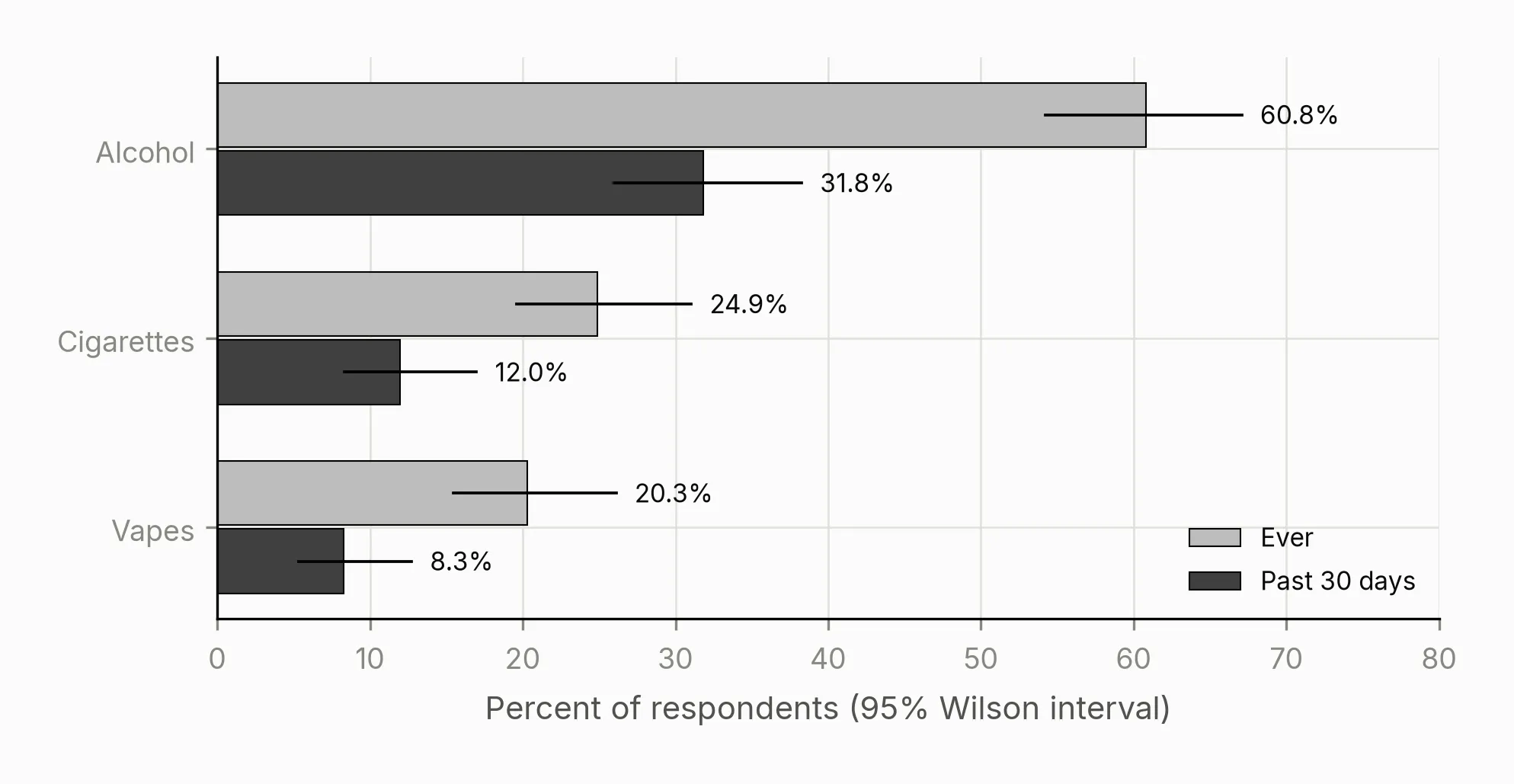
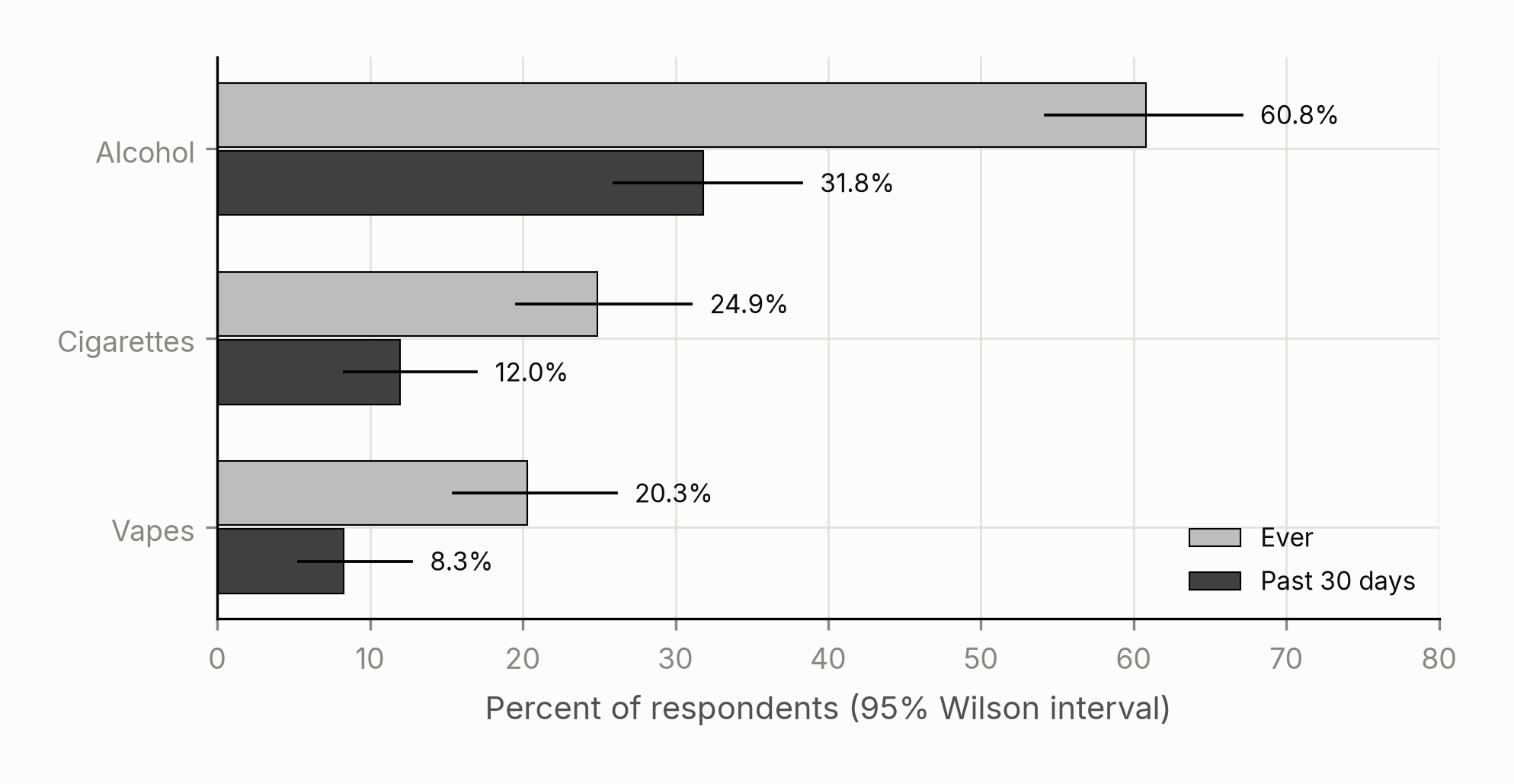
Current use differed sharply by sex and less by age (Table 4). Young men used at least one substance far more often than young women, 61.3% against 18.0%, χ²(1, N = 217) = 42.67, p < .001, V = 0.44; in relative terms the gap was widest for cigarettes (23.6% against 0.9%). Use rose from 27.5% at ages 15 to 17 to 44.8% at 18 to 20, though the difference across the three age groups fell short of significance, χ²(2, N = 217) = 5.75, p = .056. Schooling made no clear difference, χ²(2, N = 217) = 2.69, p = .261.
Table 4. Current Use (Past 30 Days) by Sex, Age Group and Schooling
Group Any of the three Alcohol Cigarettes Vapes Female 18.0% 15.3% 0.9% 5.4% Male 61.3% 49.1% 23.6% 11.3% χ², V (sex) χ²(1, N = 217) = 42.67, p < .001, V = 0.44 V = 0.36 V = 0.35 V = 0.11 Aged 15-17 27.5% 23.2% 5.8% 4.3% Aged 18-20 44.8% 37.3% 14.9% 11.9% Aged 21-24 44.4% 34.6% 14.8% 8.6% Junior or senior high school 33.8% 27.3% 7.8% 5.2% College or TVET 48.1% 40.4% 15.4% 3.8% Not in school 38.6% 30.7% 13.6% 13.6% Note. Percent of each group using in the past 30 days. Chi-square tests for sex: alcohol χ²(1, N = 217) = 28.46, p < .001; cigarettes χ²(1, N = 217) = 26.46, p < .001; vapes χ²(1, N = 217) = 2.49, p = .114. For age group: χ²(2, N = 217) = 5.75, p = .056. For schooling: χ²(2, N = 217) = 2.69, p = .261.
First use came early, and earliest for alcohol (Figure 3). Counting everyone, 35.8% had tried alcohol by age 15 and 60.6% by 18, so that half had tried by age 17; 14.3% had tried a cigarette by 15 and 22.4% by 18; 8.3% had tried a vape by 15 and 20.0% by 18. Fewer than half had tried cigarettes or vapes by 24. Among those who had drunk, the mean age at the first drink was 15.2, almost two years earlier than the age by which half had tried. The users’ mean counts only those who had started, leaving out the younger respondents who will start later; the national averages of 16 for smoking and 16.8 for drinking (UPPI, 2022b, pp. 38, 40) were computed the same way.
Figure 3. Share Who Had Tried Each Substance by Each Age (Kaplan-Meier Estimates). Everyone counts: a respondent who had not tried a substance counts until their present age. A step rises at the age of first use, in completed years.
The interactive figure below replaces the paper’s Figure 3: it shows the same Kaplan-Meier estimates beside the users-only count that produces the familiar “average age at first use”.
The completed paper · age at first use
How old were they at the first try? It depends on whom you count
Choose a substance and a way of counting. Counting only those who tried leaves out everyone who has not tried yet. Nothing you choose is kept or sent anywhere.
Counting all 215 respondents who answered, 35.8% had tried alcohol by age 15 and 60.6% by 18. Half had tried by age 17. The 85 who had not tried count until their present age, so the youngest respondents still tell the curve something.
Counting only the 130 who had tried alcohol, the mean age at a first drink is 15.2, and the curve reaches 100% at the oldest starter's age. It leaves out the 85 who had not tried, 36 of them below 18, some of whom will start later, so it makes first use look earlier and more universal than it is.
Counting all 217 respondents who answered, 14.3% had tried cigarettes by age 15 and 22.4% by 18. Fewer than half had tried cigarettes by 24. The 163 who had not tried count until their present age, so the youngest respondents still tell the curve something.
Counting only the 54 who had tried cigarettes, the mean age at a first cigarette is 15.6, and the curve reaches 100% at the oldest starter's age. It leaves out the 163 who had not tried, 53 of them below 18, some of whom will start later, so it makes first use look earlier and more universal than it is.
Counting all 217 respondents who answered, 8.3% had tried vapes by age 15 and 20.0% by 18. Fewer than half had tried vapes by 24. The 173 who had not tried count until their present age, so the youngest respondents still tell the curve something.
Counting only the 44 who had tried vapes, the mean age at a first vape is 16.1, and the curve reaches 100% at the oldest starter's age. It leaves out the 173 who had not tried, 59 of them below 18, some of whom will start later, so it makes first use look earlier and more universal than it is.
VI. Discussion of Results and Recommendations: knowledge, help and access
Youth knew the rules on selling tobacco to minors better than the rules that protect people who seek help (Table 5). The mean score was 5.84 of 10 (SD = 2.62; median 6), and 43.8% answered five or fewer items correctly; the scale’s KR-20 was .76. Most knew that selling cigarettes (82.5%) and vapes (70.5%) to minors is against the law, and that smoking and vaping are banned in schools (79.3%). Fewer knew that the records of a person who voluntarily asks for treatment are confidential (32.3%), that a positive school drug test is no ground for expulsion (39.6%), and that no national law sets a minimum age for buying alcohol (39.2%). The least known items are those that tell a young person it is safe to ask for help.
Table 5. Youth Who Answered Each Law Item Correctly (n = 217)
Statement (answer) Basis % correct Selling cigarettes to a person below 18 is against the law (true) RA 9211, Sec. 9 82.5% Selling vapes to a person below 18 is against the law (true) RA 11900, Sec. 6 70.5% Selling cigarettes within 100 meters of a school is against the law (true) RA 9211, Sec. 10 67.7% A national law sets a minimum age for buying alcohol (false) No national law; local ordinances 39.2% A child 15 or younger who commits an offense is exempt from criminal liability but goes through an intervention program (true) RA 9344, Sec. 6, as amended 60.8% An adult arrested for the first time for using dangerous drugs, and not caught with any, faces at least six months of rehabilitation rather than prison (true) RA 9165, Sec. 15 47.9% Records of a person who voluntarily asks for treatment are confidential (true) RA 9165, Sec. 60 32.3% Every barangay must have an anti-drug abuse council (true) DILG MC 2015-63; JMC 2018-01 64.5% A school may expel a learner whose random drug test is positive (false) DO 40, s. 2017, item 55 39.6% Smoking and vaping are not allowed anywhere inside a school (true) RA 9211, Sec. 5; RA 11900, Sec. 15 79.3% Note. “Don’t know” was counted as not correct. Mean score 5.84 of 10, SD 2.62, KR-20 = .76.
Fewer than half could name a source of help (Table 6). Asked where a friend could go to stop smoking, vaping, drinking or using drugs, 45.2% (95% CI [38.7, 51.8]) named at least one valid place or person. Prompted, 58.5% knew the barangay health center or rural health unit and 43.3% the school guidance office, but only 33.2% knew the BADAC, 9.2% the community-based rehabilitation program, and 7.4% the DOH Quitline. Buying was easy: 79.7% said a person below 18 could easily buy cigarettes in the barangay, 66.8% alcohol and 52.1% vapes. Only 47.9% saw great risk in vaping regularly, against 57.6% for smoking regularly, and 43.3% would accept a person recovering from drug dependence as a neighbor.
Table 6. Knowing Where to Get Help, Access, and Views (n = 217)
Measure % Named at least one valid source of help (open answer) 45.2% Knows: barangay health center or rural health unit 58.5% Knows: school guidance office or counselor 43.3% Knows: Barangay Anti-Drug Abuse Council 33.2% Knows: community-based drug rehabilitation program 9.2% Knows: DOH Quitline (1558) 7.4% Knows: National Center for Mental Health crisis hotline (1553) 5.5% Knows: a DOH treatment and rehabilitation center 6.0% Easy for someone below 18 to buy cigarettes 79.7% Easy for someone below 18 to buy alcohol 66.8% Easy for someone below 18 to buy vapes 52.1% Great risk: smoking cigarettes regularly 57.6% Great risk: using a vape regularly 47.9% Great risk: five or more drinks once or twice each weekend 47.5% Would accept a person in recovery as a neighbor 43.3% Note. “Easy” combines very easy and somewhat easy.
VI. Discussion of Results and Recommendations: prevention activities
In the past 12 months, 36.9% of youth had attended a prevention activity in school (74.0% of those in junior or senior high school) and 30.9% one held by the barangay, the SK or the health center; 45.6% had attended neither.
Barangay and SK activities, not school activities, went with knowing where to get help (Table 7, Figure 4). Of youth who attended a barangay or SK activity, 62.7% could name a source of help, against 37.3% of those who did not. With sex, age and schooling taken into account, the odds of knowing where to get help were 2.66 times as high, 95% CI [1.45, 4.87], p = .001, an average difference of 23.6 percentage points, 95% CI [9.5, 37.8]. School activities showed no association (OR = 1.09, 95% CI [0.56, 2.15]). The two together added significantly to the model, χ²(2) = 10.50, p = .005, so the first null hypothesis was rejected, for barangay and SK activities only.
Neither kind of activity went with less use. The odds of any current use were 1.60, 95% CI [0.74, 3.48], for school activities and 1.03, 95% CI [0.52, 2.04], for barangay and SK activities, and together they added nothing, χ²(2) = 1.47, p = .479; the second null hypothesis was not rejected. Sex and age, not activities, went with use: the odds were lower for young women (OR = 0.13, 95% CI [0.07, 0.25]) and higher with each year of age (OR = 1.20, 95% CI [1.05, 1.38]).
Table 7. Logistic Regression of Knowing Where to Get Help and of Any Current Use (n = 217)
Predictor Help: OR [95% CI] p Any use: OR [95% CI] p School prevention activity 1.09 [0.56, 2.15] .796 1.60 [0.74, 3.48] .231 Barangay or SK prevention activity 2.66 [1.45, 4.87] .001 1.03 [0.52, 2.04] .933 Female 1.00 [0.57, 1.74] .992 0.13 [0.07, 0.25] < .001 Age (per year) 0.95 [0.84, 1.07] .370 1.20 [1.05, 1.38] .007 In school now 1.23 [0.61, 2.49] .568 1.61 [0.73, 3.60] .241 Note. OR = odds ratio; CI = confidence interval. Knowing where to get help: 98 events, likelihood-ratio test of the two activities χ²(2) = 10.50, p = .005. Any current use: 85 events, χ²(2) = 1.47, p = .479. Average marginal effect of a barangay or SK activity on knowing where to get help: 23.6 percentage points, 95% CI [9.5, 37.8].
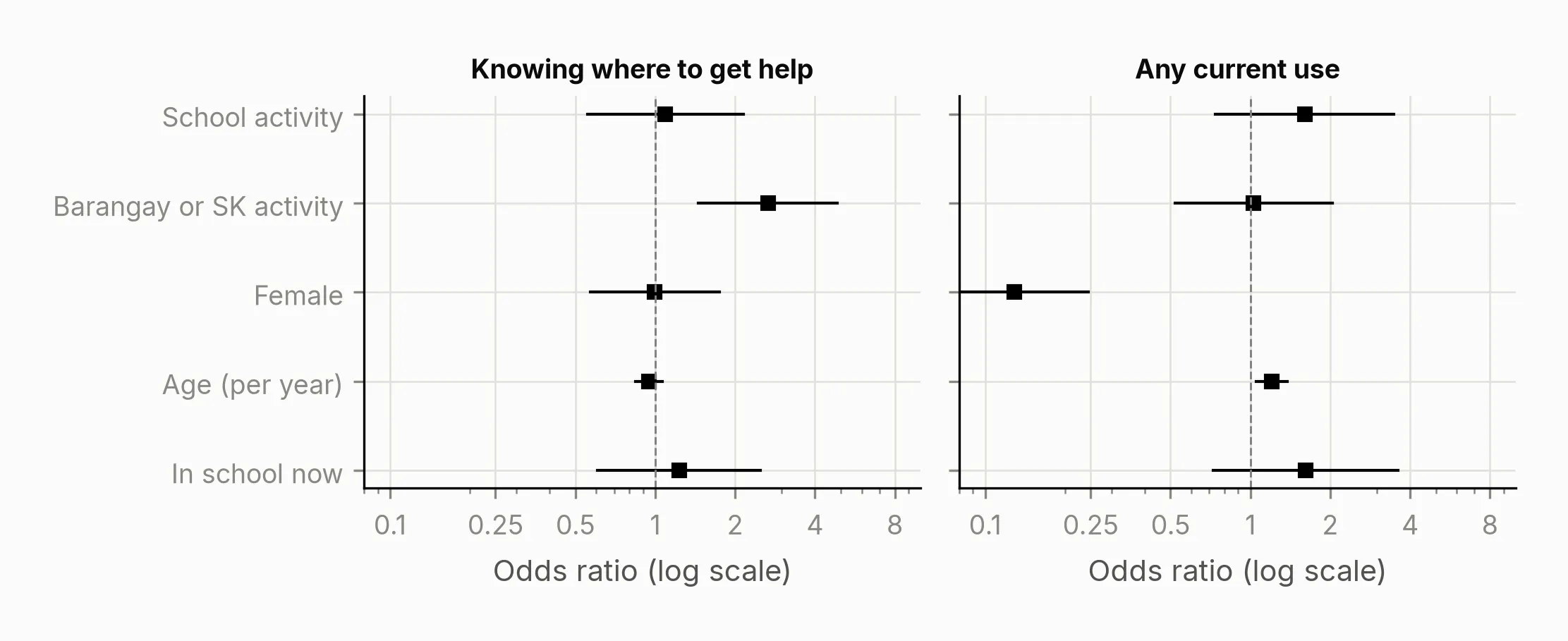
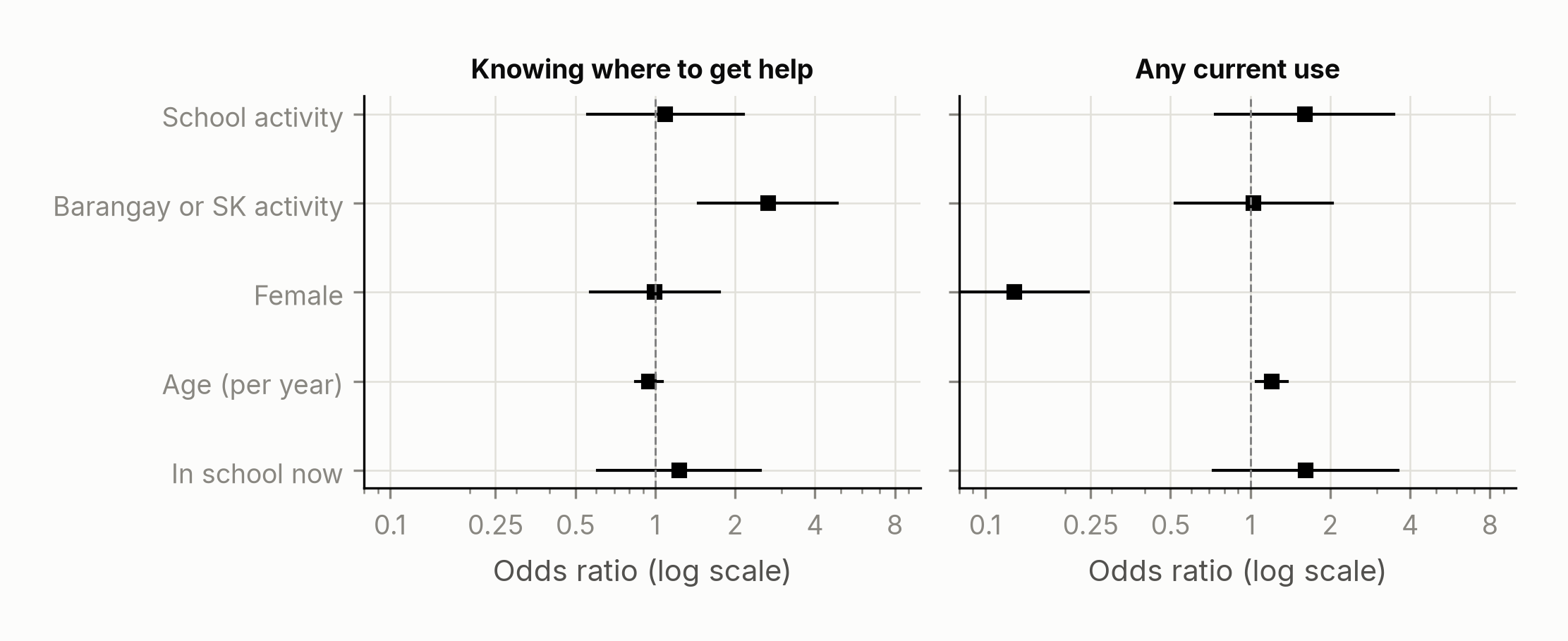
VI. Discussion of Results and Recommendations: the key informants
The analysis generated five themes from the six interviews (Table 8). The quotations were translated from Filipino by the researcher.
Drug-cleared, but not substance-free. Every informant tied the barangay’s prevention work to illegal drugs. “Our report to the municipality asks about drug personalities and surrenderers, not about cigarettes or gin,” said K1. K4 added that the school’s lessons on gateway substances “stop at the classroom door.” The political implication: the drug-clearing status had become the measure of success, so what it does not count, tobacco, vapes and alcohol, received no plan.
Drinking belongs to every gathering. Informants described drinking at fiestas, birthdays and wakes as normal for young men from their teens. K2 linked it to injuries the health center treats after celebrations (the medical implication), and K5 to quarrels at home and to money spent on drinks and on vapes that families cannot spare (the social and economic implications).
Easy to buy, rarely stopped. “Stores sell one stick at a time to anyone who has the money,” said K2. K1 knew of no citation under the ordinance, and K3 said vapes are “ordered online and delivered to the house.” The legal implication: the laws on sales to minors exist but are not enforced in the barangay.
Help that young people do not see. The health center gives counseling and the BADAC has a referral desk, but K6 said young people “come only when they are injured,” and K1 that families fear a referral will put a name on a list. K3 said youth “think the BADAC is the police.”
Activities that happen once a year. Activities were lectures during the anti-drug week or before the drug-clearing validation. K3 said the SK has funds for youth programs “but no plan for anything beyond a seminar,” and K1 that council meetings “became fewer after we were declared cleared.”
Table 8. Themes From the Key Informant Interviews and the Implications They Show
Theme Implications Informants Drug-cleared, but not substance-free Political (what is counted sets what is planned) K1, K3, K4 Drinking belongs to every gathering Medical (injuries), social (quarrels), economic (spending) K2, K5, K6 Easy to buy, rarely stopped Legal (sales to minors not enforced) K1, K2, K3 Help that young people do not see Medical, social (fear of being listed, stigma) K1, K3, K6 Activities that happen once a year Political (prevention depends on priorities and validation) K1, K3, K4 Note. K1 BADAC vice-chairperson; K2 barangay health worker; K3 SK chairperson; K4 teacher coordinating the school’s drug education program; K5 parent leader; K6 nurse of the rural health unit.
VI. Discussion of Results and Recommendations: the results together
Set side by side, the survey, the records and the interviews agree on four points and add a fifth (Table 9).
Table 9. Joint Display of the Survey, the Records and the Interviews
Matter Survey Records Interviews Together Data on substance use 39.2% used in the past 30 days; vaping 8.3% Illegal drug admissions fell; tobacco, vapes, alcohol not recorded “Drug-cleared, but not substance-free” The barangay’s records miss the substances youth use most Implications 17.1% had five or more drinks in a row 5 to 7 youth a year treated for alcohol-related injuries Injuries, quarrels, spending Drinking carries the heaviest burden Laws and policies 39.2% knew no national law sets a minimum age for buying alcohol; 32.3% knew voluntary treatment is confidential No citation for sales to minors in three years “Easy to buy, rarely stopped” Laws on sales to minors are known but not enforced; laws that protect help-seekers are little known Institutions and resources 45.2% could name a source of help; 7.4% knew the Quitline 0 to 1 youth a year counseled to stop smoking or vaping “Help that young people do not see” Services exist but youth do not see them Prevention Barangay and SK activities went with knowing where to get help; no activity went with less use Activities fell to one a year; attendance from 146 to 64 “Activities that happen once a year” One-time seminars inform; they do not change use
VI. Discussion of Results and Recommendations: discussion
The barangay’s youth drank and smoked at about the national rates, but vaped far more than youth did in 2021. The national figure for youth aged 15 to 24 is from 2021. Among students aged 13 to 15, current use of electronic cigarettes was already 14.1% in 2019, above cigarette smoking (10.0%; Department of Health Epidemiology Bureau, 2021), so vaping may be more common among young people than the 2021 youth figure suggests. Most first tried alcohol before 18, and more than a third by 15, at ages when only local ordinances, not a national law, forbid selling it to them.
The pattern in research question 4 fits what the international standards lead one to expect. Lectures and one-time seminars should not be expected to change use (Faggiano et al., 2014; UNODC & WHO, 2018, pp. 21-22), and neither kind of activity in this barangay went with less use. Barangay and SK activities, however, went with knowing where to get help, perhaps because the health center’s staff spoke at them; school lessons, which the teacher described as centered on the harms of gateway substances, did not. Among Filipino students aged 11 to 18 in 2019, having been taught where to get help for drug problems went with less current illicit drug use (Pengpid et al., 2025). The finding is an association in one survey: youth who attend barangay activities may already be the ones who seek out information.
The least known laws were those that protect a young person who asks for help, and the informants described fear of being listed. Help-seeking is held back by “fear of police and incarceration, stigma and discrimination” (Perez et al., 2025), and only 43.3% of youth here would accept a person in recovery as a neighbor. Telling young people that voluntary treatment is confidential (RA No. 9165, Sec. 60), that a child is not penalized for violating a local anti-smoking or anti-drinking ordinance (RA No. 9344, Sec. 57-A), and that a positive school drug test is no ground for expulsion (DO No. 40, s. 2017, item 55) may matter more than repeating the harms.
VI. Discussion of Results and Recommendations: conclusions and recommendations
- Alcohol is the substance youth in the barangay use most, and vaping is far more common than national figures from 2021 suggest; use is concentrated among young men and begins for many before 18.
- Youth know that stores may not sell tobacco to minors, but most find it easy to buy, and few know the laws that protect a person who seeks help.
- Fewer than half of youth can name a source of help, and very few know the hotlines and programs that exist.
- Barangay and SK prevention activities go with knowing where to get help; neither these nor school activities go with less use.
- The barangay’s records and plans follow illegal drugs, while the substances its youth use most go unrecorded and its prevention activities have thinned.
- The BADAC may add tobacco, vapes and alcohol to its plan of action and its monthly report, hold its meetings monthly as its guidelines set, and, with the municipality, orient store owners near the school on the laws on sales to minors (RA No. 9211, Secs. 9-10; RA No. 11900, Secs. 6, 7 and 9) and see that stores selling vapes post the point-of-sale notice the vape law requires (RA No. 11900, Sec. 10).
- The SK may use its funds, which the law gives priority to “Sports and wellness projects to address … substance abuse” among others (RA No. 10742, Sec. 20(c)(2), as amended by RA No. 11768), for a series of interactive sessions that build refusal and decision skills over several weeks, in place of one-time lectures (UNODC & WHO, 2018, p. 22).
- Every prevention activity, in school or in the barangay, may end with where to get help: the health center, the guidance office, the BADAC’s referral desk, the DOH Quitline (1558), and the crisis hotline (1553), with the assurance that voluntary treatment is confidential.
- The school may give the Grade 10 competency on institutions and resources (DM No. 025, s. 2021) as much time as the harms of substances, and the Barkada Kontra Bisyo may carry the leaflet on where to get help to its peers.
- The rural health unit may offer counseling to stop smoking and vaping at the health center on set days, and tell youth that it is confidential.
- Future researchers may evaluate a skills-based program with a comparison group, measure peer and family influences with validated scales, and repeat this survey in other barangays.
VIII. References and IX. Appendices
The paper’s references are the proposal’s 46 works and the AAPOR standard definitions of response rates. Its appendices are the questionnaire (also a separate file above), the eight-question interview guide, the list of records requested, the content validity and pilot results, a description of the executive data set, and the consent form.
Part 4. The dissemination, advocacy and utilization plan
The plan turns the recommendations into dated activities with a budget, the people responsible and a success indicator for each. It is the paper’s part VII and a separate document in its own right, prepared by the researcher and approved by the school head. Its production table is a landscape page in the Word file.
PLAN FOR RESEARCH DISSEMINATION, ADVOCACY AND UTILIZATION
[Name of School]
School Years 2025-2026 and 2026-2027
[Address]
I. INTRODUCTION
This plan carries the findings of the study “Substance Use, Knowledge of Laws, and Awareness of Help Among Barangay Youth” to the people who can act on them: the Barangay Anti-Drug Abuse Council, the Sangguniang Kabataan, the school, the rural health unit, and the youth themselves. It turns the study’s recommendations into activities with a date, a budget, the people responsible, and a way to tell whether each worked.
II. HIGHLIGHTS OF RESEARCH FINDINGS
- 39.2% of youth aged 15 to 24 had used alcohol, cigarettes or vapes in the past 30 days; 31.8% had drunk alcohol and 8.3% had used a vape.
- Counting everyone, 60.6% had tried alcohol by age 18.
- 79.7% said a person below 18 can easily buy cigarettes in the barangay; no citation for selling to minors was issued from 2023 to 2025.
- Only 45.2% could name a place or person that gives help; 7.4% knew the DOH Quitline.
- Youth who attended a barangay or SK activity were more likely to know where to get help (odds ratio 2.66); no activity went with less use.
- The barangay’s records and plans follow illegal drugs only, and its prevention activities fell to one in 2025.
III. GENERAL OBJECTIVES
The plan aims to bring the findings to those who decide the barangay’s and the school’s prevention work; to make help visible to young people; to move the barangay from one-time seminars to sessions that build skills; and to see that the laws on sales to minors are known and kept near the school.
IV. PRODUCTION
Dissemination/ Utilization Activities Specific Objectives Timeframe/ Target Date Budget and its Source Human Resources/ Persons Involved Material Resources Success Indicators 1. Submission of the paper and data set to the school’s research committee for archiving Keep the study available to future researchers March 27, 2026 None Researcher, adviser Paper, executive data set Paper and data set received by the research committee 2. Presentation to the BADAC Present the records’ findings and recommendations 1 and 3; propose adding tobacco, vapes and alcohol to the BADAC plan April 2026 BADAC meeting None Researcher, adviser, BADAC members Slides, printed summary Recommendation adopted in the BADAC minutes; BADAC plan revised 3. Presentation at the Katipunan ng Kabataan assembly Share the findings with youth; gather their proposals for SK activities May 2026 PHP 1,500 (snacks), SK fund Researcher, SK officials, KK members Slides, printed summary Number of youth attending; proposals recorded 4. Leaflet and poster: where young people can get help Make help visible: services, hotlines, confidentiality May to June 2026 PHP 2,500 (printing of 500 leaflets and 10 posters), SK fund Researcher, SK, health center, BKB Leaflets, posters 500 leaflets given out; posters at the barangay hall, health center, school and stores 5. Presentation to the school head, teachers and the Barkada Kontra Bisyo Share the findings; agree on the school’s actions on PDE lessons and the peer group June 2026, when classes resume None Researcher, adviser, school head, teachers, BKB members Slides, printed summary Presentation made; school’s action points recorded 6. Youth activity on the International Day Against Drug Abuse Launch skills-based sessions with the SK; give out the leaflet June 26, 2026 PHP 5,000, SK fund SK, health center, BKB, researcher Session plans, leaflets Number of youth attending; series of sessions scheduled 7. Orientation of store owners near the school Explain the laws on sales to minors and within 100 meters of a school July 2026 PHP 1,500 (snacks), barangay fund BADAC, barangay officials, researcher Copies of the laws’ key sections, signs Stores oriented; signs posted 8. Presentation at the school’s research forum Share the study and its design with other learner researchers August 2026 None Researcher, adviser, research teacher Slides, printed paper Presentation made 9. Follow-up with the BADAC and the SK Check which recommendations were acted on September 2026 None Researcher, adviser Checklist of recommendations Report on actions taken submitted to the school head V. MONITORING & EVALUATION
The researcher and the adviser will keep a record of each activity: the date, those who attended, and what was decided, with the minutes of the BADAC and the SK where the activity was part of their meeting. In September 2026, they will check each recommendation against what the BADAC, the SK, the school and the health center did, and report to the school head which were acted on, which were not, and why. The success indicators in Part IV are the measures. A second survey of youth, a year later, would show whether knowing where to get help has spread.
VI. ATTACHMENTS
- The completed research paper
- The executive data set (Microsoft Excel)
- The leaflet on where young people can get help (draft)
- The slides used in the presentations
Prepared by:
[Name of the learner researcher], Researcher, Grade 11
Approved by:
[Name of the school head], School Head
Part 5. How the statistics were chosen and computed
Each analysis answers one research question with the simplest method that handles its data honestly. The notebook computes every one, and the workbook shows each as Excel formulas.
Shares with Wilson intervals, and the weighted check
A share from a sample of 217 needs an interval. The textbook (Wald) interval, p ± 1.96√[p(1 − p)/n], misbehaves; its “chaotic coverage properties … are far more persistent than is appreciated”. Brown, Cai and DasGupta (2001) recommend the Wilson or Jeffreys interval for small samples and the Agresti-Coull interval for larger ones; at this sample size Wilson’s and Agresti-Coull’s limits differ by a tenth of a point at most. For current vaping, 18 of 217, the Wilson interval is [5.3, 12.7]. In Excel, with the share in C13, n in B4 and z in E4:
=(C13+$E$4^2/(2*$B$4)-$E$4*SQRT(C13*(1-C13)/$B$4+$E$4^2/(4*$B$4^2)))/(1+$E$4^2/$B$4)The upper limit changes the minus before the square root to a plus. The respondents are a random sample, but nonresponse can tilt them; weighting each respondent so that the sex-by-age mix matches the SK’s list, and comparing, shows whether it did. Here no current-use share moved by more than a percentage point.
from statsmodels.stats.proportion import proportion_confintlo, hi = proportion_confint(count=k, nobs=n, alpha=0.05, method="wilson")Chi-square tests and Cramér’s V
Current use by sex, age group and schooling is a cross-table of counts, and the chi-square test of independence asks whether use differs across groups more than chance would make it. Each expected count must be large enough, at least 5 by the usual rule, which held for every test reported. The effect size, Cramér’s V = √[χ² / (n × (k − 1))], with k the smaller of the table’s rows and columns, says how strong a difference is: 0.44 for sex against 0.16 for age group. Excel’s CHISQ.TEST takes the observed and expected ranges; the guide to the chi-square test in Excel works through one.
Kaplan-Meier: age at first use
“How old were you when you first …?” answered only by those who have tried gives an average that is too young: the youngest respondents, who have not tried yet but will, are left out. The Kaplan-Meier method counts everyone, each until the age of first use (an event) or their present age (censored), and estimates the share who had tried by each age. In the workbook’s First use sheet, each age’s row counts those still at risk and those starting at that age with COUNTIFS, and multiplies the survival step by step:
Not yet at age a = Not yet at age a−1 × (1 − first uses at a ÷ at risk at a)Tried by age a = 1 − Not yet at age aimport numpy as np
def km(first, ever, age): t = np.where(ever == 1, first, age) # time: age of first use, or present age surv, tried = 1.0, {} for a in range(10, 25): at_risk = (t >= a).sum() events = ((t == a) & (ever == 1)).sum() surv *= 1 - events / at_risk if at_risk else 1 tried[a] = 1 - surv return triedThe users’ mean age at first drink was 15.2; counting everyone, half had tried by 17.
Logistic regression and average marginal effects
Knowing where to get help (yes or no) and any current use (yes or no) are binary outcomes, so each gets a binary logistic regression with the two kinds of activity and three covariates. Odds ratios are hard to read as sizes, so the paper also gives average marginal effects: the average change in the probability of the outcome, in percentage points, when an activity goes from no to yes, holding the other predictors as they are. For barangay or SK activities and knowing where to get help, that was 23.6 points, 95% CI [9.5, 37.8]. With 98 and 85 events for five predictors, each model had well over ten events per predictor, the rule of thumb below which coefficients become unreliable (Peduzzi et al., 1996).
import statsmodels.formula.api as smfm = smf.logit("knows_help ~ school_activity_12m + brgy_activity_12m + female + age_c + in_school", data=s).fit()print(np.exp(m.params), np.exp(m.conf_int())) # odds ratios and 95% CIsprint(m.get_margeff(at="overall", dummy=True).summary()) # average change from no to yesExcel cannot fit a logistic regression without an add-in, so the workbook takes the coefficients and standard errors from Python and computes each odds ratio, interval and p-value as =EXP(b), =EXP(b ± 1.959964 × SE) and =2*(1-NORM.S.DIST(ABS(b/SE),TRUE)).
Thematic analysis and the joint display
The six interviews were coded and grouped into themes in the six phases of thematic analysis, from familiarizing with the data to producing the report (Braun & Clarke, 2006), with the adviser checking the codes against the transcripts; the guide to thematic analysis shows each phase with a worked example. The joint display (Table 9 of the paper) sets each of the four matters beside what the survey, the records and the interviews found, so the conclusions rest on all three.
Writing the results in APA style
- “Within the past 30 days, 31.8% of youth had drunk alcohol, 95% CI [26.0, 38.3].”
- “Young men used at least one substance far more often than young women, 61.3% against 18.0%, χ²(1, N = 217) = 42.67, p < .001, V = 0.44.”
- “The odds of knowing where to get help were 2.66 times as high, 95% CI [1.45, 4.87], p = .001.”
Write “went with”, not “led to”: the survey shows associations at one time, and youth who attend barangay activities may already be the ones who look for information.
How to adapt this sample to your own study
- One substance in depth: vaping among learners of one school, with the Global Youth Tobacco Survey’s items and the school’s own records of violations under DO 006, s. 2026.
- Adults instead of youth: parents’ awareness of the laws on sales to minors and of the barangay’s services, as a household survey with the barangay’s permission.
- An evaluation: a series of skills-based sessions for one group of youth against another that waits, with knowing where to get help and intentions as outcomes, as a quasi-experiment.
- No survey at all: a document study of the barangay’s and the municipality’s anti-drug plans and reports over five years, against the functionality indicators the councils are rated on.
Titles that follow the same plan, each naming its substance, its people and its place:
- Vaping, Perceived Risk and Access Among Junior High School Learners in One School
- Parents’ Awareness of Laws on Selling Tobacco and Alcohol to Minors in a Barangay
- Knowing Where to Get Help: Youth and the Barangay Anti-Drug Abuse Council
- Age at First Drink Among Youth in a Coastal Barangay: A Survival Analysis
Common mistakes this sample avoids
- Asking youth about their own illegal drug use. A learner cannot protect the answers; use aggregate records instead.
- Reporting the “average age at first use” among users only. It leaves out those who have not started; use Kaplan-Meier, or at least report the share who had tried by a given age.
- Taking the list’s names. The SK keeps its list; it draws the sample and delivers the invitations.
- Wald intervals for small shares. Use Wilson intervals.
- Reading an association as an effect. A cross-sectional survey shows which youth know more, not what made them know it.
- Covering only illegal drugs. DepEd’s own definition of substance use includes tobacco and alcohol, which most youth use first.
- A plan with no indicators. Each dissemination activity names who does it, when, with what money, and how anyone will know it worked.
What this means for school heads
DO 30, s. 2018 gives the school head eleven duties under the PDEP, among them to “Incorporate PDE outcomes as one of the performance objectives in their Organizational Performance Commitment and Review Form (OPCRF)”, “Coordinate with the appropriate offices and other agencies or instrumentalities for appropriate assistance and interventions”, “Allocate funds for the development of teacher-made IEC materials for preventive drug education through the school MOOE and other fund sources”, and “Document evidence-based practices … relative to PDEP” (Encl., Sec. VII.D.1). A learner’s study like this one serves several at once: it gives the school evidence on its community, a reason to sit with the barangay, and a record of research for the PDEP monitoring tool. The newest national figures for younger learners point the same way as the sample: in the 2024 Global Youth Tobacco Survey, 12.8% of learners aged 13 to 15 currently used electronic cigarettes and 7.1% smoked cigarettes, and 38.9% of current smokers who tried to buy cigarettes were not prevented from buying them because of their age (2024 GYTS fact sheet).
The public school principal, or a representative, sits on the Barangay Anti-Drug Abuse Council and on its committee on advocacy (DILG Memorandum Circular No. 2015-63, Secs. II.A and III.B), so the findings have a direct route to the council. Three other rules shape what a school does with learners who use substances. A positive random drug test “shall not be a ground for expulsion or any disciplinary action against the student” (DepEd Order No. 40, s. 2017, item 55). For school year 2026-2027, public school learners identified in school health services as using tobacco, vapes or alcohol are referred for intervention, and the data or information from what they disclose there “shall not, in themselves, constitute grounds for the imposition of penalties pursuant to DO 006, s. 2026” (DepEd Memorandum No. 059, s. 2026, item 9). And the offenses and their levels are in DepEd Order No. 006, s. 2026, Annex I, which the guide to school rules on learners’ offenses explains; the guide to the smoking and vaping ban in schools covers the 100-meter rule near the school.
A school head who supports a learner’s study on this topic can see that the proposal leaves out questions on illegal drug use, that the adviser has agreed a referral protocol with the guidance designate, and that the results go to the BADAC and the SK as well as to the school’s research forum.
Frequently asked questions
Is this a real basic research?
No. The barangay, the school, the youth, the records and the interviews are invented, to show the parts of a basic research proposal, a completed paper and a dissemination plan, and how each number is computed. The laws, DepEd’s issuances, the national figures and the studies cited are real, and the numbers in the paper come from the invented records, which you can download and check.
Can a senior high school learner do a basic research on drugs?
Yes, on substance use, with limits. DO 30, s. 2018 encourages research on preventive drug education, and DM 025, s. 2021 expects Grade 9 and 10 learners to study the data, implications, institutions and laws of substance use (under the MATATAG curriculum, Grade 8 MAPEH asks learners to evaluate the laws and policies). A learner should not ask anyone about their own or others’ illegal drug use, which the national ethical guidelines treat as a legal risk; illegal drug figures can come from the barangay’s aggregate records.
What is a good research title about drug abuse among youth?
A good title names the substance, the people and the place, and says what is measured: “Substance Use, Knowledge of Laws, and Awareness of Help Among Barangay Youth” names use, two kinds of knowledge, and the youth of one barangay in twelve words. Titles that promise a cause (“The Effect of Peer Pressure on Drug Addiction”) need a design that can show one.
Why does the questionnaire ask about vapes and alcohol and not about shabu or marijuana?
DepEd’s curriculum model defines substance use to include tobacco and alcohol, which most youth try first; and a question on illegal drug use would ask respondents to disclose a crime. The national guidelines tell researchers to ask participants not to divulge such information, and the barangay’s records give its illegal drug figures in aggregate.
Download the data
- Ever and current use, with Wilson intervals (CSV): the shares behind Figure 2.
- Age at first use, Kaplan-Meier estimates (CSV): the share who had tried each substance by each age, 10 to 24, and the users-only shares.
- Odds ratios of the two logistic regressions (CSV): every predictor’s odds ratio and interval behind Figure 4.
The records are invented, for teaching. In research and teaching you may analyze the CSVs and publish your results, citing this post; sharing or republishing the CSVs or charts needs written permission: ask through our contact form.
Sources
DepEd issuances and laws
- DepEd Order No. 30, s. 2018, Preventive Drug Education Program Policy for Curriculum and Instruction (July 12, 2018): Secs. II, IV, VII.D; Monitoring and Evaluation Tool, Part V
- DepEd Memorandum No. 025, s. 2021, Preventive Drug Education Program Curriculum Model (May 6, 2021): Encl., Grades 5, 9 and 10
- DepEd Order No. 16, s. 2017, Research Management Guidelines: Secs. V.A.iii, V.B.vii, VI.C; Annex 3
- DepEd Order No. 39, s. 2016, Adoption of the Basic Education Research Agenda: Theme 2
- DepEd Order No. 40, s. 2017, Guidelines for the Conduct of Random Drug Testing in Public and Private Secondary Schools: item 55
- DepEd Order No. 40, s. 2012, DepEd Child Protection Policy
- DepEd Order No. 006, s. 2026, Guidelines on Ensuring a Safe and Motivating Learning Environment: Annex I
- DepEd Memorandum No. 059, s. 2026, Guidelines on the Delivery of School Health Services for School Year 2026-2027: item 9
- DepEd Memorandum DM-OUOPS-2025-10-07238, Learner Leadership Skills Development Capacity Building Activity for School Year (S.Y.) 2025-2026 (November 10, 2025): Annex A, as enclosed in DepEd Region VIII Regional Memorandum No. 1685, s. 2025
- Republic Act No. 9165, Comprehensive Dangerous Drugs Act of 2002: Secs. 15, 43, 51, 54, 60
- Republic Act No. 9211, Tobacco Regulation Act of 2003: Secs. 5, 9, 10
- Republic Act No. 11900, Vaporized Nicotine and Non-Nicotine Products Regulation Act: Secs. 6, 7, 9, 10, 15, 23
- Republic Act No. 9344, Juvenile Justice and Welfare Act of 2006, as amended by Republic Act No. 10630: Secs. 6, 57-A
- Republic Act No. 10742, Sangguniang Kabataan Reform Act of 2015, as amended by Republic Act No. 11768: Secs. 4, 14(a), 20(c)
- Republic Act No. 10173, Data Privacy Act of 2012: Secs. 3(l) and 11
Other government issuances
- Dangerous Drugs Board, Board Regulation No. 5, s. 2007, Institutionalizing the Barkada Kontra Droga Program: Sec. 3
- Dangerous Drugs Board, Board Regulation No. 4, s. 2021, on the Barangay Drug Clearing Program: Sec. 11
- Dangerous Drugs Board, Board Regulation No. 7, s. 2019, on access to treatment and rehabilitation: Sec. 5
- Dangerous Drugs Board, Board Regulation No. 2, s. 2023, Amending Board Regulation No. 6, Series of 2019, Protocol When Handling Children Allegedly Involved in Dangerous Drugs: Sec. 5.2
- Department of the Interior and Local Government, Memorandum Circular No. 2015-63, Revitalization of the Barangay Anti-Drug Abuse Council: Secs. II and III.B
- Department of the Interior and Local Government and Dangerous Drugs Board, Joint Memorandum Circular No. 2018-01, on the functionality of local anti-drug abuse councils: Sec. V.B.6
- Department of the Interior and Local Government, Memorandum Circular No. 2022-033, Conduct of Profiling of the Katipunan ng Kabataan: item 6
- National Privacy Commission, Circular No. 2023-04, Guidelines on Consent: Sec. 16
- Philippine Health Research Ethics Board. (2022). National ethical guidelines for research involving human participants 2022: Elements of Research Ethics, items 30 and 31; Social Research, items 30 and 39.9; The Research Ethics Review Process, item 52; Research Involving Minors, items 3.2.4 and 3.2.7
Research and data
- University of the Philippines Population Institute. (2022). YAFS5 regional profile: Philippines: Table 2
- Department of Health. (2026). 2024 Philippines Global Youth Tobacco Survey fact sheet (ages 13 to 15)
- United Nations Office on Drugs and Crime, & World Health Organization. (2018). International standards on drug use prevention (2nd updated ed.): pp. 2-3, 21-22
- Pengpid, S., Peltzer, K., Santos, L. E., & Mallari, E. F. I. (2025). Prevalence, drug education, and other associated factors of current illicit drug use among a nationally representative sample of school-aged adolescents in the Philippines in 2019. Substance Abuse Treatment, Prevention, and Policy, 20(1), Article 22.
- Perez, A. R., Yusay, C. T., & Hechanova, M. R. (2025). Barriers and enablers to help seeking, treatment adherence and recovery among community-based drug rehabilitation clients in the Philippines. Drugs: Education, Prevention and Policy, 32(5), 440–448.
- Brown, L. D., Cai, T. T., & DasGupta, A. (2001). Interval estimation for a binomial proportion. Statistical Science, 16(2), 101–133.
- Peduzzi, P., Concato, J., Kemper, E., Holford, T. R., & Feinstein, A. R. (1996). A simulation study of the number of events per variable in logistic regression analysis. Journal of Clinical Epidemiology, 49(12), 1373–1379.
- Braun, V., & Clarke, V. (2006). Using thematic analysis in psychology. Qualitative Research in Psychology, 3(2), 77–101.
The other studies behind the paper’s literature review are listed in its references (Part 2, VIII).
Written by Mark Anthony Llego for NASH Reviewer. Sources: DepEd Order No. 30, s. 2018; DepEd Memorandum No. 025, s. 2021; DepEd Orders No. 16, s. 2017, No. 39, s. 2016, No. 40, s. 2017 and No. 006, s. 2026; Republic Acts No. 9165, 9211, 11900, 9344, 10742 and 10173; the Dangerous Drugs Board; the DILG; the National Ethical Guidelines for Research Involving Human Participants 2022; the 2021 YAFS5; UNODC and WHO.