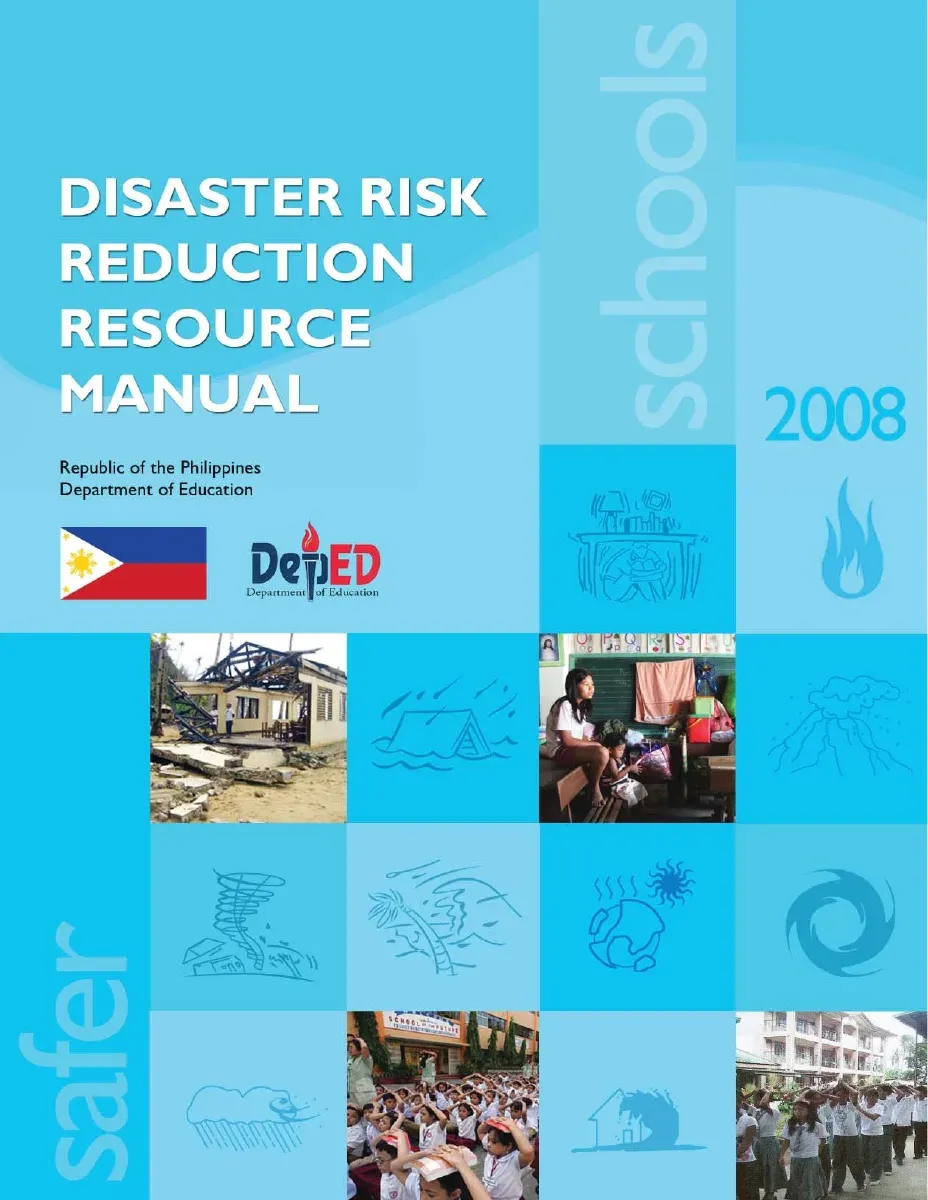
The Disaster Risk Reduction Resource Manual, subtitled Safer Schools Resource Manual, is the Department of Education’s 2008 guide for school administrators, supervisors and teachers on what to do before, during and after a hazard. DepEd published it “in partnership and with the support of” UNICEF Philippines, which funded the final printing, and printed it in collaboration with Plan International Philippines, which gave inputs and funds for printing the final draft; its copyright line names DepEd. A Technical Working Group created through DepEd Memorandum No. 175, s. 2007 wrote it. The typhoons of 2006, which damaged 5,600 schools in Southern Luzon, prompted it (Introduction).
DepEd Order No. 55, s. 2007 enjoined DepEd offices and schools to use the working group’s manual, with orientations in every region from August 14 to September 5, 2007. DepEd Order No. 98, s. 2009, dated September 18, 2009, then listed it among four Administrative Service manuals “for implementation nationwide” and authorized the regional offices to print copies for their divisions, districts and schools.
The download holds the manual as one PDF.
Is the 2008 manual still current?
Not as a rulebook. As of November 8, 2026, DepEd’s Publications page still lists the manual, and DO 21 and DO 37, s. 2015 cite it as a source of their definitions, but the system it describes has been replaced:
- The national system. The Philippine DRRM Act of 2010, Republic Act No. 10121, renamed the National Disaster Coordinating Council (NDCC) the National Disaster Risk Reduction and Management Council (NDRRMC) and amended or repealed PD 1566, one of the manual’s legal bases (Secs. 5 and 28).
- DepEd’s DRRM office. The manual proposed a permanent DRRM Office to replace the ad hoc Calamity, Disaster and Fire Control Group. DO 50, s. 2011 created a DRRM Office, now the DRRM Service.
- The school’s structure. Instead of the manual’s disaster control groups and evacuation teams, each school has a school DRRM team and a school DRRM coordinator (DO 21, s. 2015), working under the Comprehensive DRRM in Basic Education Framework of DO 37, s. 2015. DO 033, s. 2021 requires a coordinator other than the school head, a non-teaching staff member whenever feasible.
- Damage reports. DO 21, s. 2015 sets the report a school now files: the Rapid Assessment of Damages Report (RADaR), within 72 hours of a hazard. The manual’s own forms, the Rapid Disaster Assessment Report, came before it.
- Suspensions and continuity. Class suspensions follow DO 022, s. 2024 and Executive Order No. 130, s. 2026, and continuity of instruction follows the Learning and Service Continuity Plan, which DO 014, s. 2026 has schools prepare every year and update every term.
- Schools as evacuation centers. RA 10821 and DO 033, s. 2021 now limit which school spaces evacuees may use and for how long.
DepEd’s later School DRRM Manual lists this manual as further reading.
What the manual covers
- Overview of disaster risk reduction: hazards, risk (hazard times vulnerability over capacity), the legal bases, the Hyogo Framework principles DepEd adopted, and DepEd’s Calamity, Disaster and Fire Control Group.
- Natural hazards: typhoons, floods, storm surges, landslides, heat waves and other weather hazards, then earthquakes, tsunamis and volcanic eruptions, most with what to do before, during and after.
- Human-induced hazards: structure collapse, fire, road accidents, laboratory chemical spills, food poisoning, red tide, water pollution, bomb threats, hostage taking, kidnapping and civil disorder.
- The risk profile of the Philippines.
- The Philippine disaster risk management system: the NDCC framework, the cluster approach, DepEd’s role, the proposed DRRM Office, and procedures for warnings, crisis communication, contingency planning, response, and schools used as evacuation centers.
- Ensuring continuity of instruction: links to the School Improvement Plan, alternative learning venues, alternative delivery of instruction, minimum standards for education in emergencies, and emergency procurement to repair or replace school buildings, equipment and fixtures.
- Ensuring the safety of DepEd properties: school sites and buildings, records, and fixtures and equipment.
- Monitoring and evaluation: checklists and damage report forms.
The appendices cover past disasters in the Philippines, the incident command system, critical incident stress debriefing, NDCC and DepEd issuances, how to read hazard maps, and emergency numbers.
The checklists and forms
| Checklist or form | Who uses it | For |
|---|---|---|
| Checklist A: DRR Program Implementation Assessment | Regional and division offices | Rating the office’s preparedness, response, and relief and rehabilitation |
| Checklist B: DRR preparations undertaken by the school | Elementary and secondary schools | The school’s DRR plan, its DRR group, and the measures carried out |
| Checklist C: DRR preparations undertaken by the school | Elementary and secondary schools | Alternative learning venues and alternative delivery of instruction |
| Checklists on ensuring the safety of DepEd properties | Physical facilities coordinators and property custodians | Storage, records, equipment and buildings |
| RADAR forms | Schools, divisions and regions | Reporting damage and classrooms used as evacuation centers |
Why it matters for aspiring school heads
School safety is strand 2.5 of the Philippine Professional Standards for School Heads (PPSSH, DO 024, s. 2020), in Domain 2, Managing School Operations and Resources: at Career Stage 1, indicator 2.5.1 asks for knowledge of the laws, policies and issuances on school safety for disaster preparedness, mitigation and resiliency “in ensuring continuous delivery of instruction”. The manual’s chapters on records and property also touch strands 2.1 (records management) and 2.3 (school facilities and equipment). Its hazard chapters remain a plain reference for drills and lessons; for the rules, read it beside the issuances above.
The school DRRM guide covers the DRRM team, the coordinator, typhoon measures and reports. DepEd’s incident reports show what schools report after a disaster today, and the Educational Facilities Manual guide covers safe school sites and buildings.