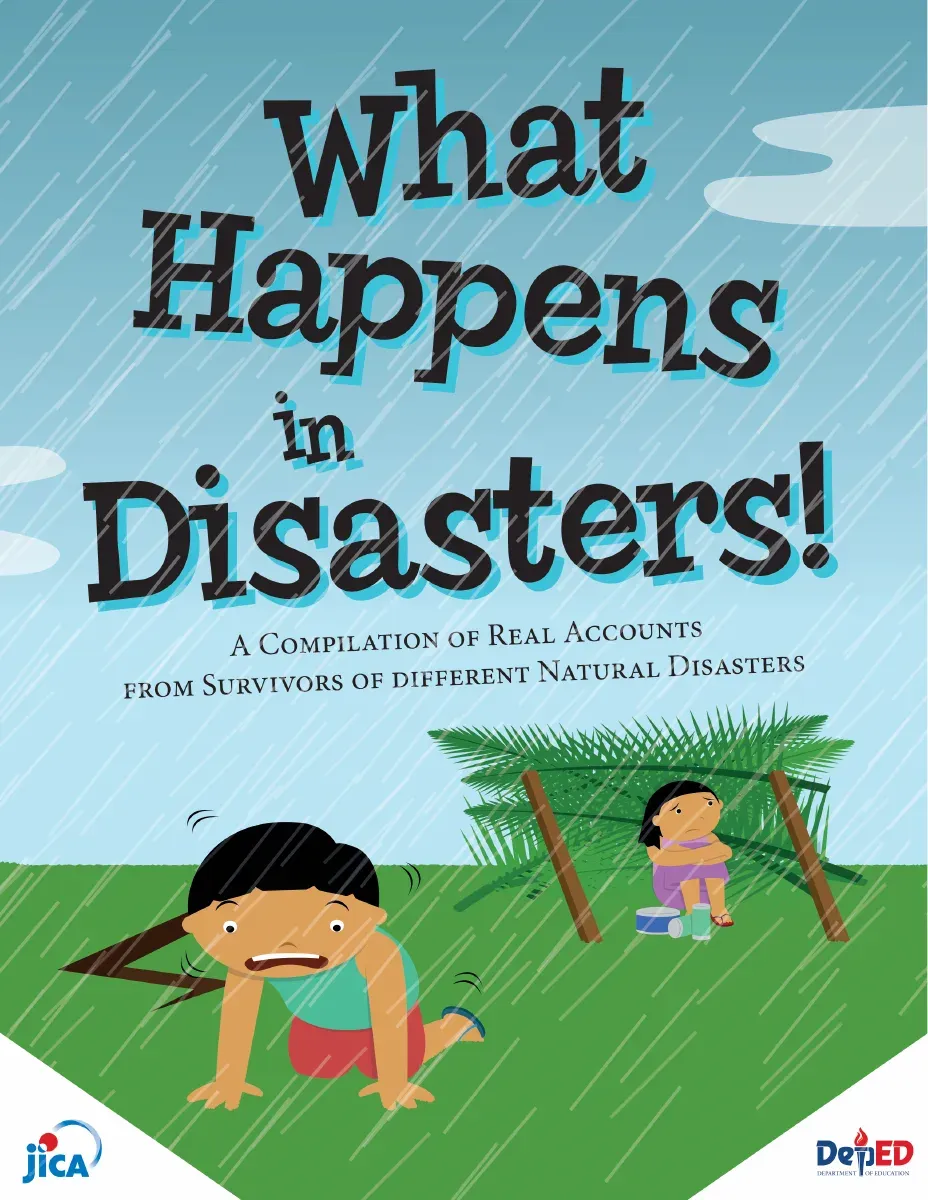
What Happens in Disasters! A Compilation of Real Accounts from Survivors of Different Natural Disasters is an illustrated storybook for learners, prepared by the Department of Education and the Japan International Cooperation Agency (JICA). Dinna Dayao wrote it and RJ Santillan III illustrated it. In his foreword, Secretary Br. Armin A. Luistro FSC writes that the stories of “actual survivors” help teachers “educate learners about the diverse classifications of disasters” and hopes the children bring that awareness home to their families. The back cover promises “true-to-life stories” that show how disasters affect a community “and how being ready for them will always help in time of need”.
The Download button opens JICA’s own copy of the book, a single PDF; JICA’s site terms allow its files to be reproduced for personal use only.
Is the book still current?
It teaches safety habits, not rules, and cites no issuance. As of November 8, 2026, DepEd’s Publications page still lists it. Its lessons are taking cover under a sturdy table while the ground shakes, staying out of floodwater, leaving for the evacuation center before a typhoon, and acting on volcano bulletins; DepEd’s School DRRM Manual turns the same preparedness into drills, evacuation procedures and family preparedness plans. For the rules on drills, class suspensions and evacuation in force today, read the guide to school DRRM and class suspensions.
The four stories
| Story | Hazard | What it shows |
|---|---|---|
| The Day the Earth Shook Violently | Earthquake | Seven-year-old Joel falls into a hole the quake opens in the yard and is pulled out with a rope; his sister and father stay safe under the dining table. Two weeks later, classes resume in tents, and teachers have the children share their stories. |
| What Lurks in the Floodwater? | Flood | Clara, in Grade 2, walks home from a flooded school after classes are suspended; her brother caught leptospirosis from wading in floodwater a year before. |
| The Typhoon that Swept Us Away | Typhoon | Bert’s family stays home to guard their house, which the water destroys; they survive by clinging to a mango tree and the roof, and resolve to “think of our safety first”. |
| The Volcano Blows Its Top | Volcanic eruption | Bonnie, a barangay captain, evacuates her village on the volcano bulletin; her son Mark takes the family’s emergency bag to the plaza, and the village spends two months in an evacuation center. |
The book ends with a vocabulary exercise of ten words and four “Questions to Think About”, among them “What should children do upon hearing that there is a hazard warning?” and “How should people prepare for a disaster before it happens?”
Using it in school
The stories fit the third pillar of DepEd’s Comprehensive DRRM in Basic Education Framework, DepEd Order No. 37, s. 2015: Risk Reduction and Resilience Education, which brings DRRM into the curriculum and into school activities. They can open an earthquake drill, a homeroom session before the rainy season, or a session after a real event, where teachers can do what the earthquake story’s teachers do: have children share their stories so they feel less afraid and can return to their lessons.
Why it matters for aspiring school heads
School safety is strand 2.5 of the Philippine Professional Standards for School Heads (PPSSH, DO 024, s. 2020), in Domain 2, Managing School Operations and Resources: at Career Stage 1, indicator 2.5.1 asks for knowledge of the policies on school safety for disaster preparedness, mitigation and resiliency “in ensuring continuous delivery of instruction”. A school’s DRRM plan covers learners as well as buildings, and this book is a ready material for the learners’ part of it.
The school DRRM guide explains the school DRRM team, drills, suspensions and reports. DepEd’s School DRRM Manual is its guide for school heads and teachers; its 2008 Disaster Risk Reduction Resource Manual predates today’s rules.