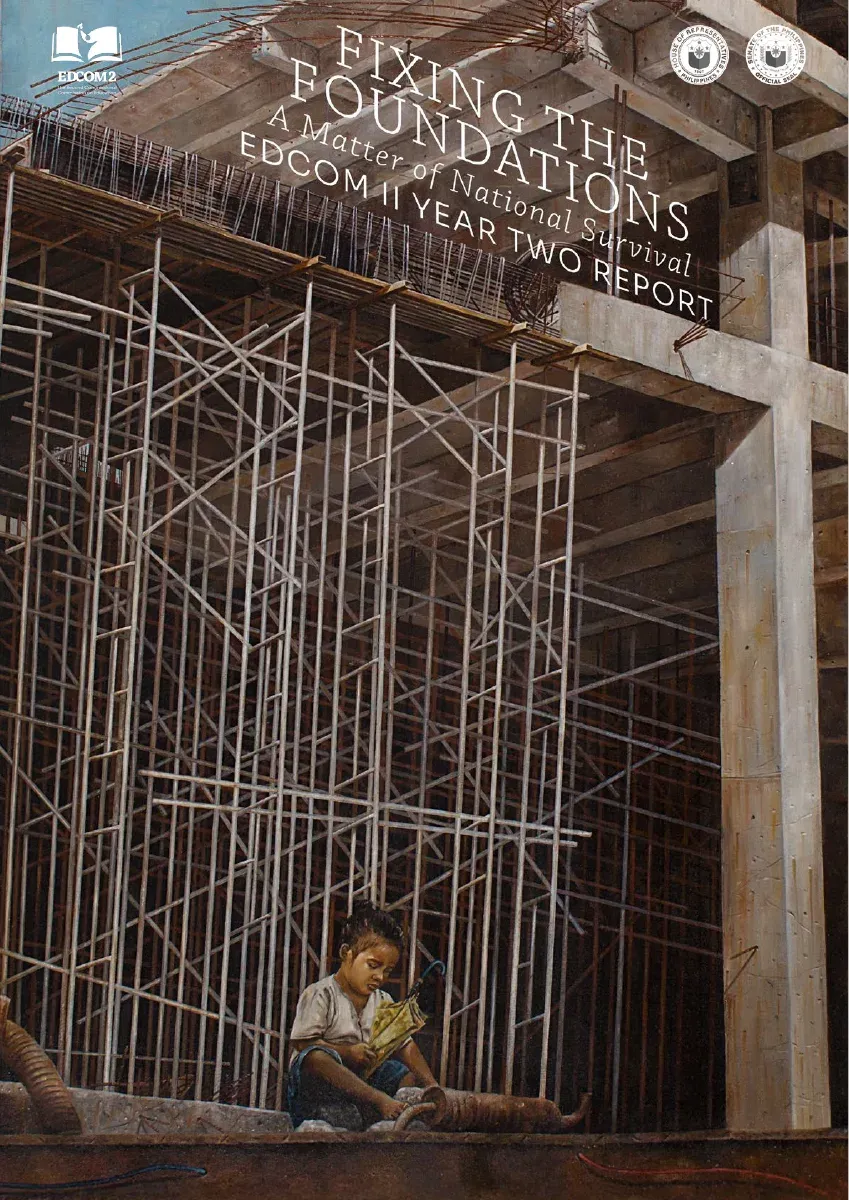
Fixing the Foundations: A Matter of National Survival is the Year Two Report of the Second Congressional Commission on Education (EDCOM II), which Republic Act No. 11899 created to assess Philippine education and recommend reforms. The Commission published it in 2025, on its publications page, as a 395-page PDF. The Download button opens the Commission’s own copy. Its copyright page lets readers quote or reproduce parts of it “for literary or educational research, and for information and advocacy, provided that appropriate citation is made”, but not reproduce or reprint it for commercial purposes.
What the report does
The report narrows the Year One diagnosis to the foundations. Its introduction names three impediments: “We have spread ourselves too thinly”; the system “did not consistently track learning outcomes of students”; and it “lacked the ability to enforce accountability” (p. 42). The Commission pursued 16 of its 28 priority areas in 2024 (p. 42). Each chapter gives “Year One Updates” before a “Year Two Overview”, so the report also tracks what changed after the first.
What is inside
- The preface, executive summary, introduction and priority areas.
- Early childhood care and development: nutrition and feeding, supply-side and demand-side factors, and governance and financing (“Safeguarding the Vital Window”).
- Basic education: school infrastructure, the Alternative Learning System, and the home and school environment, with updates on learning resources, assessment and curriculum (“Starting with the Basics”).
- Higher education: access, quality assurance, digital transformation, graduate education and research, and internationalization (“Access, Equity, and Progress”).
- Teacher education: the alignment of CHED, the PRC and DepEd, preservice education, and in-service training and teacher welfare (“From Classroom to Career”).
- Technical and vocational education and training, and the recognition of nonformal and informal learning.
- Governance and finance: the seamless and integrated delivery of education, the complementarity of public and private education, performance management and accountability, financing, and decentralization.
- The conclusion and references.
Is it still current?
Partly. As of November 8, 2026, it is the second of EDCOM II’s three reports. The Final Report (2026) synthesizes all three years and says it corrects outdated data (p. 54). Some Year Two figures changed in it and some were carried forward unchanged, such as the classroom backlog of 165,443 (an EDCOM II news release of September 23, 2026 puts it at 147,347 as of September 2025); EDCOM II’s three reports compared traces sixteen headline numbers through the three reports.
Why it matters for aspiring school heads
In the Philippine Professional Standards for School Heads (PPSSH, DO 024, s. 2020), reading these reports serves Domain 1, Leading Strategically: strand 1.4 (research and innovation), whose first indicator asks school heads to identify relevant research findings from reliable sources, and strand 1.3 (policy implementation and review). Their findings on learning outcomes also bear on Domain 3, strand 3.4 (learner achievement and other performance indicators).
Its chapters on basic education, teachers and school governance cover the conditions a school head manages: classrooms, school leadership posts, funding and accountability. What EDCOM II achieved, 2023-2025 lists the laws and policies that followed, and the Final Report guide reads the Commission’s last report for school heads.