The School Improvement Plan Instructional Videos are six videos that walk a school through the enhanced SIP process of DepEd Order No. 44, s. 2015, from the preparatory steps to the School Report Card (SRC). The School Effectiveness Division of DepEd’s Bureau of Human Resource and Organizational Development produced them in partnership with UNICEF, and the series closes with the logos of DepEd, UNICEF and CBN Asia. DepEd’s Central Office released them in a memorandum of November 27, 2018, as “reference materials that will facilitate the preparation of the next SIP cycle”, meant to “guide the new school heads who were not included during the first run of training”.
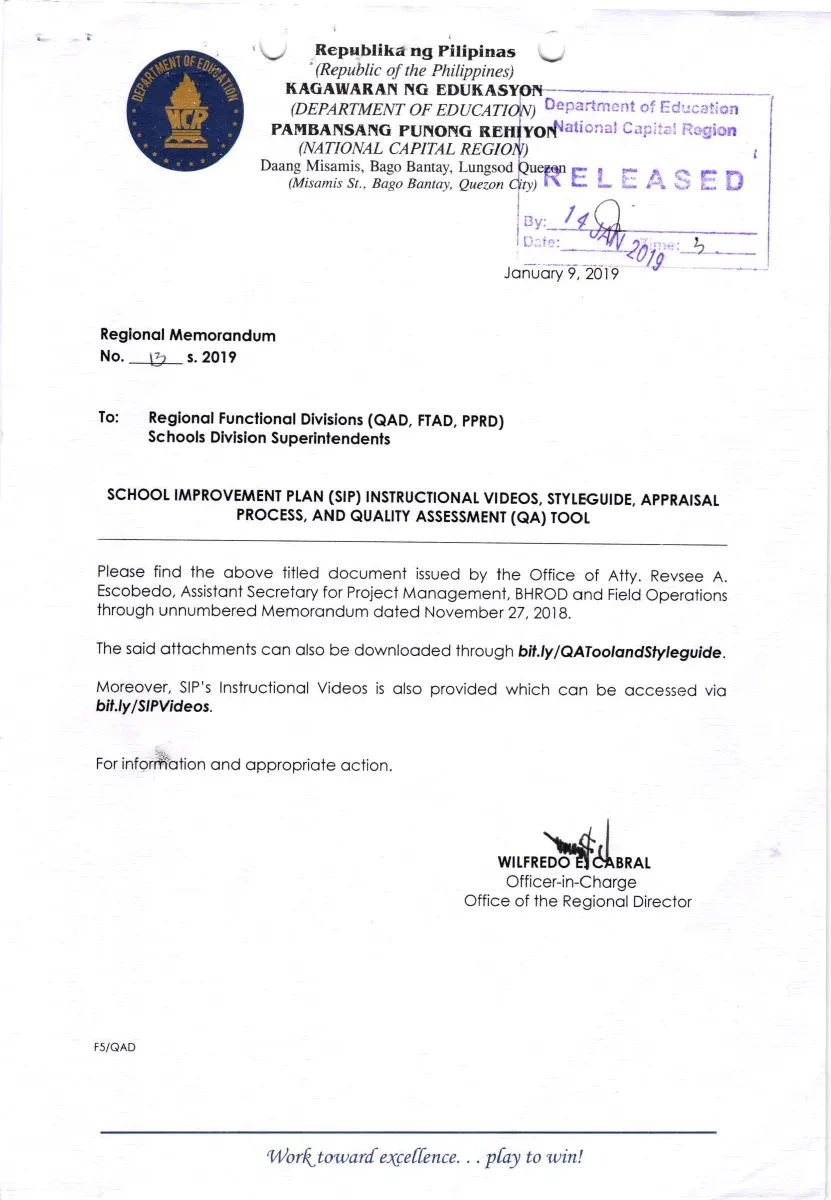
The videos above play from UNICEF Philippines’ YouTube channel, the copies that DepEd’s own page on the videos also plays. They run from 9 to 42 minutes, about two hours in all. The download is the memorandum, as DepEd’s National Capital Region forwarded it in Regional Memorandum No. 13, s. 2019: a 19-page PDF with the regional cover memo, the Central Office memorandum, and the tools released beside the videos (the appraisal process, the QA Tool and the template for writing the SIP).
Are the videos still current?
As of November 8, 2026, DO 44, s. 2015 still governs school improvement planning, and the videos follow its guidebook step by step. Some rules have changed since 2019. The School-Based Management system is now the revised one under DepEd Order No. 007, s. 2024, and the school year runs in three terms under DepEd Order No. 009, s. 2026. The DepEd School Improvement Plan guide has the current rules beside each step.
What the six videos cover
- Opening remarks: a message from then-Secretary Briones, and an introduction to DO 44, s. 2015 from then-Undersecretary Mateo.
- Preparatory phase: an overview of the SIP, its cycle and its principles, then Step 1, preparing for SIP development.
- Assess phase: Steps 2 and 3, the priority improvement areas and their root causes.
- Plan phase: Steps 4 to 8, from solutions and project designs to the SIP and the Annual Implementation Plan (AIP).
- Act phase: Steps 9 and 10, testing and rolling out the solutions, then monitoring their progress (Step 11) and stakeholder participation.
- School Report Card: how the SRC is prepared and presented.
The styleguide in the download and the videos’ own title cards count only the five phase videos: Video 1 is the Preparatory phase and Video 5 the School Report Card.
The Assess phase is the longest, at nearly 42 minutes. Watch it with the guidebook’s Annexes 3 to 8 open, the templates and guidelines its steps use.
Use them with the guidebook and the QA Tool
The videos show the steps; the documents hold the forms. The SIP Guidebook and its annexes give every template the videos refer to, and the SIP Quality Assessment Tool, released in the same memorandum, shows what the division checks when it appraises the finished plan.
Why they matter for aspiring school heads
School improvement planning sits in Domain 1 of the Philippine Professional Standards for School Heads (PPSSH, DO 24, s. 2020), Leading Strategically: strand 1.2 on school planning and implementation, 1.6 on learner voice, and 1.7 on monitoring and evaluation. The SRC video draws on Domain 5, Building Connections: communication (5.4) and community engagement (5.5). Root cause analysis for the SIP works through the Assess phase with an example, and the SIP communication plan covers reporting to stakeholders.