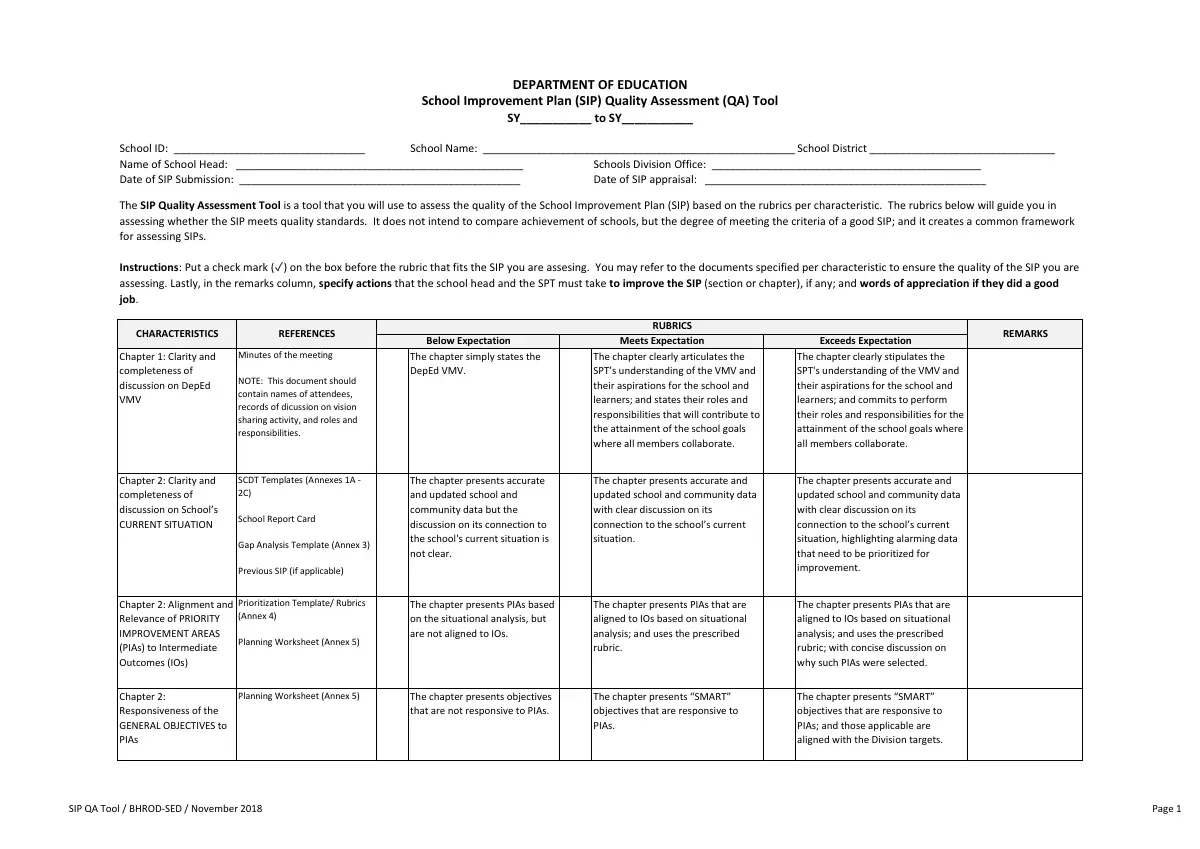
The SIP Quality Assessment (QA) Tool is the rubric a Schools Division Office uses to rate a school’s School Improvement Plan (SIP) before the Schools Division Superintendent approves it. DepEd’s Central Office released it in an unnumbered memorandum of November 27, 2018, from the Assistant Secretary for Project Management, BHROD and Field Operations, together with the appraisal process, a styleguide for writing the SIP, and SIP instructional videos. The Bureau of Human Resource and Organizational Development’s School Effectiveness Division (BHROD-SED) prepared the QA Tool, the appraisal process and the styleguide. DepEd’s National Capital Region forwarded the memorandum and its attachments to its divisions in Regional Memorandum No. 13, s. 2019.
The download holds four files: the QA Tool and the appraisal process as two-page PDFs, the styleguide as a nine-slide PowerPoint, and the design template as a Word file. The ZIP file holds all four.
Is it still current?
As of November 8, 2026, no national issuance has replaced these tools. DepEd Order No. 44, s. 2015, the order they serve, is still in effect. It requires the school to submit the SIP to the division but sets no approval step; these tools supply one. DepEd’s Quality Basic Education Development Plan 2025-2035 also says that “School plans shall be appraised by the SDO”. The memorandum describes the appraisal process as steps “which the SDOs may customize to suit their specific needs”, so ask your division which version it uses.
Two details need care. The design template’s AIP section plans “by Fiscal Year (Quarters 1 to 4) plus additional Quarter 1 of the following year”, so that January to March activities are covered; DepEd Order No. 008, s. 2019, the order on school MOOE, still has the AIP “follow the calendar year format (Annex 1)”. And the template’s list of acronyms expands SIP as “School Improvement Program”; write School Improvement Plan.
What is inside
- The QA Tool. Nine characteristics across the SIP’s four chapters, each rated Below, Meets or Exceeds Expectation, with the documents the appraiser may check and a remarks column. It “does not intend to compare achievement of schools, but the degree of meeting the criteria of a good SIP”.
- The appraisal process. The Division Appraisal Committee, of at least seven members and always an odd number; what it checks; how it returns a plan for revision; and the SDS’s approval and Certificate of Acceptance, with a one-page flowchart.
- The styleguide. The parts of the SIP document: a title page, an optional message, a table of contents, four chapters (DepEd VMV; Assess; Plan; Monitoring and Evaluation), a list of acronyms, and a list of tables and illustrations, with the content each chapter needs and suggested page counts for the first two chapters.
- The design template. The same layout as a Word document to write in, with a “Content Check” box for each chapter and a sample Certificate of Acceptance.
When each file is used
| File | Who uses it | When |
|---|---|---|
| SIP QA Tool | The Division Appraisal Committee; the school head and School-Community Planning Team (SPT) as a self-check | Before submitting the SIP, and at the division’s appraisal |
| Appraisal of the School Improvement Plan | The division, to set up the committee and its steps; the school, to know what follows submission | When the SIP is submitted |
| The SIP Styleguide | The school head, to brief the SPT on the document’s parts | When the SPT starts writing the SIP (Step 7 of the SIP Guidebook) |
| Design template | The SPT member who compiles the SIP | While writing the SIP |
The tools refer to the SIP Guidebook’s annexes throughout, such as the Planning Worksheet (Annex 5), the root cause analysis overview (Annex 8) and the AIP template (Annex 10). The SIP Guidebook and its annexes are a separate download.
Why it matters for aspiring school heads
Writing a SIP that passes appraisal is work under Domain 1 of the Philippine Professional Standards for School Heads (PPSSH, DO 24, s. 2020), Leading Strategically: strand 1.2 on school planning and implementation and strand 1.7 on monitoring and evaluation processes and tools. The QA Tool shows, chapter by chapter, what the division will look for, from evidence of the root cause analysis to an AIP aligned with the school head’s OPCRF.
The DepEd School Improvement Plan guide explains the appraisal and sets out all nine criteria as a self-check table. Root cause analysis for the SIP shows how to keep the evidence the QA Tool asks for, and the strategic leadership guide places the SIP among a school head’s other plans.