A DepEd school head leads strategically by setting the school’s direction within national policy and turning that direction into a School Improvement Plan (SIP) that the school community writes, funds and carries out. Republic Act No. 9155, the Governance of Basic Education Act of 2001, gives school heads authority, accountability and responsibility for “Setting the mission, vision, goals and objectives of the school” and “Developing the school education program and school improvement plan”, all “Consistent with the national educational policies, plans and standards” (Sec. 7(E)). DepEd Order No. 44, s. 2015 still sets how the SIP is made as of November 8, 2026.
The work runs in one line. A school head reads the laws and issuances that govern the school, adapts them to the school’s learners and community without breaking them, reads the school’s culture and climate, reviews the plan the school already has, builds the next one with the people it serves, and tells them, plainly and often, what the plan is and how it is going. Each of those steps has its own rules, and many of them changed between 2024 and 2026.
Domain 1 of the Philippine Professional Standards for School Heads (PPSSH), Leading Strategically, names this work. PPSSH Domain 1 for the NASH: Leading Strategically reads each strand with DepEd’s public data.
Key findings
- The school head plans within national policy, not apart from it. RA 9155 gives the school head twelve areas of authority, including the SIP, “Consistent with the national educational policies, plans and standards” (Sec. 7(E)), and has the field offices (regions, divisions, schools and learning centers) translate policy into programs “developed, adapted and offered to fit local needs” (Sec. 2).
- Issuances bind at different strengths. A DepEd Order “contains policies promulgated by the Central Office, which are general or permanent in nature”; a DepEd Memorandum “disseminates instructions, information, or related matters”; an advisory announces partners’ activities that people attend “on a voluntary basis” (DepEd Manual of Style, Appendix 5). Administrative and executive orders and regulations are valid “only when they are not contrary to the laws or the Constitution” (Civil Code, Art. 7).
- The Child Protection Policy still stands. DepEd Order No. 40, s. 2012 remains in force. DepEd Order No. 006, s. 2026 “does not amend or repeal” it; it supplements and harmonizes it, and requires every public school to adopt a localized anti-bullying policy submitted to the Schools Division Office (SDO) (Secs. III and VI.A.3).
- The SIP is the plan the other plans hang on. DO 44, s. 2015 makes the SIP “the basis for the school’s Annual Implementation Plan (AIP) and other specific plans such as the Child Protection plan, Disaster Risk Reduction Management (DRRM) plan, and Learning Action Cell (LAC) action plan” (Encl., Sec. V.A). School MOOE, the Special Education Fund and, for recipient schools, the 2026 School Innovation and Improvement Fund pay for activities in the approved SIP (DO 008, s. 2019, Sec. V.D; Joint Circular No. 01, s. 2025, Sec. 6.3.1; DM 048, s. 2026, Encl., Sec. III.1).
- DO 44, s. 2015 still governs the SIP. The SIP covers three school years in three phases, Assess, Plan and Act, and is signed by all members of a School-Community Planning Team of at least seven. Its months still fit: the year it was issued, SY 2015-2016, ran from June 1, 2015 to April 1, 2016 (DepEd Order No. 9, s. 2015, para. 2), and School Year (SY) 2026-2027 runs from June 8, 2026 to April 8, 2027 under DepEd Order No. 009, s. 2026 (para. 4). What changed is the structure: plans written in quarters and grading periods now need terms.
- Self-assessment feeds the plan. Under DepEd Order No. 007, s. 2024, the school integrates its School-Based Management (SBM) self-assessment results into its strategic and implementation plans, and the school head’s role as SBM coordinator “shall not be delegated nor reassigned” (Encl., Secs. V.D.2 and V.F.1).
- Communicating the plan has rules too. The School Report Card (SRC) is presented at least twice a year (DO 44, s. 2015, Encl., Sec. V.B.3). The school head approves what the school posts online, and learners’ personal information may not go on the school’s social media without explicit consent (DepEd Order No. 007, s. 2026, Sec. V.B.1.c; DepEd Order No. 017, s. 2025, Sec. X.C).
What leading strategically means for a DepEd school head
What RA 9155 asks of the school head
RA 9155 makes the school the center of the system: “The school shall be the heart of the formal education system. It is where children learn” (Sec. 2). It defines the school head as “a person responsible for the administrative and instructional supervision of the school or cluster of schools” (Sec. 4(m)), and it adds that the school head “shall be both an instructional leader and administrative manager” (Sec. 7(E)).
Sec. 7(E) then lists twelve areas of authority. Six of them are strategic in the plain sense, because they set direction rather than run the day:
| RA 9155, Sec. 7(E) | What it means in strategic work |
|---|---|
| (1) “Setting the mission, vision, goals and objectives of the school” | The school adopts DepEd’s vision, mission and core values; DepEd Order No. 36, s. 2013 says “the official DepEd VMV shall be the only vision, mission, and core values adopted by all offices and schools” (para. 2). The school sets its own goals and objectives under it. |
| (2) “Creating an environment within the school that is conducive to teaching and learning” | Culture and climate, child protection, safety |
| (4) “Developing the school education program and school improvement plan” | The SIP and the AIP |
| (5) “Offering educational programs, projects and services which provide equitable opportunities for all learners in the community” | Programs designed from the school’s own learner data |
| (6) “Introducing new and innovative modes of instruction to achieve higher learning outcomes” | Projects tested in the SIP’s Act phase |
| (10) “Establishing school and community networks and encouraging the active participation of teachers organizations, nonacademic personnel of public schools, and parents-teachers-community associations” | The planning team, the School Governance Council (SGC), the Parent-Teacher Association (PTA), partners |
All twelve, with what each means in current policy, are explained in RA 9155 Duties of DepEd School Heads. Why the shared governance the law promised has moved slowly is in RA 9155 at 25.
Two phrases in the law frame everything that follows. The school head’s authority is exercised “Consistent with the national educational policies, plans and standards” (Sec. 7(E)), and the same words open the regional director’s and the schools division superintendent’s lists (Sec. 7(B) and (C)). And the field offices are where “the policy and principle for the governance of basic education shall be translated into programs, projects and services developed, adapted and offered to fit local needs” (Sec. 2). Strategic leadership in a public school lives between those two lines: national rules, local fit.
PPSSH Domain 1 at Career Stages 1 and 2
The PPSSH, adopted by DepEd Order No. 024, s. 2020, says Domain 1 “highlights the role of school heads in setting the direction, goals, and objectives of schools, and in ensuring that these are understood and embraced by all stakeholders”. School heads in this domain “are expected to identify and comprehend relevant sources of information such as existing laws, policies, research, feedback and contexts, and establish their connections and alignment.”
Career Stage 1 describes aspiring school heads, who show knowledge and understanding. Career Stage 2 describes school heads who apply that knowledge on their own. The indicators, verbatim:
| Strand | Career Stage 1 | Career Stage 2 |
|---|---|---|
| 1.1 Vision, mission and core values | 1.1.1 Demonstrate knowledge of the DepEd vision, mission and core values to foster shared understanding and alignment of school policies, programs, projects and activities. | 1.1.2 Communicate the DepEd vision, mission and core values to the wider school community to ensure shared understanding and alignment of school policies, programs, projects and activities. |
| 1.2 School planning and implementation | 1.2.1 Demonstrate knowledge and understanding of the phases of development and implementation of school plans aligned with institutional goals and policies. | 1.2.2 Develop and implement with the planning team school plans aligned with institutional goals and policies. |
| 1.3 Policy implementation and review | 1.3.1 Demonstrate knowledge and understanding of policy implementation and review to ensure that school operations are consistent with national and local laws, regulations and issuances. | 1.3.2 Undertake policy implementation and review in the school to ensure that operations are consistent with national and local laws, regulations and issuances. |
| 1.4 Research and innovation | 1.4.1 Identify relevant research findings from reliable sources in facilitating data-driven and evidence-based innovations to improve school performance. | 1.4.2 Utilize relevant research findings from reliable sources in facilitating data-driven and evidence-based innovations to improve school performance. |
| 1.5 Program design and implementation | 1.5.1 Display understanding of the implementation of programs in the school that support the development of learners. | 1.5.2 Implement programs in the school that support the development of learners. |
| 1.6 Learner voice | 1.6.1 Demonstrate knowledge and understanding of utilizing learner voice to inform policy development and decision-making towards school improvement. | 1.6.2 Utilize learner voice, such as feelings, views and/ or opinions to inform policy development and decision-making towards school improvement. |
| 1.7 Monitoring and evaluation processes and tools | 1.7.1 Display knowledge and understanding of monitoring and evaluation processes and tools to promote learner achievement. | 1.7.2 Utilize available monitoring and evaluation processes and tools to promote learner achievement. |
Read the two columns side by side and the shift is in the verbs: “demonstrate knowledge” becomes “develop and implement with the planning team” and “undertake policy implementation and review”. Strategic leadership in practice is the second column. The full standards are in PPSSH Domains, Strands and Indicators.
How Domain 1 connects with Domains 2 and 5
A strategy that no one funds, staffs or keeps safe is a document, and a strategy the community does not know is not shared. That is why Domain 1 leans on two other domains:
| Domain | Strands that carry the plan | Where they meet the SIP |
|---|---|---|
| 2, Managing School Operations and Resources | 2.1 Records management; 2.2 Financial management; 2.3 School facilities and equipment; 2.4 Management of staff; 2.5 School safety for disaster preparedness, mitigation and resiliency; 2.6 Emerging opportunities and challenges | The SIP’s projects need funds, records, rooms and people. Indicator 2.5.2 asks the school head to “Manage school safety for disaster preparedness, mitigation and resiliency to ensure continuous delivery of instruction,” which is the DRRM and learning continuity content every SIP carries. |
| 5, Building Connections | 5.1 Management of diverse relationships; 5.2 Management of school organizations; 5.3 Inclusive practice; 5.4 Communication; 5.5 Community engagement | The planning team, the SGC, the PTA and partners make the plan; indicator 5.4.2 asks the school head to “Communicate effectively in speaking and in writing to teachers, learners, parents and other stakeholders” and indicator 5.5.2 to “Initiate partnerships with the community”. |
PPSSH Domain 2 and PPSSH Domain 5 cover those domains strand by strand. The operations behind a plan (funds, procurement, records, staff) are set out in DepEd School Operations: Funds, Procurement, Records, HR.
How to read a DepEd order, memorandum and law
Which issuances bind what
A school receives a stream of documents: laws, executive orders, DepEd Orders, DepEd Memoranda, regional and division memoranda, advisories. They do not carry the same weight. The DepEd Manual of Style (DMOS), adopted by DepEd Order No. 030, s. 2019, defines DepEd’s own issuances in its Appendix 5, and the Civil Code and RA 9155 place them under the law.
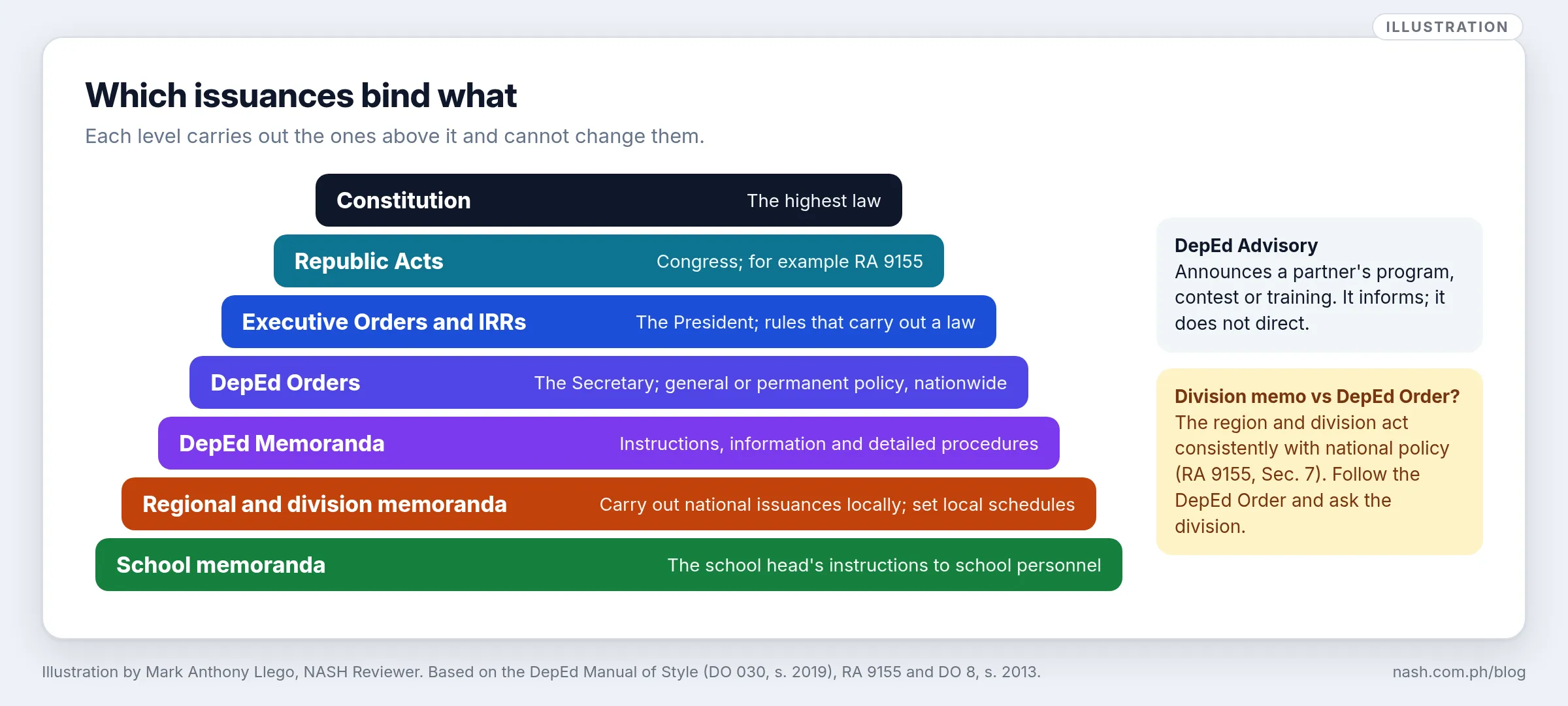
| Document | Who issues it | What it does | How far it reaches |
|---|---|---|---|
| Constitution | The people | The highest law | Every law, order and memorandum must conform to it. |
| Republic Act | Congress, then the President’s approval (or it lapses into law) | Sets policy, rights and duties, as RA 9155 does for school governance | Binds everyone. DepEd issuances implement it and cannot contradict it: “Administrative or executive acts, orders and regulations shall be valid only when they are not contrary to the laws or the Constitution” (Civil Code, Art. 7). |
| Executive Order | The President | Directs the executive branch, as Executive Order No. 130, s. 2026 does for class suspensions | Binds executive agencies, DepEd included, within the law. EO 130 also covers private schools (Sec. 4). |
| Implementing rules and regulations (IRR) | The agencies the law names | Details how a law is carried out | Valid only within the law it implements. |
| DepEd Order (DO) | The Secretary, “as the alter ego of the President” | “policies promulgated by the Central Office, which are general or permanent in nature” | “department-wide or nationwide in scope, and is usually long-term in nature unless rescinded or amended by another DO” (DMOS, Appendix 5). |
| DepEd Memorandum (DM) | The Secretary, or by delegation the Undersecretary of a strand | “disseminates instructions, information, or related matters”; “may provide the detailed procedures for implementing established laws or policies” | Those it is addressed to. A memorandum carries out policy; it does not replace an order. |
| Office orders and office memoranda | A Central Office bureau or unit | Instructions within the Central Office | Central Office officials and staff (DMOS, Appendix 5). |
| Unnumbered memoranda and memoranda with limited application | An Undersecretary, an Assistant Secretary or an office head | Instructions from one strand or office. Some reach every school, such as the 2024 supplemental guidelines on the Child Protection Policy, coded by the issuing office as DM-OUOPS-2024-05-07998; a memorandum with limited application is “limited only to regions or offices” (DMOS, Appendix 5). | The offices and schools named. |
| Regional and division memoranda | The Regional Director; the Schools Division Superintendent (SDS) | Implement national issuances in the region or division and set local schedules | Schools in the region or division. Both offices act “Consistent with the national educational policies, plans and standards” (RA 9155, Sec. 7(B) and (C)). |
| School memorandum | The school head | Internal instructions to school personnel | The school’s personnel. |
| DepEd Advisory | DepEd, at a partner’s request, under DepEd Order No. 8, s. 2013 | Announces a partner’s program, contest, training or scholarship | Binds no one. Participation is voluntary, “hence, traveling expenses and registration fees are charged to personal accounts” (DMOS, Appendix 5), and the advisory states it is issued “not for endorsement” but “only for the information” of DepEd personnel and the public. |
No issuance ranks regional and division memoranda against a DepEd Order in so many words. It follows from RA 9155, Sec. 7: a region or division acting consistently with national policy implements a DepEd Order; it cannot change it. When a division memorandum seems to differ from an order, write to the SDO, keep the reply, and follow the order until the SDO clarifies.
The parts of a Republic Act
RA 9155 is a short, clear model of how a law is built:
| Part | In RA 9155 | What to read it for |
|---|---|---|
| Title and enacting clause | “An Act Instituting a Framework of Governance for Basic Education …”; “Be it enacted by the Senate and the House of Representatives” | What the law covers |
| Short title | Sec. 1, “Governance of Basic Education Act of 2001” | How to cite it |
| Declaration of policy | Sec. 2 | The State’s purpose; the standard for reading the rest |
| Purposes and objectives | Sec. 3 | What the law is meant to achieve |
| Definitions | Sec. 4 (school head, school, learner, cluster) | The exact meaning of words used later |
| Operative provisions | Secs. 5 to 13 (shared governance, the powers of each level, resources, personnel) | The rules themselves |
| Rules and regulations | Sec. 14: the Secretary issues the IRR within ninety days | Where the details are (the IRR is DepEd Order No. 1, s. 2003) |
| Separability clause | Sec. 15 | If one part is struck down, the rest stands |
| Repealing clause | Sec. 16: inconsistent laws and rules “are hereby repealed or modified accordingly” | What the law displaced |
| Effectivity clause | Sec. 17: fifteen days after publication in at least two newspapers of general circulation | When it began to bind |
A “Whereas” clause or a declaration of policy explains; the operative sections rule. When a reader is unsure what a section means, the declaration of policy and the definitions are the first places to look.
The parts of a DepEd Order
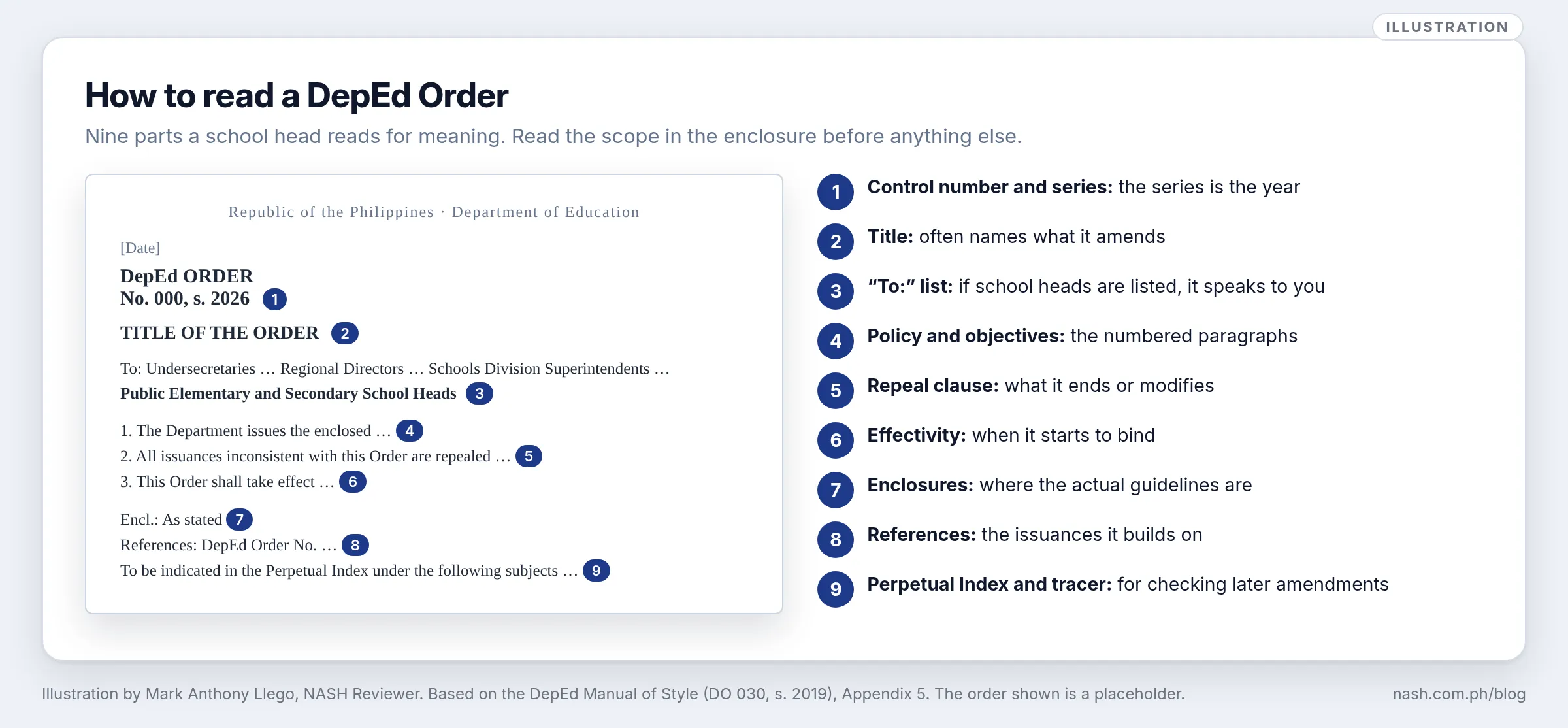
The DMOS lists 16 elements of a DepEd Order (Appendix 5). The ones a school head reads for meaning are these:
- Date and control number with series, as in “No. 007, s. 2024”. The series is the year.
- Title, which often names what the order amends (“Amendment to DepEd Order No. 017, s. 2024” is the title of DepEd Order No. 004, s. 2026).
- “To:” list, the offices and people the order addresses. “Public Elementary and Secondary School Heads” on the list means the order speaks to you.
- Statement of the policy and its objectives, in the numbered paragraphs of the cover order.
- Statement on what it repeals, rescinds or modifies.
- Statement of publication and effectivity.
- Enclosures, which hold the actual guidelines.
- References, the earlier issuances it builds on or repeals.
- Perpetual Index subjects and the tracer, which the DMOS says is used “for checking whether the approved DepEd regulation/issuance has been amended or rescinded.”
The enclosed policy guidelines follow the structure the DMOS takes from DepEd Order No. 13, s. 2015: I. Rationale; II. Scope; III. Definition of Terms; IV. Policy Statement; V. Procedures; VI. Monitoring and Evaluation; VII. References; VIII. Effectivity or Transitory Provision. DO 007, s. 2024 follows the same order, folding monitoring, the repealing clause, effectivity and references into Section V (V.G to V.J): the cover order repeals DepEd Order No. 83, s. 2012 by name (para. 3), sets effectivity fifteen days after publication (para. 4), and the enclosure’s Section V holds the procedures and Section V.I a three-year transitory period.
Read the scope before anything else. DO 006, s. 2026 “applies to all public schools and CLCs,” while private schools “are highly encouraged to adopt this Order” (Sec. III). A rule read without its scope is easily applied to the wrong school.
The parts of a DepEd Memorandum, an advisory, and regional and division memoranda
A DepEd Memorandum has 17 elements in the DMOS, built around an activity rather than a policy: a statement of the activity, its objectives, the target participants and the contact details of the proponent (Appendix 5). Many memoranda are signed “By Authority of the Secretary” by an Undersecretary. DepEd Memorandum No. 048, s. 2026, on the School Innovation and Improvement Fund, is signed that way by the Undersecretary and Chief of Staff, and ends “Immediate dissemination of this Memorandum is desired.”
An advisory, as the table shows, binds no one: it is not an instruction to join an activity, collect fees or release teachers from class.
Regional and division memoranda follow the same frame under their own letterheads and numbers (for example, “Regional Memorandum No. 301, s. 2023”). They usually tell schools how and when to carry out a national issuance in the region or division: a deadline, a template, a training schedule. Read them with the national issuance they cite open beside them.
When an issuance takes effect: publication and the ONAR
Laws take effect “after fifteen days following the completion of their publication either in the Official Gazette or in a newspaper of general circulation in the Philippines, unless it is otherwise provided” (Executive Order No. 200, s. 1987, Sec. 1, which amended Art. 2 of the Civil Code). In Tañada v. Tuvera (G.R. No. L-63915, December 29, 1986, resolution of the full Court), the Supreme Court held that “all statutes, including those of local application and private laws, shall be published as a condition for their effectivity,” and that administrative rules must also be published “if their purpose is to enforce or implement existing law.” It added that “Interpretative regulations and those merely internal in nature, that is, regulating only the personnel of the administrative agency and not the public, need not be published.”
The Administrative Code of 1987 adds a filing rule for agency rules: “Every agency shall file with the University of the Philippines Law Center three (3) certified copies” of every rule it adopts, and each rule “shall become effective fifteen (15) days from the date of filing” unless a different date is fixed by law, or specified in the rule in cases of imminent danger to public health, safety and welfare (Book VII, Chapter 2, Secs. 3 and 4). That office is the Office of the National Administrative Register (ONAR), which is why DepEd Orders end with a sentence about registering certified copies there.
Each order states its own effectivity, and they differ. Read the clause every time:
| Order | Its effectivity clause |
|---|---|
| DO 44, s. 2015 (SIP) | “fifteen (15) days after its publication in the Office of the National Administrative Register (ONAR)” (Encl., Sec. X) |
| DO 007, s. 2024 (SBM) | “fifteen (15) days after its publication in the Official Gazette or a newspaper of general circulation” (Encl., Sec. V.I) |
| DO 006, s. 2026 (safe learning environment) | “upon its approval, issuance, and 15 days after its publication in the Official Gazette or in a newspaper of general circulation and after its publication on the DepEd website” (para. 4) |
| DepEd Order No. 002, s. 2026 (wellness leave) | “immediately upon its approval, issuance, and publication on the DepEd website” (para. 5) |
How amendments, repeals and transitory clauses work
Laws “are repealed only by subsequent ones, and their violation or non-observance shall not be excused by disuse, or custom or practice to the contrary” (Civil Code, Art. 7), and they “shall have no retroactive effect, unless the contrary is provided” (Art. 4). DepEd issuances change in four ways, and a school head should recognize each:
| How it changes | Example |
|---|---|
| Express repeal: the new order names what it ends. | DO 007, s. 2024 repeals DO 83, s. 2012 on the old SBM framework (para. 3). DO 009, s. 2026 “expressly repeals” DepEd Order No. 012, s. 2025, the earlier calendar order, “in its entirety” (para. 5). |
| Express amendment of part of an order | DO 009, s. 2026 “amends the transfer and enrollment provisions in DO 017, s. 2025” (para. 5). DepEd Order No. 014, s. 2026 “effectively updates the provisions on choosing learning experiences during emergencies” in Annex B of DepEd Order No. 022, s. 2024 (para. 103), without repealing the rest of that order. |
| General repealing clause: “All other issuances … inconsistent with this Order are repealed, rescinded, or modified accordingly.” | Almost every order has one (DO 014, s. 2026, para. 105). It repeals only what truly conflicts, so the reader has to compare the texts. |
| Supplement without amendment | DO 006, s. 2026 lists DO 40, s. 2012 among the issuances it governs and says it “serves as a general guideline and does not amend or repeal the above issuances. Its purpose is to supplement, harmonize, and clarify existing instructions and procedures” (Sec. III). |
A transitory provision gives time to change over. DO 007, s. 2024 gave schools, SDOs and regional offices “a three-year transitory period” to familiarize themselves with the revised SBM (Encl., Sec. V.I). DO 44, s. 2015 had every school begin a new SIP cycle “starting January 2016” (Encl., Sec. VIII). A rule still in its transition may apply only in part; the transitory clause says which part.
How to cite DepEd orders, memoranda and laws
Inside DepEd documents, the DMOS sets the form (rules 16 to 18):
-
First mention, in full: “DepEd Order No. 8, s. 2013”; “Republic Act No. 10533, s. 2013”.
-
After that, short: “DO 8, s. 2013”; “RA 10533, s. 2013”. Republic Act, administrative order and executive order become RA, AO and EO, without periods.
-
In a references line, a colon before several numbers: “DepEd Memorandum: Nos. 63, 68, and 93, s. 2016” (rule 124). Two practices make a citation checkable:
-
Use one form of the number throughout a document: DepEd prints recent numbers with zeros (DO 007, s. 2024) and older ones without (DO 44, s. 2015).
-
Cite the section, paragraph or item, not only the order: “DO 44, s. 2015, Encl., Sec. V.A”. A rule cited without its section cannot be checked.
For action research and other papers, DepEd does not require APA by name, but APA 7 is the usual style. The format and examples are in How to Cite DepEd Orders in APA 7. The DMOS as a whole is explained in DepEd Manual of Style (DMOS): A Guide for School Heads.
How to find the current version of a rule
Older reviewers and seminar slides often still cite rules that have been replaced. Before acting on any rule:
- Open the issuance itself on deped.gov.ph and read it in full, enclosures and annexes included. A summary, a slide deck or a social media post interprets an issuance; it is not the issuance.
- Read its own clauses: scope, repealing clause, effectivity and transitory provisions.
- Search for later issuances on the same subject, and for the number in every form it is cited (“DepEd Order No. 40, s. 2012”, “DO 40, s. 2012”, “DO No. 40”). Later orders name what they amend in their titles and in their references.
- Read the newest order’s scope list. DO 006, s. 2026, for example, lists the ten issuances it governs, from DO 40, s. 2012 to the IRR of the Anti-Bullying Act (Sec. III).
- Check whether a law, an executive order or a Civil Service Commission rule now governs the point. Executive Order No. 130, s. 2026 amended Executive Order No. 66, s. 2012 “insofar as the suspension of in-person classes and activities, and onsite work in educational institutions and learning centers is concerned” (Sec. 11). Where a statute speaks, it governs.
- Ask in writing when two texts conflict, and keep the reply. Until it comes, follow the course that satisfies both texts where one exists.
How to contextualize national and local policies for one school
Contextualizing a policy means fitting how it is carried out to one school’s learners and community while keeping every requirement it sets. RA 9155 expects it: programs are “developed, adapted and offered to fit local needs” (Sec. 2). DO 44, s. 2015 builds it into planning: the SDO gives schools “copies of their division plans to guide the schools in objectives and targets setting,” and regional offices “contextualize this policy in their own regions” (Encl., Sec. VI). Every SIP “must contribute to the attainment of the goals of the Division Education Development Plan (DEDP)” (Encl., Sec. V.A).
Separate what is fixed from what the school decides
Every issuance has parts a school must follow as written and parts it leaves to the school. Read for the difference:
| Fixed by the issuance | Left to the school |
|---|---|
| Every public school “shall adopt a localized antibullying policy reflecting learners’ and community needs, submitted to the Schools Division Office (SDO), and integrated into the Learner Handbook” (DO 006, s. 2026, Sec. VI.A.3). | The school may use DepEd’s template “and adopt it in full or in part, as appropriate to their operations” (same section). |
| The Learning and Service Continuity Plan (LSCP) “is to be developed annually before the beginning of each school year, and shall be updated every term” (DO 014, s. 2026, para. 25). | Which community representatives join the personnel, learners and parents the order names: for example, “IP community elders with local knowledge about the pattern of disasters in the area and safe areas for evacuation” (para. 26). |
| The school DRRM coordinator “shall be different from the School Head” (DepEd Order No. 033, s. 2021, para. 13). | Which hazards the school drills for: “quarterly multi-hazard drills applicable to the school’s identified hazards” (para. 20(n)). |
| DepEd’s Standardized Code of Conduct, to be developed by BLSS and BHROD (DO 006, s. 2026, Secs. VI.A.2 and IX.A); as of November 8, 2026, it had not been issued. | Once issued, “Schools may adapt it to local contexts while maintaining alignment with DepEd policies” (Sec. VI.A.2). Until then, the school’s code is the one its Child Protection Committee drafts (DO 40, s. 2012, Sec. 10(B)). |
The general rule for contextualizing curriculum, the closest and best-developed case, is in DepEd Contextualization, Localization and Indigenization: keep the standards and competencies; adapt the examples, materials, strategies and settings.
Work with the Local School Board and the barangay
Local governments are partners in the plan, and the law gives them a formal place. Under the Local Government Code, Republic Act No. 7160, every province, city and municipality has a local school board, co-chaired by the governor or mayor and, respectively, the division superintendent, the city superintendent or the district supervisor of schools (Sec. 98). The board determines the supplementary budget needs of public schools and authorizes the treasurer to disburse the Special Education Fund (SEF) (Sec. 99), and meets at least once a month (Sec. 100). The school head is not a member, so the school’s case reaches the board through its plan and its reports.
The SEF rules make that link explicit. The DepEd-DBM-DILG-DOF Joint Circular No. 01, s. 2025 requires the board’s six-year SEF Investment Program to be “aligned and complementary with the current School Improvement Plan (SIP) and Division Education Development Plan (DEDP)” (Sec. 6.2), and every SEF budget item to be “contained in the approved SIP and DEDP” (Sec. 6.3.1). The board considers “The report of the school heads on the state of education at the start of every school year, which will provide an annual progress report on the SIP” (Sec. 6.4.2), and schools send funding requests for the next year “Not later than August 31” (Sec. 6.8). A project missing from the SIP has no path to SEF money. Local School Boards and the Special Education Fund covers the board and the fund in full.
The barangay sits inside the school’s own structures. The School-Community Planning Team includes a barangay or LGU representative and a member of the Barangay Disaster Risk Reduction and Management Council (SIP Guidebook, Activity 1.2), and the Child Protection Committee includes a community representative “as designated by the Punong Barangay, preferably a member of the Barangay Council for the Protection of Children (BCPC)” (DO 40, s. 2012, Sec. 10(A)).
When national and local decisions meet
Class suspensions show how national and local authority now fit together. EO 130, s. 2026, signed October 28, 2026, sets three ways to suspend in-person classes: automatic suspension when a warning meets set thresholds, suspension by the local chief executive, and a school’s own “granular” suspension, declared “in coordination with the concerned LCE” (Sec. 4). It also states that “The suspension of in-person classes shall not automatically suspend learning” (Sec. 3). DepEd and other agencies were given thirty days to issue implementing guidelines (Sec. 7); until those come out, School DRRM and Class Suspensions sets out which rules apply.
When an ordinance or a request from the local government seems to collide with a DepEd issuance, the safe course is the same as for a division memorandum: put the question to the SDS in writing, coordinate with the local official, and record both.
A six-step routine for any new issuance
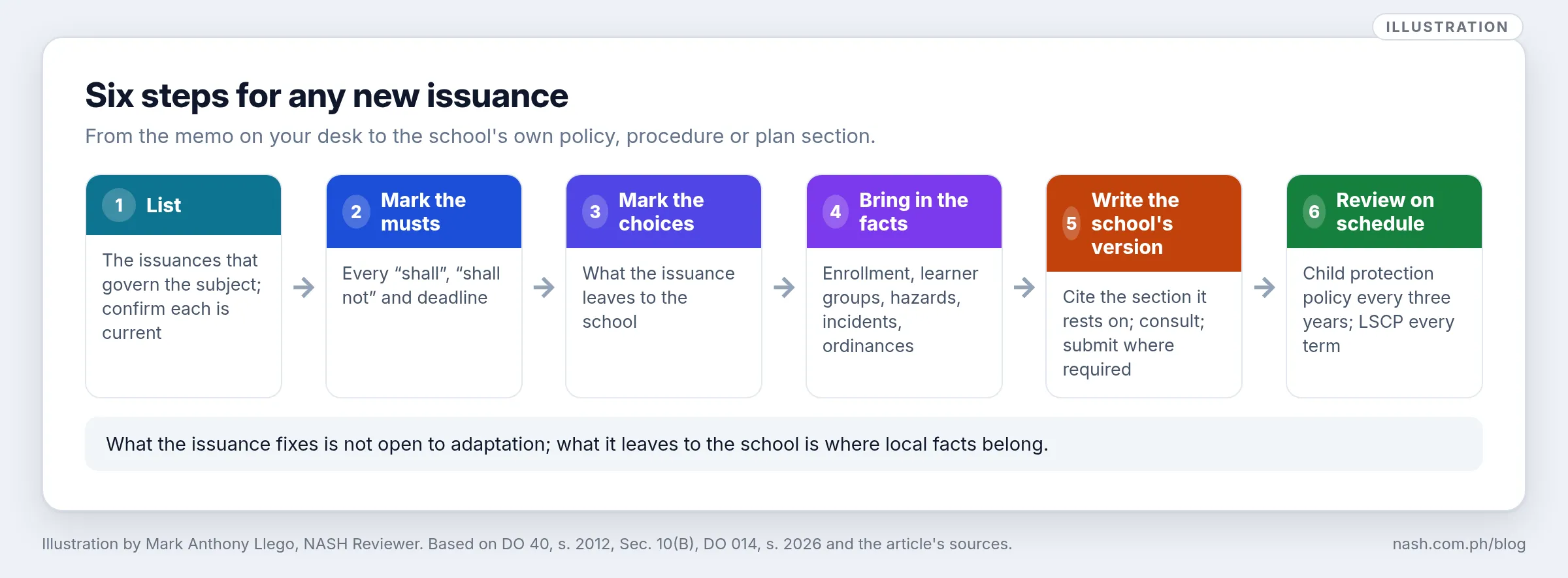
- List the issuances that govern the subject, and confirm each is current (the steps in the previous section).
- Mark every “shall”, “shall not” and deadline. These are not open to adaptation.
- Mark what the issuance leaves to the school: templates “in full or in part”, choices of members, schedules, local hazards.
- Bring in the school’s facts: enrollment, learner groups (Indigenous Peoples, ALIVE, learners with disabilities), hazard map, incident records, community resources, local ordinances.
- Write the school’s version (a policy, a standard operating procedure, a plan section), cite the issuance and section it rests on, consult the people it affects, and submit it where the issuance says to.
- Review it on its schedule. The child protection policy and code of conduct “shall be reviewed every three (3) years” (DO 40, s. 2012, Sec. 10(B)); the LSCP is updated every term.
Policies every school plan must reflect in 2026
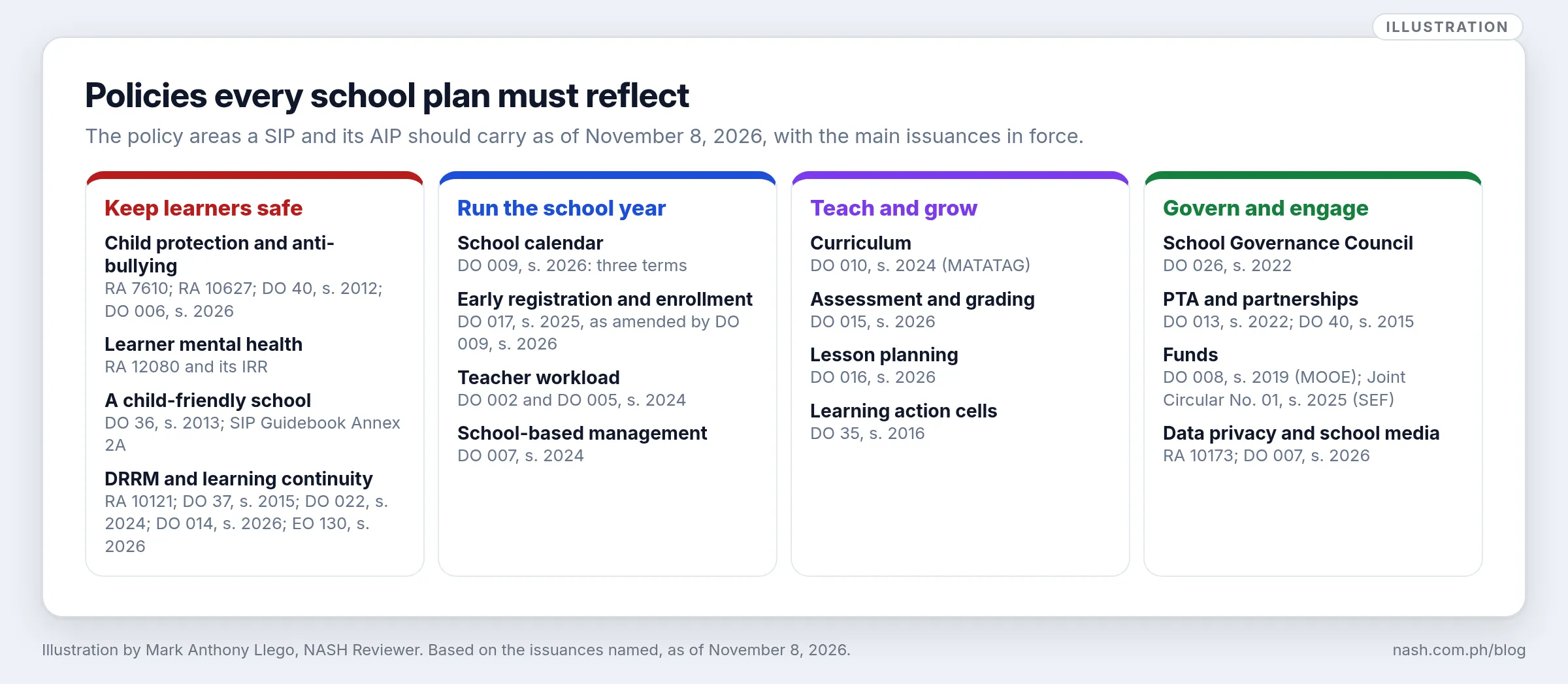
The checklist below lists the policy areas a SIP and its AIP should carry as of November 8, 2026, the issuances in force for each, and where each shows up in the plan. Most rows link to a full guide.
| Policy area | Issuances in force | What the school head must do | Where it shows in the SIP and AIP |
|---|---|---|---|
| Child protection and anti-bullying | Republic Act No. 7610; Republic Act No. 10627 and its revised IRR, disseminated by DepEd Memorandum No. 090, s. 2025; DO 40, s. 2012; DO 006, s. 2026; DepEd Memorandum No. 055, s. 2026 (Learner Formation Officers) | Organize and convene the Child Protection Committee and ensure the school adopts a child protection policy and a student code of conduct (DO 40, Sec. 7); adopt the localized anti-bullying policy and submit it to the SDO (DO 006, Sec. VI.A.3); implement a monthly random bag inspection under a plan submitted to the SDS (Sec. VI.A.5.c); keep the reporting clocks: referral within 48 hours, fact-finding report within 10 calendar days, results to the SDS and Regional Director within 30 calendar days, and an annual bullying report in the first week of each school year (Sec. VII.A.2) | The Child Protection Policy Implementation Checklist (SIP Guidebook, Annex 2B) in the preparatory step; a Child Protection Committee member on the planning team; the child protection plan, based on the SIP. Guides: DepEd Child Protection and Anti-Bullying, Sexual Harassment and Child Abuse Complaints |
| Learner mental health | Republic Act No. 12080 and its IRR, disseminated by DepEd Memorandum No. 077, s. 2025; DepEd Order No. 019, s. 2026 (qualification standards) | Support the Care Center the law requires “in every public basic education school” (Sec. 7), which develops “a localized school-based mental health program” (Sec. 8(a)); keep the referral path and case records confidential | Mental health services and referral in the learning environment projects. Guide: RA 12080, Bullying and School Mental Health |
| A child-friendly school | DO 36, s. 2013 (DepEd’s mission: learners “learn in a child-friendly, gender-sensitive, safe, and motivating environment”); DO 44, s. 2015, SIP Guidebook Annex 2A | Have the planning team complete the Child-Friendly School Survey, “required information in the SRC” (SIP Guidebook, Activity 1.1) | Survey results in the preparatory data and in the SRC; gaps become priority improvement areas. Guide: Child-Friendly School Survey and the CFSS |
| Disaster risk reduction and learning continuity | Republic Act No. 10121; DepEd Order No. 37, s. 2015; DepEd Order No. 23, s. 2015; DO 033, s. 2021; DO 022, s. 2024; DO 014, s. 2026; EO 130, s. 2026; DepEd Memorandum No. 064, s. 2026 (Super El Niño) | Designate a DRRM coordinator other than yourself (DO 033, para. 13); conduct an annual risk assessment through student-led school watching and hazard mapping “prior to the development of the School Improvement Plan (SIP)” (para. 20(f)); keep a contingency plan with a Student-Family Reunification Plan (para. 20(h)); develop the LSCP every year and update it every term, with an emergency call tree (DO 014, paras. 25 and 33) | DRRM interventions “shall be incorporated in the plans of schools” with “the necessary budget” (DO 37, Sec. V.7); “Integrate DRRM in regular school programs and activities and in the School Improvement Plan (SIP)” (DO 033, para. 20(i)); a communication allowance for the call tree “may be indicated in the AIP” (DO 014, para. 33). Guides: School DRRM and Class Suspensions, Hayo, Hinay, Hinga, Hinto, Super El Niño 2026 |
| Learning action cells | DepEd Order No. 35, s. 2016; DO 009, s. 2026, para. 22 | Hold LAC sessions “at least once a month,” with “One to two hours a week” strongly recommended (DO 35, item 17.5), “within the Instructional Block” (DO 009, para. 22). DO 009 promises new LAC guidelines “in a subsequent issuance”; none had been issued as of November 8, 2026. | The LAC plan “should be integrated or linked with the School Improvement Plan (SIP) or Annual Implementation Plan” (DO 35, item 17.10); teaching-learning projects “should involve the members of the school’s LACs” (DO 44, para. 7). Guide: DepEd Learning Action Cell (LAC) Guidelines |
| School-based management | DO 007, s. 2024 | Lead the self-assessment with internal and external stakeholders, using the checklist of six dimensions; the role “shall not be delegated nor reassigned, especially to any teaching personnel” (Encl., Secs. V.D.2 and V.F.1) | The school “integrates the results of its self-assessment in its strategic plan as identified improvement areas and in the (adjusted) implementation plan” (Sec. V.D.2, Step 2). Guide: DepEd Revised SBM |
| Early registration and enrollment | DO 017, s. 2025, as amended by DO 009, s. 2026 | Run early registration “from the last Saturday of January to the last Friday of February” (DO 017, Sec. V.A); for SY 2027-2028 the calendar sets January 30 to February 26, 2027 (DO 009, Annex). Enrollment runs “one week before the official start and opening of classes” (DO 017, Sec. VI.A). | Child mapping during early registration, “at least every 3 years (preferably at the start of the SIP cycle)” (SIP Guidebook, Activity 1.1); capability mapping during early registration for the LSCP (DO 014, para. 28). Guide: DepEd Early Registration and Enrollment Policy |
| School calendar | DO 009, s. 2026 | Plan the year on three terms: SY 2026-2027 opened June 8, 2026 and ends April 8, 2027, with 201 class days (para. 4) | The AIP schedule, the SRC assemblies and the planning months |
| Teacher workload | DepEd Order No. 002, s. 2024; DepEd Order No. 005, s. 2024 | Keep administrative tasks off teachers; assign teaching-related work only as DO 005 allows | Teaching-related assignments may be designated to teachers “provided that developmental programs are included in the School Improvement Plan (SIP)” (DO 005, Encl., Sec. V.A.4). Guide: DepEd Teacher Workload Policies |
| Curriculum, assessment and lesson planning | DepEd Order No. 010, s. 2024 (MATATAG); DepEd Order No. 015, s. 2026 (assessment and grading from SY 2026-2027); DepEd Order No. 016, s. 2026 (lesson planning) | Supervise instruction under the current orders, not the ones they replaced | Quality projects (reading, numeracy, assessment) that rest on the current orders. Guides: DepEd Grading System, DO 015, DepEd Lesson Planning, DO 016 |
| Governance, partners and funds | DepEd Order No. 026, s. 2022 (SGC); DepEd Order No. 013, s. 2022 (PTA); DepEd Order No. 40, s. 2015 (partnerships); DepEd Order No. 008, s. 2019 (MOOE); Joint Circular No. 01, s. 2025 (SEF); DM 048, s. 2026 (School Innovation and Improvement Fund) | The SGC is to “participate actively in the formulation and implementation of the SIP” (DO 026, Sec. V.B); the school head is the school’s partnership focal person (DO 40, s. 2015, item 9) | School MOOE funds “activities as identified in the approved School Improvement Plan (SIP)” and determined in the AIP (DO 008, Sec. V.D); PTA contributions are allowed only “whenever they support the programs and activities identified in the SIP” (DO 013, Sec. 26.1); grant-funded activities must be “reflected in their approved School Improvement Plan (SIP) and Annual Implementation Plan (AIP)” (DM 048, Encl., Sec. III.1). Guides: School Governance Council, PTA and Partners, DepEd School MOOE |
| Data privacy and school media | Republic Act No. 10173; DO 017, s. 2025, Sec. X; DO 007, s. 2026 | Approve what the school posts (DO 007, s. 2026, Sec. V.B.1.c); keep learners’ personal information off public channels without “the explicit consent of the learner and their parents or legal guardian” (DO 017, Sec. X.C) | The communication plan and every SRC |
Other programs a school’s plan may carry have their own issuances: the school-based feeding program (DepEd Order No. 013, s. 2026), water, sanitation and hygiene (DepEd Order No. 10, s. 2016), the ARAL program for learners below minimum proficiency (Republic Act No. 12028), the medium of instruction in Kindergarten to Grade 3 (Republic Act No. 12027), and inclusive education for learners with disabilities (Republic Act No. 11650). Put a program in the plan with the issuance that governs it, not with what an old reviewer says about it.
School culture and climate: how to read them and build them
What the two terms mean, and how they differ
No DepEd issuance defines school culture or school climate, though the PPSSH names “developing a strong school culture” among its principles (DO 024, s. 2020, para. 9(d)). Two research definitions are widely cited: culture is the shared norms, values, beliefs, traditions and rituals a school builds up over time as people work together (Peterson and Deal, 1998); climate is the quality and character of school life, as people experience it (Cohen and colleagues, 2009).
| School culture | School climate | |
|---|---|---|
| What it is | The beliefs and habits underneath: the way things are done in the school | How school life feels to learners, teachers and parents |
| How fast it changes | Slowly, over years | Faster, within a school year |
| Where it shows | Routines, rituals, what is praised and what is tolerated, who speaks at meetings, how mistakes are handled | Safety, relationships, how learners and staff rate the school, incidents, attendance |
| How a school head reads it | Observation and conversation over time | Surveys, records and feedback |
Culture produces climate. A school where teachers have always worked alone will feel lonely to a new teacher, whatever the bulletin board says about teamwork.
How a school head reads culture and climate
Start with what is already collected:
- Norms and practices. Sit in on a faculty meeting, a LAC session and a class assembly. Note who talks, who decides, how disagreement is handled, and how learners are corrected. DO 35, s. 2016 treats the LAC as the school’s main space for collegial work and says action points on teaching and learning “must be included in the SIP” (para. 7).
- Who has a voice. List the faculty and staff by career stage, years in the school, gender, language, and roles held. Ask whether Indigenous Peoples, ALIVE and multigrade teachers, newly hired teachers and non-teaching staff have a voice in decisions, and whether workload falls fairly. One of the SBM checklist’s indicators reads “Teacher workload is distributed fairly and equitably” (DO 007, s. 2024, Annex A, indicator 35).
- Data. The Child-Friendly School Survey (SIP Guidebook, Annex 2A); the SBM self-assessment; the school’s incident database, which DO 006, s. 2026 requires (Sec. VII.C.1); attendance and dropout records; and the feedback channels the order requires, through which learners, parents and staff may respond “anonymously or named” (Sec. VII.C.3).
- Learner voice. The SIP Guidebook’s Activity 3.3 asks project teams to listen to learners and other stakeholders before choosing solutions.
A falling count of reported incidents is not proof of a better climate. It can mean that learners have stopped reporting. Read incident counts with survey results and learner interviews.
Actions that build a positive culture
- Practice positive discipline. DO 006, s. 2026 adopts the Child Protection Policy’s definition: “a holistic, constructive, and proactive approach that helps learners develop appropriate behavior and self-discipline” (Sec. VII.B.1). Corporal punishment and humiliating discipline are prohibited.
- Write the school’s code of conduct with the people it governs. The Child Protection Committee, which seats teacher, parent, learner and community representatives, drafts it and reviews it every three years (DO 40, s. 2012, Sec. 10).
- Be visible. Among the school’s duties under DO 006 is to “Enhance administrative and supervisory routines (e.g., visibility of authorities …)” (Sec. IX.D.1).
- Give learners real roles. “Engage learner governments and school organizations to lead protection campaigns” (Sec. IX.D.7).
- Make collaboration the routine. Regular, needs-based LAC sessions build the habit of solving problems together.
- Protect the workload. A culture of improvement cannot run on teachers buried in paperwork; DO 002 and DO 005, s. 2024 exist for that reason.
Culture changes slowly, so choose one or two norms to shift in a year and measure the climate signs that should move with them. School Culture, Climate and Positive Discipline in DepEd covers norms, discipline and measures in detail; Change Management in Schools covers how to lead the shift, and Organizational Diagnosis Models in Schools covers tools for reading the school as an organization.
How to analyze an existing School Improvement Plan
The SIP’s elements and the AIP
DO 44, s. 2015 defines the SIP as “a roadmap that lays down specific interventions that a school, with the help of the community and other stakeholders, will undertake within a period of three consecutive school years” (para. 2). It “is evidence-based, results-based, and child or learner-centered” and aims to improve the three key result areas: access, quality and governance (Encl., Sec. V.A).
The SIP document has four parts (SIP Guidebook, Step 7):
- DepEd Vision, Mission and Core Values Statement
- School’s Current Situation, a narrative based on the School-Community Data Template (Annex 1A) and the SRC
- Planning Worksheet
- Monitoring and Evaluation arrangements
The AIP is the year-by-year plan, prepared from the SIP’s general objectives with the template in Annex 10, with the project designs attached (Step 8). The AIPs for years 1 to 3 rest on the SIP’s objectives, the SIP on the division’s goals, and those on DepEd’s vision and mission; the guidebook tells planners to “Check this alignment before you proceed to the next steps.”
The phases and steps
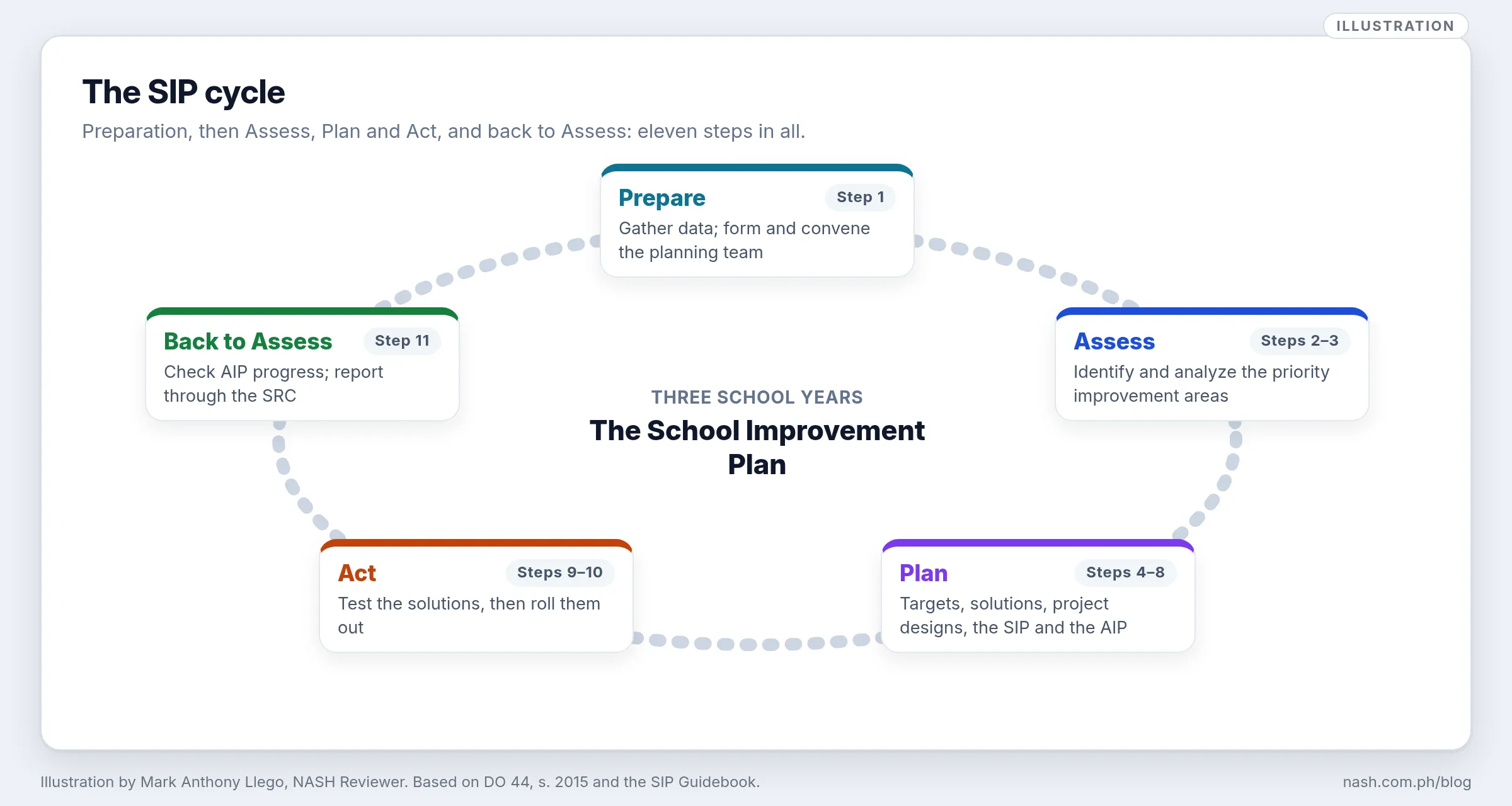
| Phase | Steps (SIP Guidebook) | Who leads | Main outputs |
|---|---|---|---|
| Preparatory activities | 1. Prepare for SIP development: gather data, form the planning team, convene it | School head with a team | School-Community Data Template, Child Mapping Tool, first SRC, Child-Friendly School Survey, Child Protection Policy Implementation Checklist, school watching checklist and hazard map, planning team list, timetable |
| Assess | 2. Identify or review the priority improvement areas (PIAs); 3. Analyze the PIAs: set general objectives, organize project teams, listen to learners and stakeholders, analyze school processes, select the area of focus, do root cause analysis, present the root cause | Planning team; project teams | PIAs rated with the rubric, general objectives, root causes |
| Plan | 4. Review general objectives and targets; 5. Formulate solutions; 6. Develop project designs; 7. Write the SIP; 8. Prepare the AIP | Planning team; project teams | Project designs, the signed SIP, the AIP |
| Act | 9. Test the solutions; 10. Roll out the solutions | Project teams; process owners | Tested solutions, roll-out |
| Back to Assess | 11. Check progress of the AIP | Planning team | Project monitoring reports, updated SRC |
PIAs are rated on four criteria from 1 to 5: strategic importance, urgency, magnitude and feasibility (Activity 2.2). They are “not just limited to issues within the school”: a community situation “such as flooding and unsafe school water source” can be one. In years 2 and 3, the cycle returns to Assess to check the impact of the solutions and adjust the next AIP (DO 44, s. 2015, Encl., Sec. V.A.2).
Each step, with its templates and a worked example, is in DepEd School Improvement Plan (SIP): Steps, AIP and SRC. Root cause tools are in Root Cause Analysis for the DepEd School Improvement Plan.
A SIP review checklist
Use this checklist on the plan the school has now, before planning the next one. Each “no” is a finding for the planning team.
| Check | What to look for | Basis |
|---|---|---|
| Who made it | A planning team of at least seven with good gender balance: the school head as leader, and learner, teacher, parent, barangay or LGU, barangay DRRM council and Child Protection Committee representatives; at least one SGC member; Indigenous Peoples or Muslim representation in multicultural settings; an odd number | SIP Guidebook, Activity 1.2 |
| Ownership | The SIP “signed by all the SPT members to ensure its ownership and accuracy” | DO 44, Encl., Sec. V.A.2 |
| Evidence | A complete School-Community Data Template; a gap analysis against the division’s targets (Annex 3); current data (enrollment by grade, reading and numeracy results, attendance, dropout) | SIP Guidebook, Activities 1.1 and 2.1 |
| Required preparatory tools | Child mapping, the Child-Friendly School Survey, the Child Protection Policy Implementation Checklist, student-led school watching and hazard mapping | SIP Guidebook, Activity 1.1; DO 033, para. 20(f) |
| Learner voice | Records of interviews, focus groups or surveys with learners and other stakeholders | SIP Guidebook, Activity 3.3 |
| PIAs | Rated with the four-criterion rubric; tied to access, quality or governance | SIP Guidebook, Activity 2.2 |
| Root causes | A cause found from evidence, not a solution restated as a cause | SIP Guidebook, Activity 3.6 |
| Objectives | General objectives drawn from the PIAs, checked against the root causes, with targets the school can measure | SIP Guidebook, Activity 3.1 and Step 4 |
| Alignment | DepEd’s vision, mission and core values, unaltered; objectives tied to the division plan | DO 36, s. 2013; DO 44, Encl., Sec. V.A |
| Policy coverage | DRRM integrated with a budget; the child protection plan, LAC plan and LSCP drawn from the SIP; SBM self-assessment results in the improvement areas | DO 37, Sec. V.7; DO 44, Encl., Sec. V.A; DO 007, s. 2024, Encl., Sec. V.D.2 |
| Projects and funds | One solution per project design; a budget and a fund source for each activity: MOOE, SEF, the School Innovation and Improvement Fund, PTA, partners | SIP Guidebook, Step 6; DO 008, s. 2019, Sec. V.D; Joint Circular No. 01, s. 2025, Sec. 6.3.1 |
| Monitoring | Project monitoring reports at the middle and end of each project; the AIP checked each year | SIP Guidebook, Step 11 |
| Reporting | The SRC presented at least twice a year and the year-end SRC given to the SDO with the AIP | DO 44, Encl., Secs. V.A.3 and V.B.3 |
| Results | Did the targets move? Which projects worked, and which never started? | Project monitoring reports; SRC |
Common weaknesses
- A plan of buildings. DepEd’s Basic Education Development Plan 2030, adopted by DepEd Order No. 024, s. 2022, found that “most School Improvement Plans (SIP) unevenly focused on improving school facilities rather than directly addressing issues on teaching and learning.” Facilities belong in a plan when the data show they block learning.
- Solutions before causes. A project list written before any root cause analysis.
- A plan written by two people. The school head and one teacher, signed afterward by a team that never met.
- No learner voice. Activity 3.3 skipped.
- Targets without baselines. “Improve reading” with no starting figure.
- Separate plans that never meet. A DRRM plan, a child protection plan and a LAC plan that do not refer to the SIP, each with its own budget request.
- An old calendar. Timelines in quarters and grading periods that no longer match the three-term school year.
How to build the next SIP
Start with the people: the planning team and the SGC
The planning team writes the SIP; the school head leads it but does not write it alone. Form it before any analysis, with the membership in the checklist above. The SGC under DO 026, s. 2022 is a separate body with its own role: it is to “participate actively in the formulation and implementation of the SIP” and to “communicate to the SPT and project teams the learners’ and stakeholders’ feedback and satisfaction on the physical and financial accomplishment of the SIP and Annual Implementation Plans (AIP)” (Sec. V.B). The SIP Guidebook still uses the older name “School Governing Council”; the current body is the School Governance Council.
Follow the steps in order
DO 44, s. 2015 says “it is best to follow the steps sequentially,” though steps in the Assess phase, such as listening to learners, “can be repeated to validate data and information” (Encl., Sec. V.A.2). The order matters most at the start: gather the data (enrollment by grade for several years, learner groups, reading and numeracy results, attendance and dropout, staffing, facilities, hazards, survey results and the SBM self-assessment) and choose the PIAs from them before anyone proposes a project. A solution chosen first tends to pull the data toward itself.
The School Innovation and Improvement Fund shows how the steps pay off. For Fiscal Year 2026, recipient schools “are not required to submit funding proposals”; instead they ensure that planned activities “are reflected in their approved School Improvement Plan (SIP) and Annual Implementation Plan (AIP),” focused on literacy and numeracy, and they revisit the AIP to “identify PIAs to enhance literacy and numeracy” when needed (DM 048, s. 2026, Encl., Secs. III.1 and IV.4). A school whose SIP already names its reading and numeracy priorities can use such a grant at once.
Connect the other plans and the budget to the SIP
| Plan or fund | Its rule | How it connects |
|---|---|---|
| AIP | DO 44, s. 2015; SIP Guidebook, Step 8 | The yearly slice of the SIP. For MOOE, the AIP follows “the calendar year format” (DO 008, s. 2019, Sec. V.D). |
| LSCP | DO 014, s. 2026, paras. 25 to 33 | Written every year before the school year and updated every term; school-based ALS Community Learning Centers are reflected in the LSCP and the AIP (para. 32). |
| DRRM plan and contingency plan | DO 37, s. 2015; DO 033, s. 2021 | Hazard mapping before the SIP; DRRM in the SIP with a budget; the contingency plan with a reunification plan. DM 064, s. 2026 adds that “A separate El Niño preparedness plan or reporting system shall not be required when relevant information can be incorporated into existing instruments” (Sec. 9.4). |
| Child protection plan | DO 40, s. 2012, Sec. 10 | Drafted by the Child Protection Committee and reviewed every three years; the SIP is its basis (DO 44, Encl., Sec. V.A). |
| LAC plan | DO 35, s. 2016, item 17.10 | Integrated or linked with the SIP or AIP. |
| School MOOE | DO 008, s. 2019, Sec. V.D | Funds SIP activities determined in the AIP. |
| SEF | Joint Circular No. 01, s. 2025, Sec. 6 | Items must be in the approved SIP and the division plan; requests by August 31 for the next year. |
| PTA contributions | DO 013, s. 2022, Sec. 26.1 | Only for programs and activities identified in the SIP. |
| Partners and Brigada Eskwela | DO 40, s. 2015 | The school head, as partnership focal person, matches partners to the SIP’s needs. |
Monitor, and report through the SRC
The SRC “is not for planning and accountability; it is a communication and advocacy tool intended for internal and external stakeholders” (DO 44, s. 2015, Encl., Sec. V.B). It has three parts: the school profile, performance indicators on access, quality and governance, and the status of school projects. Once prepared, it is signed by the School Head, the PTA President, the Student Body President, the teacher representatives or Teacher Club President, and the School Governing Council Chair “to ensure its ownership and accuracy.” It is presented “At the minimum … twice: during the mid-year (October) and year-end (March) general assemblies,” and the year-end SRC goes to the SDO with the AIP (Encl., Secs. V.A.3 and V.B.3). October still falls near the middle of SY 2026-2027, and late March opens its final End-of-Term Block (March 24 to April 8, 2027), so both months still fit the three-term year.
The SDO’s School Governance and Operations Division monitors the SIP and AIP and evaluates each SIP “at the end of every cycle” (DO 44, Encl., Sec. V.A.4). Before that, a new SIP is appraised: under a 2018 Central Office procedure, a Division Appraisal Committee rates it with the SIP Quality Assessment Tool, and the SDS approves it and issues a Certificate of Acceptance (how the division appraises your SIP).
How to analyze stakeholders and write the SIP communication plan
Who the stakeholders are
DO 007, s. 2024 defines a stakeholder as any person or organization with “professional or civic interests or concerns for the interest of the schools and their students,” and divides them in two (Encl., Sec. III.10). Internal stakeholders “include the learners and school personnel.” External stakeholders “may include parents and guardians, community members, local government units, civil society organizations, other national government agencies,” private companies, foundations and individuals. Parents, under this definition, are external.
DepEd defines stakeholders but prescribes no method for analyzing them. A practical method has six steps:
- Set the purpose. Analyze stakeholders for a decision: forming the planning team, choosing PIAs, launching a project.
- Identify the stakeholders, internal and external, by role, not by name.
- Gather information on each: what they know about the issue, their position (support, neutral, opposition), their interest, and their power to help or block.
- Map them on a power and interest grid: manage closely (high power, high interest), keep satisfied (high power, low interest), keep informed (low power, high interest), monitor (low power, low interest).
- Decide how to engage each one: a seat on the planning team, a consultation, regular reports, a partnership.
- Record, share and update the analysis at each AIP review.
For partners, DO 40, s. 2015 has its own procedure: the partnership focal person “for the school is the School Head,” who conducts internal and external assessments, identifies resource gaps and potential partners, and keeps a database of resources and potential partners (item 9 and the table of the focal person’s responsibilities that follows it). Learners belong in the analysis as stakeholders with their own views, not only as the subject of the plan. The full method, with a worked example, is in Stakeholder Analysis for DepEd School Heads.
What DepEd prescribes for communicating the SIP
DepEd prescribes the SRC, not a communication plan template. The SRC’s interpretations are to be written “using the language most easily understood by the stakeholders” (DO 44, s. 2015, Encl., Sec. V.B.1), and the school is encouraged to share it “on bulletin boards, school website, and in school newsletters” (Sec. V.B.3). A communication plan is how a school makes sure each audience hears what it needs, in time, through a channel it uses.
A workable SIP communication plan has nine parts:
- Situation and purpose: what the SIP is trying to change, in one paragraph.
- Objectives: what each audience should know, believe or do by a date.
- Audiences, from the stakeholder analysis.
- Key messages for each audience, in plain words.
- Channels: assemblies, homeroom meetings, the SRC, letters, the school’s official social media page, barangay assemblies.
- Timing, tied to the SIP calendar.
- Messengers: who speaks to whom.
- Resources and budget, in the AIP.
- Feedback and evaluation: how the school will know the message landed.
DepEd’s rules for letters and plain writing
Letters and official communications follow the DMOS, and DepEd Memorandum No. 082, s. 2022 requires “the block letter format” for letters and official communications and Bookman Old Style, 11 point (paras. 4 and 5). The DMOS sets seven principles of effective business writing (p. ix):
| Principle | The DMOS rule |
|---|---|
| Clarity | “Keep it clear and simple. Avoid using jargon. Use the active voice as much as possible.” |
| Conciseness | “Keep it short, brief, and direct to the point.” |
| Completeness | “Provide complete and necessary information.” |
| Concreteness | “Avoid vague terms and language. Do not use idiomatic expressions and figures of speech.” |
| Consistency | Consistent spelling, grammar, punctuation, capitalization and abbreviations |
| Coherence | “Follow a logical sequence in your discourse.” |
| Courtesy | “Always build goodwill in your communications. Be polite and courteous to your readers.” |
For a parent audience, that means the bottom line first, short sentences, and no acronyms such as PIA, AIP or SBM without an explanation. American spelling is required in DepEd documents (DMOS, rule 167).
Social media, spokespersons and privacy
Under DO 007, s. 2026, school heads are “the approving authority for posting all the content” on the school’s official accounts (Sec. V.B.1.c). The SDS “shall serve as the official spokesperson for the SDO,” and “at the school level, School Heads may be authorized to speak on local school matters, subject to prior approval from the SDS” (Sec. V.A.1). A school head who plans to explain the SIP on local radio clears it with the SDS first.
Learner data stay private. Personally identifiable information “shall not be disclosed or disseminated to third parties, including to the public (i.e., social media accounts of the school, teachers, officials) without the explicit consent of the learner and their parents or legal guardian”, unless “required by law or necessary for the legitimate purposes of the data controller” (DO 017, s. 2025, Sec. X.C). Report reading results by grade and section, never by learner name. Information on the parties to an incident “shall be treated with the utmost confidentiality” (DO 006, s. 2026, Sec. XII).
The structure, style and a full sample plan are in SIP Communication Plan: Structure, Style and a Sample.
A timeline for the next SIP, November 2026 to SY 2027-2028
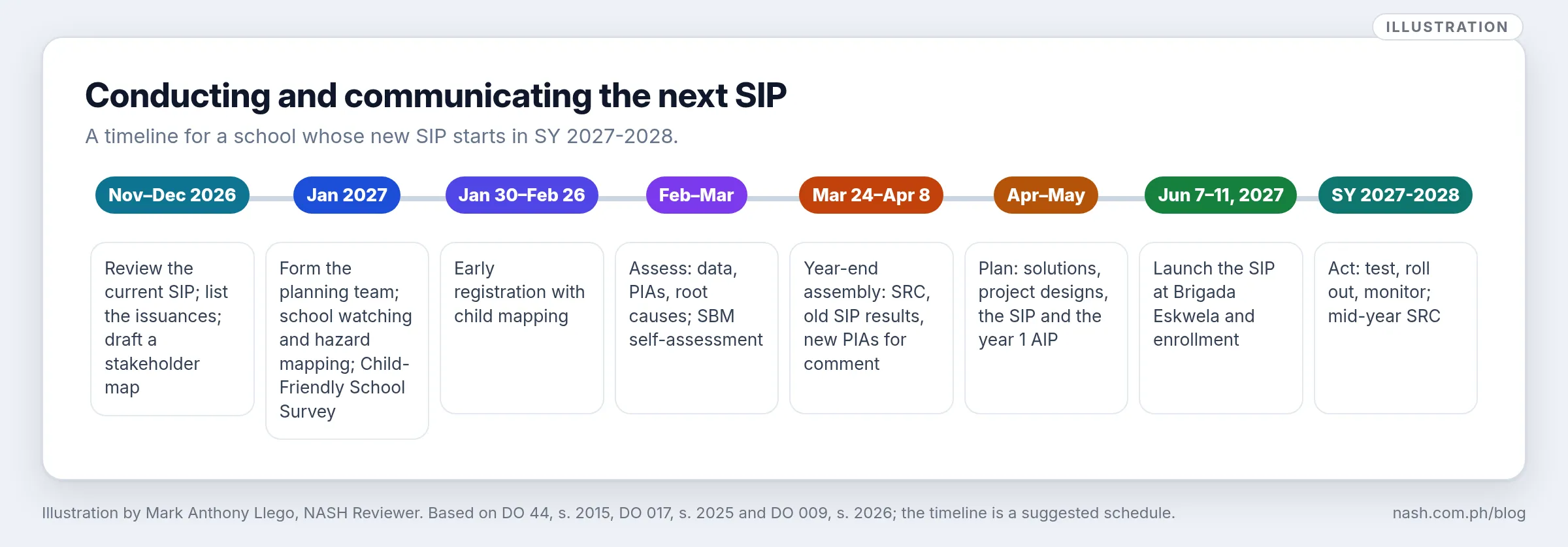
The plan below is for a school whose SIP ends with SY 2026-2027 and whose new SIP starts in SY 2027-2028. The dates come from DO 009, s. 2026; the month for each SIP step follows the SIP Guidebook’s flowchart, moved onto the three-term year. No issuance has restated the SIP calendar for the three-term school year as of November 8, 2026, so confirm the division’s own schedule and submission date before you start.
Timeline
| When | What to do | Who | Outputs |
|---|---|---|---|
| November to mid-December 2026 (Term 2; End-of-Term Block December 7 to 18) | Review the current SIP and AIPs with the checklist above. List the issuances in force for each policy area. Confirm the Child Protection Committee, the SGC and the Learner Formation Officer are in place. Draft a stakeholder map. Start the School-Community Data Template. | School head with a small team | Review notes; issuance list; stakeholder map; data template begun |
| January 4 to 29, 2027 (Term 3 begins) | Form the planning team and hold the one-day orientation, vision sharing and scheduling. Conduct student-led school watching and hazard mapping. Complete the Child-Friendly School Survey and the Child Protection Policy Implementation Checklist. Prepare the first SRC for the team. | School head; planning team; learners for the hazard mapping | Team list; timetable; hazard map; survey results; checklist; first SRC |
| January 30 to February 26, 2027 | Run early registration and child mapping together; do capability mapping for the LSCP. | School head; registration desk staff; barangay volunteers | Child mapping data; capability map |
| February to March 2027 | Assess: present the data, compare with division targets, rate PIAs, set general objectives, form project teams, listen to learners and other stakeholders, analyze processes, find root causes. Conduct the SBM self-assessment with stakeholders. | Planning team; project teams | PIAs; objectives; root causes; SBM checklist |
| March 24 to April 8, 2027 (End-of-Term Block) | Hold the year-end general assembly: present the year-end SRC, report the old SIP’s results, and present the new PIAs for comment. | School head; SGC; PTA; learner government | Year-end SRC; assembly minutes; feedback |
| April to May 2027 | Plan: review targets, formulate solutions, write project designs with budgets and fund sources, write the SIP, have all members sign, prepare the year 1 AIP. Align the child protection plan, the DRRM and contingency plans and the LAC plan. Write the LSCP for SY 2027-2028 with its call tree. Submit the SIP, AIP, project monitoring reports and year-end SRC to the SDO by the date it sets (DO 44 says “no later than the second week of May”). | Planning team; project teams; school head | Signed SIP; AIP; project designs; aligned plans; LSCP |
| June 7 to 11, 2027 (Brigada Eskwela and enrollment; confirm with DepEd’s SY 2027-2028 memorandum) | Launch the SIP to parents and partners; orient personnel, learners and parents on the LSCP; match Brigada partners to SIP needs. | School head; teachers; PTA; partners | Launch materials; orientation records |
| SY 2027-2028 | Act: test solutions on a small scale, then roll them out; monitor each project at its middle and end; hold the mid-year assembly with the mid-year SRC; send SEF funding requests for 2028 by August 31, 2027; update the LSCP every term. | Project teams; process owners; planning team | Project monitoring reports; mid-year SRC; SEF requests |
Roles
| Role | Responsibilities in the SIP |
|---|---|
| School head | Leads the planning team; gathers data; leads the SBM self-assessment; chairs the Child Protection Committee; is the partnership focal person; approves school posts; signs the SRC; answers to the SDO for the plan |
| Planning team | Identifies PIAs; sets objectives; writes and signs the SIP; prepares and checks the AIP |
| Project teams | Analyze one PIA each; design, test and roll out solutions; report progress |
| SGC | Participates in formulating and implementing the SIP; relays stakeholders’ feedback to the planning team |
| PTA | Supports SIP programs; collects voluntary contributions only for SIP activities |
| Teachers and LAC groups | Carry out teaching-learning projects; link the LAC plan to the SIP |
| Learners | Sit on the planning team; give their views in Activity 3.3; join hazard mapping |
| Barangay and LGU | Sit on the planning team; share hazard and community data; carry the school’s needs to the local school board |
| SDO | Provides division plans and technical assistance; receives the SIP and AIP; monitors and evaluates |
Document checklist
- Issuance list with the current issuance for each policy area
- SIP review notes on the previous cycle
- School-Community Data Template (Annex 1A) and Child Mapping Tool (Annex 1B)
- Child-Friendly School Survey (Annex 2A) and Child Protection Policy Implementation Checklist (Annex 2B)
- Hazard map and school watching checklist (Annex 2C)
- SBM self-assessment checklist (DO 007, s. 2024, Annex A)
- Planning team list, timetable and minutes
- PIA rubric, root cause analysis and project designs
- Signed SIP and year 1 AIP
- LSCP with call tree; DRRM and contingency plans; child protection plan; LAC plan
- SRCs (mid-year and year-end) and assembly minutes
- Stakeholder map and communication plan
- Project monitoring reports
What this means for school heads
- Keep an issuance list. For each policy area in the checklist, write the current issuance and the section that binds the school. Update it whenever a new order or memorandum on the subject comes out.
- Read every issuance whole. Scope, repealing clause, effectivity, transitory provisions and enclosures, before acting on a summary.
- Plan within the rules, adapt within the room they leave. Follow every “shall”; use the templates “in full or in part” where allowed; bring in local hazards, learners and partners.
- Make the SIP the one plan. Draw the child protection, DRRM, LAC and continuity plans from it, and fund nothing that is not in it.
- Build the team before the plan. A planning team of at least seven, with learners, parents and the barangay, meeting before any analysis.
- Read culture before changing it. Use the survey, the SBM checklist, incident records and learner voice, and choose a few norms to shift.
- Communicate on schedule and within the rules. Two SRC assemblies at least, plain language, approved posts, no learner names.
What a school head may not do: adopt a vision other than DepEd’s (DO 36, s. 2013, para. 2); delegate the SBM coordinator role, “especially to any teaching personnel” (DO 007, s. 2024, Encl., Sec. V.F.1); designate themselves as the school DRRM coordinator (DO 033, s. 2021, para. 13); allow PTA contributions for activities outside the SIP (DO 013, s. 2022, Sec. 26.1); or post learners’ personal information without consent (DO 017, s. 2025, Sec. X.C).
How the NASH may test this
The items below are original practice items, scored 3 (Relational), 2 (Multistructural), 1 (Unistructural) or 0 (Prestructural). An option that breaks a rule scores 0.
Question 1
Indicator 1.3.2, Policy implementation and review. Career Stage 2, Situational, Moderate.
You are the school head of a large elementary school in a coastal town. The Schools Division Office asks every school to submit its localized anti-bullying policy within the month. Your school’s child protection policy and code of conduct were adopted five years ago and have not been reviewed since. A teacher offers to copy a neighboring school’s approved anti-bullying policy, change the school’s name, and submit it next week. What is the most appropriate action?
- A. Have the guidance teacher write a new anti-bullying policy alone over the next two months so that it fits the school, and tell the division that the policy will be submitted late.
- B. Accept the teacher’s offer to submit the neighboring school’s approved policy under the school’s name, since a policy the division already approved meets its requirement.
- C. Convene the Child Protection Committee to tailor DepEd’s template to the school’s bullying data and learner and parent input, then submit it within the month and schedule the overdue review.
- D. Convene the Child Protection Committee to adopt DepEd’s template in full, filling in only the school’s name, then submit it to the Schools Division Office within the month and schedule the overdue review.
Answer and explanation
Best answer: C. Points: A = 1, B = 0, C = 3, D = 2.
- A (1 point, Unistructural). A policy written for the school is the right aim, but one person drafting it alone skips the committee and the consultation the policy needs, and the school misses the division’s deadline.
- B (0 points, Prestructural). A copied policy does not reflect this school’s learners and community, which is what makes it “localized”, and presenting another school’s policy as the school’s own misrepresents what the school has done.
- C (3 points, Relational). The committee fits DepEd’s template to the school’s own bullying data and the views of learners and parents, the school meets the deadline, and the overdue three-year review of the child protection policy is put back on schedule.
- D (2 points, Multistructural). The committee, the template, the deadline and the overdue review are all right, and the template may be adopted in full. But the template leaves sections for each school to complete, and a policy with only the school’s name filled in does not reflect “learners’ and community needs”.
Why. This aligns with Career Stage 2 expectations because indicator 1.3.2 asks the school head to undertake policy implementation and review so that school operations follow the issuances in force. DO 006, s. 2026 requires each public school to “adopt a localized antibullying policy reflecting learners’ and community needs, submitted to the Schools Division Office (SDO),” using DepEd’s template “in full or in part, as appropriate” (Sec. VI.A.3); the template notes that “Sections highlighted in yellow shall be completed by the schools” (Annex D). The Child Protection Committee, which the school head convenes and which drafts the child protection policy and code of conduct, reviews them “every three (3) years” (DO 40, s. 2012, Secs. 7 and 10). A template with only the school’s name filled in meets the deadline but not the school’s own needs.
Indicator 1.3.2: Undertake policy implementation and review in the school to ensure that operations are consistent with national and local laws, regulations and issuances.
Sources: DepEd Order No. 006, s. 2026, Secs. IV.A and VI.A.3, and Annex D; DepEd Order No. 40, s. 2012, Secs. 7 and 10; DepEd Order No. 024, s. 2020.
Question 2
Indicator 1.2.2, School planning and implementation. Career Stage 2, Situational, Difficult.
You are the new school head of a multigrade elementary school in an upland barangay where most learners are Indigenous Peoples. The school’s three-year improvement plan ends this school year, and the division expects the new plan and the first-year implementation plan before classes open. The old plan was written by the former school head and one teacher, lists mostly building repairs, and was never signed by a planning team. What is the most appropriate action?
- A. Form a planning team with a learner, a teacher, a parent, an Indigenous Peoples elder and barangay officials, and have it carry the old plan’s repair projects over into the new plan.
- B. Submit the old plan’s repair list as the new plan on time, and form a planning team later in the school year to review it with teachers, parents and barangay officials.
- C. Copy a well-rated plan from a larger school in the district, and ask the parents’ association officers to sign it as the planning team so it reaches the division on time.
- D. Form a planning team with a learner, a teacher, a parent, an Indigenous Peoples elder and barangay officials, and have it set priorities from school data before writing the plan.
Answer and explanation
Best answer: D. Points: A = 2, B = 1, C = 0, D = 3.
- A (2 points, Multistructural). The planning team is right, including Indigenous Peoples representation, but it carries over a list of repairs instead of choosing priority areas from data, so the plan stays a plan of buildings.
- B (1 point, Unistructural). It meets the deadline and brings stakeholders in eventually, but the plan has no team, no data and no ownership when it is submitted, and a review later in the year does not make it the community’s plan.
- C (0 points, Prestructural). Another school’s plan does not describe this school, and having officers sign as a planning team that never met makes the signatures false. The planning team’s signatures are meant “to ensure its ownership and accuracy”.
- D (3 points, Relational). It builds the team the guidelines require, with the community the school serves, and has that team identify priority improvement areas from evidence before anything is written, which is what makes the plan evidence-based and learner-centered.
Why. This aligns with Career Stage 2 expectations because indicator 1.2.2 asks the school head to develop and implement school plans with the planning team. DO 44, s. 2015 requires a SIP that is “evidence-based, results-based, and child or learner-centered” and “signed by all the SPT members to ensure its ownership and accuracy” (Encl., Secs. V.A and V.A.2), and the SIP Guidebook has the planning team identify priority improvement areas from the school’s data, with Indigenous Peoples representation in multicultural settings (Activities 1.2 and 2.2). The team that carries over the repair list has the right members but skips the evidence.
Indicator 1.2.2: Develop and implement with the planning team school plans aligned with institutional goals and policies.
Sources: DepEd Order No. 44, s. 2015, Encl., Secs. V.A and V.A.2, and the SIP Guidebook, Activities 1.2 and 2.2; DepEd Order No. 024, s. 2020.
Nothing in this guide reproduces or predicts examination content.
Frequently asked questions
Is DepEd Order No. 44, s. 2015 still the rule for the School Improvement Plan in 2026?
Yes. As of November 8, 2026, no DepEd order has replaced DO 44, s. 2015, which “shall remain in effect, unless sooner repealed, amended, or rescinded” (para. 9). Later orders build on it: DO 007, s. 2024 feeds SBM self-assessment results into the plan, and DO 009, s. 2026 changed the school calendar the SIP’s months were written for.
Did DepEd Order No. 006, s. 2026 replace the DepEd Child Protection Policy?
No. DO 006, s. 2026 says it “does not amend or repeal” the issuances it governs, which include DO 40, s. 2012; it supplements, harmonizes and clarifies them (Sec. III). It repeals by name only four old orders on hazing and cellphones (para. 3). Schools follow both: DO 40 for the Child Protection Committee and policy, DO 006 for the localized anti-bullying policy, security measures and reporting timelines.
What is the difference between a DepEd Order and a DepEd Memorandum?
A DepEd Order states policy that is “general or permanent in nature,” signed by the Secretary, and stays in force until another order rescinds or amends it. A DepEd Memorandum “disseminates instructions, information, or related matters,” such as committees, reports, activities and the detailed procedures for carrying out a policy, and may be signed by an Undersecretary by authority of the Secretary (DMOS, Appendix 5).
Can a division memorandum change a DepEd Order?
No issuance allows it. RA 9155 has the schools division superintendent act “Consistent with the national educational policies, plans and standards” (Sec. 7(C)), so a division memorandum implements national orders and sets local schedules. When the two seem to conflict, ask the SDO in writing and follow the DepEd Order until it answers.
How often does a school update its plans?
The SIP covers three school years, and the AIP is prepared each year with the previous year’s monitoring reports (DO 44, s. 2015, Encl., Sec. V.A.3). The LSCP is developed every year and updated every term (DO 014, s. 2026, para. 25). The child protection policy and code of conduct are reviewed every three years (DO 40, s. 2012, Sec. 10(B)).
Sources
Laws, executive orders and court decisions
- Republic Act No. 9155, Governance of Basic Education Act of 2001, August 11, 2001: Secs. 1 to 7 and 14 to 17.
- Republic Act No. 7160, Local Government Code of 1991, October 10, 1991: Secs. 98 to 100.
- Republic Act No. 7610, Special Protection of Children Against Abuse, Exploitation and Discrimination Act, June 17, 1992.
- Republic Act No. 10121, Philippine Disaster Risk Reduction and Management Act of 2010, May 27, 2010.
- Republic Act No. 10173, Data Privacy Act of 2012, August 15, 2012.
- Republic Act No. 10627, Anti-Bullying Act of 2013, September 12, 2013.
- Republic Act No. 11650, on inclusion and services for learners with disabilities
- Republic Act No. 12027, on the medium of instruction
- Republic Act No. 12028, the Academic Recovery and Accessible Learning (ARAL) Program Act
- Republic Act No. 12080, Basic Education Mental Health and Well-Being Promotion Act, December 6, 2024: Secs. 4, 7 and 8.
- Civil Code of the Philippines, Republic Act No. 386, June 18, 1949: Arts. 4 and 7.
- Executive Order No. 200, s. 1987, Providing for the Publication of Laws Either in the Official Gazette or in a Newspaper of General Circulation in the Philippines as a Requirement for Their Effectivity, June 18, 1987: Sec. 1.
- Executive Order No. 292, s. 1987, Administrative Code of 1987: Book VII, Chapter 2, Secs. 3 and 4.
- Executive Order No. 66, s. 2012, on the suspension of classes and work in government offices during typhoons, floods and other calamities, January 9, 2012, amended by EO 130, s. 2026 as to educational institutions.
- Executive Order No. 130, s. 2026, on the suspension and resumption of in-person classes and onsite work in educational institutions, October 28, 2026: Secs. 3, 4, 7 and 11.
- Tañada v. Tuvera, G.R. No. L-63915, December 29, 1986, resolution of the Supreme Court sitting en banc (Cruz, J.).
DepEd Orders
- DepEd Order No. 1, s. 2003, Implementing Rules and Regulations of RA 9155, January 6, 2003.
- DepEd Order No. 40, s. 2012, DepEd Child Protection Policy, May 14, 2012: Secs. 7 and 10.
- DepEd Order No. 83, s. 2012, Implementing Guidelines on the Revised School-Based Management (SBM) Framework, Assessment Process and Tool (APAT), repealed by DO 007, s. 2024.
- DepEd Order No. 8, s. 2013, Policy Guidelines on Regulating the Issuance of DepEd Advisories, February 13, 2013.
- DepEd Order No. 36, s. 2013, Our Department of Education Vision, Mission and Core Values (DepEd VMV): para. 2.
- DepEd Order No. 13, s. 2015, Establishment of a Policy Development Process at the Department of Education, April 13, 2015.
- DepEd Order No. 23, s. 2015, Student-Led School Watching and Hazard Mapping, June 16, 2015.
- DepEd Order No. 37, s. 2015, The Comprehensive Disaster Risk Reduction and Management (DRRM) in Basic Education Framework, August 12, 2015: Sec. V.7.
- DepEd Order No. 40, s. 2015, Guidelines on K to 12 Partnerships, August 28, 2015: item 9.
- DepEd Order No. 44, s. 2015, Guidelines on the Enhanced School Improvement Planning (SIP) Process and the School Report Card (SRC), with the SIP Guidebook and Annexes: paras. 2, 7 and 9; Encl., Secs. V, VI, VIII and X; Guidebook, Steps 1 to 11.
- DepEd Order No. 9, s. 2015, School Calendar for School Year 2015-2016: para. 2
- DepEd Order No. 013, s. 2026, Institutional Guidelines on the Implementation of the School-Based Feeding Program, June 4, 2026
- DepEd Order No. 10, s. 2016, Policy and Guidelines for the Comprehensive Water, Sanitation and Hygiene in Schools (WinS) Program
- DepEd Order No. 35, s. 2016, The Learning Action Cell as a K to 12 Basic Education Program School-Based Continuing Professional Development Strategy for the Improvement of Teaching and Learning, June 7, 2016: para. 7; items 17.5 and 17.10.
- DepEd Order No. 008, s. 2019, Revised Implementing Guidelines on the Direct Release, Use, Monitoring and Reporting of Maintenance and Other Operating Expenses Allocation of Schools, May 2, 2019: Sec. V.D.
- DepEd Order No. 030, s. 2019, The Department of Education Manual of Style, October 18, 2019: Principles of Effective Business Writing, rules 16, 17, 124 and 167, and Appendix 5.
- DepEd Order No. 024, s. 2020, National Adoption and Implementation of the Philippine Professional Standards for School Heads, September 7, 2020: para. 9 and Domains 1, 2 and 5.
- DepEd Order No. 033, s. 2021, School-Based Disaster Preparedness and Response Measures for Tropical Cyclones, Flooding, and Other Weather-Related Disturbances and Calamities, August 20, 2021: paras. 13 and 20.
- DepEd Order No. 013, s. 2022, Omnibus Guidelines on the Regulation of Operations of the Parent-Teacher Associations, March 18, 2022: Sec. 26.1.
- DepEd Order No. 024, s. 2022, Adoption of the Basic Education Development Plan 2030, May 30, 2022.
- DepEd Order No. 026, s. 2022, Implementing Guidelines on the Establishment of School Governance Council, June 17, 2022: Sec. V.B.
- DepEd Order No. 002, s. 2024, Immediate Removal of Administrative Tasks of Public School Teachers, January 26, 2024.
- DepEd Order No. 005, s. 2024, Rationalization of Teachers’ Workload in Public Schools and Payment of Teaching Overload, April 29, 2024.
- DepEd Order No. 007, s. 2024, Policy Guidelines on the Implementation of the Revised School-Based Management (SBM) System, May 16, 2024: paras. 3 and 4; Encl., Secs. III and V.
- DepEd Order No. 010, s. 2024, Policy Guidelines on the Implementation of the MATATAG Curriculum, July 23, 2024.
- DepEd Order No. 022, s. 2024, Revised Guidelines on Class and Work Suspension in Schools During Disasters and Emergencies, December 23, 2024.
- DepEd Order No. 012, s. 2025, Multi-Year Implementing Guidelines on the School Calendar and Activities, April 15, 2025, repealed by DO 009, s. 2026.
- DepEd Order No. 017, s. 2025, Revised Basic Education Enrollment Policy, June 13, 2025: Secs. V.A, VI.A and X.C.
- DepEd Order No. 002, s. 2026, Guidelines on the Grant of Wellness Leave for the Department of Education Personnel, February 13, 2026: para. 5.
- DepEd Order No. 004, s. 2026, Amendment to DepEd Order No. 017, s. 2024, February 25, 2026.
- DepEd Order No. 006, s. 2026, Guidelines on Ensuring a Safe and Motivating Learning Environment, March 24, 2026: paras. 3 and 4; Secs. III, IV, VI.A, VII, IX.D and XII.
- DepEd Order No. 007, s. 2026, Media Management Guidelines, March 25, 2026: Secs. V.A.1 and V.B.1.
- DepEd Order No. 009, s. 2026, Guidelines on the Implementation of the Three-Term School Calendar in Basic Education, April 16, 2026: paras. 4, 5 and 22, and the calendar annexes.
- DepEd Order No. 014, s. 2026, Guidelines on Learning Continuity in Emergencies, June 4, 2026: paras. 25 to 33, 103 and 105.
- DepEd Order No. 015, s. 2026, Revised Guidelines on Classroom Assessment, Grading System, and Awards and Recognition for the K to 12 Basic Education Program, June 4, 2026.
- DepEd Order No. 016, s. 2026, Guidelines on Lesson Planning and Learning Design, June 4, 2026.
- DepEd Order No. 019, s. 2026, Qualification Standards for Positions Created Under Republic Act No. 12080, July 22, 2026.
DepEd Memoranda and joint circulars
- DepEd Memorandum No. 082, s. 2022, Reiteration of the Strict Compliance to the Use of the Department of Education Manual of Style, September 7, 2022: paras. 4 and 5.
- DepEd Memorandum No. 077, s. 2025, Dissemination of the Implementing Rules and Regulations of RA 12080, September 18, 2025.
- DepEd Memorandum No. 090, s. 2025, Dissemination of the Revised Implementing Rules and Regulations of RA 10627, October 9, 2025.
- DepEd Memorandum No. 048, s. 2026, Allocation and Release of the School Innovation and Improvement Fund to Non-Implementing Unit Public Schools to Strengthen Decentralization Practices in the Department of Education for Fiscal Year 2026, August 3, 2026: Encl., Secs. III.1 and IV.4.
- DepEd Memorandum No. 055, s. 2026, Clarificatory Guidelines on the Designation of Learner Formation Officers in Schools, September 17, 2026.
- DepEd Memorandum No. 064, s. 2026, Anticipatory Action, Preparedness, and Protective Measures for the 2026-2027 Super El Niño, October 26, 2026: Sec. 9.4.
- DepEd-DBM-DILG-DOF Joint Circular No. 01, s. 2025, Omnibus Guidelines on the Use of the Special Education Fund (SEF), December 3, 2025: Secs. 6.2, 6.3.1, 6.4.2 and 6.8.
Research
- Kent D. Peterson and Terrence E. Deal, “How Leaders Influence the Culture of Schools,” Educational Leadership 56, no. 1 (September 1998).
- Jonathan Cohen, Elizabeth M. McCabe, Nicholas M. Michelli and Terry Pickeral, “School Climate: Research, Policy, Practice, and Teacher Education,” Teachers College Record 111, no. 1 (2009): 180-213.
Written by Mark Anthony Llego for NASH Reviewer. Illustrations by Mark Anthony Llego; they may be reused only with written permission from support@nash.com.ph. Sources: Republic Act No. 9155; DepEd Order No. 44, s. 2015 and its SIP Guidebook; DepEd Orders No. 024, s. 2020, No. 007, s. 2024, No. 006, s. 2026, No. 009, s. 2026 and No. 014, s. 2026; DepEd Order No. 030, s. 2019 (DepEd Manual of Style); Joint Circular No. 01, s. 2025; the Civil Code and the Administrative Code of 1987.