A public school receives its Maintenance and Other Operating Expenses (MOOE) by one of two routes. A school that is an implementing unit (IU) has its own bookkeeper and disbursing officer, and the Department of Budget and Management (DBM) releases its allotment and cash directly to it. A school that is a non-implementing unit (non-IU) has no financial staff, and it receives its MOOE from the Schools Division Office (SDO) as cash advances that the school head must liquidate every month. The rule for both is DepEd Order No. 008, s. 2019 (Enclosure, Sec. V.B).
Almost every school takes the second route. In DepEd’s School MOOE allocation list for FY 2026, issued early in 2026, 2,679 of 45,801 schools are implementing units, or 5.85%. Not one of them is an elementary-only school.
A school does not choose its route. Under DepEd Order No. 033, s. 2025, the Central Office identifies the schools that qualify to become implementing units, and the DBM activates each school’s organization code.
Key findings
- An implementing unit gets its money from the DBM; a non-IU gets it from the division. The IU keeps its own books of accounts. The non-IU’s transactions are covered by the division office’s account, and its MOOE arrives as a cash advance (DO 008, s. 2019, Sec. V.B, items 2.1 and 2.2).
- 5.85% of schools are implementing units, and they hold 21.1% of school MOOE. The 2,679 IUs receive PHP 12.51 billion of the PHP 59.35 billion in the FY 2026 list (DepEd, School MOOE Allocation, FY 2026).
- Implementing units are high schools. Of the 2,679, 2,445 offer junior and senior high school and 205 junior high school only. None of the 35,029 elementary-only schools and none of the 262 stand-alone senior high schools is an IU (DepEd, School MOOE Allocation, FY 2026).
- Six in ten high school learners study in an implementing unit; almost no elementary learner does. IUs enroll 60.5% of junior high and 61.2% of senior high learners, and 0.2% of elementary learners (DepEd, School MOOE Allocation, FY 2026, with enrollment data for SY 2024-2025).
- The 2025 criteria are three: an organization code from the DBM, a filled principal position, and a designated bookkeeper and disbursing officer. Elementary schools may now qualify, and the school no longer applies (DO 033, s. 2025, pars. 2 and 3).
- About 2,000 non-IU schools already reported all three positions. In SY 2023-2024, 1,973 schools that are non-IUs in the FY 2026 list had a principal, a bookkeeper and a disbursing officer; 1,125 of them are elementary-only (DepEd, School Personnel in SY 2023-2024).
- EDCOM II wants more implementing units, chosen by size. It asks DepEd and the DBM to set thresholds for IU designation and to cluster smaller schools under a lead school (EDCOM II Final Report, p. 372).
What an implementing unit is
DepEd’s Financial Management Operations Manual describes an implementing unit as a secondary school “with a minimum required set of financial staff to enable the separation of functions as provided by basic accounting principles of internal control. That is, recording of transactions is separate from handling of cash and disbursements” (p. 126). DO 008, s. 2019 puts it this way:
- “The IUs are capable of administering their own funds since they have Bookkeeper and Disbursing Officer plantilla positions” (Sec. V.B, item 1).
- “The non-IUs do not have their own financial staff and receive allocations of school MOOE from their respective SDOs in the form of cash advance” (Sec. V.B, item 2.2).
An older order uses another name for the same thing. DepEd Order No. 40, s. 2014 calls an implementing unit a high school with fiscal autonomy, one “receiving its allotment directly from the DBM”, and a non-implementing unit a high school without fiscal autonomy (Part IV, items 15 and 16).
The difference is one of accounting, not of rank. Both kinds of school plan, spend and report under the same budgeting, accounting, procurement and auditing rules. What differs is who keeps the books and how the cash arrives.
| Implementing unit | Non-implementing unit | |
|---|---|---|
| Financial staff | Bookkeeper and disbursing officer | None of its own |
| Who releases the money | The DBM, directly to the school | The SDO, as a cash advance |
| Books of accounts | The school’s own | The division’s |
| Who pays | The school’s disbursing officer | The school head, as special disbursing officer |
| Reports | The school’s own financial reports | A monthly liquidation to the SDO |
How the money reaches each kind of school
Figure
Two routes for the same peso
An implementing unit can spend at its third stop. A non-implementing unit can spend at its sixth, and goes back to the division office every month.
Follows a school's MOOE down both routes at the same pace.
Implementing unit
4 stops
The school has a bookkeeper and a disbursing officer, and the money comes to it from the DBM.
Department of Budget and Management
The DBM releases the allotment to the school
The DBM office concerned releases the allotment direct to the implementing unit: through the General Appropriations Act as the allotment order, or by a Special Allotment Release Order for items held for later release.
DO 008, s. 2019, Sec. V.A, item 1
Department of Budget and Management
The cash goes to the school's own sub-account
The DBM issues the cash allocation direct to the Modified Disbursement Scheme sub-account that the school keeps in a government depository bank.
DO 008, s. 2019, Sec. V.A, item 2; Sec. V.B, item 2
The school
The school's finance staff pay the bills
The school can spend from here.
A bookkeeper keeps the accounts and a disbursing officer handles the cash. The school disburses under the budgeting, accounting, procurement and auditing rules.
DO 008, s. 2019, Sec. V.B, item 1; Sec. V.C, item 4.1
The school
The school keeps its own books and reports
The school maintains its own sets of books of accounts and submits the reports the order requires. The division office reports the school's fund utilization every month.
DO 008, s. 2019, Sec. V.B, item 2.1; Sec. V.C, item 4.2; Sec. VI.A, item 6
Non-implementing unit
9 stops
The school has no financial staff of its own, and the money comes to it from the division office as cash advances.
Department of Budget and Management
The DBM releases the allotment to the division
The school's allocation is part of the appropriation for its Schools Division Office, and the DBM releases the allotment to the division office, which is the implementing unit.
DO 008, s. 2019, Sec. V.A, item 1; Sec. V.C, item 1.1
Department of Budget and Management
The cash goes to the division's sub-account
The DBM issues the cash allocation to the division office's Modified Disbursement Scheme sub-account, which covers the transactions of the division's non-implementing schools.
DO 008, s. 2019, Sec. V.A, item 2; Sec. V.B, item 2.2
Schools Division Office
The division tells the school head the amount
The division office informs the school head in writing of the school's MOOE allocation for the year.
DO 008, s. 2019, Sec. V.C, item 2.1
School head
The school head is bonded
The school head, designated a special disbursing officer by authority of the superintendent, applies for a bond with the Fidelity Bond Division of the Bureau of the Treasury.
DO 008, s. 2019, Sec. V.C, items 3 and 3.1
Schools Division Office
The division grants a cash advance
The school head draws a cash advance from the division office for the school's MOOE requirements. A school whose monthly MOOE is PHP 20,000 or less receives three months' requirements at once.
DO 008, s. 2019, Sec. V.C, item 3.2; Sec. V.B, item 3
School headEvery month
The school head spends the advance
The school can spend from here.
The school head disburses the money under the budgeting, accounting, procurement and auditing rules.
DO 008, s. 2019, Sec. V.C, item 3.4
School headEvery month
The school head liquidates by the 5th
On or before the 5th day of the following month, the school head submits the Cash Disbursement Register, the paid disbursement vouchers and all supporting documents to the division office.
DO 008, s. 2019, Sec. V.C, item 3.3
Schools Division OfficeEvery month
The division replenishes the advance
The division office replenishes within three working days of receiving the liquidation report. A new advance is granted only when the register covers at least 75% of the previous one. Then the school spends and liquidates again.
DO 008, s. 2019, Sec. V.C, items 2.2 and 3.3
School head and Schools Division Office
At year end, everything is settled
By the end of the year the division office must have downloaded the school's allocation in full, and the school head liquidates any remaining advance in full and refunds the unexpended balance.
DO 008, s. 2019, Sec. V.C, items 2.2 and 3.3
DepEd Order No. 008, s. 2019, Enclosure, Secs. V and VI
The figure shows why the status matters to a school head. An implementing unit’s money passes through no office between the DBM and the school. A non-IU’s money passes through the division office, and comes back to it every month.
Three rules protect a non-IU on that longer route (DO 008, s. 2019, Sec. V.C, items 2.2 and 2.3):
- The full amount must reach the school. The division office must ensure that “by the end of the year” the school’s MOOE allocation has been “fully downloaded” to the school head.
- Replenishment has a deadline. It “must be made within three (3) working days upon receipt of the liquidation report”.
- The division may not buy for the school. Division offices “are prohibited from undertaking centralized procurement of any goods or services out of school MOOE intended for distribution to schools in kind”, except in extreme cases, which they must report within 30 days after the procurement.
The guide to school MOOE covers the cash advance, the bond, the school bank account and the monthly liquidation in full.
How many schools are implementing units
DepEd’s allocation list tags every school IU or NON-IU.
| FY 2025 | FY 2026 | |
|---|---|---|
| Schools on the list | 45,229 | 45,801 |
| Implementing units | 2,661 | 2,679 |
| Share of schools | 5.88% | 5.85% |
| MOOE of implementing units | PHP 11.23 billion | PHP 12.51 billion |
| Share of all school MOOE | 23.2% | 21.1% |
Of the 45,045 schools on both lists, 18 became implementing units between FY 2025 and FY 2026 and none stopped being one. The FY 2026 list adds the Division of Sulu, 457 schools counted in Region IX and none of them an implementing unit. Without Sulu, the FY 2026 share is 5.91% and Region IX’s is 3.1%.
The few schools that are IUs are large. They enroll 5.37 million of the 21.75 million learners in the listed schools, or 24.7%, and their median enrollment is 1,424 learners against 207 in non-IUs. The median IU receives PHP 3,465,000 in MOOE and the median non-IU PHP 830,500. School MOOE Allocation by School, FY 2020 to FY 2026 traces both groups over seven years.
By level
| Levels the school has an allocation for | Schools | Implementing units | Share |
|---|---|---|---|
| Elementary only | 35,029 | 0 | 0.0% |
| Junior and senior high | 6,598 | 2,445 | 37.1% |
| Elementary and junior high | 1,704 | 3 | 0.2% |
| Junior high only | 1,375 | 205 | 14.9% |
| Kindergarten to Grade 12 | 833 | 26 | 3.1% |
| Senior high only | 262 | 0 | 0.0% |
Until October 2025, only a high school could become an implementing unit. That history shows in the list.
By school size
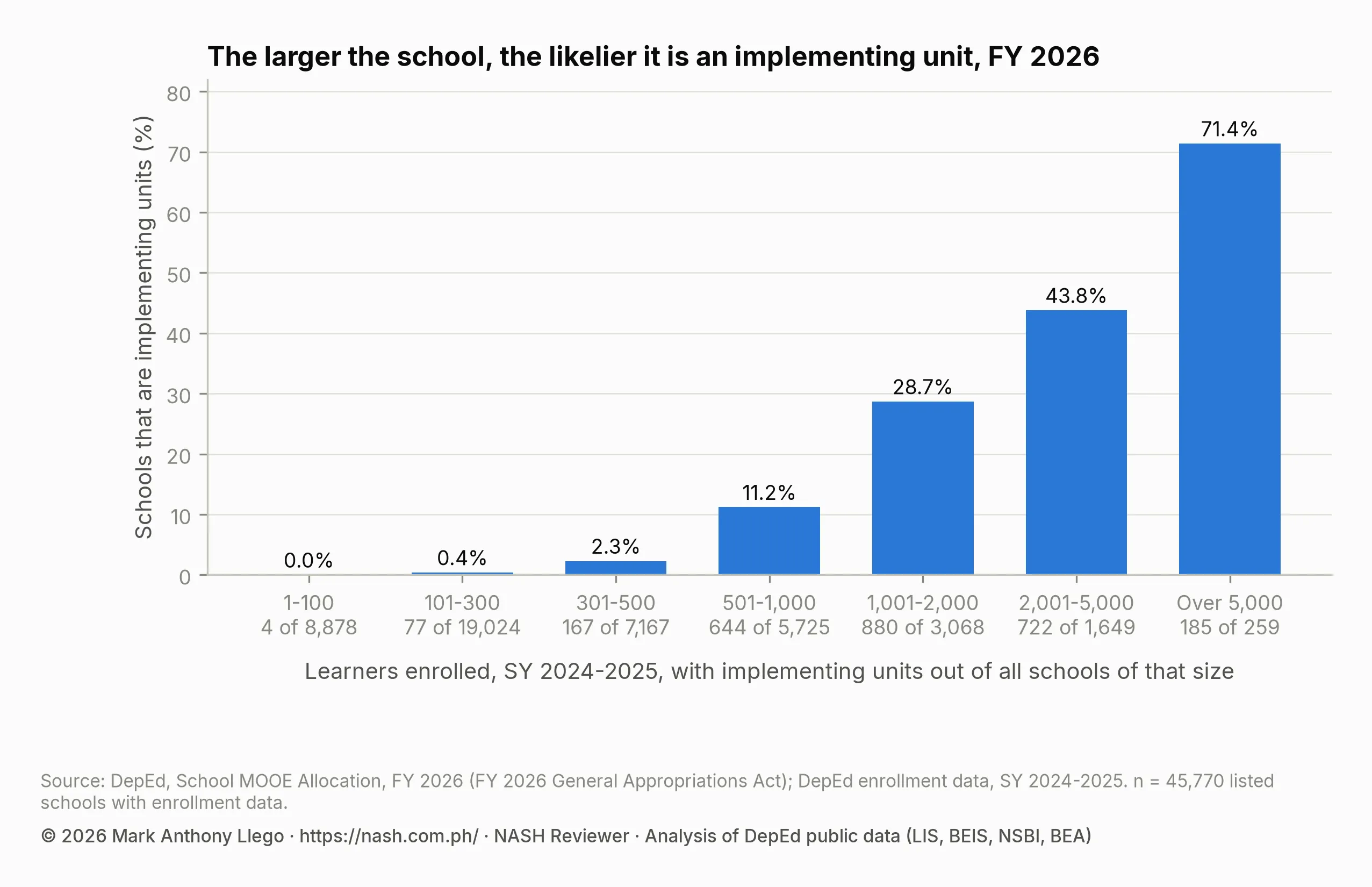
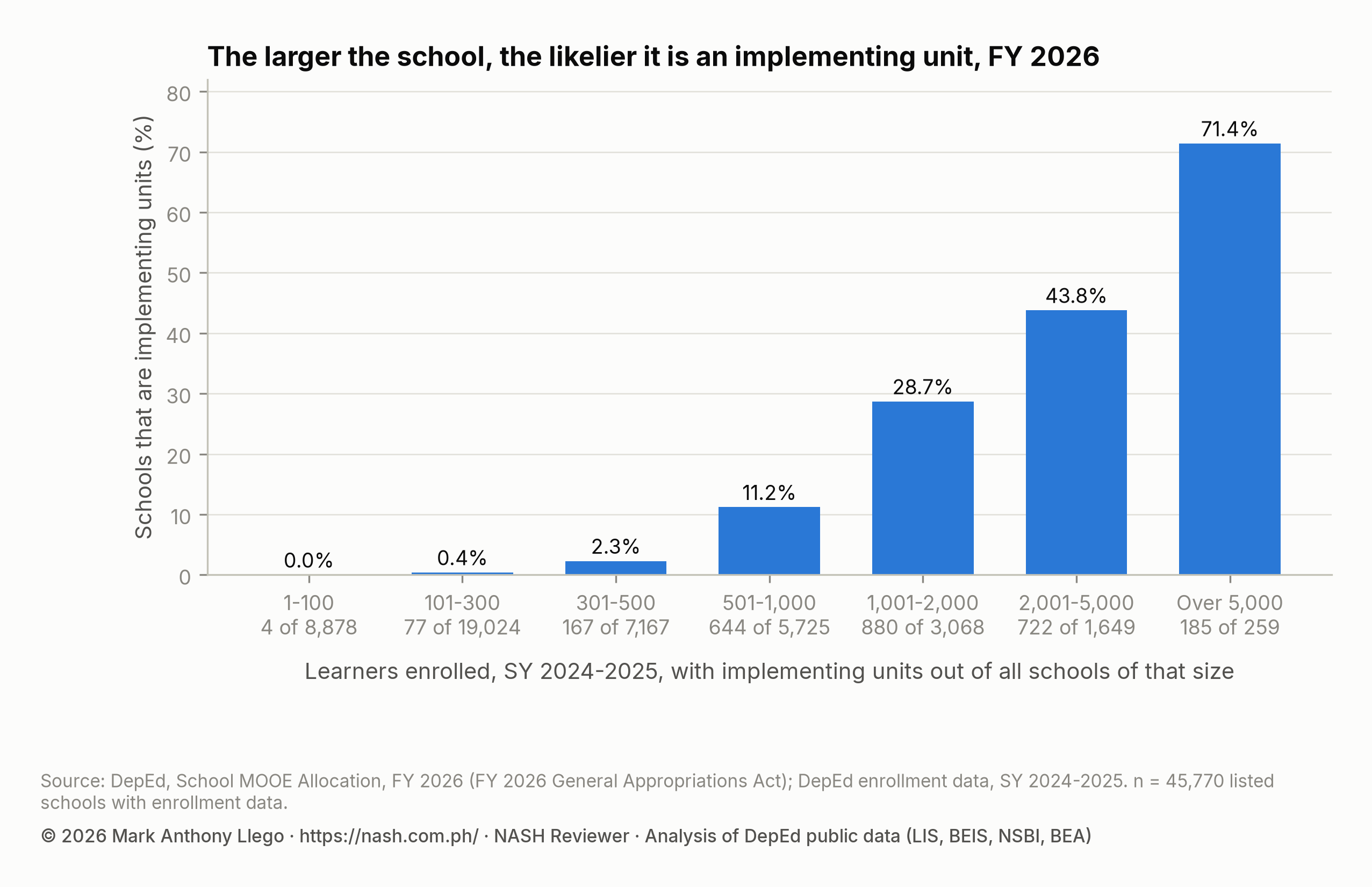
Size raises the odds but does not settle the matter. Among schools with more than 2,000 learners, 1,001 are non-IUs. The largest is an elementary school in Pasig City with 11,689 learners and an allocation of PHP 13,555,000, which its school head receives and liquidates as cash advances. At the other end, 81 implementing units have 300 learners or fewer.
By region
| Region | Schools | Implementing units | Share of schools | IUs’ share of the region’s school MOOE |
|---|---|---|---|---|
| National Capital Region (NCR) | 827 | 181 | 21.9% | 37.7% |
| Region VI (Western Visayas) | 2,835 | 287 | 10.1% | 29.9% |
| Region IV-A (CALABARZON) | 3,576 | 337 | 9.4% | 27.7% |
| Region III (Central Luzon) | 3,744 | 336 | 9.0% | 27.3% |
| Negros Island Region (NIR) | 2,242 | 166 | 7.4% | 25.2% |
| Region VII (Central Visayas) | 2,828 | 178 | 6.3% | 19.9% |
| Region V (Bicol) | 3,873 | 237 | 6.1% | 21.6% |
| Region XIII (CARAGA) | 2,105 | 126 | 6.0% | 18.9% |
| Region I (Ilocos) | 2,865 | 156 | 5.4% | 21.8% |
| Region XI (Davao) | 2,227 | 118 | 5.3% | 21.7% |
| Region IV-B (MIMAROPA) | 2,392 | 120 | 5.0% | 18.5% |
| Region II (Cagayan Valley) | 2,542 | 107 | 4.2% | 15.2% |
| Region XII (SOCCSKSARGEN) | 2,163 | 79 | 3.7% | 17.0% |
| Cordillera Administrative Region (CAR) | 1,842 | 56 | 3.0% | 10.2% |
| Region IX (Zamboanga Peninsula) | 3,014 | 78 | 2.6% | 12.3% |
| Region VIII (Eastern Visayas) | 4,191 | 75 | 1.8% | 8.3% |
| Region X (Northern Mindanao) | 2,535 | 42 | 1.7% | 8.8% |
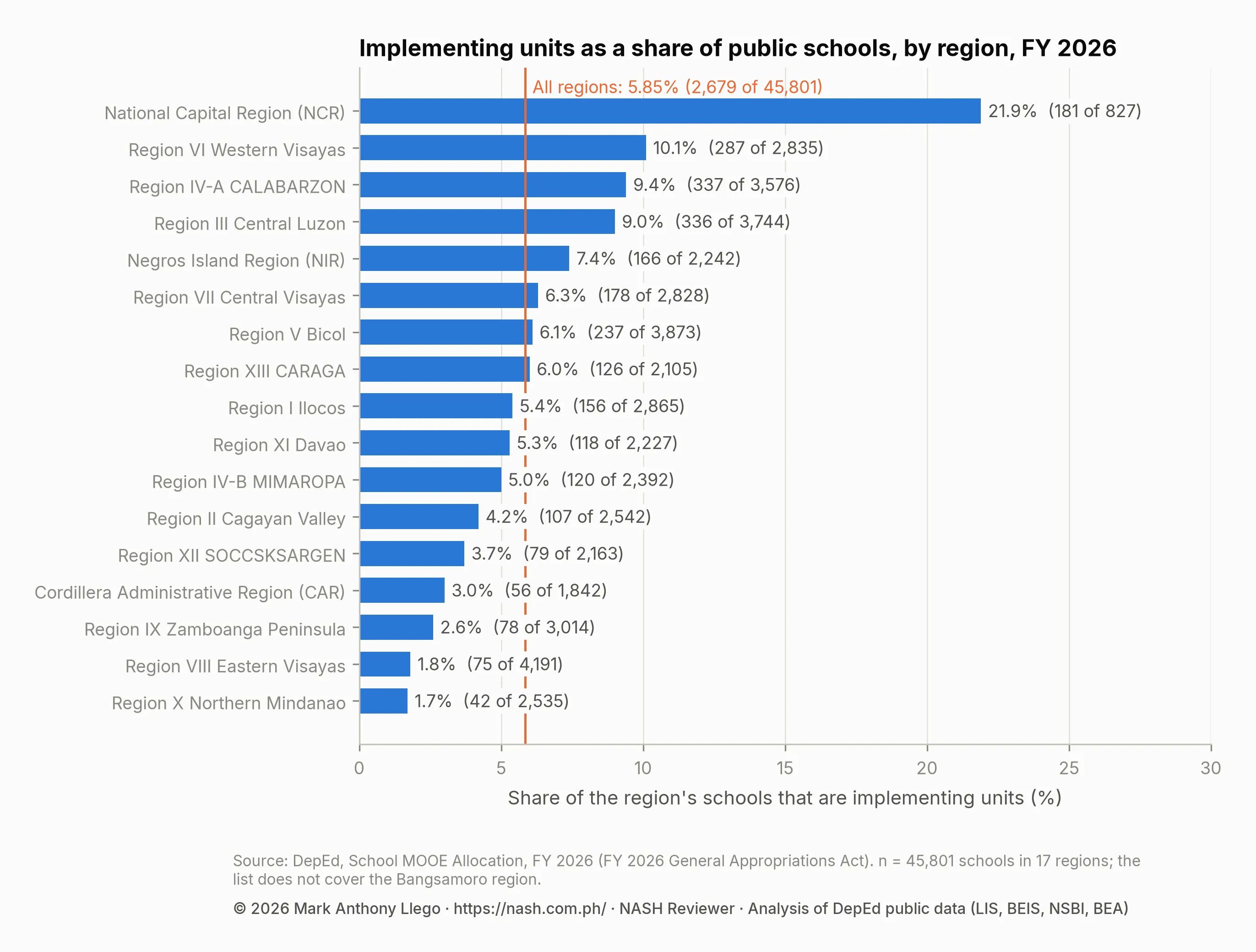
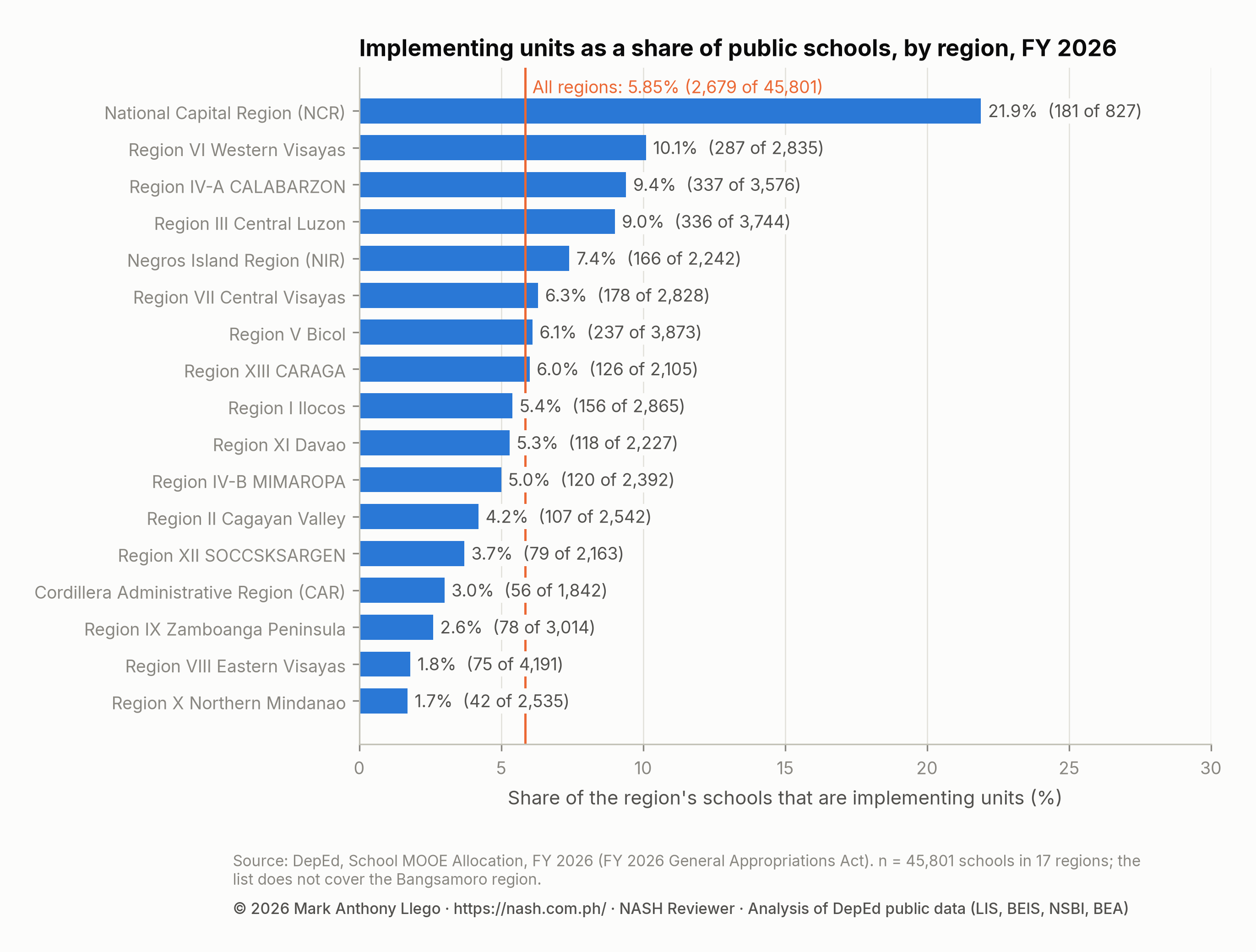
The list does not cover the Bangsamoro region. A school head in Metro Manila is about thirteen times as likely to head an implementing unit as one in Northern Mindanao.
Divisions differ more. Manila has the highest share, 32 of its 105 schools (30.5%), and Iloilo the most implementing units, 120. Four divisions have none: Sulu, new to the list in FY 2026, and Cagayan de Oro City, El Salvador City and Gingoog City. Eighteen divisions have one. The count for every division is in the data file below.
How a school becomes an implementing unit
The criteria before and after October 2025
DO 033, s. 2025, dated October 9, 2025, replaced the criteria of DO 40, s. 2014 to “further promote decentralization and capacitate schools in handling their funds, especially with the increase of the school Maintenance and Other Operating Expenses (MOOE) funds” (par. 2).
| DO 40, s. 2014 (Part VI.B, item 4.a) | DO 033, s. 2025 (pars. 2 and 3) | |
|---|---|---|
| Which schools | High schools | “whether elementary or secondary schools” |
| School head | A Principal position and at least 20 teachers | “an incumbent filled up principal position” |
| Code | An agency code | “an organization code issued by the DBM” |
| Financial staff | Designated or appointed Bookkeeper and Disbursing Officer, with training certificates | “designated financial staff (bookkeeper and disbursing officer)” |
| Budget | At least PHP 6 million in appropriations for personnel, MOOE and capital outlay | No minimum |
| Who starts | The school head requests; the division and the region endorse | The Central Office identifies the schools |
Two changes matter most. Elementary schools can now qualify, and the PHP 6 million floor is gone. One requirement has become stricter in practice: the principal position must be filled. A school led by a head teacher or a teacher-in-charge does not meet the second criterion, whatever its size. Principal, Head Teacher or Teacher-in-Charge in DepEd explains the difference.
The order also promises help. The Bureau of Human Resource and Organizational Development “shall endeavor to provide the ideal financial personnel complement per school”, and the finance offices at every level, with the National Educators Academy of the Philippines, are to give schools technical assistance so they can submit financial reports to the oversight agencies (par. 3).
The procedure, month by month
The enclosure to DO 033, s. 2025 sets the yearly procedure. It has no step at which the school applies.
| When | Who | What happens |
|---|---|---|
| January | Finance Service, Budget Division | Identifies the schools classified as implementing units and non-implementing units |
| January | Bureau of Human Resource and Organizational Development, School Effectiveness Division | Identifies non-IU schools with Principal, Administrative Assistant II and Administrative Assistant III positions, through the electronic School Form 7 (eSF7) |
| January to February | The same division | Confirms with division offices that those positions are filled |
| February to March | Finance Service, Budget Division | For a school with no organization code, requests the DBM to issue one |
| February to April | Finance Service, Accounting Division | Requests the DBM to activate the organization code |
| May | Finance Service | Notifies all converted schools through an Office Memorandum, with copies to the Central Office, regional and division offices concerned |
Where a school is not converted, the flowchart’s next step is to “Comply with the requirements of the DBM”; it does not say who complies. The decision rests with the Central Office and the DBM, not with the division or the school.
How many non-IU schools already have the three positions
DepEd’s personnel file for SY 2023-2024 lists, school by school, the positions the procedure looks for: School Principal, a bookkeeper (Administrative Assistant III, Senior Bookkeeper, or the older Bookkeeper item) and Administrative Assistant II (Disbursing Officer).
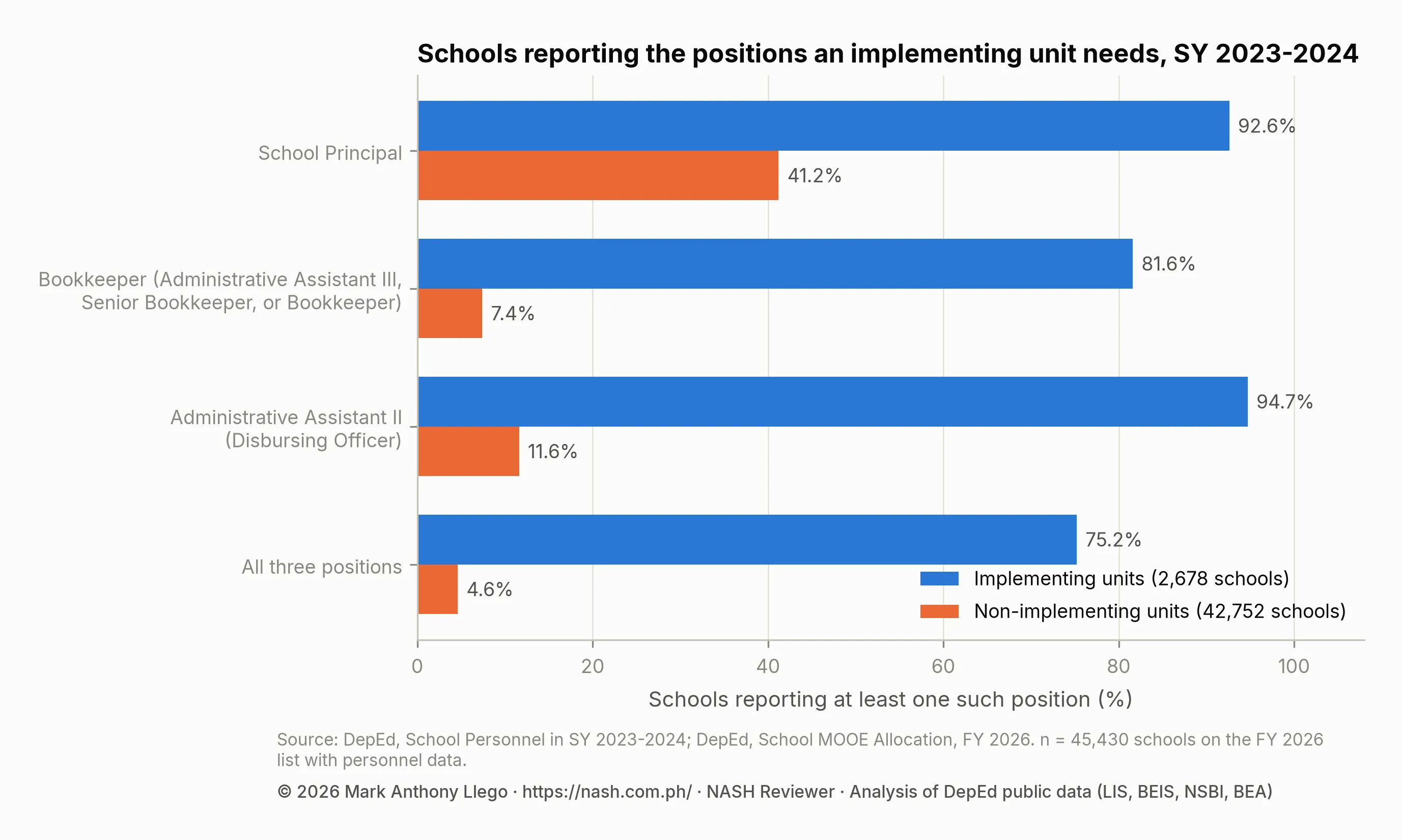
Of the 42,752 non-IU schools with personnel data:
- 17,593 (41.2%) reported a principal;
- 3,152 (7.4%) reported a bookkeeper;
- 4,968 (11.6%) reported a disbursing officer; and
- 1,973 (4.6%) reported all three.
Those 1,973 schools are the nearest candidates. More than half, 1,125, are elementary-only schools, which could not have qualified before October 2025, and 710 are junior and senior high schools. In the FY 2026 list, 848 of the 1,973 also carry an organization code.
Two limits apply to these counts. The personnel data are from SY 2023-2024, before the 2025 order, so positions created or filled after that year are not in them. And the file records positions a school reported, which is not the same as the DBM’s test for activating a code. The finance staff are the binding shortage: nine in ten non-IU schools reported no bookkeeper.
What EDCOM II found, and what it recommends
The Second Congressional Commission on Education treats the non-IU route as a bottleneck.
- Releases are delayed. “A non-IU school cannot receive its school MOOE budget directly. Instead, school heads have to regularly submit monthly cash advance requests and liquidation reports to access portions of the school’s MOOE allotment from their division office. Potential delays are compounded for schools in remote and isolated locations” (EDCOM II Year Two Report, p. 358).
- Some divisions hold money back. EDCOM II’s consultations “revealed that it is a prevalent practice for some SDOs to withhold portions of the MOOE funds allocated to non-IU schools instead of releasing the full amount, beyond the necessity of risk management” (Laguda et al., 2025, p. 28). DO 008, s. 2019 requires the opposite: the full allocation downloaded by year end.
- Routine spending waits on the division. Processing MOOE through division offices “subjects routine expenditures to additional layers of approval, procurement, and liquidation requirements that already-stretched division offices struggle to process efficiently” (EDCOM II Final Report, p. 370).
Its recommendation is to expand coverage by rule, not case by case. “In coordination with DBM, DepEd should establish clear and evidence-based thresholds (i.e., minimum student population size, enrollment across multiple grade levels, or annual budget allocation) that determine which schools possess sufficient scale to merit IU designation”. Schools below the thresholds “may be clustered under a lead school to achieve economies of scale while still benefiting from more direct fund access” (Final Report, p. 372). The National Education Plan adds that DepEd should “strategically expand the number of Implementing Units (IUs) by prioritizing schools with large enrollment size” (Final Report, p. 497).
DepEd’s own plan goes further. The Quality Basic Education Development Plan sets a target of 100% of schools as implementing units by 2031, from a baseline of 5.88% (Annex 6), as the Q-BEDP guide sets out. DO 033, s. 2025 widened the criteria in October 2025. The distance is long: 43,122 schools were non-IUs in the FY 2026 list, 18 had been converted since the FY 2025 list, and the three criteria exclude every school without a principal or finance staff. Both lists were drawn up before the first yearly cycle under DO 033, s. 2025 reached its May 2026 notice, so neither shows what that cycle converted. The plan sets no figure for 2028. RA 9155 at 25: Why Shared Governance Has Not Happened places the question in the larger debate on decentralization.
What changes for a school that becomes an implementing unit
Direct release brings direct accountability. An implementing unit:
- opens its own Modified Disbursement Scheme sub-account in a government depository bank, to which the DBM issues its cash allocation (DO 008, s. 2019, Sec. V.A, item 2, and Sec. V.B, item 2);
- maintains its own sets of books of accounts (Sec. V.B, item 2.1);
- keeps recording separate from the handling of cash, which is why it needs two finance positions and not one (Financial Management Operations Manual, p. 126); and
- submits its own financial statements and reports to the oversight agencies, a duty the 2025 order names when it promises technical assistance (Financial Management Operations Manual, pp. 126-127; DO 033, s. 2025, par. 3).
The school head of an implementing unit answers for obligations, disbursements, books and reports, not only for a cash advance. The guide to DepEd’s Financial Management Operations Manual covers those duties.
What this means for school heads
If your school is a non-IU, which is likely:
- Know your allocation and ask for it in writing. The division office must inform you in writing of the school’s annual MOOE (DO 008, s. 2019, Sec. V.C, item 2.1), and DepEd posts every school’s amount online.
- Liquidate on time, every month. The next advance is granted only when your register covers at least 75% of the last one (Sec. V.C, item 3.3). A late or incomplete liquidation holds up the next release.
- Track what has been released against what was allocated. If releases fall short while your liquidations are current, write to the superintendent, cite the three rules above (Sec. V.C, item 2.2), and keep a copy.
- Know when the division may buy for you. It may do so only in extreme cases, such as when you have unliquidated cash advances and cannot receive another, and it must then report the purchase to the regional office and the Central Office within 30 days (Sec. V.C, items 2.2 and 2.3). The report covers the items “listed by the receiving school”, so give the division your list in writing and keep a copy. Staying current on liquidation removes the ground for the exception.
If your school may qualify:
- Check the three criteria against your own records: an organization code (the FY 2026 list shows one for 8,077 non-IU schools), a filled principal position, and Administrative Assistant II and III positions that are filled.
- Keep the eSF7 accurate. The Central Office finds candidate schools there. A position that is filled but not encoded will not be seen.
- Prepare the people, not only the papers. A bookkeeper and a disbursing officer who have not kept books will need training before the first direct release.
If your school is an implementing unit: keep recording and cash handling in separate hands, and treat the financial reports as your own, because they are.
These duties fall under Domain 2 of the Philippine Professional Standards for School Heads, on managing school operations and resources.
Frequently asked questions
What is an implementing unit in DepEd?
A school that has its own bookkeeper and disbursing officer, keeps its own books of accounts, and receives its allotment and cash directly from the DBM (DO 008, s. 2019, Sec. V.A and V.B). In the FY 2026 allocation list, 2,679 of 45,801 schools are implementing units.
What is the difference between an IU and a non-IU school?
An implementing unit receives its MOOE directly and disburses it through its own finance staff. A non-implementing unit receives its MOOE from the Schools Division Office as cash advances, which the school head spends and liquidates by the 5th day of the following month (DO 008, s. 2019, Sec. V.B, item 2.2, and Sec. V.C, item 3.3).
Can an elementary school become an implementing unit?
Yes, since October 2025. DO 033, s. 2025 opened conversion to schools “whether elementary or secondary” (par. 2). The FY 2026 list, drawn up before the order’s first yearly cycle ended, shows no elementary-only school as an implementing unit.
How does a school apply to become an implementing unit?
It does not apply. Under DO 033, s. 2025 the Central Office identifies non-IU schools that have a filled principal position and the two finance positions, confirms them with the division offices, and asks the DBM to issue or activate each school’s organization code. Converted schools are notified in May.
Can the division office keep part of a non-IU school’s MOOE?
No, not past the end of the year. The division office must ensure that the school’s allocation is fully downloaded by the end of the year, and it may not buy goods or services centrally out of school MOOE for distribution in kind, except in extreme cases that it must report within 30 days after the procurement (DO 008, s. 2019, Sec. V.C, items 2.2 and 2.3). During the year, each release still waits on the liquidation of the one before.
Download the data
- Implementing units by region (CSV): schools, implementing units, their share, and school MOOE, FY 2026. Source: DepEd, School MOOE Allocation, FY 2026.
- Implementing units by division (CSV): schools and implementing units in each of the 219 divisions, FY 2026. Source: the same list.
- Implementing units by school size (CSV): schools and implementing units by enrollment, SY 2024-2025. Sources: the same list and DepEd enrollment data.
- Positions held (CSV): share of schools reporting a principal, a bookkeeper and a disbursing officer, SY 2023-2024. Source: DepEd, School Personnel in SY 2023-2024.
The CSVs and charts may be reused only with written permission: email support@nash.com.ph. The rules themselves come from DepEd’s issuances, which you can cite directly. The school-level files behind these counts are in Download Cleaned DepEd School Data.
Sources
DepEd issuances
- DepEd Order No. 008, s. 2019, Revised Implementing Guidelines on the Direct Release, Use, Monitoring and Reporting of Maintenance and Other Operating Expenses Allocation of Schools, Including Other Funds Managed by Schools (May 2, 2019), Enclosure, Secs. V.A, V.B, V.C and VI.A.
- DepEd Order No. 40, s. 2014, Establishment, Merging, Conversion, and Naming/Renaming of Public Schools, and Separation of Public School Annexes in Basic Education (August 26, 2014), Part IV, items 15 and 16, and Part VI.B, item 4.a.
- DepEd Order No. 033, s. 2025, Amendment to DepEd Order No. 40, s. 2014 (October 9, 2025), pars. 2 and 3 and the Enclosure.
- DepEd Order No. 029, s. 2019, Procedural Guidelines on the Management of Cash Advances for School Maintenance and Other Operating Expenses and Program Funds of Non-Implementing Units (October 17, 2019).
- COA-DBM-DepEd Joint Circular No. 2019-1, Management of Cash Advances to DepEd Non-Implementing Units for School MOOE and Program Funds (February 4, 2019).
- DepEd, Financial Management Operations Manual (2016), pp. 126-127, adopted by DepEd Order No. 60, s. 2016.
- DepEd, Quality Basic Education Development Plan 2025-2035 (July 29, 2025), Annex 6, p. 43.
Reports
- Second Congressional Commission on Education (2025). Fixing the Foundations: A Matter of National Survival, EDCOM II Year Two Report, p. 358.
- Second Congressional Commission on Education (2026). Turning Point: A Decade of Necessary Reform (2026-2035), EDCOM II Final Report, pp. 370, 372 and 497.
- Laguda, R., Aquino, G., Cangayao, L., and Tagle, R. (2025). Realizing Shared Governance: Decentralization of Philippine Basic Education. The Asia Foundation and EDCOM II, p. 28.
Data
- DepEd, School MOOE Allocation, FY 2026 (45,801 schools) and Public Schools MOOE Allocation, FY 2025 (45,229 schools).
- DepEd enrollment data by school, SY 2024-2025, and DepEd, School Personnel in SY 2023-2024.
Written by Mark Anthony Llego for NASH Reviewer. Sources: DepEd Orders No. 008, s. 2019, No. 40, s. 2014 and No. 033, s. 2025; DepEd’s School MOOE allocation lists for FY 2025 and FY 2026, its enrollment data and its school personnel file; the Quality Basic Education Development Plan 2025-2035; the EDCOM II Year Two and Final Reports; Laguda et al. (2025). Charts may be reused only with written permission from support@nash.com.ph.