

A Learning Action Cell (LAC) session on the Performance Management and Evaluation System (PMES) for School Year (SY) 2026-2027 can be run in 90 minutes with the 44-slide PowerPoint on this page. The slides teach the rules of Memorandum DM-OSEC-OUHRODI-2026-0003 of November 9, 2026: one rated classroom observation in Term 2 or Term 3, 12 indicators of the Philippine Professional Standards for Teachers (PPST), and evidence from a teacher’s regular work. They then put teachers to work on their own documents and lesson plans.
The memorandum itself names LAC sessions among the formative support a school gives its teachers (item 6) and sends schools to DepEd Order (DO) No. 35, s. 2016 for how to run one (item 7). Under that order a session’s activities “can include stimulus”, such as a lecture or a workshop, “followed by collaborative discussion of possible ways forward”, and “The final activity of the session will involve individual and group action planning” (item 18). A session that stops at reading a memorandum aloud has only the stimulus, and its announcements belong in the administrative meetings that DO 35 asks schools to schedule separately (item 17.5).
The rules below are those in force on November 27, 2026. The guide to PMES 2026-2027 explains each rule of the memorandum, and the guide to DM 089’s PMES for teachers covers what the memorandum leaves unchanged.
Key findings
- DepEd counts LAC sessions as formative support. “Formative support may be provided through various activities, including, but not limited to, coaching, mentoring, conducting feedback sessions, facilitating Learning Action Cell (LAC) sessions, conducting Lesson Study and walkthrough observations, engaging in professional reflection, and providing technical assistance” (DM-OSEC-OUHRODI-2026-0003, item 6).
- A LAC session gives no rating. “Formative activities shall not substitute for evaluative classroom observation, generate unofficial performance ratings, or be imposed as additional rated observations” (item 10).
- Its records can serve as evidence. DepEd’s PMES tool for Teachers I to III lists “LAC or other professional learning community records or outputs” for Objectives 9, 11 and 12, which are indicators 5.5.2, 7.3.2 and 7.4.2 (Reference Matrix of Possible Means of Verification).
- Taking part is not yet Satisfactory. For indicator 7.3.2, the tool’s Unsatisfactory level is a teacher who “Participated in professional networks but demonstrated limited sharing of knowledge, experiences, or teaching practices” (Objective 11). The session below gives every member something to share.
- DO 35 describes a session and recommends its hours. A session’s activities “can include stimulus” followed by “collaborative discussion of possible ways forward”, and its final activity is “individual and group action planning” (item 18). “One to two hours a week is strongly recommended”, and sessions “should be conducted at least once a month” (item 17.5).
- The session belongs in the Instructional Block. “Learning Action Cell (LAC) sessions shall continue to be conducted within the Instructional Block” (DO 009, s. 2026, item 22). Term 2’s Instructional Block ends with the Term 2 Examination on December 3 and 4, 2026, and Term 3 starts on January 4, 2027 (Annex B).
- The deck has six parts. Six slides open the session, 19 give the rules, 11 run two workshops and three school situations, and the last eight hold each teacher’s plan, the answers to six opening statements, and the sources.
Download the LAC session PowerPoint (PPT) on PMES 2026-2027
Download: LAC session on the PMES for teachers, SY 2026-2027 (PPTX, 44 slides, 334 KB). The file opens in PowerPoint and in LibreOffice Impress, and every slide can be edited.
Each slide that states a rule names the item of the issuance it rests on, most often the memorandum or DepEd Memorandum (DM) No. 089, s. 2025, so a teacher can check the slide against DepEd’s text. The notes under the slides give the facilitator the fuller rule and what to ask the group. The deck is NASH Reviewer’s own work and is not a DepEd material.
Two of DepEd’s own files belong beside it on the table: the memorandum (PDF, 4 pages) and the PMES tool for the members’ positions, for its matrix of evidence. The tool for Teachers I to III (PDF, 15 pages) and the tool for Teachers IV to VII (PDF, 15 pages) are DepEd’s files, unchanged.
Is the PMES a proper topic for a LAC session?
Yes, when teachers work on their own practice in it. DO 35 lets teachers choose what a LAC takes up “under the general guidance of the school head or LAC leader” (item 14), asks them to “find time to discuss” how the sessions “promote their own professional growth”, and adds that “LAC sessions also cover DepEd thrusts and policies” relevant to their priority needs (item 16). It names the sources of those needs: “self-assessment tools, classroom observation results, critical reflections, surveys” and others, read against “the professional teacher standards set for one’s career stage” (item 17.1). The PMES rates teachers on those standards.
The same order draws the line a PMES session can cross. Schools “are encouraged to prioritize LAC sessions instead of administrative meetings, which should be scheduled separately from LAC sessions” (item 17.5). An hour in which the school head reads the memorandum and announces deadlines has no discussion and no action planning, and its announcements belong in those meetings. The 2026 memorandum asks for more than that: LAC sessions “shall provide a positive, supportive, and safe environment for professional dialogue, reflection, and continuous improvement” (item 7).
So the plan gives the rules 25 of its 90 minutes. In the rest, each teacher lists the documents their work has already produced, a group annotates one member’s lesson plan, and everyone leaves with a plan of their own. The guide to LAC session problems covers sessions that have turned into meetings, lectures or echo seminars.
LAC session plan on the PMES: 90 minutes, or two one-hour sittings
The session has six parts: an opening, the rules, two workshops, three school situations, and the plans. DO 35 fixes only the end: the final activity of a session is action planning (item 18). The order of the other parts and the time given to each are a plan a school can change, and the deck prints the 90-minute version on its third slide.
A session plan on DO 35, s. 2016, item 18
Who has the floor in a LAC session on the PMES
Each band is a stretch of the session: the top lane when the facilitator talks, the bottom lane when teachers work. Choose a length. Enter a starting time to read the parts on the clock.
90 minutes
One sitting, the plan printed on the deck’s third slide.
Teachers have the floor for 54 of 90 minutes. The facilitator has it for 36.
Part 1: Open: objectives, norms, six statements
Minute 0 to 1010 minutesslides 1 to 6
- Facilitator, 5 minStates the objectives and the order of the session, and recalls the group’s norms: what is said here is not rated.
- Teachers, 5 minMark six statements about this year’s PMES agree or disagree, two minutes alone and three with a partner. No answers yet.
For the record: Attendance, the topic, and who facilitates and documents.
Part 2: The rules for SY 2026-2027
Minute 10 to 3525 minutesslides 7 to 25
- Facilitator, 20 minPresents the rules: one rated observation in Term 2 or Term 3, the 12 indicators, strand 3.2 or 3.5, evidence from regular work, and what stays formative.
- Teachers, 5 minAsk their questions. Any question the memorandum does not answer is written down for the school head.
For the record: The questions asked, and those the memorandum leaves open.
Part 3: Workshop 1: the evidence we already have
Minute 35 to 5015 minutesslides 26 to 28
- Facilitator, 2 minGives the four steps and shows the worked example.
- Teachers, 13 minList the documents their regular work has produced, write the indicators each can support, and tell a partner what a rater would need to see in one of them.
For the record: The practices members shared, and each indicator someone has no document for yet.
Part 4: Workshop 2: annotate a lesson plan for strand 3.5
Minute 50 to 7020 minutesslides 29 to 32
- Facilitator, 4 minReads what item 15(b) asks of an annotation and shows the sample.
- Teachers, 16 minIn groups of three or four, annotate two parts of one member’s lesson plan, then read one annotation to everyone.
For the record: One annotation from each group, and what the others said of it.
Part 5: Three situations
Minute 70 to 8010 minutesslides 33 to 36
- Teachers, 7 minSay what they would do in each of three school situations before the rule is shown.
- Facilitator, 3 minShows the item of the memorandum that settles each situation.
For the record: What the group agreed to do in each situation.
Part 6: Our plans, and the six statements again
Minute 80 to 9010 minutesslides 37 to 44
- Teachers, 8 minWrite their own plan in silence (their case for 3.2 or 3.5, two dates to propose, a document for each indicator), then agree on the group’s questions and what each member brings next time.
- Facilitator, 2 minReturns to the six statements with the item that settles each, and closes.
For the record: The next courses of action: who reports back on what, and when.
Two one-hour sittings
For a LAC that meets an hour a week: the rules and the evidence in the first week, the lesson plans in the second.
Teachers have the floor for 76 of 120 minutes. The facilitator has it for 44.
First sitting, 60 minutes
Part 1: Open: objectives, norms, six statements
Minute 0 to 1010 minutesslides 1 to 6
- Facilitator, 5 minStates the objectives and the order of the session, and recalls the group’s norms: what is said here is not rated.
- Teachers, 5 minMark six statements about this year’s PMES agree or disagree, two minutes alone and three with a partner. No answers yet.
For the record: Attendance, the topic, and who facilitates and documents.
Part 2: The rules for SY 2026-2027
Minute 10 to 3525 minutesslides 7 to 25
- Facilitator, 20 minPresents the rules: one rated observation in Term 2 or Term 3, the 12 indicators, strand 3.2 or 3.5, evidence from regular work, and what stays formative.
- Teachers, 5 minAsk their questions. Any question the memorandum does not answer is written down for the school head.
For the record: The questions asked, and those the memorandum leaves open.
Part 3: Workshop 1: the evidence we already have
Minute 35 to 5015 minutesslides 26 to 28
- Facilitator, 2 minGives the four steps and shows the worked example.
- Teachers, 13 minList the documents their regular work has produced, write the indicators each can support, and tell a partner what a rater would need to see in one of them.
For the record: The practices members shared, and each indicator someone has no document for yet.
Part 4: Close: what to bring next time
Minute 50 to 6010 minutesslide 38
- Teachers, 7 minWrite the first lines of their own plan: their case for 3.2 or 3.5, two dates to propose, and a document for each indicator.
- Facilitator, 3 minAsks each member to bring one lesson plan used in class to the second sitting.
For the record: What each member brings to the second sitting.
Second sitting, 60 minutes
Part 1: Report back
Minute 0 to 1010 minutes
- Teachers, 8 minSay what they found when they matched their documents, and which indicator still has none.
- Facilitator, 2 minRecalls the rule for strands 3.2 and 3.5 (the deck’s slide 19).
For the record: What each member reported.
Part 2: Workshop 2: annotate a lesson plan for strand 3.5
Minute 10 to 3525 minutesslides 29 to 32
- Facilitator, 4 minReads what item 15(b) asks of an annotation and shows the sample.
- Teachers, 21 minIn groups of three or four, annotate two parts of one member’s lesson plan, then read one annotation to everyone.
For the record: One annotation from each group, and what the others said of it.
Part 3: Three situations
Minute 35 to 4510 minutesslides 33 to 36
- Teachers, 7 minSay what they would do in each of three school situations before the rule is shown.
- Facilitator, 3 minShows the item of the memorandum that settles each situation.
For the record: What the group agreed to do in each situation.
Part 4: Our plans, and the six statements again
Minute 45 to 6015 minutesslides 37 to 44
- Teachers, 10 minWrite their own plan in silence (their case for 3.2 or 3.5, two dates to propose, a document for each indicator), then agree on the group’s questions and what each member brings next time.
- Facilitator, 5 minReturns to the six statements with the item that settles each, and closes.
For the record: The next courses of action: who reports back on what, and when.
Two hours
One sitting with longer workshops, for a group that annotates a lesson plan for every member’s subject.
Teachers have the floor for 79 of 120 minutes. The facilitator has it for 41.
Part 1: Open: objectives, norms, six statements
Minute 0 to 1010 minutesslides 1 to 6
- Facilitator, 5 minStates the objectives and the order of the session, and recalls the group’s norms: what is said here is not rated.
- Teachers, 5 minMark six statements about this year’s PMES agree or disagree, two minutes alone and three with a partner. No answers yet.
For the record: Attendance, the topic, and who facilitates and documents.
Part 2: The rules for SY 2026-2027
Minute 10 to 4030 minutesslides 7 to 25
- Facilitator, 22 minPresents the rules: one rated observation in Term 2 or Term 3, the 12 indicators, strand 3.2 or 3.5, evidence from regular work, and what stays formative.
- Teachers, 8 minAsk their questions. Any question the memorandum does not answer is written down for the school head.
For the record: The questions asked, and those the memorandum leaves open.
Part 3: Workshop 1: the evidence we already have
Minute 40 to 6020 minutesslides 26 to 28
- Facilitator, 2 minGives the four steps and shows the worked example.
- Teachers, 18 minList the documents their regular work has produced, write the indicators each can support, and tell a partner what a rater would need to see in one of them.
For the record: The practices members shared, and each indicator someone has no document for yet.
Part 4: Workshop 2: annotate a lesson plan for strand 3.5
Minute 60 to 9030 minutesslides 29 to 32
- Facilitator, 4 minReads what item 15(b) asks of an annotation and shows the sample.
- Teachers, 26 minIn groups of three or four, annotate two parts of one member’s lesson plan, then read one annotation to everyone.
For the record: One annotation from each group, and what the others said of it.
Part 5: Three situations
Minute 90 to 10515 minutesslides 33 to 36
- Teachers, 11 minSay what they would do in each of three school situations before the rule is shown.
- Facilitator, 4 minShows the item of the memorandum that settles each situation.
For the record: What the group agreed to do in each situation.
Part 6: Our plans, and the six statements again
Minute 105 to 12015 minutesslides 37 to 44
- Teachers, 11 minWrite their own plan in silence (their case for 3.2 or 3.5, two dates to propose, a document for each indicator), then agree on the group’s questions and what each member brings next time.
- Facilitator, 4 minReturns to the six statements with the item that settles each, and closes.
For the record: The next courses of action: who reports back on what, and when.
How a session is described, and the recommended hours: DepEd Order No. 35, s. 2016, items 17.5 and 18. The minutes and the slide numbers are this plan’s own.
Hold the session on a day of the Instructional Block. DO 009, s. 2026 keeps LAC sessions “within the Instructional Block” and promises a later issuance on their scheduling (item 22). For this topic that leaves the last days of Term 2’s Instructional Block, which ends with the Term 2 Examination on December 3 and 4, 2026, or the first weeks of Term 3, which starts on January 4, 2027 (DO 009, s. 2026, Annex B). The year’s one rated observation falls in Term 2 or Term 3 (memorandum, item 11), so a session in early January still comes before the observations a school holds in Term 3.
The time is part of the teacher’s working day. “Attendance to Learning Action Cell (LAC) sessions” is one of the ancillary tasks that fill two of a teacher’s eight hours (DO 005, s. 2024, Sec. V.A.3).
One LAC “could be composed of five (5) to 15 members” (DO 35, item 17.3). A school with forty teachers runs the session in its LACs, by grade level or learning area, and the facilitators of those LACs can go through the deck together first.
Sample LAC session plan and what the facilitator prepares
The facilitator of a LAC “Prepares his/her session plan that identifies the topic, objectives, materials needed, and outline of activities (at the very least)” (DO 35, Annex 2, LAC Facilitator, item 9). DO 35 prescribes no form for it. The sample below fills those four parts for this session; a school changes what does not fit.
| Part of the plan | For this session |
|---|---|
| Topic | The PMES for teachers in SY 2026-2027: what Memorandum DM-OSEC-OUHRODI-2026-0003 changes for our observation and our evidence |
| Objectives | State the year’s rules and the item behind each. Tell the indicators rated in the one observation from those rated from evidence. Match existing documents to the five indicators rated from evidence. Annotate a lesson plan for strand 3.5. Leave with a personal plan. |
| Materials | The deck; the memorandum, on screen or printed; DepEd’s PMES tool for the members’ positions; paper for each member’s list and plan |
| Members bring | One lesson plan used in class, and nothing made for the session |
| Outline | The six parts above, with the time given to each |
| Roles | The facilitator runs the parts and keeps the time. The documenter of the month keeps the record. The school head, as LAC leader, receives the questions the memorandum does not answer. |
The memorandum has LAC sessions “Facilitated by the School Head or a designated LAC Leader” (item 7). DO 35’s terms of reference add that each LAC has “an assigned facilitator, preferably a Master Teacher or senior teacher or senior member of the faculty” (Annex 2, LAC Leader, item 3), and that the facilitator “Announces the LAC session including topic, time, venue, and other matters that the group should know” (LAC Facilitator, item 11).
The rater of the teachers in the room can still facilitate, since the session rates nothing. Under DM 089 the rater is the Master Teacher, Department Head or Assistant School Head where the school has one, and the school head where it has none (Table 18). Where a Master Teacher facilitates, the school head joins as a member and takes the questions that go to the Schools Division Office (SDO). Each rater agrees on observation dates with their own teachers (DM 089, item 46).
LAC session guide: the six parts and their slides
The session moves through the deck in order. Each part below names its slides, what the facilitator does, and what teachers do.
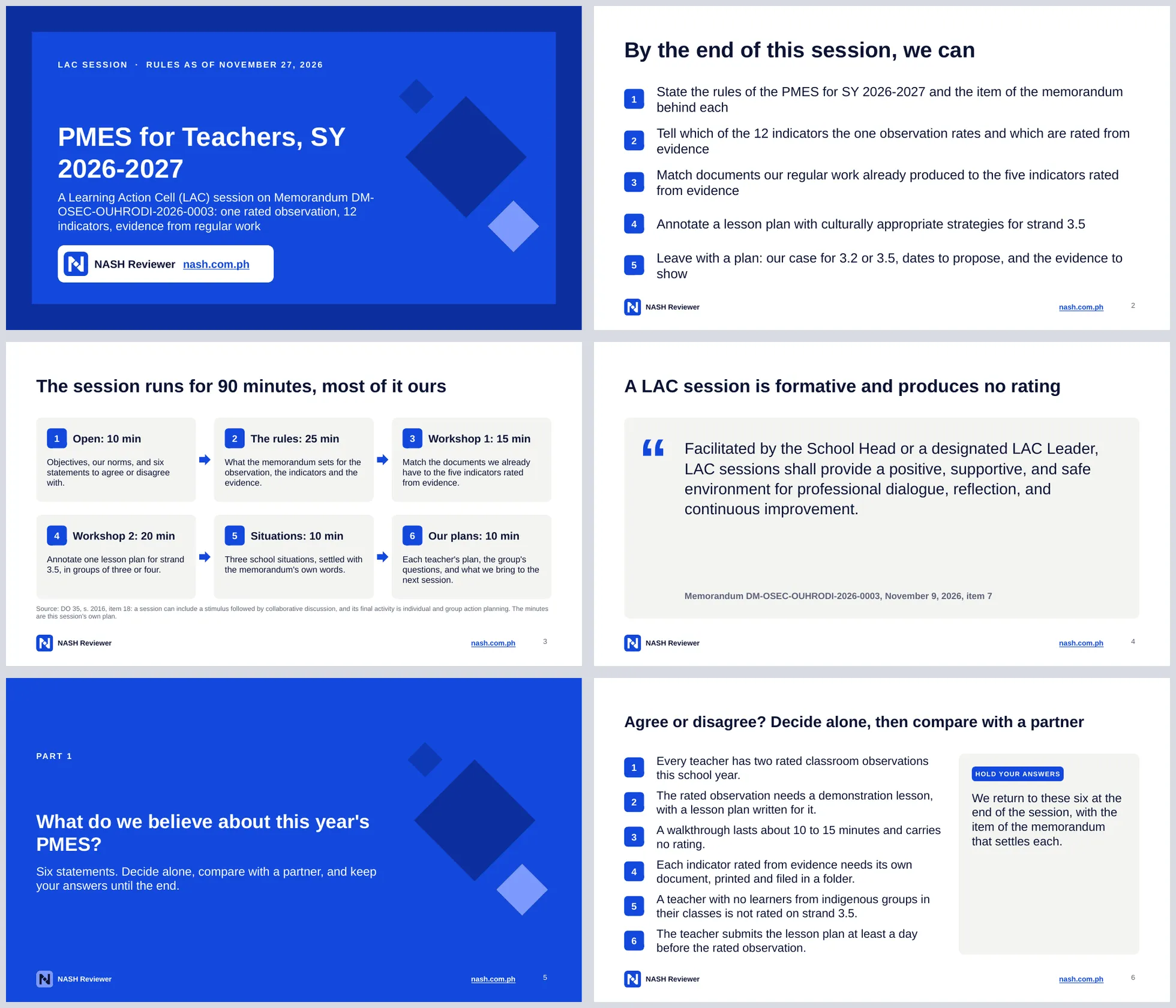
Part 1. Open with six statements (slides 1 to 6)
The first four slides give the title, five objectives, the order of the session and the memorandum’s sentence on a safe environment (item 7). The facilitator recalls the group’s own norms here. DO 35 lists confidentiality among them: “What content is to be held in confidence? What can be shared after the meeting?” (item 17.8).
Slide 6 then asks each member to mark six statements agree or disagree, alone and then with a partner. Two are true: a walkthrough lasts about 10 to 15 minutes and carries no rating (memorandum, item 8), and the lesson plan goes to the observer at least a day before the rated observation (DM 089, item 50). The other four are not: two rated observations a year, a demonstration lesson, a folder for every indicator, and no rating on strand 3.5 for a teacher with no learners from indigenous groups. The facilitator confirms nothing yet. The answers come back on slide 40, and a member who changed an answer in between can say which slide changed it.
Part 2. The rules for SY 2026-2027 (slides 7 to 25)
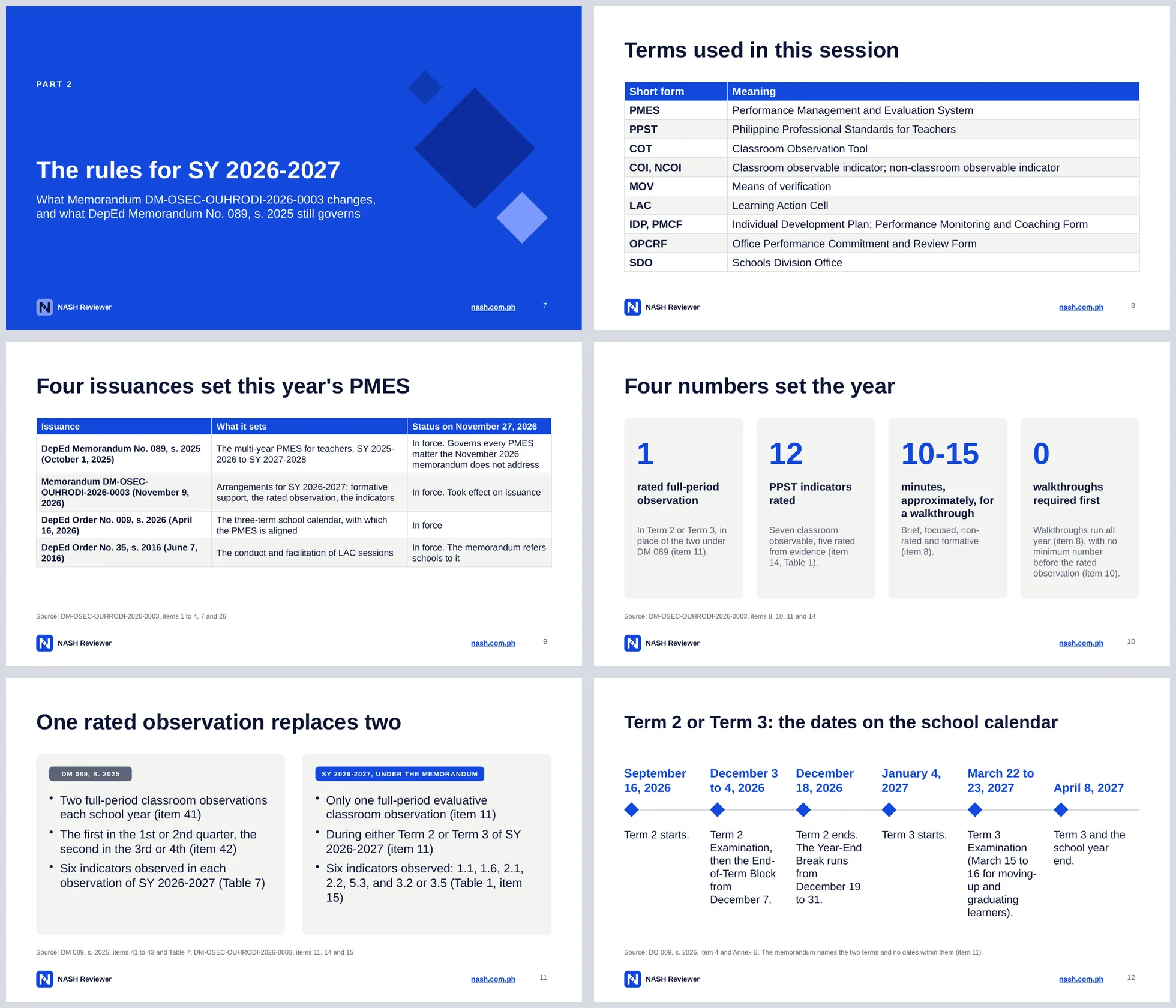
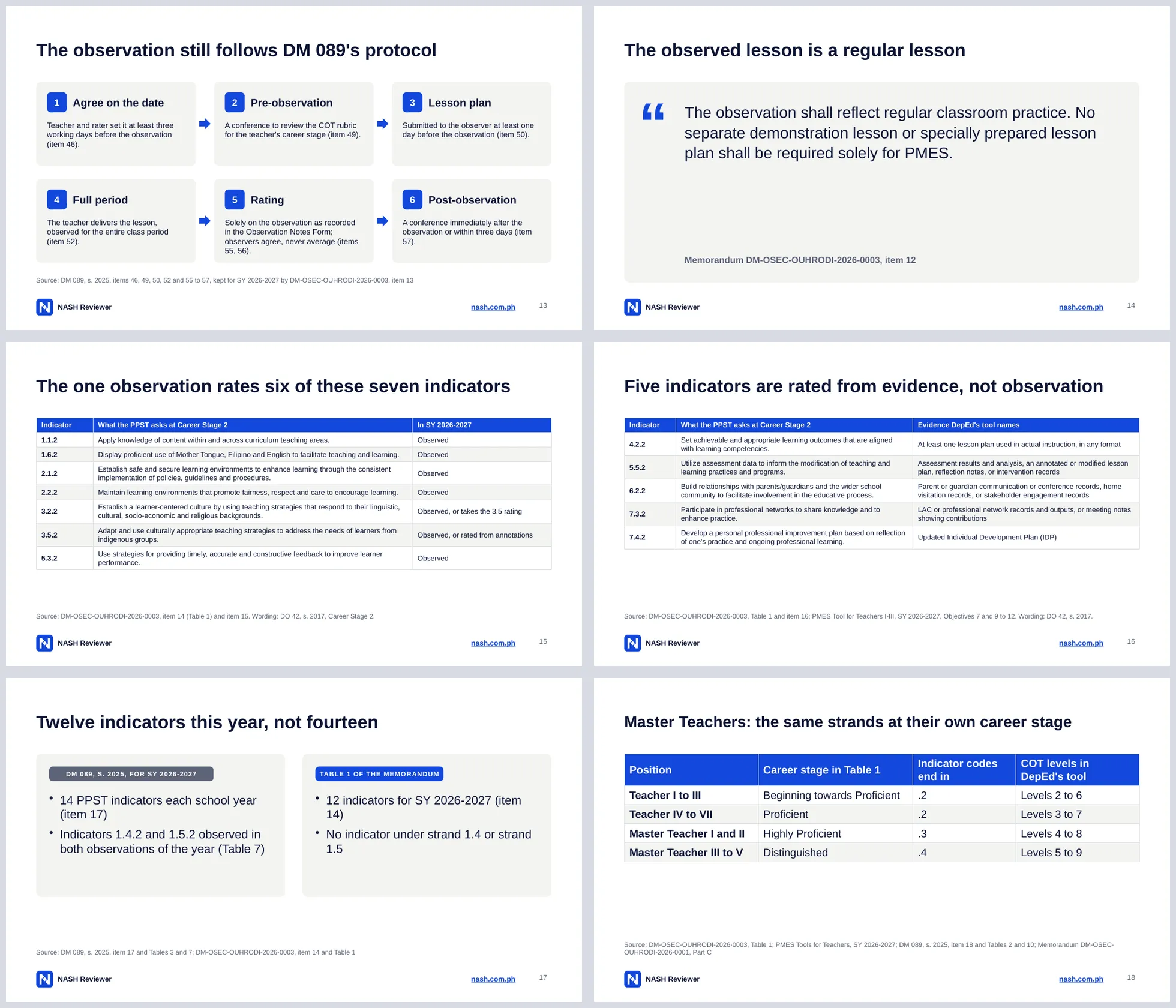
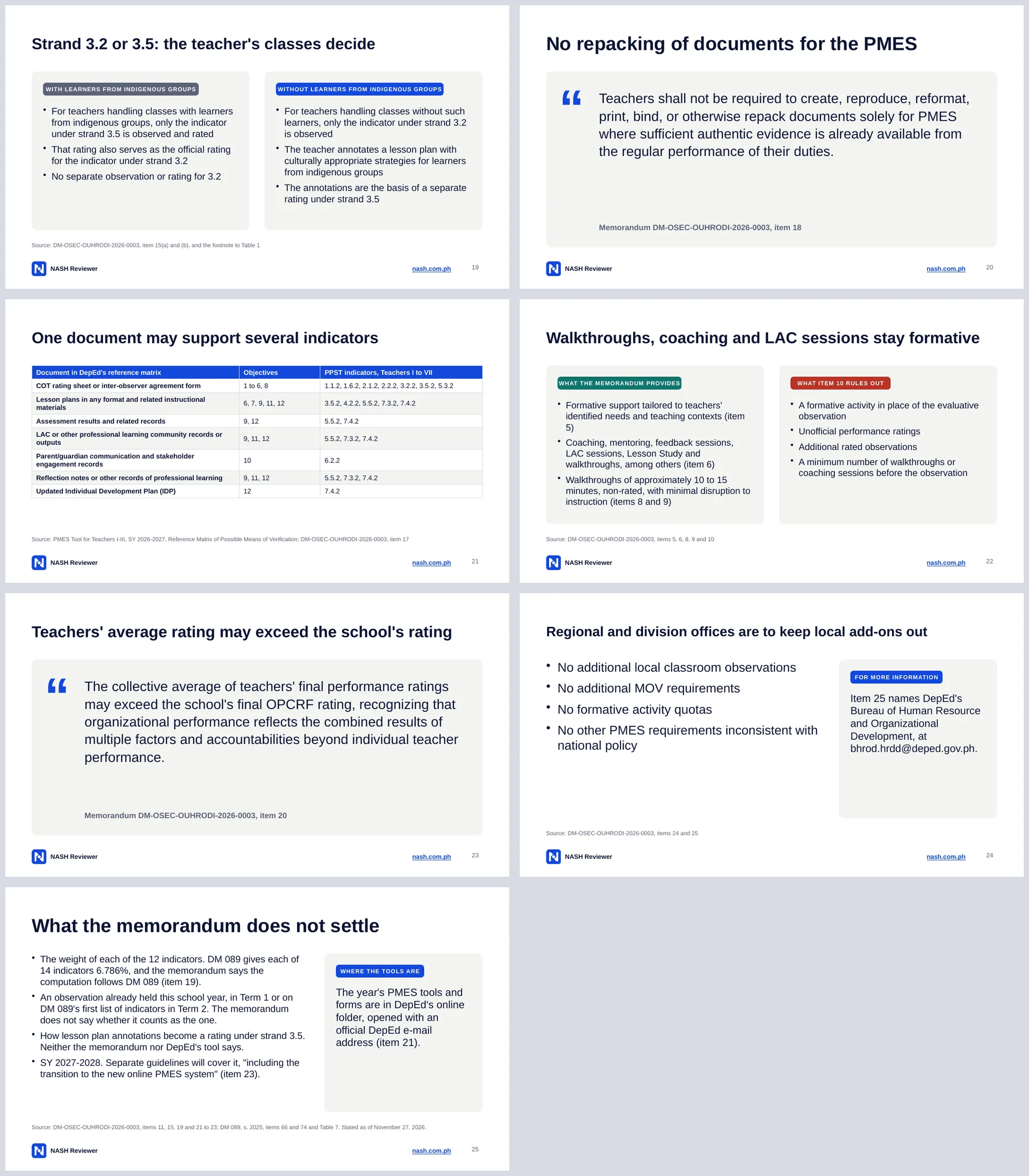
The stimulus of the session is 19 slides: a divider, a table of terms, and 17 slides that each make one point and cite its source.
| Slides | What they teach | Main sources |
|---|---|---|
| 8 to 10 | The terms, the four issuances behind this year’s PMES, and four numbers: one rated observation, 12 indicators, 10 to 15 minutes for a walkthrough, and no minimum number of walkthroughs | Memorandum, items 1 to 4, 8, 10, 11 and 14 |
| 11 to 14 | One full-period observation in Term 2 or Term 3 in place of two; the dates of both terms; DM 089’s observation protocol; a regular lesson with no demonstration lesson | Memorandum, items 11 to 13; DM 089, items 41, 42, 46 and 49 to 57; DO 009, s. 2026, Annex B |
| 15 to 19 | The seven classroom indicators, the five rated from evidence, strands 1.4 and 1.5 left out of the year, the levels for each position, and the rule for strands 3.2 and 3.5 | Memorandum, items 14 and 15 and Table 1; DM 089, items 17 and 18 |
| 20 to 21 | No repacking of documents, and DepEd’s matrix of the documents that may support several indicators | Memorandum, items 17 and 18; PMES tool, Reference Matrix |
| 22 to 25 | What stays formative, ratings that may exceed the school’s, no local add-ons, and what the memorandum does not settle | Memorandum, items 5 to 10, 19 to 21 and 23 to 25 |
Slide 25 lists what the memorandum does not settle. It does not restate the weight of each of the 12 indicators, it does not say whether an observation held earlier in the school year counts as the year’s one, and neither it nor DepEd’s tool says how lesson plan annotations become a rating. When a member asks about any of these, the answer is that the memorandum does not say. The question is written down for the school head to raise with the SDO.
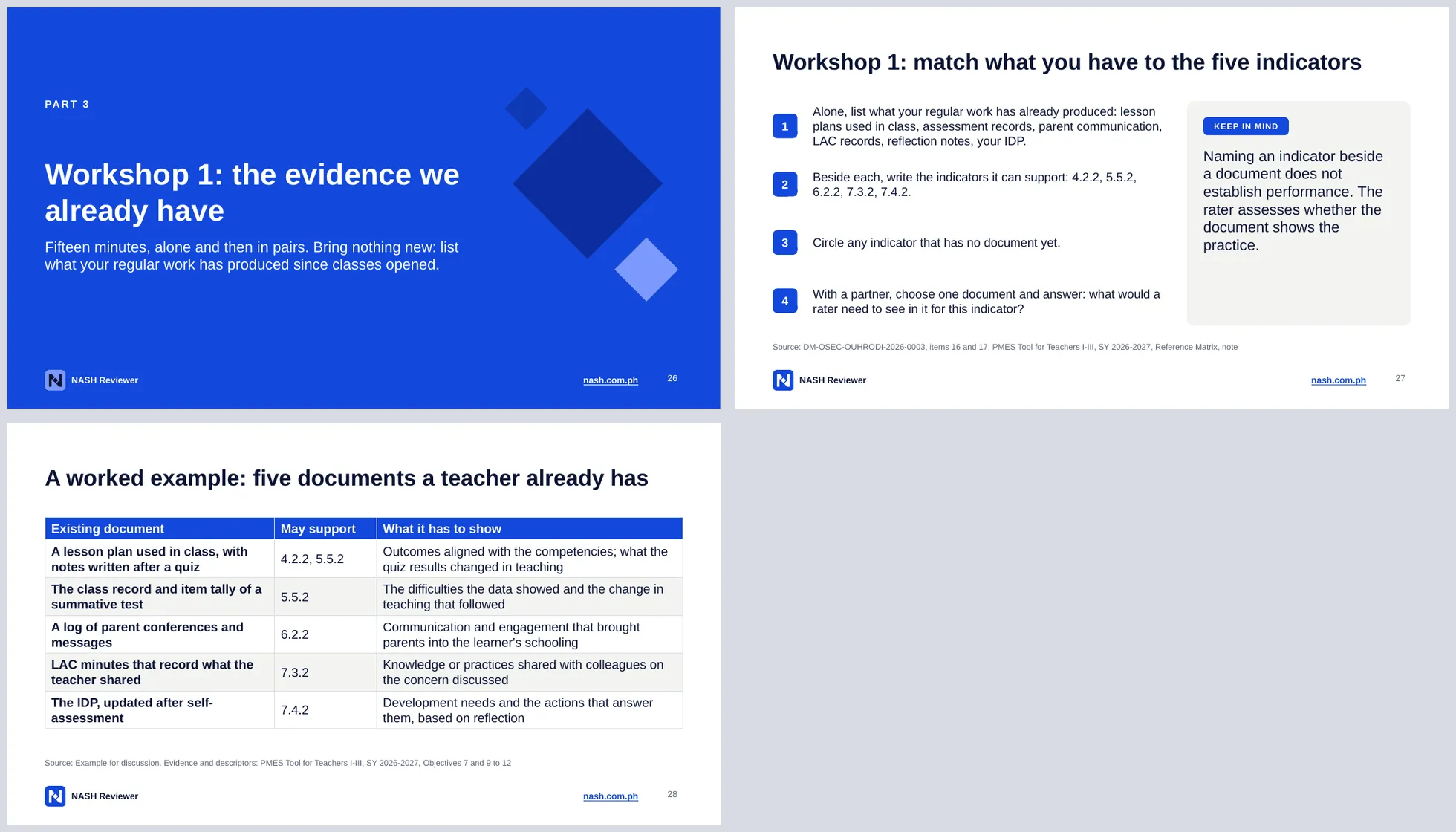
Part 3. Workshop 1: the evidence teachers already have (slides 26 to 28)
Five of the year’s 12 indicators are rated from “relevant and sufficient authentic evidence generated through teachers’ regular duties and responsibilities” (memorandum, item 16), and “One authentic MOV may support multiple NCOIs when relevant and sufficient” (item 17). MOV is means of verification, and an NCOI is a non-classroom observable indicator. In the first workshop each member lists what their work has produced since classes opened and writes beside each document the indicators it can support. Nobody prints or copies anything for it.
DepEd’s tool does half of the matching. Each PMES tool for SY 2026-2027 ends with a “Reference Matrix of Possible Means of Verification (MOV)”, which names kinds of document and the objectives each may support. The figure below reads the matrix of the tool for Teachers I to III from the indicator’s side. The tool for Teachers IV to VII prints the same seven rows.
Try it: DepEd’s reference matrix, SY 2026-2027
Which indicators can your documents support?
Tick the kinds of document your regular work has already produced. Each indicator below then lists those DepEd’s reference matrix marks for it.
4.2.2 Set achievable and appropriate learning outcomes that are aligned with learning competencies
Objective 7rated from evidence
On your list
- Lesson plans and materials
Nothing ticked for this indicator yet.
What DepEd’s tool asks for 4.2.2
Means of verification
“At least one (1) lesson plan used in actual instruction, in any format, showing learning outcomes aligned with the intended learning competencies.”
Satisfactory (3), Teachers I to III
“Set learning outcomes that are achievable, appropriate to the intended learners, and aligned with the intended learning competencies.”
5.5.2 Utilized assessment data to inform the modification of teaching and learning practices and programs
Objective 9rated from evidence
On your list
- Lesson plans and materials
- Assessment results
- LAC records and outputs
- Reflection notes
Nothing ticked for this indicator yet.
What DepEd’s tool asks for 5.5.2
Means of verification
“Any of the following existing documents or equivalent evidence, as applicable:
- Assessment results and analysis;
- Annotated or modified lesson plan;
- Reflection notes on assessment-informed instructional modifications; or
- Learning intervention or program records showing the use of assessment data.”
Satisfactory (3), Teachers I to III
“Used assessment data to identify learners' difficulties and implemented corresponding modifications to teaching and learning practices.”
6.2.2 Built relationships with parents/guardians and the wider school community to facilitate involvement in the educative process
Objective 10rated from evidence
On your list
- Parent and stakeholder records
Nothing ticked for this indicator yet.
What DepEd’s tool asks for 6.2.2
Means of verification
“Any of the following existing documents or equivalent evidence, as applicable:
- Parent/guardian communication or conference records;
- Home visitation records;
- Stakeholder engagement or participation records; or
- Records of collaborative activities or follow-up actions.”
Satisfactory (3), Teachers I to III
“Established positive relationships with parents/guardians and/or members of the wider school community through communication and engagement that facilitated their involvement in the educative process.”
This objective also has a timeliness measure: engaging parents and the community “at appropriate times” is Satisfactory.
7.3.2 Participated in professional networks to share knowledge and to enhance practice
Objective 11rated from evidence
On your list
- Lesson plans and materials
- LAC records and outputs
- Reflection notes
Nothing ticked for this indicator yet.
What DepEd’s tool asks for 7.3.2
Means of verification
“Any of the following existing documents or equivalent evidence, as applicable:
- LAC or professional network records and outputs;
- Meeting notes or collaborative learning outputs showing knowledge sharing or contributions;
- Instructional resources or teaching practices shared with colleagues; or
- Existing lesson plans, instructional outputs, or reflection notes demonstrating application of learning from professional exchanges.”
Satisfactory (3), Teachers I to III
“Participated in professional networks and shared relevant experiences, knowledge, or practices drawn from one's own teaching.”
7.4.2 Developed a personal professional improvement plan based on reflection of one's practice and ongoing professional learning
Objective 12rated from evidence
On your list
- Lesson plans and materials
- Assessment results
- LAC records and outputs
- Reflection notes
- Updated IDP
Nothing ticked for this indicator yet.
What DepEd’s tool asks for 7.4.2
Means of verification
“Updated Individual Development Plan (IDP), supported, as applicable, by existing reflection notes, professional learning records, self-assessment results, or other documents showing the basis for identified development needs.”
Satisfactory (3), Teachers I to III
“Developed a professional improvement plan identifying development needs and corresponding improvement actions based on reflection on teaching practice and professional learning.”
3.5.2 Adapted and used culturally appropriate teaching strategies to address the needs of learners from indigenous groups
Objective 6rated by observation or from annotations
On your list
- Lesson plans and materials
Nothing ticked for this indicator yet.
What DepEd’s tool asks for 3.5.2
Means of verification
“Classroom Observation Tool (COT) Rating Sheet or Inter-Observer Agreement Form or Annotated lesson plan from any class period/sessions highlighting possible teaching strategies for learners from indigenous groups.”
A classroom indicator. A teacher with no learners from indigenous groups in their classes is rated on it from annotations in a lesson plan (Memorandum DM-OSEC-OUHRODI-2026-0003, item 15(b)); a teacher whose classes include such learners is observed on it. Only one MOV is required.
“The identification of applicable objectives does not automatically establish performance. Raters shall assess whether the MOV sufficiently demonstrates the specific practice and performance criteria for each objective.”
PMES Tool for Beginning towards Proficient Teachers (Teachers I-III), SY 2026-2027, Reference Matrix of Possible Means of Verification, note
Nothing ticked yet.
Documents, objectives, lists of evidence and descriptors: PMES Tool for Beginning towards Proficient Teachers (Teachers I-III), SY 2026-2027 (PDF), pages numbered 7 to 14.
In the last step, each member picks one document with a partner and says what a rater would need to see in it. A lesson plan supports indicator 5.5.2 only if it shows what the assessment results changed in the teaching, since the tool’s Satisfactory level is a teacher who “Used assessment data to identify learners’ difficulties and implemented corresponding modifications to teaching and learning practices” (Objective 9). The matrix itself warns that naming an objective beside a document “does not automatically establish performance”.
A Master Teacher’s tool reads differently. For Master Teachers I and II the matrix lists “Learning Action Cell (LAC) records or other professional learning and collaborative records or outputs” for six objectives, because their indicators are about work with colleagues. The guide to Master Teachers’ PMES ratings covers their evidence.
Part 4. Workshop 2: annotating a lesson plan for strand 3.5 (slides 29 to 32)
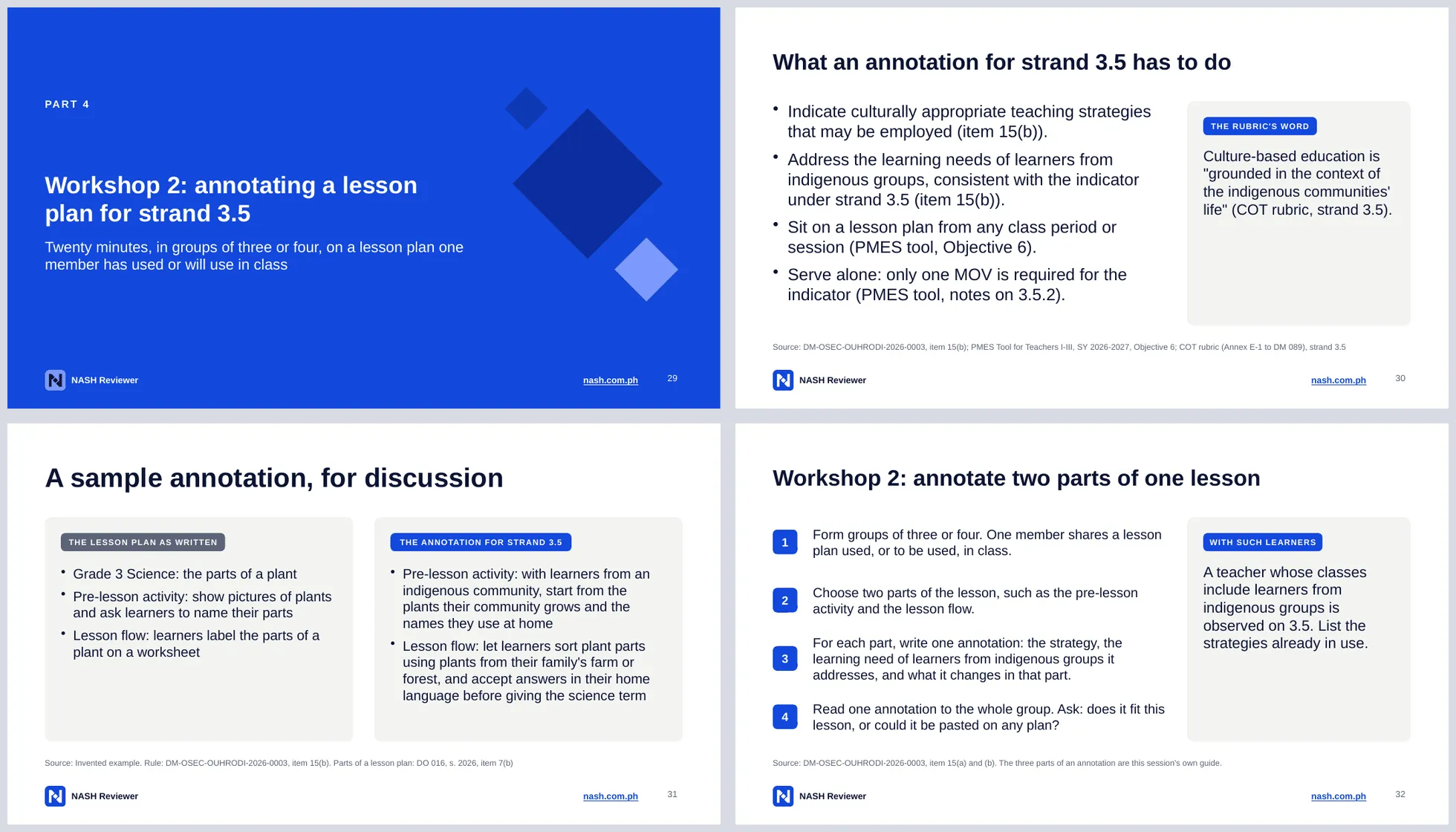
A teacher with no learners from indigenous groups in their classes is observed on indicator 3.2 and rated on 3.5 from a lesson plan. Such teachers “shall annotate their lesson plans to indicate culturally appropriate teaching strategies that may be employed to address the learning needs of learners from indigenous groups”, and “These annotations shall serve as the basis for a separate rating under Strand 3.5” (memorandum, item 15(b)). The tool accepts an “Annotated lesson plan from any class period/sessions”, and “Only one (1) MOV shall be required for the applicable indicator” (PMES tool, Objective 6).
The requirement dates from November 9, 2026, so the annotation is new work for a LAC to take up together. Groups of three or four take a lesson plan one member has used, choose two parts of the lesson, and write one annotation for each: the strategy, the learning need it addresses, and what it changes in that part. The third element is this session’s own addition, so that a rater can see where the strategy fits.
The deck’s sample annotates the pre-lesson activity and the lesson flow of a Grade 3 Science lesson. Both are parts of the Learning Experience in DepEd Order No. 016, s. 2026, which has governed lesson plans in full since Term 2 (item 43). The same element asks teachers to “incorporate relevant real-life, cultural, or community-based contexts” (item 7(b)(iv)), which is where an annotation for strand 3.5 sits most easily. The order also names LAC sessions among the “venues for collaborative planning and reflective professional discussions” (item 27). The guide to DO 016’s lesson plan explains its four elements. Each group then reads one annotation aloud, and the others ask whether it fits this lesson or could be pasted on any plan.
Neither the memorandum nor the tool says how annotations become a rating. The session therefore teaches what item 15(b) asks for and stops there. The sample action research proposal on lesson plan annotations has three annotated lesson plans to compare with the groups’ work.
A teacher whose classes include learners from indigenous groups is observed on 3.5, and that rating also counts for 3.2 (item 15(a)). In the workshop that teacher lists the strategies already in use, ready for the pre-observation conference. The memorandum does not say which class is observed when only some of a teacher’s classes have such learners. Item 15(a) speaks of “teachers handling classes with learners from indigenous groups”, so the safer course is to plan the observation in a class that has them and to confirm with the SDO.
DO 35 itself asks that “the members of the community participate in indigenization processes, so that the curriculum will be accurate and faithful to the culture in consideration” (item 15.5). What an annotation says about a community’s own knowledge should be checked with that community first.
Part 5. Three situations to settle together (slides 33 to 36)
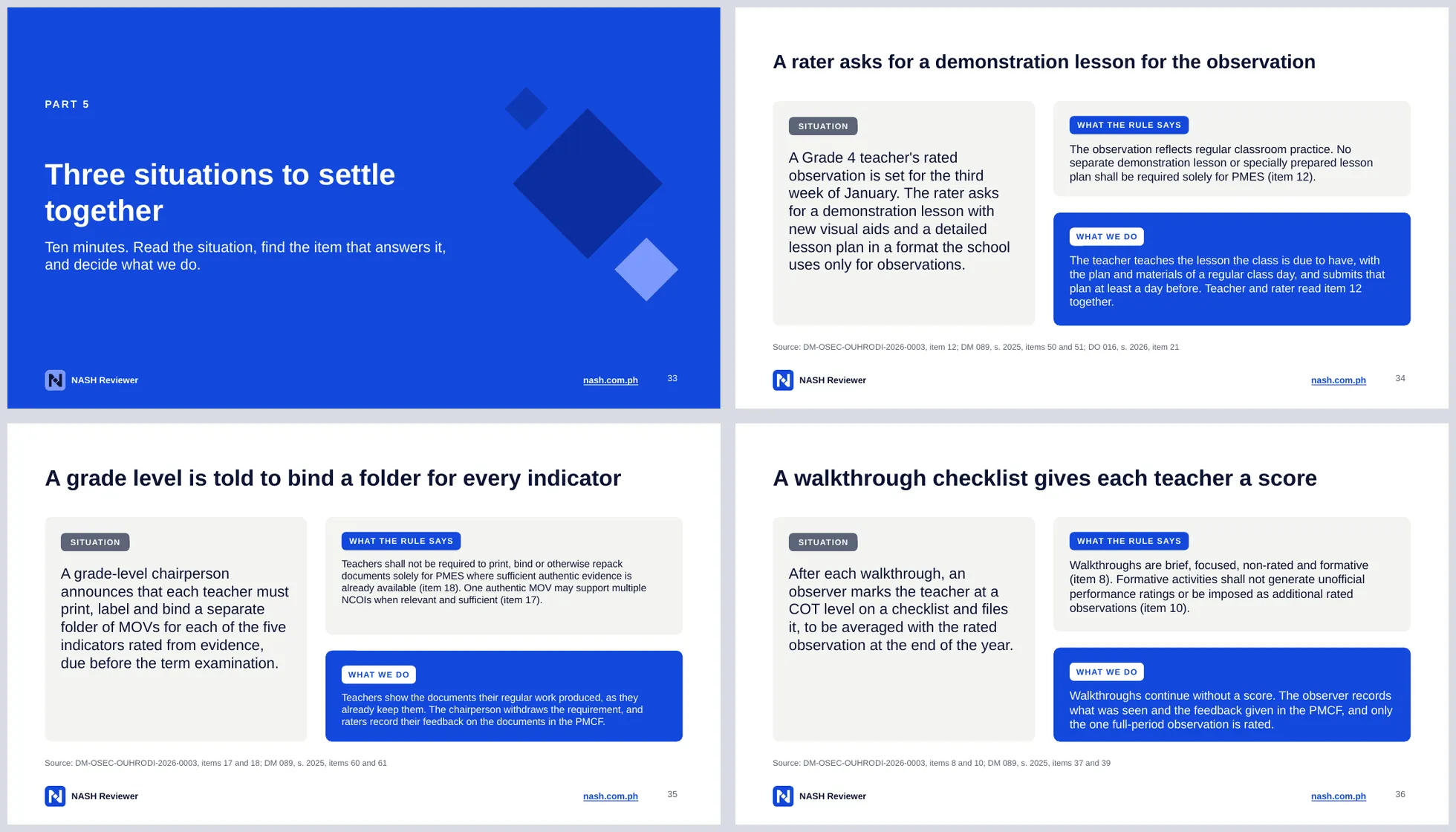
Each of slides 34 to 36 puts a school situation, then the rule, then what to do. The group answers before the rule is shown.
| Situation | The rule on the slide | What the group does |
|---|---|---|
| A rater asks for a demonstration lesson with a lesson plan in a special format | “No separate demonstration lesson or specially prepared lesson plan shall be required solely for PMES” (item 12) | The teacher teaches the lesson the class is due to have and submits its plan a day before |
| A grade level is told to bind a folder of MOVs for every indicator | No teacher is required to “print, bind, or otherwise repack documents solely for PMES” where authentic evidence already exists (item 18) | Teachers show their documents as they keep them, and raters record feedback in the Performance Monitoring and Coaching Form |
| A walkthrough checklist marks each teacher at a level of the Classroom Observation Tool (COT) | Formative activities shall not “generate unofficial performance ratings” (item 10) | Walkthroughs continue without a score, and only the one full-period observation is rated |
On the first, DO 016, s. 2026 adds that schools “shall not require additional or expanded lesson plan templates” (item 21). Regional and division offices are to see that no local requirement of this kind is imposed on teachers (memorandum, item 24). A LAC that has met one of them writes it down with the item that answers it and hands it to the school head.
Part 6. Plans, the six statements again, and the close (slides 37 to 44)
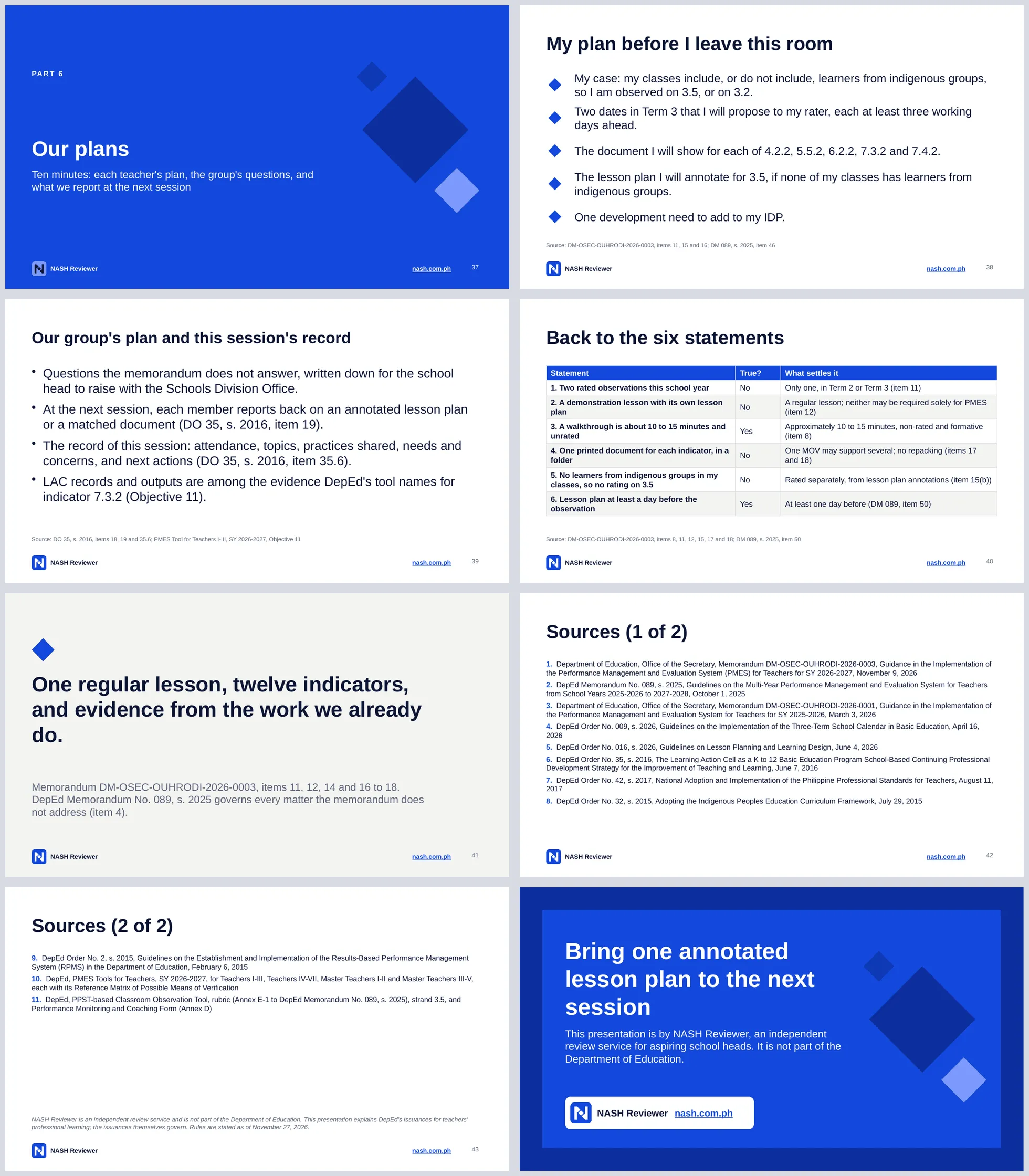
DO 35 ends every session with “individual and group action planning in order to implement agreed activities in the classroom” (item 18). On slide 38 each member writes five lines in silence:
- Whether their classes include learners from indigenous groups, and so whether they are observed on 3.5 or on 3.2.
- Two dates to propose to their rater, each at least three working days ahead (DM 089, item 46).
- The document they will show for each of 4.2.2, 5.5.2, 6.2.2, 7.3.2 and 7.4.2.
- The lesson plan they will annotate for 3.5, if none of their classes has learners from indigenous groups.
- One development need to add to their Individual Development Plan (IDP).
The plan stays with the teacher. Slide 39 holds the group’s part: the questions for the SDO, what each member reports at the next session, and what goes in the record. Slide 40 answers the six statements, slide 41 gives the session in one sentence, and the last three slides list the sources and close.
Sample minutes of the LAC session
DO 35 asks that “Proceedings of team meetings should be recorded” on a template that includes “a) attendance; b) topics of discussion; c) best practices that were shared during the meeting; d) current or emerging needs and concerns”, “evidence of whether Plan is working or not working”, and “next courses of action to be taken” (item 35.6). It prescribes no form. The sample below is an invented Grade 6 LAC of eight teachers, written on those six lines.
| Part of the record | What the documenter wrote |
|---|---|
| Attendance | Eight of eight members. Facilitator: the Master Teacher I of Grade 6. Documenter: the Mathematics teacher, whose turn it is this month. |
| Topic | The PMES for teachers in SY 2026-2027 (Memorandum DM-OSEC-OUHRODI-2026-0003) |
| Practices shared | The Science teacher writes each quiz’s least mastered competency on the next day’s lesson plan and re-teaches it, and offered the plans as evidence for 5.5.2. The Araling Panlipunan teacher keeps a one-line log of every message and conference with a parent. The English teacher read an annotation for a lesson on folk tales that begins from stories the learners’ own elders tell. |
| Needs and concerns | Three members have no record of parent communication since June. No member has taught learners from indigenous groups, and all asked for another session on annotations. Two members were observed in Term 1 and ask whether that observation counts. |
| Is the plan working? | All eight left with a list that matches their documents to the five indicators. Six changed at least one answer on the six statements. |
| Next courses of action | Each member brings one annotated lesson plan to the next session. The school head sends the question on Term 1 observations to the SDO. Raters and teachers agree on observation dates before the Year-End Break. |
Write what was shared, and by whom. What a member admitted, such as a lesson that failed, is the kind of item a LAC can agree to keep out of the record: DO 35 has each LAC settle “which items should be confidential and which can be shared after the meeting” (item 35.6).
DepEd Order No. 006, s. 2025 limits the forms teachers accomplish to those in its enclosures (item 4), which list the LAC plan and accomplishment report and no minutes. One short record a session, kept by the LAC, meets both orders. The guide to LAC session problems sets out the limits.
Does attending this LAC session count as PMES evidence?
The record can, when it shows what the teacher shared. Indicator 7.3.2, “Participate in professional networks to share knowledge and to enhance practice”, is one of the five rated from evidence this year, and the tool’s list for it begins with “LAC or professional network records and outputs” and “Meeting notes or collaborative learning outputs showing knowledge sharing or contributions” (Objective 11). The tool rates the sharing, at five levels.
| Rating | Teachers I to III | Teachers IV to VII |
|---|---|---|
| Outstanding (5) | “Participated in professional networks, shared relevant knowledge or teaching practices, and contributed insights or possible solutions to teaching challenges discussed with colleagues.” | “Participated in professional networks, shared relevant knowledge or teaching practices, contributed insights or possible solutions to teaching challenges, and applied learning from professional exchanges to improve teaching practice, with reflection on the results of its application.” |
| Very Satisfactory (4) | “Participated in professional networks and shared relevant knowledge or teaching practices that addressed the topics or teaching concerns discussed with colleagues.” | “Participated in professional networks, shared relevant knowledge or teaching practices, and contributed insights or possible solutions to teaching challenges discussed with colleagues.” |
| Satisfactory (3) | “Participated in professional networks and shared relevant experiences, knowledge, or practices drawn from one’s own teaching.” | “Participated in professional networks and shared relevant knowledge, experiences, or teaching practices with colleagues.” |
| Unsatisfactory (2) | “Participated in professional networks but demonstrated limited sharing of knowledge, experiences, or teaching practices.” | The same |
| Poor (1) | “Did not demonstrate participation or knowledge sharing in professional networks during the evaluation period. or No acceptable evidence was shown.” | The same |
An attendance sheet shows that a teacher took part and shows no sharing. The Satisfactory level asks for sharing “drawn from one’s own teaching”, and the tool’s level for participation with “limited sharing” is Unsatisfactory. Minutes that name the practice a teacher shared, as the sample above does, give the rater evidence of sharing. The rater decides the level.
Three limits apply. No one scores a member’s contribution at the session (memorandum, item 10). The rating is for the evaluation period: the tool sets no number of sessions or documents, and one session’s record is one piece of that evidence. And the matrix’s note binds every document: “Raters shall assess whether the MOV sufficiently demonstrates the specific practice and performance criteria for each objective.”
After the session: reporting back and follow-up
DO 35 expects the work to continue in classrooms. “LAC members are expected to implement the proposed strategies or activities in their classroom or school or community as appropriate and evaluate their success”, and “should be prepared to report back on the success of these activities in future LAC sessions” (item 19). For this session the report is short: the annotated lesson plan each member wrote, the document they found for an indicator that had none, and the date agreed with the rater.
The same item has school heads “support the LACs by doing class observations”. Under the memorandum such a visit is formative: a walkthrough is brief and non-rated, and no formative activity may be “imposed as additional rated observations” (items 8 and 10). The observer records the feedback in the Performance Monitoring and Coaching Form (DM 089, items 37 and 39) and gives no score.
A member whose list showed a gap, such as no record of parent communication, has a development need to write in the IDP. The tool’s evidence for indicator 7.4.2 is the “Updated Individual Development Plan (IDP)” (Objective 12), and the guide to the e-SAT shows how self-assessment answers become its priorities.
What this means for school heads
- Put the session in the LAC plan, on a day of the Instructional Block. The guide to DO 35 covers the LAC plan and its funding.
- Name the facilitator. The memorandum allows the school head or a designated LAC leader (item 7), and DO 35 prefers a Master Teacher or senior teacher as facilitator. The facilitator assigns the documenter, on rotation (DO 35, Annex 2).
- Keep announcements out. Deadlines for forms and the observation schedule itself go out in writing or in a separate meeting (DO 35, item 17.5).
- Rate nothing in the room. No score, checklist or ranking comes out of the session (memorandum, item 10). DM 089’s “Classroom Observation via Learning Action Cells” is another thing: an alternative mode of the rated observation itself, for times when school operations are disrupted (item 48).
- Ask for no new form. The LAC’s usual record is enough, and teachers “shall not be required to create, reproduce, reformat, print, bind, or otherwise repack documents solely for PMES” where sufficient authentic evidence already exists from their regular duties (item 18).
- Take the questions to the SDO. Regional and division offices “shall provide technical assistance to schools” on the memorandum (item 24). Bring the answers back at the next session.
- Schedule the observations with the teachers. “Schools shall schedule observations in consultation with teachers, considering class schedules and the number of teachers to be observed” (item 11). The dates members propose on slide 38 are a start, and the guide to instructional supervision covers the plan that holds them.
Leading this session draws on three strands of the Philippine Professional Standards for School Heads (PPSSH): 4.4, Performance management, 4.5, Professional development of school personnel, and 3.3, Teacher performance feedback. The guides to PPSSH Domain 4 and PPSSH Domain 3 explain them.
Frequently asked questions
Is there a PowerPoint (PPT) on PMES 2026-2027 for teachers?
The 44-slide PowerPoint on this page covers the PMES for teachers in SY 2026-2027 as a LAC session, with speaker notes and a source on each slide that states a rule. It is NASH Reviewer’s own and is not a DepEd material. DepEd’s tools and forms for the year are in the folder the memorandum links, which opens with an official DepEd email address (DM-OSEC-OUHRODI-2026-0003, item 21).
How long should a LAC session on the PMES be?
DO 35, s. 2016 sets no length for one session. It strongly recommends “One to two hours a week” for a LAC and requires a session at least once a month (item 17.5). The plan on this page takes 90 minutes, two sittings of an hour each, or two hours.
Who facilitates a LAC session on the PMES?
The school head or a designated LAC leader (DM-OSEC-OUHRODI-2026-0003, item 7). Under DO 35, s. 2016, the facilitator of a LAC “could be the Principal or School Head, a Master Teacher or a senior teacher or senior member of the faculty”, and the role “could be assigned on a rotation basis” (Annex 2).
Can a LAC attendance sheet be an MOV for the IPCRF in SY 2026-2027?
It is a LAC record, which DepEd’s tool lists for indicator 7.3.2 of the Individual Performance Commitment and Review Form (IPCRF), but attendance alone shows no sharing. The tool’s Satisfactory level asks that the teacher “shared relevant experiences, knowledge, or practices drawn from one’s own teaching” (PMES Tool for Teachers I to III, Objective 11). Minutes or outputs that show what the teacher shared serve better, and the rater decides whether they are sufficient.
Can the LAC session be held during the End-of-Term Block?
DO 009, s. 2026 keeps LAC sessions “within the Instructional Block” (item 22). The End-of-Term Block holds a different activity: schools organize professional development “for two (2) days during the End-of-Term Blocks, for a minimum of thirty-two (32) hours annually” (item 21). In Term 2 those in-service training days are December 17 and 18, 2026 (Annex B).
Sources
DepEd issuances:
- Memorandum DM-OSEC-OUHRODI-2026-0003, Guidance in the Implementation of the Performance Management and Evaluation System (PMES) for Teachers for SY 2026-2027, November 9, 2026. Items 1 to 21 and 23 to 25, and Table 1.
- DepEd Memorandum No. 089, s. 2025, Guidelines on the Multi-Year Performance Management and Evaluation System for Teachers from School Years 2025-2026 to 2027-2028, October 1, 2025. Items 17, 18, 37, 39, 41, 42, 46, 48 and 49 to 57, and Table 18.
- DepEd Order No. 35, s. 2016, The Learning Action Cell as a K to 12 Basic Education Program School-Based Continuing Professional Development Strategy for the Improvement of Teaching and Learning, June 7, 2016. Items 14 to 19 and 35.6, and Annex 2.
- DepEd Order No. 009, s. 2026, Guidelines on the Implementation of the Three-Term School Calendar in Basic Education, April 16, 2026. Items 21 and 22, and Annex B.
- DepEd Order No. 016, s. 2026, Guidelines on Lesson Planning and Learning Design, June 4, 2026. Items 7, 21, 27 and 43.
- DepEd Order No. 005, s. 2024, Rationalization of Teachers’ Workload in Public Schools and Payment of Teaching Overload, April 29, 2024. Sec. V.A.1 and V.A.3.
- DepEd Order No. 006, s. 2025, Guidelines on the Streamlining of School Forms and Reports Accomplished by Teachers, March 20, 2025. Item 4 and Enclosure No. 2.
- DepEd Order No. 42, s. 2017, National Adoption and Implementation of the Philippine Professional Standards for Teachers, August 11, 2017. Indicator 7.3.2.
- DepEd Order No. 024, s. 2020, National Adoption and Implementation of the Philippine Professional Standards for School Heads, September 7, 2020. Strands 3.3, 4.4 and 4.5.
DepEd’s PMES tools (tinyurl.com/MultiYearPMESTeachers, opened with an official DepEd email address):
- PMES Tool for Beginning towards Proficient Teachers (Teachers I-III), SY 2026-2027. Objectives 6, 7 and 9 to 12, and the Reference Matrix of Possible Means of Verification.
- PMES Tool for Proficient Teachers (Teachers IV-VII), SY 2026-2027. Objective 11 and the Reference Matrix.
- PMES Tool for Highly Proficient Teachers (Master Teachers I-II), SY 2026-2027. The Reference Matrix.
Written by Mark Anthony Llego for NASH Reviewer. Sources: DepEd Memorandum DM-OSEC-OUHRODI-2026-0003 and DM 089, s. 2025; DO 35, s. 2016; DO 009 and DO 016, s. 2026; DepEd’s PMES tools for SY 2026-2027.