

DepEd counts one teacher for every self-contained class of up to 15 learners, school by school: “Max of 15 learners per class” and “1 teacher per class” for each school’s non-graded learners, in its memoranda on new teaching items for 2024 and 2026 (DM-OUHRODI-2026-1215, Encl., II.2). By that count, public schools’ self-contained classes need 9,127 teachers. Filled with special needs education (SNEd) teachers, formerly called SPED teachers, as DepEd’s rules on SPED items intend, and set against the latest teacher count, that takes 3,284 to 4,974 new positions beyond the about 7,113 DepEd has. EDCOM 2, the Second Congressional Commission on Education, asked for 652 in the 2027 budget.
A second standard gives a similar answer. EDCOM 2’s own floor of one SNEd teacher for every 40 learners with disabilities, applied to all of them, needs 4,310 to 5,451 new positions. Its 652 must rest on fewer learners or another method: its own table of 20 divisions, rebuilt below from its printed numbers, already needs 3,349.
The counts come from DepEd’s school-level enrollment files for SY 2017-2018 to SY 2025-2026, its SY 2023-2024 school personnel file, DepEd’s memoranda and orders on SNEd teachers, and EDCOM 2’s releases of October 19, November 3 and November 19, 2026.
Key findings
- DepEd has about 7,113 SNEd teacher positions for SY 2026-2027. EDCOM 2 counted 6,613 authorized positions on February 11, 2026, 717 of them (10.8%) vacant, and DBM approved 500 Teacher IV positions for SNEd in May 2026 (EDCOM 2, October 19, 2026; DepEd, May 18, 2026). EDCOM 2 puts the SNEd positions newly created for 2026 at about 600 (November 3, 2026).
- 99,989 learners were in non-graded (self-contained) classes in public schools in SY 2025-2026, 93,553 in elementary and 6,436 in junior high, in 4,116 schools. The count has grown about 10% a year since SY 2022-2023 (DepEd enrollment data).
- DepEd’s deployment parameter of one teacher for each class of up to 15 needs 9,127 teachers, 2,014 more than all 7,113 positions even if every one sat in the right school. Counted as SNEd positions against each school’s SY 2023-2024 teachers, 3,284 to 4,974 new positions are needed, in 214 of 231 divisions (DM-OUHRODI-2026-1215; DepEd enrollment and personnel data).
- At EDCOM 2’s 1:40 for every learner with disabilities, 4,310 to 5,451 new positions are needed. EDCOM 2’s ratios of 1:71 in elementary and 1:155 in junior high imply 456,912 to 502,540 learners with disabilities in public elementary and junior high schools (EDCOM 2, November 19, 2026).
- EDCOM 2’s 652 is not the sum of its own table. Its top 20 divisions alone need 3,349 new positions by its printed method, and its 50 elementary and 154 junior high divisions make 204, not the 208 it prints. Its ₱303.3 million matches twelve months of a Salary Grade 14, Step 1 salary (₱38,764 in 2026) for each position.
- Most of the gap is in two kinds of place. Big divisions near Metro Manila have large enrollments in a few dozen schools and too few teachers: Quezon City needs 160 more, Bulacan 132. Mindanao and Visayas divisions have small classes spread over hundreds of schools: 297 of Zamboanga del Norte’s 358 schools with self-contained learners had no SNEd teacher (DepEd enrollment and personnel data).
- The proposed 2027 budget creates no SNEd teacher positions. The NEP’s ₱849.98 million Special Needs Education Program is all maintenance and other operating expenses, down from ₱1.04 billion in 2026, and its target for newly created teaching positions filled is zero (NEP FY 2027; House CPBRD, September 2026).
SPED or SNEd: what DepEd calls the program now
Republic Act No. 11650, the Inclusive Education Act of March 11, 2022, renamed the program: “The term ‘Special Needs Education’ shall replace the term ‘Special Education (SPED)’” (Sec. 4(r)). Its implementing rules repeat the sentence (Sec. 5(aa)). The positions followed: a Special Needs Education Teacher is “Formerly Special Education Teacher renamed pursuant to RA 11650” (DepEd Order No. 021, s. 2024, item 4.a.iv, note 2). Under the Expanded Career Progression System, SPED Teacher I to V became Teacher IV to VII and Master Teacher I, and the entry position is Teacher IV (Special Needs Education Teacher I), at Salary Grade 14 (DepEd Order No. 024, s. 2025, Annex A-2).
The law does not forbid the old word; it sets the official name. “SPED” still appears where a name has not yet changed: the SPED Centers the law converts into Inclusive Learning Resource Centers (RA 11650, Sec. 6), schools named for their SPED programs, DepEd’s school personnel file (“SPED/SNED Teacher”) and the “Special Education (SPED) Rooms” of DepEd’s 2026 building standards (DepEd Order No. 022, s. 2026). In a school’s own papers, a learner’s records and a request to the Schools Division Office, the law’s term is Special Needs Education (SNED in its implementing rules; DepEd also writes SNEd).
How many SNEd teachers the Philippines has
DepEd had 6,613 authorized SNEd teacher positions on February 11, 2026, of which 5,896 were filled and 717 (10.8%) were vacant. NCR (216), Region III (109) and Region IV-A (74) had the most vacancies. Quezon City (48), Manila (40), Zamboanga del Norte (20), Davao City (19) and Bulacan (17) had the most vacant elementary positions, and Pasay City (46) the most vacant junior high positions (EDCOM 2, October 19, 2026).
For SY 2026-2027, DBM approved 500 Teacher IV positions for SNEd among 32,916 new teaching positions in May 2026 (DepEd, May 18, 2026). EDCOM 2 later put the SNEd positions newly created for 2026 at about 600 (EDCOM 2, November 3, 2026); about 100 more positions would lower the low end of each range below by up to 100. DepEd paused hiring for vacant and new SNEd positions on July 23, 2026, while it waited for new qualification standards, and lifted the pause on September 2, 2026, applying the 1995 qualification standards until new ones are issued (DM-OUHRODI-2026-2591; DM-OUHRODI-2026-3573, Secs. II and III.1).
| Date | SNEd teacher positions | Filled | Source |
|---|---|---|---|
| January 2019 | 4,894 | 3,688 | DepEd Order No. 011, s. 2019, Table 5-1 |
| June 2025 | 6,869 | 6,082 (88.54%) | EDCOM II Final Report, p. 471 |
| February 11, 2026 | 6,613 | 5,896 | EDCOM 2, October 19, 2026 |
| SY 2026-2027 | about 7,113 (6,613 and the 500 approved in May 2026) | not yet reported | computed from the two rows’ sources; DepEd, May 18, 2026 |
Table: SPED/SNEd Teacher I to V positions, all ranks. The June 2025 and February 2026 counts come from different extracts of DepEd’s records, and neither document explains why the positions fell by 256.
DepEd’s SY 2023-2024 school personnel file, the latest that lists teachers school by school, counts 5,423 SNEd teachers in public schools, listed as SPED/SNEd teachers, 4,932 in elementary schools and 491 in junior high schools, in 1,968 schools. Most are at the entry rank:
| Position | Elementary | Junior high | Total |
|---|---|---|---|
| SPED/SNEd Teacher I | 3,537 | 285 | 3,822 |
| SPED/SNEd Teacher II | 565 | 73 | 638 |
| SPED/SNEd Teacher III | 816 | 114 | 930 |
| SPED/SNEd Teacher IV | 8 | 14 | 22 |
| SPED/SNEd Teacher V | 6 | 5 | 11 |
| Total | 4,932 | 491 | 5,423 |
Table: SPED/SNEd teachers in public schools by rank and level, SY 2023-2024. Data: DepEd, school personnel, SY 2023-2024.
How many learners need a SNEd teacher
Three counts of learners with disabilities are in use, and each gives a different answer.
Learners in self-contained classes. DepEd’s enrollment files count “non-graded” learners in every school, apart for elementary and junior high. DepEd defines them as “learners with severe or profound difficulties who are provided with interventions focused on self-help skills and other life skills in a self-contained class” (DepEd Order No. 45, s. 2017, Table 7, note 1). Under DepEd Order No. 044, s. 2021, the self-contained class “is exclusively for those LWDs who are diagnosed or identified to have severe to profound disabilities. They are the non-graded LWDs or those who are in the transition program” (Sec. VI.A.7.3). Public schools had 99,989 of these learners in SY 2025-2026, in 4,116 schools. For SY 2024-2025, EDCOM II’s Final Report counted 97,772 learners with disabilities in non-graded or self-contained programs (p. 470); DepEd’s files give 91,337 in public schools and 94,737 in all schools that year.
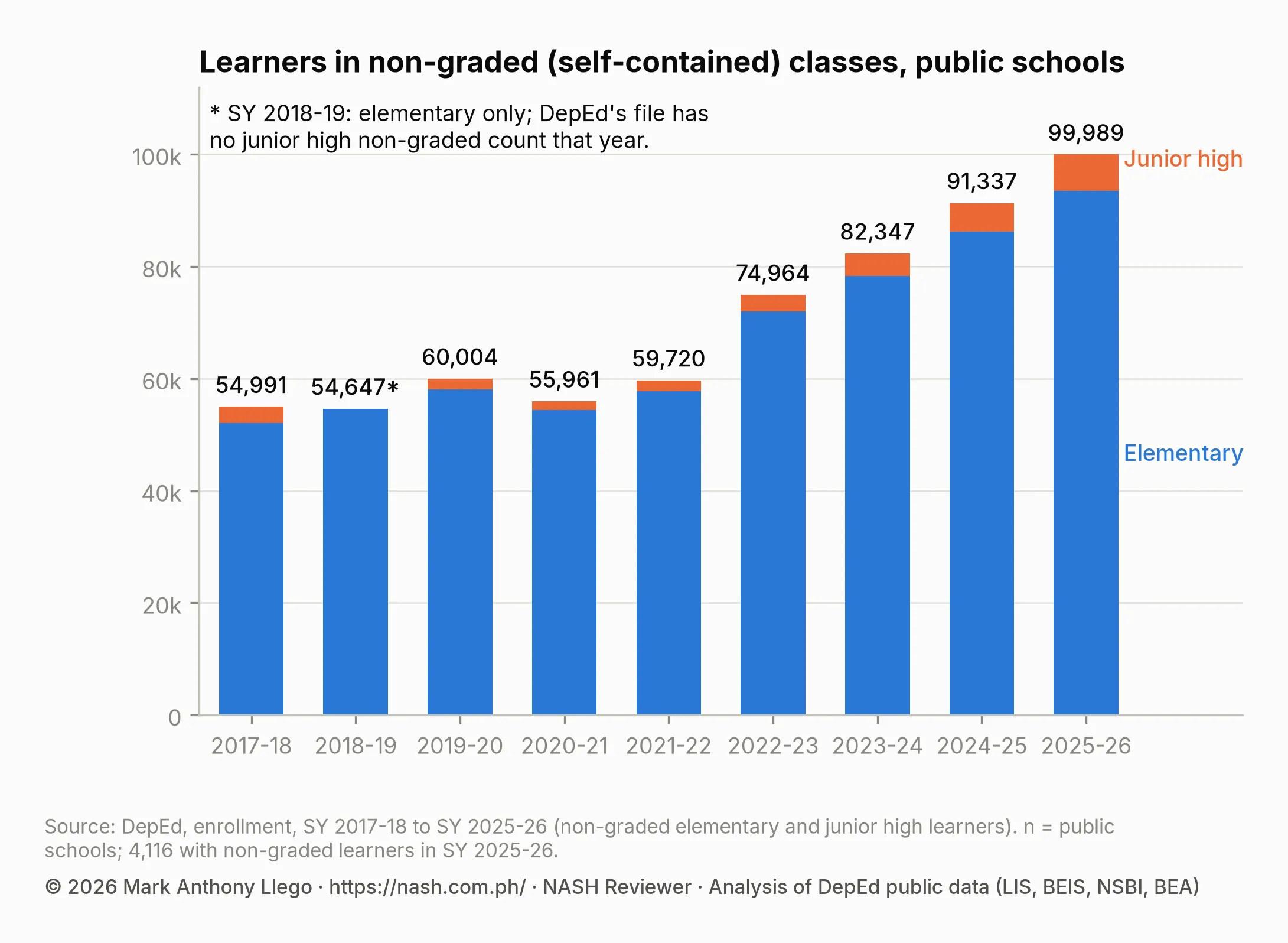
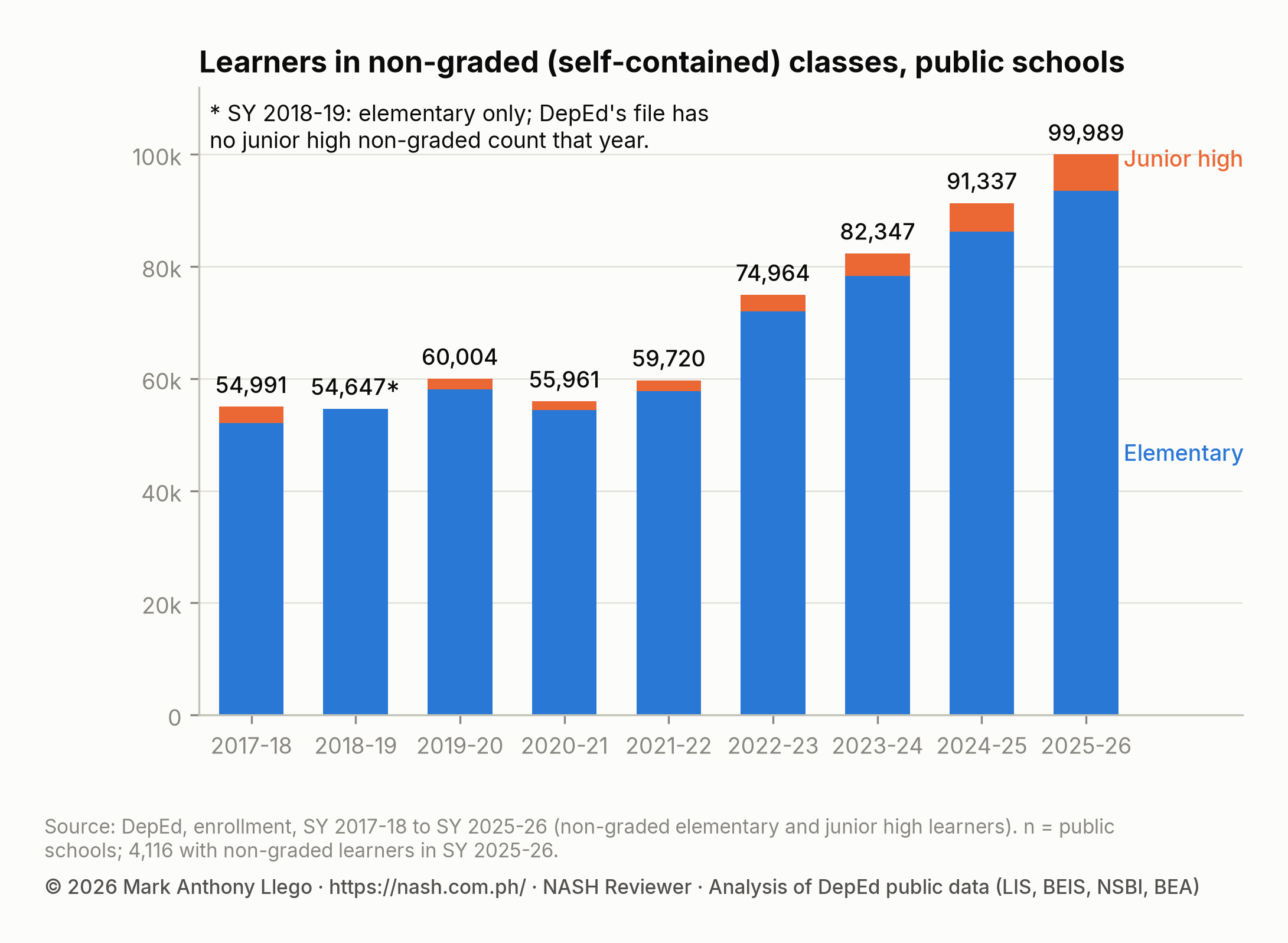
The count stayed near 55,000 to 60,000 from SY 2017-2018 to SY 2021-2022, jumped 25.5% to 74,964 in SY 2022-2023, then rose 9.8%, 10.9% and 9.5% in the next three years, about 10.1% a year. Junior high grew fastest, from 2,952 learners in SY 2022-2023 to 6,436.
Learners with a formal diagnosis. EDCOM 2 and DepEd’s Education Center for AI Research counted 180,519 learners in public schools with a formal diagnosis of a disability in SY 2025-2026, 38% of them with autism spectrum disorder; the release gives no breakdown by level (EDCOM 2, November 19, 2026).
Every learner with disabilities, diagnosed or with manifestations. DepEd’s Learner Information System (LIS) tags learners “with diagnosis from licensed medical specialists” and learners “without Medical Diagnosis but with manifestations of disabilities” (DepEd Order No. 023, s. 2022, Sec. VI). EDCOM 2’s division table counts both, and so do its national ratios: one filled SNEd position for every 71 such learners in elementary and every 155 in junior high.
EDCOM 2 does not print the national total. If between 491 (the junior high SNEd teachers of SY 2023-2024) and 964 of the 5,896 filled positions are in junior high, its ratios give 456,912 to 502,540 learners with disabilities in public elementary and junior high schools; splitting the teachers as in SY 2023-2024 gives 463,472. At the Senate’s hearing on DepEd’s 2027 budget, DepEd’s records showed about 495,000 learners with special needs, about 150,000 of them with a medical diagnosis (Senate of the Philippines, October 21, 2026). EDCOM II’s Final Report counted 391,089 learners with disabilities in public schools in SY 2024-2025 (p. 470), and DepEd’s own National Expenditure Program counts 524,935 public learners enrolled in special needs education in 2025, at every level, with a target of 556,310 for 2027 (NEP FY 2027, DepEd, Performance Information).
On the middle count, about one learner with disabilities in five (21.6%) is in a self-contained class. The other four in five, about 363,000, are in regular classes, as EDCOM II’s Final Report also finds (75% in mainstream classes, p. 470); DO 044, s. 2021 keeps learners with mild to moderate disabilities out of SPED and self-contained classes (Sec. VIII.A.2.2). There a SNEd teacher’s help comes through a resource room, an itinerant visit or work with the class teacher.
How EDCOM 2 arrived at 652
EDCOM 2’s release of November 19, 2026, “At least 652 SNED teacher positions urgently needed in 2027”, estimates “at least 652 new SNED teacher positions are needed across 208 divisions to achieve a minimum ratio of at least one SNED teacher for every 40 learners”, and prints a summary and a table of the 20 divisions that need the most:
| Level | Divisions needing teachers | New positions | First-year salary |
|---|---|---|---|
| Elementary | 50 | 278 | ₱129.3 million |
| Junior high school | 154 | 374 | ₱174.0 million |
| Total | 208 | 652 | ₱303.3 million |
Table: EDCOM 2, November 19, 2026, as printed.
The division table can be rebuilt from EDCOM 2’s own numbers. Its note gives the method: learners with disabilities, “with diagnosis + with manifestations”, in public elementary and junior high schools (the LIS SNED database, SY 2025-2026), divided by “filled SPED Teacher I–V positions” (DepEd’s Government Manpower Information System, February 2026).
- Filled positions. A division’s learners divided by its printed ratio gives a whole number of teachers, within the ratio’s rounding, in all 20 rows: Camarines Sur 46, Davao Oriental 92, Iloilo 119, Davao City 288. Dividing back gives EDCOM 2’s printed ratio in every row.
- Teachers needed. The learners divided by 40, rounded up. Davao City: 15,966 ÷ 40 = 399.15, so 400.
- The gap. Teachers needed less the filled positions. Davao City: 400 − 288 = 112.
- Vacant positions. EDCOM 2 lists 83 for Davao City, 29 fewer than 112. Its October 19 release counted exactly 29 vacant SNEd positions in Davao City, 19 elementary and 10 junior high. A vacant position is filled, not created, so it comes off the new positions.
Across the 20 divisions, the leftover after step 3 runs from 0 (Davao Oriental and Quirino) to 29 (Davao City) and adds up to 98, against 717 vacancies nationally. The ledger below works the arithmetic for any of the 20.
Interactive
EDCOM 2's arithmetic, line by line
Choose one of the 20 divisions in EDCOM 2's table. Its learners, its ratio and the 1:40 target give back EDCOM 2's figure once the division's vacant positions come off.
Davao City
- Learners with disabilities, diagnosed or with manifestations15,966
- ÷EDCOM 2's current ratio, 1 SNEd teacher per 55.4 learners: teachers in filled positions288
- ÷ 40The learners at 1 teacher per 40, rounded up: teachers needed400
- −Less the teachers in filled positions: the gap112
- −Less the positions already authorized but vacant, which are filled, not created (what is left over)29
- =New positions EDCOM 2 lists for Davao City83
EDCOM 2's release of October 19, 2026 counted 29 vacant SNEd positions in Davao City: 19 elementary and 10 junior high. The ledger closes on them exactly.
Added up the same way, the 20 divisions need 3,349 new positions. EDCOM 2's figure for the whole country is 652, so it cannot rest on the same count of learners.
EDCOM 2, November 19, 2026: learners with disabilities (with diagnosis and with manifestations, public elementary and junior high, LIS SNED database SY 2025-26), current ratio (filled SPED Teacher I to V positions, GMIS, February 2026) and needed new plantilla at 1:40; EDCOM 2, October 19, 2026 (Davao City's vacancies).
Done this way, the 20 divisions need 4,676 teachers at 1:40, have 1,229 filled positions, and need 3,349 new positions. The national total cannot be 652 on the same count of learners. The summary’s division count does not reconcile either: 50 elementary and 154 junior high divisions make 204 at most, not 208.
EDCOM 2 does not say which learners the 652 counts, and one count would fit it: the formally diagnosed learners. Its November 3 release computed its ratios that way, division by division and level by level: “Diagnosed learners only (with diagnosis from a licensed medical specialist). Ratios measure division-wide coverage using filled SPED teaching positions” (EDCOM 2, November 3, 2026). At 1:40, the 180,519 diagnosed learners need 4,513 teachers, 1,383 fewer than the 5,896 in filled positions. On that count the country as a whole has enough SNEd teachers. A shortage can then come only from divisions and levels where the teachers are not: a few hundred positions spread thinly over many divisions, as in EDCOM 2’s 154 junior high divisions needing 2.4 positions each. EDCOM 2 has not published the diagnosed counts by division that would confirm it.
The cost line is twelve months of one salary. ₱129.3 million for 278 positions, ₱174.0 million for 374 and ₱303.3 million for 652 each work out to ₱465,168 a position within the rounding of the printed totals. That is twelve times ₱38,764, the monthly salary at Salary Grade 14, Step 1, in the 2026 salary schedule (DBM National Budget Circular No. 601, s. 2026, Annex A), the grade of the entry SNEd position. It leaves out the allowances, bonuses and government contributions that come with every position, and the 2027 rates of the fourth salary tranche under Executive Order No. 64, s. 2024.
What you count decides the answer
The same arithmetic gives very different answers depending on which learners are counted and how many each SNEd teacher serves. The figure below sets each choice against DepEd’s positions, pooling the whole country, which gives the fewest teachers each choice could need.
Interactive
What you count decides how many SNEd teachers are needed
Choose who is counted and how many learners one SNEd teacher serves. The squares set the teachers that choice needs against the positions DepEd has; each square is 100 teachers.
Counting all learners with disabilities (463,472) at 1 SNEd teacher per 40: 11,587 teachers. On the range of learners EDCOM 2's ratios allow, 11,423 to 12,564. That is 4,474 more than the about 7,113 SNEd teacher positions DepEd has for SY 2026-27 (6,613 in February 2026 and 500 approved in May), before counting where they are.
DepEd, enrollment SY 2025-26 (non-graded learners, public schools), and its May 18, 2026 release (500 Teacher IV positions for SNEd); EDCOM 2, October 19, 2026 (6,613 authorized positions, 717 vacant, as of February 11, 2026) and November 19, 2026 (180,519 diagnosed learners; ratios of 1:71 in elementary and 1:155 in junior high schools; 652 new positions). Teachers needed are pooled nationally, level by level for self-contained classes, and rounded up.
| Learners counted | 1 teacher per 10 | 1 teacher per 15 | 1 teacher per 40 |
|---|---|---|---|
| In self-contained classes (99,989) | 10,000 | 6,667 | 2,500 |
| With a formal diagnosis (180,519) | 18,052 | 12,035 | 4,513 |
| All with disabilities (about 463,500) | 46,348 | 30,899 | 11,587 |
Table: teachers needed, pooled nationally, against 7,113 positions for SY 2026-2027. Self-contained classes are counted level by level, the others as totals; every figure is rounded up.
DepEd’s issuances set ratios only for classes. DepEd’s guidelines on new positions for 2010 gave “The ideal pupil/ student-teacher ratio is 15:1 (SPED Handbook)” for SPED classes and centers (DepEd Order No. 77, s. 2010, item 2.a.1.d), later revised into ranges by disability (DepEd Order No. 93, s. 2010). Neither RA 11650, its implementing rules nor DO 044, s. 2021 sets a ratio for learners with disabilities in regular classes. EDCOM 2 calls its 1:40 “only an interim floor, well above the usual 1:15 ratio for learners with disabilities” (EDCOM 2, November 19, 2026). At the Senate hearing, Assistant Secretary Jerome Buenviaje gave one receiving teacher for every five learners requiring support as the ideal for inclusive education, met by training regular teachers as well as hiring SNEd teachers (EDCOM 2, October 19, 2026).
How many teachers the self-contained classes need
DepEd’s deployment parameter is in its memoranda on new teaching items. The division office computes “the teacher requirements for each school”: for each school, “SNED Non-Graded (Elem/JHS)” learners are counted at “Max of 15 learners per class” and “1 teacher per class” (DM-OUHRODI-2026-1215, April 21, 2026, Encl., II.2; the same parameter is in DM-OUHROD-2024-0952, May 16, 2024, Encl. A, II.2). A self-contained class meets every school day, so it needs its own teacher in its own school. The parameter counts teachers, not SNEd positions; the counts below fill each class with a SNEd teacher, as DO 044, s. 2021 intends for SPED items (Sec. VII.B).
Smaller classes are DepEd’s older standard. The enrollment guide in DepEd Order No. 53, s. 2008, “as contained in the Policies and Guidelines in Special Education”, sets a class size for each disability (Encl., item A.2):
| Area of exceptionality (the order’s words) | One grade level | Multi-grade level |
|---|---|---|
| Mental retardation (intellectual disability) | 8 to 15 | 5 to 8 |
| Hearing impairment | 7 to 15 | 6 to 8 |
| Visual impairment | 7 to 10 | 5 to 6 |
| Autism | 7 to 10 | 3 to 6 |
| Multiple disabilities | 3 to 5 | 2 to 3 |
| Physical disabilities and health impairment | 10 to 15 | 7 to 10 |
| Giftedness | 30 to 35 | 15 to 20 |
Table: DO 53, s. 2008, Encl., item A.2. No DepEd order has named DO 53 since; DO 044, s. 2021 replaces any provision inconsistent with it (cover memorandum, item 4) and moved the gifted and talented program out of special education (Sec. VI.A.8).
DO 93, s. 2010 gives learners with autism spectrum disorder 5 to 8 a class. DepEd’s enrollment files do not say which disability each non-graded learner has, so the counts below take one class size for every class: 15, DepEd’s deployment parameter and the most any group allows; 10, the most for learners with autism under DO 53; and the sizes between.
Three choices shape the count:
- Each school and each level is counted apart. A school needs its elementary non-graded learners divided by the class size, rounded up, and the same for junior high, one teacher a class. DepEd’s table gives one row for “SNED Non-Graded (Elem/JHS)”; an elementary and a junior high class are counted as two.
- The teachers are those in DepEd’s SY 2023-2024 file, the latest count by school. DepEd had about 7,113 positions for SY 2026-2027, 1,690 more than the 5,423 teachers in that file, vacancies and new positions together, and where they are is not published by school. Each shortfall is therefore a range: from all 1,690 filling a gap (the low end) to none of them doing so (the high end).
- A school’s spare teachers stay in their school. A SNEd teacher in a school with no self-contained class is counted for nothing here; such teachers run resource rooms and support regular classes, which this count leaves out.
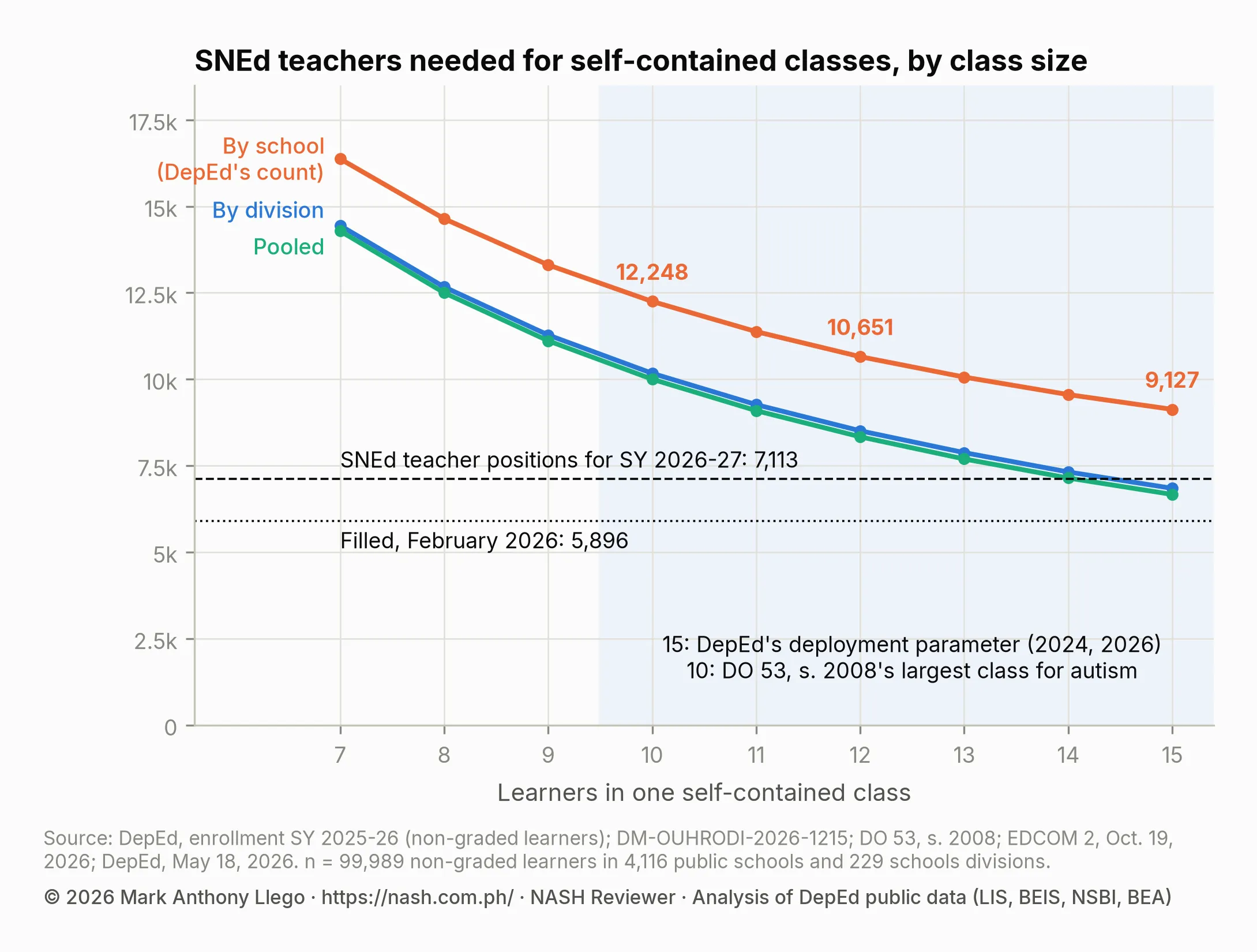
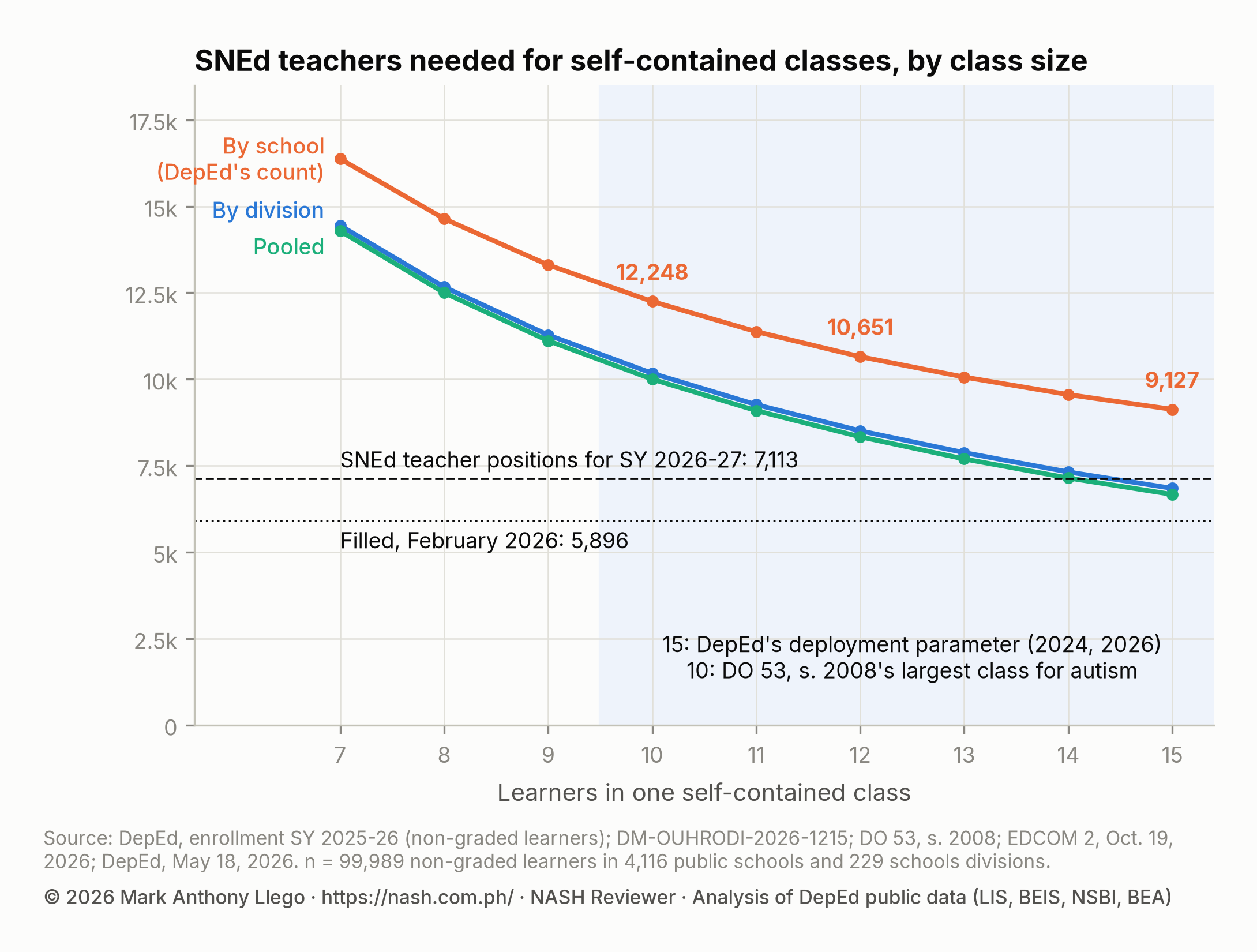
| Learners in one class | Teachers needed, school by school | Short against SY 2023-2024 teachers | New positions needed |
|---|---|---|---|
| 15 (DepEd’s parameter) | 9,127 | 4,974 in 214 divisions | 3,284 to 4,974 |
| 12 | 10,651 | 6,287 in 218 divisions | 4,597 to 6,287 |
| 10 (DO 53’s largest class for autism) | 12,248 | 7,753 in 222 divisions | 6,063 to 7,753 |
Table: teachers needed for the 99,989 learners in self-contained classes, SY 2025-2026, one teacher a class, school by school and level by level. New positions run from the shortfall less the 1,690 positions beyond the SY 2023-2024 teachers to the whole shortfall.
At DepEd’s 15 a class, the self-contained classes need 9,127 teachers, 2,014 more than the 7,113 positions DepEd has, even if every position were filled, sat in a school with a self-contained class, and served only that class. None would then be left for the resource rooms, itinerant visits and support to receiving teachers that the other 363,000 or so learners with disabilities rely on.
Much of the school count comes from small classes. 2,492 of the 4,116 schools (60.5%) have 15 or fewer self-contained learners, nearly all of them one class each. Of the 2,311 schools with no SNEd teacher in SY 2023-2024, half have five or fewer such learners. DO 53, s. 2008 lets a SPED teacher without enough learners for a full class teach regular classes part of the day (Encl., item A.3), where DO 044, s. 2021’s rule that SPED item holders teach learners with disabilities allows (Sec. VII.B). DO 044 also lets “the SPED teacher or a trained general education teacher” handle a self-contained class (Sec. VI.A.7.3(b)). If each division could pool its schools’ classes, the need at 15 a class would fall to 6,844, and the new positions to 526 to 2,216. That pooling gives the fewest teachers the classes could need; DepEd’s parameter counts school by school.
Where the shortage is, division by division
At DepEd’s 15 a class, 214 of DepEd’s 231 schools divisions are short of SNEd teachers for their self-contained classes, school by school. The figure below shows every division at any class size from 7 to 15, region by region.
Interactive
Every schools division's self-contained classes and SNEd teachers
Set how many learners one self-contained class holds; DepEd plans for 15. Each region opens to its divisions: the solid bar is the SNEd teachers a division had in SY 2023-24, the dashed bar the teachers its schools still lack.
At 15 learners a class, one teacher a class, school by school, the self-contained classes need 9,127 teachers. Against each school's SY 2023-24 teachers, 4,974 are missing, in 214 divisions; if all 1,690 positions beyond those teachers fill gaps, at least 3,284 new positions are needed.
National Capital Region17,144 learners, 915 SNEd teachers, 630 short at 15 a class
Quezon City
4,052 learners in self-contained classes in 54 schools (12 with no SNEd teacher) · 200 SNEd teachers (SY 2023-24) · needs 297 at 15 a class · 160 short
Taguig City and Pateros
1,225 learners in self-contained classes in 18 schools (3 with no SNEd teacher) · 40 SNEd teachers (SY 2023-24) · needs 90 at 15 a class · 50 short
Marikina City
871 learners in self-contained classes in 7 schools (2 with no SNEd teacher) · 14 SNEd teachers (SY 2023-24) · needs 63 at 15 a class · 49 short
Manila
2,769 learners in self-contained classes in 13 schools (0 with no SNEd teacher) · 163 SNEd teachers (SY 2023-24) · needs 190 at 15 a class · 46 short
Paranaque City
900 learners in self-contained classes in 16 schools (4 with no SNEd teacher) · 27 SNEd teachers (SY 2023-24) · needs 68 at 15 a class · 41 short
Pasig City
897 learners in self-contained classes in 10 schools (2 with no SNEd teacher) · 29 SNEd teachers (SY 2023-24) · needs 65 at 15 a class · 36 short
Makati City
735 learners in self-contained classes in 7 schools (2 with no SNEd teacher) · 26 SNEd teachers (SY 2023-24) · needs 53 at 15 a class · 36 short
Navotas
642 learners in self-contained classes in 6 schools (3 with no SNEd teacher) · 10 SNEd teachers (SY 2023-24) · needs 46 at 15 a class · 36 short
Malabon City
595 learners in self-contained classes in 9 schools (4 with no SNEd teacher) · 14 SNEd teachers (SY 2023-24) · needs 44 at 15 a class · 32 short
Muntinlupa City
666 learners in self-contained classes in 6 schools (2 with no SNEd teacher) · 18 SNEd teachers (SY 2023-24) · needs 48 at 15 a class · 30 short
Pasay City
957 learners in self-contained classes in 12 schools (3 with no SNEd teacher) · 137 SNEd teachers (SY 2023-24) · needs 70 at 15 a class · 28 short
Mandaluyong City
891 learners in self-contained classes in 5 schools (0 with no SNEd teacher) · 120 SNEd teachers (SY 2023-24) · needs 62 at 15 a class · 25 short
Valenzuela City
814 learners in self-contained classes in 24 schools (2 with no SNEd teacher) · 62 SNEd teachers (SY 2023-24) · needs 65 at 15 a class · 24 short
Las Piñas City
452 learners in self-contained classes in 4 schools (1 with no SNEd teacher) · 10 SNEd teachers (SY 2023-24) · needs 32 at 15 a class · 22 short
Caloocan City
488 learners in self-contained classes in 6 schools (3 with no SNEd teacher) · 36 SNEd teachers (SY 2023-24) · needs 36 at 15 a class · 9 short
City of San Juan
190 learners in self-contained classes in 3 schools (1 with no SNEd teacher) · 9 SNEd teachers (SY 2023-24) · needs 14 at 15 a class · 6 short
Cordillera Administrative Region1,180 learners, 118 SNEd teachers, 111 short at 15 a class
Benguet
437 learners in self-contained classes in 65 schools (54 with no SNEd teacher) · 28 SNEd teachers (SY 2023-24) · needs 82 at 15 a class · 58 short
Apayao
77 learners in self-contained classes in 27 schools (23 with no SNEd teacher) · 4 SNEd teachers (SY 2023-24) · needs 28 at 15 a class · 24 short
Mt. Province
109 learners in self-contained classes in 18 schools (11 with no SNEd teacher) · 14 SNEd teachers (SY 2023-24) · needs 19 at 15 a class · 11 short
Baguio City
363 learners in self-contained classes in 9 schools (7 with no SNEd teacher) · 35 SNEd teachers (SY 2023-24) · needs 30 at 15 a class · 7 short
Abra
58 learners in self-contained classes in 2 schools (1 with no SNEd teacher) · 3 SNEd teachers (SY 2023-24) · needs 5 at 15 a class · 4 short
Kalinga
7 learners in self-contained classes in 4 schools (4 with no SNEd teacher) · 1 SNEd teachers (SY 2023-24) · needs 4 at 15 a class · 4 short
Ifugao
69 learners in self-contained classes in 6 schools (2 with no SNEd teacher) · 12 SNEd teachers (SY 2023-24) · needs 7 at 15 a class · 2 short
Tabuk City
60 learners in self-contained classes in 5 schools (1 with no SNEd teacher) · 21 SNEd teachers (SY 2023-24) · needs 6 at 15 a class · 1 short
Region I (Ilocos Region)4,430 learners, 335 SNEd teachers, 144 short at 15 a class
Pangasinan I, Lingayen
1,398 learners in self-contained classes in 30 schools (4 with no SNEd teacher) · 49 SNEd teachers (SY 2023-24) · needs 109 at 15 a class · 60 short
Pangasinan II, Binalonan
797 learners in self-contained classes in 23 schools (3 with no SNEd teacher) · 116 SNEd teachers (SY 2023-24) · needs 66 at 15 a class · 16 short
Batac City
125 learners in self-contained classes in 13 schools (11 with no SNEd teacher) · 13 SNEd teachers (SY 2023-24) · needs 18 at 15 a class · 12 short
La Union
450 learners in self-contained classes in 10 schools (0 with no SNEd teacher) · 31 SNEd teachers (SY 2023-24) · needs 36 at 15 a class · 10 short
Ilocos Norte
159 learners in self-contained classes in 10 schools (7 with no SNEd teacher) · 9 SNEd teachers (SY 2023-24) · needs 16 at 15 a class · 9 short
San Fernando City (Region I)
353 learners in self-contained classes in 2 schools (1 with no SNEd teacher) · 20 SNEd teachers (SY 2023-24) · needs 25 at 15 a class · 8 short
Ilocos Sur
275 learners in self-contained classes in 19 schools (5 with no SNEd teacher) · 25 SNEd teachers (SY 2023-24) · needs 28 at 15 a class · 7 short
Dagupan City
217 learners in self-contained classes in 2 schools (0 with no SNEd teacher) · 8 SNEd teachers (SY 2023-24) · needs 15 at 15 a class · 7 short
San Carlos City (Region I)
259 learners in self-contained classes in 27 schools (2 with no SNEd teacher) · 32 SNEd teachers (SY 2023-24) · needs 34 at 15 a class · 5 short
Laoag City
128 learners in self-contained classes in 2 schools (0 with no SNEd teacher) · 6 SNEd teachers (SY 2023-24) · needs 10 at 15 a class · 4 short
Alaminos City
81 learners in self-contained classes in 4 schools (1 with no SNEd teacher) · 4 SNEd teachers (SY 2023-24) · needs 8 at 15 a class · 4 short
Candon City
101 learners in self-contained classes in 1 school (0 with no SNEd teacher) · 5 SNEd teachers (SY 2023-24) · needs 7 at 15 a class · 2 short
Urdaneta City
47 learners in self-contained classes in 1 school (0 with no SNEd teacher) · 12 SNEd teachers (SY 2023-24) · needs 4 at 15 a class · none short
Vigan City
40 learners in self-contained classes in 1 school (0 with no SNEd teacher) · 5 SNEd teachers (SY 2023-24) · needs 3 at 15 a class · none short
Region II (Cagayan Valley)2,616 learners, 156 SNEd teachers, 167 short at 15 a class
Cagayan
539 learners in self-contained classes in 66 schools (61 with no SNEd teacher) · 15 SNEd teachers (SY 2023-24) · needs 79 at 15 a class · 72 short
Quirino
292 learners in self-contained classes in 28 schools (21 with no SNEd teacher) · 19 SNEd teachers (SY 2023-24) · needs 44 at 15 a class · 28 short
Santiago City
344 learners in self-contained classes in 2 schools (1 with no SNEd teacher) · 13 SNEd teachers (SY 2023-24) · needs 24 at 15 a class · 23 short
Isabela
459 learners in self-contained classes in 17 schools (7 with no SNEd teacher) · 21 SNEd teachers (SY 2023-24) · needs 40 at 15 a class · 21 short
Cauayan City
190 learners in self-contained classes in 2 schools (0 with no SNEd teacher) · 4 SNEd teachers (SY 2023-24) · needs 14 at 15 a class · 10 short
Tuguegarao City
275 learners in self-contained classes in 7 schools (0 with no SNEd teacher) · 22 SNEd teachers (SY 2023-24) · needs 21 at 15 a class · 4 short
Nueva Vizcaya
340 learners in self-contained classes in 10 schools (1 with no SNEd teacher) · 46 SNEd teachers (SY 2023-24) · needs 29 at 15 a class · 3 short
City of Ilagan
143 learners in self-contained classes in 5 schools (2 with no SNEd teacher) · 13 SNEd teachers (SY 2023-24) · needs 13 at 15 a class · 3 short
Batanes
34 learners in self-contained classes in 5 schools (2 with no SNEd teacher) · 3 SNEd teachers (SY 2023-24) · needs 6 at 15 a class · 3 short
Region III (Central Luzon)12,594 learners, 465 SNEd teachers, 624 short at 15 a class
Bulacan
2,564 learners in self-contained classes in 53 schools (23 with no SNEd teacher) · 75 SNEd teachers (SY 2023-24) · needs 199 at 15 a class · 132 short
Pampanga
1,547 learners in self-contained classes in 43 schools (19 with no SNEd teacher) · 32 SNEd teachers (SY 2023-24) · needs 127 at 15 a class · 95 short
Zambales
986 learners in self-contained classes in 32 schools (13 with no SNEd teacher) · 34 SNEd teachers (SY 2023-24) · needs 82 at 15 a class · 49 short
City of San Jose Del Monte
757 learners in self-contained classes in 32 schools (19 with no SNEd teacher) · 21 SNEd teachers (SY 2023-24) · needs 68 at 15 a class · 47 short
Bataan
1,063 learners in self-contained classes in 27 schools (14 with no SNEd teacher) · 55 SNEd teachers (SY 2023-24) · needs 87 at 15 a class · 46 short
Tarlac
838 learners in self-contained classes in 29 schools (12 with no SNEd teacher) · 26 SNEd teachers (SY 2023-24) · needs 70 at 15 a class · 44 short
Nueva Ecija
831 learners in self-contained classes in 48 schools (24 with no SNEd teacher) · 52 SNEd teachers (SY 2023-24) · needs 81 at 15 a class · 43 short
San Fernando City (Region III)
687 learners in self-contained classes in 4 schools (0 with no SNEd teacher) · 24 SNEd teachers (SY 2023-24) · needs 48 at 15 a class · 24 short
Angeles City
492 learners in self-contained classes in 9 schools (8 with no SNEd teacher) · 16 SNEd teachers (SY 2023-24) · needs 37 at 15 a class · 23 short
Aurora
193 learners in self-contained classes in 21 schools (15 with no SNEd teacher) · 13 SNEd teachers (SY 2023-24) · needs 25 at 15 a class · 18 short
Cabanatuan City
423 learners in self-contained classes in 4 schools (1 with no SNEd teacher) · 15 SNEd teachers (SY 2023-24) · needs 31 at 15 a class · 16 short
Mabalacat City
368 learners in self-contained classes in 6 schools (3 with no SNEd teacher) · 17 SNEd teachers (SY 2023-24) · needs 28 at 15 a class · 14 short
Malolos City
331 learners in self-contained classes in 4 schools (1 with no SNEd teacher) · 10 SNEd teachers (SY 2023-24) · needs 24 at 15 a class · 14 short
Meycauayan City
294 learners in self-contained classes in 8 schools (3 with no SNEd teacher) · 14 SNEd teachers (SY 2023-24) · needs 24 at 15 a class · 13 short
City of Baliwag
188 learners in self-contained classes in 2 schools (1 with no SNEd teacher) · 3 SNEd teachers (SY 2023-24) · needs 14 at 15 a class · 11 short
Tarlac City
145 learners in self-contained classes in 6 schools (5 with no SNEd teacher) · 2 SNEd teachers (SY 2023-24) · needs 12 at 15 a class · 10 short
Olongapo City
388 learners in self-contained classes in 6 schools (1 with no SNEd teacher) · 28 SNEd teachers (SY 2023-24) · needs 27 at 15 a class · 7 short
Gapan City
187 learners in self-contained classes in 5 schools (3 with no SNEd teacher) · 9 SNEd teachers (SY 2023-24) · needs 14 at 15 a class · 7 short
Balanga City
170 learners in self-contained classes in 5 schools (3 with no SNEd teacher) · 8 SNEd teachers (SY 2023-24) · needs 15 at 15 a class · 7 short
San Jose City
91 learners in self-contained classes in 2 schools (0 with no SNEd teacher) · 9 SNEd teachers (SY 2023-24) · needs 7 at 15 a class · 2 short
Science City of Muñoz
51 learners in self-contained classes in 3 schools (2 with no SNEd teacher) · 2 SNEd teachers (SY 2023-24) · needs 4 at 15 a class · 2 short
Region IV-A (CALABARZON)17,375 learners, 725 SNEd teachers, 682 short at 15 a class
Rizal
2,443 learners in self-contained classes in 54 schools (24 with no SNEd teacher) · 93 SNEd teachers (SY 2023-24) · needs 188 at 15 a class · 99 short
Quezon
2,138 learners in self-contained classes in 73 schools (22 with no SNEd teacher) · 114 SNEd teachers (SY 2023-24) · needs 181 at 15 a class · 75 short
Cavite
1,698 learners in self-contained classes in 24 schools (4 with no SNEd teacher) · 67 SNEd teachers (SY 2023-24) · needs 126 at 15 a class · 62 short
Laguna
1,349 learners in self-contained classes in 50 schools (20 with no SNEd teacher) · 57 SNEd teachers (SY 2023-24) · needs 113 at 15 a class · 61 short
Batangas
1,857 learners in self-contained classes in 50 schools (11 with no SNEd teacher) · 91 SNEd teachers (SY 2023-24) · needs 147 at 15 a class · 58 short
Imus City
860 learners in self-contained classes in 10 schools (5 with no SNEd teacher) · 21 SNEd teachers (SY 2023-24) · needs 61 at 15 a class · 40 short
Antipolo City
836 learners in self-contained classes in 9 schools (3 with no SNEd teacher) · 23 SNEd teachers (SY 2023-24) · needs 61 at 15 a class · 38 short
Batangas City
606 learners in self-contained classes in 21 schools (13 with no SNEd teacher) · 21 SNEd teachers (SY 2023-24) · needs 52 at 15 a class · 31 short
Bacoor City
585 learners in self-contained classes in 6 schools (1 with no SNEd teacher) · 12 SNEd teachers (SY 2023-24) · needs 42 at 15 a class · 30 short
Cabuyao City
460 learners in self-contained classes in 5 schools (2 with no SNEd teacher) · 8 SNEd teachers (SY 2023-24) · needs 33 at 15 a class · 25 short
General Trias City
282 learners in self-contained classes in 14 schools (12 with no SNEd teacher) · 10 SNEd teachers (SY 2023-24) · needs 27 at 15 a class · 25 short
Dasmarinas City
881 learners in self-contained classes in 9 schools (3 with no SNEd teacher) · 44 SNEd teachers (SY 2023-24) · needs 63 at 15 a class · 21 short
Tayabas City
230 learners in self-contained classes in 15 schools (7 with no SNEd teacher) · 11 SNEd teachers (SY 2023-24) · needs 26 at 15 a class · 17 short
Sta. Rosa City
306 learners in self-contained classes in 3 schools (1 with no SNEd teacher) · 12 SNEd teachers (SY 2023-24) · needs 22 at 15 a class · 16 short
Binan City
318 learners in self-contained classes in 9 schools (7 with no SNEd teacher) · 11 SNEd teachers (SY 2023-24) · needs 26 at 15 a class · 15 short
Sto. Tomas City
289 learners in self-contained classes in 4 schools (2 with no SNEd teacher) · 6 SNEd teachers (SY 2023-24) · needs 21 at 15 a class · 15 short
Lipa City
478 learners in self-contained classes in 7 schools (3 with no SNEd teacher) · 24 SNEd teachers (SY 2023-24) · needs 34 at 15 a class · 12 short
Cavite City
332 learners in self-contained classes in 4 schools (0 with no SNEd teacher) · 14 SNEd teachers (SY 2023-24) · needs 25 at 15 a class · 11 short
San Pedro City
154 learners in self-contained classes in 3 schools (1 with no SNEd teacher) · 7 SNEd teachers (SY 2023-24) · needs 13 at 15 a class · 10 short
Lucena City
292 learners in self-contained classes in 9 schools (3 with no SNEd teacher) · 16 SNEd teachers (SY 2023-24) · needs 23 at 15 a class · 8 short
Tanauan City
304 learners in self-contained classes in 1 school (0 with no SNEd teacher) · 15 SNEd teachers (SY 2023-24) · needs 21 at 15 a class · 6 short
Calamba City
304 learners in self-contained classes in 3 schools (0 with no SNEd teacher) · 17 SNEd teachers (SY 2023-24) · needs 21 at 15 a class · 4 short
Calaca City
62 learners in self-contained classes in 4 schools (3 with no SNEd teacher) · 2 SNEd teachers (SY 2023-24) · needs 5 at 15 a class · 3 short
San Pablo City
254 learners in self-contained classes in 1 school (0 with no SNEd teacher) · 22 SNEd teachers (SY 2023-24) · needs 18 at 15 a class · none short
Carmona City
57 learners in self-contained classes in 2 schools (0 with no SNEd teacher) · 7 SNEd teachers (SY 2023-24) · needs 5 at 15 a class · none short
MIMAROPA Region2,755 learners, 190 SNEd teachers, 168 short at 15 a class
Oriental Mindoro
785 learners in self-contained classes in 40 schools (19 with no SNEd teacher) · 38 SNEd teachers (SY 2023-24) · needs 72 at 15 a class · 37 short
Romblon
479 learners in self-contained classes in 40 schools (24 with no SNEd teacher) · 24 SNEd teachers (SY 2023-24) · needs 55 at 15 a class · 32 short
Puerto Princesa City
392 learners in self-contained classes in 15 schools (12 with no SNEd teacher) · 12 SNEd teachers (SY 2023-24) · needs 39 at 15 a class · 28 short
Marinduque
148 learners in self-contained classes in 40 schools (22 with no SNEd teacher) · 35 SNEd teachers (SY 2023-24) · needs 42 at 15 a class · 23 short
Palawan
277 learners in self-contained classes in 26 schools (15 with no SNEd teacher) · 25 SNEd teachers (SY 2023-24) · needs 33 at 15 a class · 19 short
Occidental Mindoro
307 learners in self-contained classes in 21 schools (14 with no SNEd teacher) · 27 SNEd teachers (SY 2023-24) · needs 33 at 15 a class · 16 short
Calapan City
367 learners in self-contained classes in 31 schools (13 with no SNEd teacher) · 29 SNEd teachers (SY 2023-24) · needs 41 at 15 a class · 13 short
Region V (Bicol Region)4,447 learners, 255 SNEd teachers, 229 short at 15 a class
Catanduanes
279 learners in self-contained classes in 59 schools (49 with no SNEd teacher) · 22 SNEd teachers (SY 2023-24) · needs 66 at 15 a class · 51 short
Camarines Sur
995 learners in self-contained classes in 50 schools (21 with no SNEd teacher) · 50 SNEd teachers (SY 2023-24) · needs 92 at 15 a class · 48 short
Naga City
522 learners in self-contained classes in 29 schools (26 with no SNEd teacher) · 21 SNEd teachers (SY 2023-24) · needs 47 at 15 a class · 30 short
Albay
748 learners in self-contained classes in 24 schools (7 with no SNEd teacher) · 35 SNEd teachers (SY 2023-24) · needs 61 at 15 a class · 28 short
Sorsogon
634 learners in self-contained classes in 21 schools (4 with no SNEd teacher) · 26 SNEd teachers (SY 2023-24) · needs 53 at 15 a class · 28 short
Camarines Norte
328 learners in self-contained classes in 14 schools (3 with no SNEd teacher) · 24 SNEd teachers (SY 2023-24) · needs 29 at 15 a class · 13 short
Masbate
118 learners in self-contained classes in 15 schools (8 with no SNEd teacher) · 7 SNEd teachers (SY 2023-24) · needs 19 at 15 a class · 12 short
Ligao City
167 learners in self-contained classes in 6 schools (4 with no SNEd teacher) · 7 SNEd teachers (SY 2023-24) · needs 14 at 15 a class · 7 short
Legaspi City
276 learners in self-contained classes in 4 schools (2 with no SNEd teacher) · 23 SNEd teachers (SY 2023-24) · needs 20 at 15 a class · 4 short
Masbate City
100 learners in self-contained classes in 4 schools (3 with no SNEd teacher) · 5 SNEd teachers (SY 2023-24) · needs 9 at 15 a class · 4 short
Sorsogon City
132 learners in self-contained classes in 4 schools (1 with no SNEd teacher) · 10 SNEd teachers (SY 2023-24) · needs 11 at 15 a class · 2 short
Tabaco City
28 learners in self-contained classes in 1 school (1 with no SNEd teacher) · 7 SNEd teachers (SY 2023-24) · needs 2 at 15 a class · 2 short
Iriga City
120 learners in self-contained classes in 1 school (0 with no SNEd teacher) · 18 SNEd teachers (SY 2023-24) · needs 8 at 15 a class · none short
Region VI (Western Visayas)4,905 learners, 240 SNEd teachers, 252 short at 15 a class
Iloilo
2,481 learners in self-contained classes in 120 schools (75 with no SNEd teacher) · 121 SNEd teachers (SY 2023-24) · needs 246 at 15 a class · 132 short
Aklan
704 learners in self-contained classes in 15 schools (6 with no SNEd teacher) · 28 SNEd teachers (SY 2023-24) · needs 55 at 15 a class · 28 short
Antique
306 learners in self-contained classes in 27 schools (24 with no SNEd teacher) · 18 SNEd teachers (SY 2023-24) · needs 38 at 15 a class · 25 short
Guimaras
195 learners in self-contained classes in 20 schools (19 with no SNEd teacher) · 7 SNEd teachers (SY 2023-24) · needs 24 at 15 a class · 20 short
Capiz
457 learners in self-contained classes in 16 schools (5 with no SNEd teacher) · 22 SNEd teachers (SY 2023-24) · needs 38 at 15 a class · 17 short
Iloilo City
349 learners in self-contained classes in 11 schools (10 with no SNEd teacher) · 22 SNEd teachers (SY 2023-24) · needs 27 at 15 a class · 16 short
Roxas City
332 learners in self-contained classes in 3 schools (0 with no SNEd teacher) · 19 SNEd teachers (SY 2023-24) · needs 24 at 15 a class · 11 short
Passi City
81 learners in self-contained classes in 1 school (0 with no SNEd teacher) · 3 SNEd teachers (SY 2023-24) · needs 6 at 15 a class · 3 short
Negros Island Region4,410 learners, 218 SNEd teachers, 151 short at 15 a class
Negros Occidental
1,033 learners in self-contained classes in 31 schools (16 with no SNEd teacher) · 42 SNEd teachers (SY 2023-24) · needs 82 at 15 a class · 41 short
Bacolod City
651 learners in self-contained classes in 11 schools (9 with no SNEd teacher) · 22 SNEd teachers (SY 2023-24) · needs 49 at 15 a class · 27 short
Escalante City
131 learners in self-contained classes in 2 schools (1 with no SNEd teacher) · 2 SNEd teachers (SY 2023-24) · needs 10 at 15 a class · 8 short
Negros Oriental
501 learners in self-contained classes in 33 schools (1 with no SNEd teacher) · 48 SNEd teachers (SY 2023-24) · needs 48 at 15 a class · 7 short
Bayawan City
173 learners in self-contained classes in 13 schools (4 with no SNEd teacher) · 13 SNEd teachers (SY 2023-24) · needs 17 at 15 a class · 7 short
Guihulngan City
120 learners in self-contained classes in 9 schools (6 with no SNEd teacher) · 5 SNEd teachers (SY 2023-24) · needs 12 at 15 a class · 7 short
Siquijor
120 learners in self-contained classes in 7 schools (4 with no SNEd teacher) · 5 SNEd teachers (SY 2023-24) · needs 12 at 15 a class · 7 short
La Carlota City
213 learners in self-contained classes in 1 school (0 with no SNEd teacher) · 9 SNEd teachers (SY 2023-24) · needs 15 at 15 a class · 6 short
Cadiz City
162 learners in self-contained classes in 3 schools (2 with no SNEd teacher) · 7 SNEd teachers (SY 2023-24) · needs 13 at 15 a class · 6 short
Victorias City
174 learners in self-contained classes in 1 school (0 with no SNEd teacher) · 7 SNEd teachers (SY 2023-24) · needs 12 at 15 a class · 5 short
Bago City
131 learners in self-contained classes in 1 school (0 with no SNEd teacher) · 4 SNEd teachers (SY 2023-24) · needs 9 at 15 a class · 5 short
San Carlos City (NIR)
101 learners in self-contained classes in 2 schools (1 with no SNEd teacher) · 2 SNEd teachers (SY 2023-24) · needs 7 at 15 a class · 5 short
Dumaguete City
217 learners in self-contained classes in 1 school (0 with no SNEd teacher) · 12 SNEd teachers (SY 2023-24) · needs 15 at 15 a class · 4 short
Sipalay City
68 learners in self-contained classes in 2 schools (1 with no SNEd teacher) · 1 SNEd teachers (SY 2023-24) · needs 5 at 15 a class · 4 short
Silay City
192 learners in self-contained classes in 2 schools (1 with no SNEd teacher) · 13 SNEd teachers (SY 2023-24) · needs 15 at 15 a class · 3 short
Sagay City
112 learners in self-contained classes in 2 schools (0 with no SNEd teacher) · 6 SNEd teachers (SY 2023-24) · needs 9 at 15 a class · 3 short
Kabankalan City
89 learners in self-contained classes in 1 school (0 with no SNEd teacher) · 4 SNEd teachers (SY 2023-24) · needs 6 at 15 a class · 2 short
Himamaylan City
31 learners in self-contained classes in 2 schools (1 with no SNEd teacher) · 1 SNEd teachers (SY 2023-24) · needs 3 at 15 a class · 2 short
Canlaon City
78 learners in self-contained classes in 2 schools (0 with no SNEd teacher) · 5 SNEd teachers (SY 2023-24) · needs 6 at 15 a class · 1 short
Bais City
47 learners in self-contained classes in 1 school (0 with no SNEd teacher) · 4 SNEd teachers (SY 2023-24) · needs 4 at 15 a class · 1 short
Tanjay City
66 learners in self-contained classes in 2 schools (0 with no SNEd teacher) · 6 SNEd teachers (SY 2023-24) · needs 5 at 15 a class · none short
Region VII (Central Visayas)4,579 learners, 259 SNEd teachers, 240 short at 15 a class
Bohol
922 learners in self-contained classes in 113 schools (82 with no SNEd teacher) · 53 SNEd teachers (SY 2023-24) · needs 134 at 15 a class · 95 short
Cebu
1,242 learners in self-contained classes in 66 schools (37 with no SNEd teacher) · 62 SNEd teachers (SY 2023-24) · needs 116 at 15 a class · 65 short
Cebu City
930 learners in self-contained classes in 13 schools (2 with no SNEd teacher) · 47 SNEd teachers (SY 2023-24) · needs 68 at 15 a class · 33 short
Lapu-Lapu City
441 learners in self-contained classes in 6 schools (3 with no SNEd teacher) · 10 SNEd teachers (SY 2023-24) · needs 32 at 15 a class · 23 short
Toledo City
268 learners in self-contained classes in 8 schools (2 with no SNEd teacher) · 12 SNEd teachers (SY 2023-24) · needs 22 at 15 a class · 10 short
Carcar City
89 learners in self-contained classes in 3 schools (1 with no SNEd teacher) · 3 SNEd teachers (SY 2023-24) · needs 8 at 15 a class · 5 short
City of Naga, Cebu
193 learners in self-contained classes in 5 schools (3 with no SNEd teacher) · 17 SNEd teachers (SY 2023-24) · needs 17 at 15 a class · 4 short
Bogo City
107 learners in self-contained classes in 2 schools (0 with no SNEd teacher) · 5 SNEd teachers (SY 2023-24) · needs 8 at 15 a class · 3 short
Mandaue City
35 learners in self-contained classes in 3 schools (1 with no SNEd teacher) · 21 SNEd teachers (SY 2023-24) · needs 4 at 15 a class · 2 short
Tagbilaran City
171 learners in self-contained classes in 1 school (0 with no SNEd teacher) · 12 SNEd teachers (SY 2023-24) · needs 12 at 15 a class · none short
Talisay City
131 learners in self-contained classes in 2 schools (0 with no SNEd teacher) · 12 SNEd teachers (SY 2023-24) · needs 9 at 15 a class · none short
Danao City
50 learners in self-contained classes in 1 school (0 with no SNEd teacher) · 5 SNEd teachers (SY 2023-24) · needs 4 at 15 a class · none short
Region VIII (Eastern Visayas)2,709 learners, 186 SNEd teachers, 147 short at 15 a class
Leyte
937 learners in self-contained classes in 34 schools (14 with no SNEd teacher) · 37 SNEd teachers (SY 2023-24) · needs 80 at 15 a class · 48 short
Northern Samar
222 learners in self-contained classes in 53 schools (43 with no SNEd teacher) · 20 SNEd teachers (SY 2023-24) · needs 56 at 15 a class · 43 short
Southern Leyte
287 learners in self-contained classes in 21 schools (12 with no SNEd teacher) · 28 SNEd teachers (SY 2023-24) · needs 33 at 15 a class · 17 short
Biliran
289 learners in self-contained classes in 15 schools (6 with no SNEd teacher) · 12 SNEd teachers (SY 2023-24) · needs 26 at 15 a class · 14 short
Tacloban City
238 learners in self-contained classes in 13 schools (9 with no SNEd teacher) · 10 SNEd teachers (SY 2023-24) · needs 20 at 15 a class · 14 short
Samar (Western Samar)
57 learners in self-contained classes in 5 schools (2 with no SNEd teacher) · 3 SNEd teachers (SY 2023-24) · needs 7 at 15 a class · 4 short
Maasin City
113 learners in self-contained classes in 4 schools (3 with no SNEd teacher) · 17 SNEd teachers (SY 2023-24) · needs 11 at 15 a class · 3 short
Eastern Samar
58 learners in self-contained classes in 2 schools (0 with no SNEd teacher) · 5 SNEd teachers (SY 2023-24) · needs 4 at 15 a class · 2 short
Ormoc City
179 learners in self-contained classes in 2 schools (1 with no SNEd teacher) · 20 SNEd teachers (SY 2023-24) · needs 13 at 15 a class · 1 short
Catbalogan City
104 learners in self-contained classes in 4 schools (1 with no SNEd teacher) · 10 SNEd teachers (SY 2023-24) · needs 8 at 15 a class · 1 short
Calbayog City
88 learners in self-contained classes in 1 school (0 with no SNEd teacher) · 10 SNEd teachers (SY 2023-24) · needs 6 at 15 a class · none short
Baybay City
71 learners in self-contained classes in 1 school (0 with no SNEd teacher) · 6 SNEd teachers (SY 2023-24) · needs 5 at 15 a class · none short
Borongan City
66 learners in self-contained classes in 1 school (0 with no SNEd teacher) · 8 SNEd teachers (SY 2023-24) · needs 5 at 15 a class · none short
Region IX (Zamboanga Peninsula)4,705 learners, 309 SNEd teachers, 429 short at 15 a class
Zamboanga del Norte
2,085 learners in self-contained classes in 358 schools (297 with no SNEd teacher) · 93 SNEd teachers (SY 2023-24) · needs 384 at 15 a class · 313 short
Zamboanga City
1,268 learners in self-contained classes in 41 schools (16 with no SNEd teacher) · 75 SNEd teachers (SY 2023-24) · needs 105 at 15 a class · 44 short
Zamboanga del Sur
598 learners in self-contained classes in 56 schools (28 with no SNEd teacher) · 50 SNEd teachers (SY 2023-24) · needs 79 at 15 a class · 39 short
Zamboanga Sibugay
267 learners in self-contained classes in 29 schools (16 with no SNEd teacher) · 47 SNEd teachers (SY 2023-24) · needs 37 at 15 a class · 16 short
Isabela City
137 learners in self-contained classes in 8 schools (6 with no SNEd teacher) · 10 SNEd teachers (SY 2023-24) · needs 14 at 15 a class · 8 short
Sulu
97 learners in self-contained classes in 2 schools (2 with no SNEd teacher) · 6 SNEd teachers (SY 2023-24) · needs 8 at 15 a class · 8 short
Dapitan City
55 learners in self-contained classes in 2 schools (1 with no SNEd teacher) · 8 SNEd teachers (SY 2023-24) · needs 5 at 15 a class · 1 short
Dipolog City
117 learners in self-contained classes in 1 school (0 with no SNEd teacher) · 12 SNEd teachers (SY 2023-24) · needs 8 at 15 a class · none short
Pagadian City
81 learners in self-contained classes in 1 school (0 with no SNEd teacher) · 8 SNEd teachers (SY 2023-24) · needs 6 at 15 a class · none short
Region X (Northern Mindanao)5,041 learners, 271 SNEd teachers, 269 short at 15 a class
Cagayan de Oro City
1,061 learners in self-contained classes in 52 schools (35 with no SNEd teacher) · 40 SNEd teachers (SY 2023-24) · needs 97 at 15 a class · 65 short
Bukidnon
766 learners in self-contained classes in 62 schools (34 with no SNEd teacher) · 57 SNEd teachers (SY 2023-24) · needs 88 at 15 a class · 55 short
Misamis Oriental
730 learners in self-contained classes in 39 schools (24 with no SNEd teacher) · 22 SNEd teachers (SY 2023-24) · needs 69 at 15 a class · 47 short
Iligan City
527 learners in self-contained classes in 13 schools (7 with no SNEd teacher) · 24 SNEd teachers (SY 2023-24) · needs 42 at 15 a class · 21 short
Lanao del Norte
302 learners in self-contained classes in 15 schools (10 with no SNEd teacher) · 12 SNEd teachers (SY 2023-24) · needs 28 at 15 a class · 17 short
Ozamis City
303 learners in self-contained classes in 14 schools (7 with no SNEd teacher) · 15 SNEd teachers (SY 2023-24) · needs 30 at 15 a class · 15 short
Misamis Occidental
263 learners in self-contained classes in 17 schools (5 with no SNEd teacher) · 21 SNEd teachers (SY 2023-24) · needs 26 at 15 a class · 10 short
Malaybalay City
310 learners in self-contained classes in 11 schools (3 with no SNEd teacher) · 19 SNEd teachers (SY 2023-24) · needs 25 at 15 a class · 9 short
El Salvador
89 learners in self-contained classes in 9 schools (7 with no SNEd teacher) · 4 SNEd teachers (SY 2023-24) · needs 12 at 15 a class · 9 short
Gingoog City
99 learners in self-contained classes in 12 schools (7 with no SNEd teacher) · 9 SNEd teachers (SY 2023-24) · needs 14 at 15 a class · 7 short
Valencia City
234 learners in self-contained classes in 8 schools (2 with no SNEd teacher) · 15 SNEd teachers (SY 2023-24) · needs 19 at 15 a class · 4 short
Camiguin
147 learners in self-contained classes in 13 schools (4 with no SNEd teacher) · 13 SNEd teachers (SY 2023-24) · needs 16 at 15 a class · 4 short
Tangub City
44 learners in self-contained classes in 7 schools (4 with no SNEd teacher) · 6 SNEd teachers (SY 2023-24) · needs 8 at 15 a class · 4 short
Oroquieta City
166 learners in self-contained classes in 3 schools (2 with no SNEd teacher) · 14 SNEd teachers (SY 2023-24) · needs 13 at 15 a class · 2 short
Region XI (Davao Region)5,687 learners, 426 SNEd teachers, 397 short at 15 a class
Davao City
2,375 learners in self-contained classes in 138 schools (84 with no SNEd teacher) · 180 SNEd teachers (SY 2023-24) · needs 244 at 15 a class · 124 short
Davao Oriental
517 learners in self-contained classes in 124 schools (95 with no SNEd teacher) · 49 SNEd teachers (SY 2023-24) · needs 131 at 15 a class · 99 short
Davao del Norte
667 learners in self-contained classes in 83 schools (58 with no SNEd teacher) · 55 SNEd teachers (SY 2023-24) · needs 102 at 15 a class · 63 short
Davao Occidental
219 learners in self-contained classes in 33 schools (25 with no SNEd teacher) · 12 SNEd teachers (SY 2023-24) · needs 38 at 15 a class · 28 short
Davao De Oro
560 learners in self-contained classes in 18 schools (10 with no SNEd teacher) · 29 SNEd teachers (SY 2023-24) · needs 46 at 15 a class · 22 short
Island Garden City of Samal
162 learners in self-contained classes in 28 schools (21 with no SNEd teacher) · 12 SNEd teachers (SY 2023-24) · needs 33 at 15 a class · 21 short
Tagum City
437 learners in self-contained classes in 12 schools (7 with no SNEd teacher) · 20 SNEd teachers (SY 2023-24) · needs 35 at 15 a class · 15 short
Davao del Sur
230 learners in self-contained classes in 17 schools (10 with no SNEd teacher) · 23 SNEd teachers (SY 2023-24) · needs 28 at 15 a class · 14 short
Panabo City
255 learners in self-contained classes in 3 schools (0 with no SNEd teacher) · 14 SNEd teachers (SY 2023-24) · needs 18 at 15 a class · 6 short
Digos City
175 learners in self-contained classes in 6 schools (1 with no SNEd teacher) · 16 SNEd teachers (SY 2023-24) · needs 14 at 15 a class · 3 short
Mati City
90 learners in self-contained classes in 4 schools (2 with no SNEd teacher) · 16 SNEd teachers (SY 2023-24) · needs 9 at 15 a class · 2 short
Region XII (SOCCSKSARGEN)2,703 learners, 171 SNEd teachers, 114 short at 15 a class
North Cotabato
454 learners in self-contained classes in 31 schools (22 with no SNEd teacher) · 32 SNEd teachers (SY 2023-24) · needs 52 at 15 a class · 30 short
Sultan Kudarat
386 learners in self-contained classes in 18 schools (14 with no SNEd teacher) · 14 SNEd teachers (SY 2023-24) · needs 33 at 15 a class · 23 short
General Santos City
486 learners in self-contained classes in 14 schools (7 with no SNEd teacher) · 35 SNEd teachers (SY 2023-24) · needs 41 at 15 a class · 17 short
Sarangani
504 learners in self-contained classes in 12 schools (3 with no SNEd teacher) · 31 SNEd teachers (SY 2023-24) · needs 38 at 15 a class · 13 short
South Cotabato
285 learners in self-contained classes in 19 schools (9 with no SNEd teacher) · 28 SNEd teachers (SY 2023-24) · needs 30 at 15 a class · 13 short
Koronadal City
243 learners in self-contained classes in 8 schools (4 with no SNEd teacher) · 15 SNEd teachers (SY 2023-24) · needs 20 at 15 a class · 9 short
Kidapawan City
208 learners in self-contained classes in 2 schools (0 with no SNEd teacher) · 10 SNEd teachers (SY 2023-24) · needs 15 at 15 a class · 5 short
Tacurong City
137 learners in self-contained classes in 2 schools (1 with no SNEd teacher) · 6 SNEd teachers (SY 2023-24) · needs 10 at 15 a class · 4 short
Caraga2,305 learners, 172 SNEd teachers, 185 short at 15 a class
Agusan del Sur
474 learners in self-contained classes in 87 schools (75 with no SNEd teacher) · 22 SNEd teachers (SY 2023-24) · needs 94 at 15 a class · 79 short
Dinagat Island
226 learners in self-contained classes in 36 schools (29 with no SNEd teacher) · 12 SNEd teachers (SY 2023-24) · needs 40 at 15 a class · 30 short
Surigao del Sur
312 learners in self-contained classes in 28 schools (17 with no SNEd teacher) · 11 SNEd teachers (SY 2023-24) · needs 35 at 15 a class · 24 short
Bayugan City
161 learners in self-contained classes in 15 schools (11 with no SNEd teacher) · 8 SNEd teachers (SY 2023-24) · needs 20 at 15 a class · 12 short
Butuan City
289 learners in self-contained classes in 6 schools (3 with no SNEd teacher) · 23 SNEd teachers (SY 2023-24) · needs 22 at 15 a class · 9 short
Agusan del Norte
200 learners in self-contained classes in 13 schools (5 with no SNEd teacher) · 32 SNEd teachers (SY 2023-24) · needs 23 at 15 a class · 8 short
Tandag City
61 learners in self-contained classes in 11 schools (8 with no SNEd teacher) · 9 SNEd teachers (SY 2023-24) · needs 13 at 15 a class · 8 short
Bislig City
143 learners in self-contained classes in 11 schools (3 with no SNEd teacher) · 11 SNEd teachers (SY 2023-24) · needs 15 at 15 a class · 6 short
Surigao City
133 learners in self-contained classes in 4 schools (3 with no SNEd teacher) · 9 SNEd teachers (SY 2023-24) · needs 12 at 15 a class · 4 short
Surigao del Norte
125 learners in self-contained classes in 3 schools (1 with no SNEd teacher) · 13 SNEd teachers (SY 2023-24) · needs 9 at 15 a class · 4 short
Cabadbaran City
104 learners in self-contained classes in 4 schools (0 with no SNEd teacher) · 9 SNEd teachers (SY 2023-24) · needs 9 at 15 a class · 1 short
Siargao
77 learners in self-contained classes in 5 schools (0 with no SNEd teacher) · 13 SNEd teachers (SY 2023-24) · needs 8 at 15 a class · none short
BARMM404 learners, 12 SNEd teachers, 35 short at 15 a class
Maguindanao II
118 learners in self-contained classes in 7 schools (7 with no SNEd teacher) · 0 SNEd teachers (SY 2023-24) · needs 12 at 15 a class · 12 short
Lamitan City
116 learners in self-contained classes in 2 schools (2 with no SNEd teacher) · 0 SNEd teachers (SY 2023-24) · needs 9 at 15 a class · 9 short
Basilan
50 learners in self-contained classes in 3 schools (3 with no SNEd teacher) · 0 SNEd teachers (SY 2023-24) · needs 5 at 15 a class · 5 short
Cotabato City
89 learners in self-contained classes in 3 schools (0 with no SNEd teacher) · 6 SNEd teachers (SY 2023-24) · needs 8 at 15 a class · 3 short
Tawi-Tawi
27 learners in self-contained classes in 1 school (1 with no SNEd teacher) · 0 SNEd teachers (SY 2023-24) · needs 2 at 15 a class · 2 short
Lanao del Sur - II
2 learners in self-contained classes in 2 schools (2 with no SNEd teacher) · 0 SNEd teachers (SY 2023-24) · needs 2 at 15 a class · 2 short
Special Geographic Area Division
1 learners in self-contained classes in 1 school (1 with no SNEd teacher) · 0 SNEd teachers (SY 2023-24) · needs 1 at 15 a class · 1 short
Maguindanao I
1 learners in self-contained classes in 1 school (1 with no SNEd teacher) · 1 SNEd teachers (SY 2023-24) · needs 1 at 15 a class · 1 short
Lanao del Sur - I
0 learners in self-contained classes in 0 schools (0 with no SNEd teacher) · 5 SNEd teachers (SY 2023-24) · needs 0 at 15 a class · none short
Marawi City
0 learners in self-contained classes in 0 schools (0 with no SNEd teacher) · 0 SNEd teachers (SY 2023-24) · needs 0 at 15 a class · none short
DepEd, enrollment SY 2025-26 (non-graded elementary and junior high learners) and school personnel SY 2023-24 (SPED/SNEd Teacher I to V), public schools, by the SY 2025-26 schools division of each school; DM-OUHRODI-2026-1215 (15 learners a class, one teacher a class) and DO 53, s. 2008, Encl., item A.2 (smaller classes by disability). Each school's levels are counted apart and rounded up; a school's spare teachers are not moved to another.
The largest shortfalls at 15 a class are of two kinds:
| Division | Learners in self-contained classes, SY 2025-2026 | Schools with such learners (with no SNEd teacher) | SNEd teachers, SY 2023-2024 | Teachers needed at 15 | Short |
|---|---|---|---|---|---|
| Zamboanga del Norte | 2,085 | 358 (297) | 93 | 384 | 313 |
| Quezon City | 4,052 | 54 (12) | 200 | 297 | 160 |
| Bulacan | 2,564 | 53 (23) | 75 | 199 | 132 |
| Iloilo | 2,481 | 120 (75) | 121 | 246 | 132 |
| Davao City | 2,375 | 138 (84) | 180 | 244 | 124 |
| Rizal | 2,443 | 54 (24) | 93 | 188 | 99 |
| Davao Oriental | 517 | 124 (95) | 49 | 131 | 99 |
| Bohol | 922 | 113 (82) | 53 | 134 | 95 |
| Pampanga | 1,547 | 43 (19) | 32 | 127 | 95 |
| Agusan del Sur | 474 | 87 (75) | 22 | 94 | 79 |
Table: the ten divisions with the largest shortfall at 15 learners a class, one teacher a class, school by school. Data: DepEd, enrollment SY 2025-2026 and school personnel SY 2023-2024.
In Quezon City, Bulacan, Rizal and Pampanga, large enrollments in a few dozen schools have too few teachers: Pampanga’s 1,547 learners shared 32. In Zamboanga del Norte, Davao Oriental, Bohol and Agusan del Sur, a few learners sit in each of a hundred or more schools, most of them with no SNEd teacher at all. The first kind needs more teachers in schools that already have SNEd classes; the second needs a way to reach many small classes. Region IV-A (682), NCR (630) and Region III (624) together are short 1,936 teachers, 38.9% of the national shortfall at 15 a class.
EDCOM 2’s top 20 is a third list. Camarines Sur, Davao Oriental and Isabela lead it because they have many learners tagged with manifestations of a disability in regular classes and few SNEd teachers: Camarines Sur’s 21,627 learners with disabilities share 46 filled positions. Its 995 learners in self-contained classes had 50 SNEd teachers in SY 2023-2024.
Some places have no SNEd teacher at all for the learners they enroll:
- 2,311 of the 4,116 public schools with self-contained learners in SY 2025-2026 (56.1%) had no SNEd teacher in the SY 2023-2024 file. They held 20,707 of the learners (20.7%). EDCOM 2’s October 19 analysis found 1,906 such schools.
- Six divisions, all in BARMM, enrolled self-contained learners (314 in all) and had no SNEd teacher: Basilan, Lamitan City, Lanao del Sur II, Maguindanao II, the Special Geographic Area Division and Tawi-Tawi.
- 51 divisions had junior high non-graded learners (1,381 in all) and no junior high SNEd teacher.
Do the teachers follow the learners?
Only partly. Across the 229 divisions with self-contained learners, divisions with more learners have more teachers (a Spearman rank correlation of 0.83), but not in proportion:
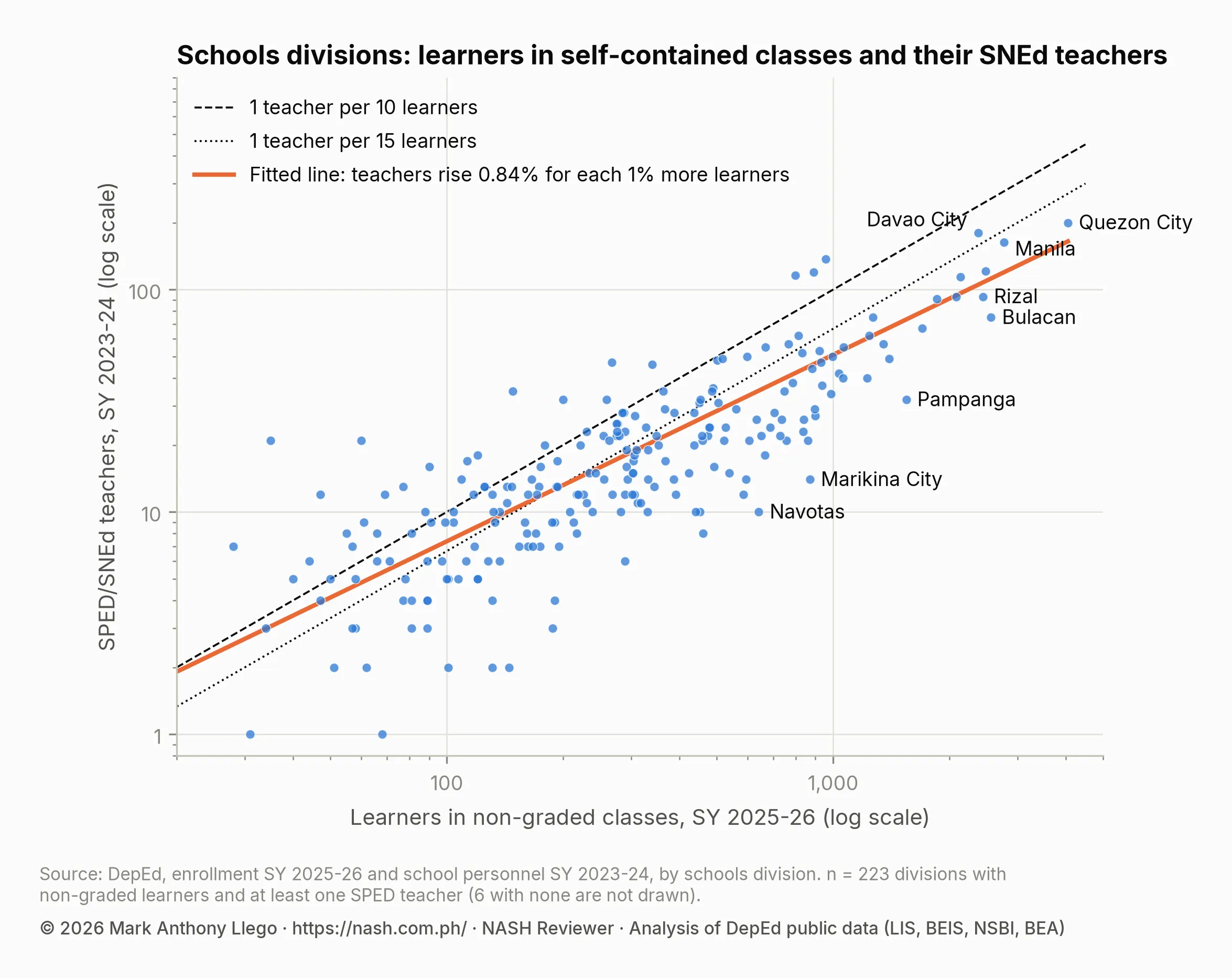
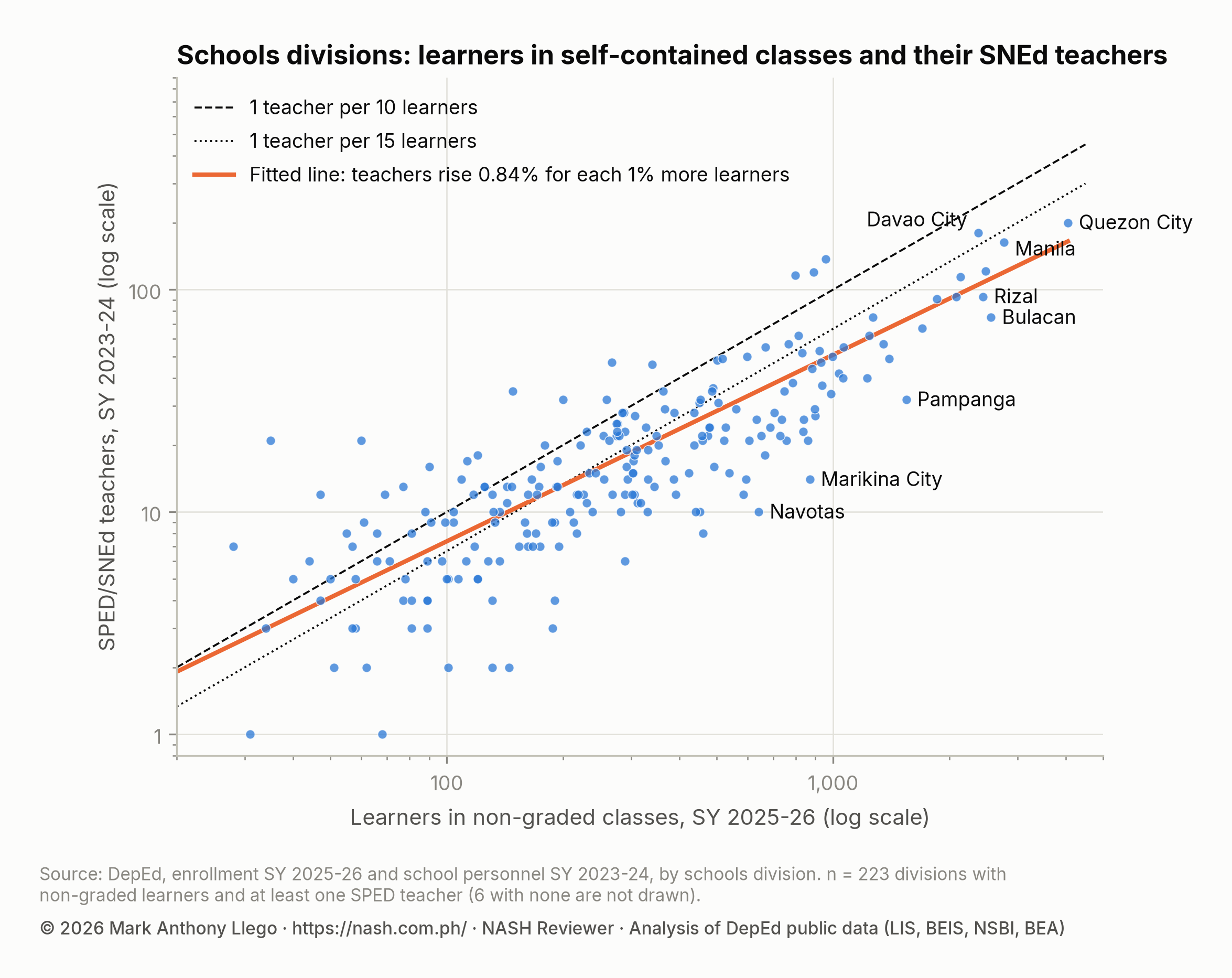
- Teachers rise about 0.84% for each 1% more learners. A division with 100 learners in self-contained classes has, on the fitted line, about 7 teachers, one for every 13.6 learners; a division with 2,000 has about 91, one for every 21.9. The slope’s 95% interval is 0.77 to 0.91, so larger divisions have fewer teachers per learner across the whole range, not because of a few divisions.
- The middle division has 18.8 self-contained learners per teacher. One division in ten has fewer than 8, and one in ten more than 33. Tarlac City (145 learners, 2 teachers), Navotas (642 and 10) and Marikina City (871 and 14) have more than 60.
- About 1,025 teachers, 18.9% of them, would have to change division for SNEd teachers to be spread across divisions exactly as the self-contained learners are (the dissimilarity index). Moving teachers is not how DepEd staffs schools, but the number shows how much of the shortage is placement rather than headcount.
How many new positions, and what they cost
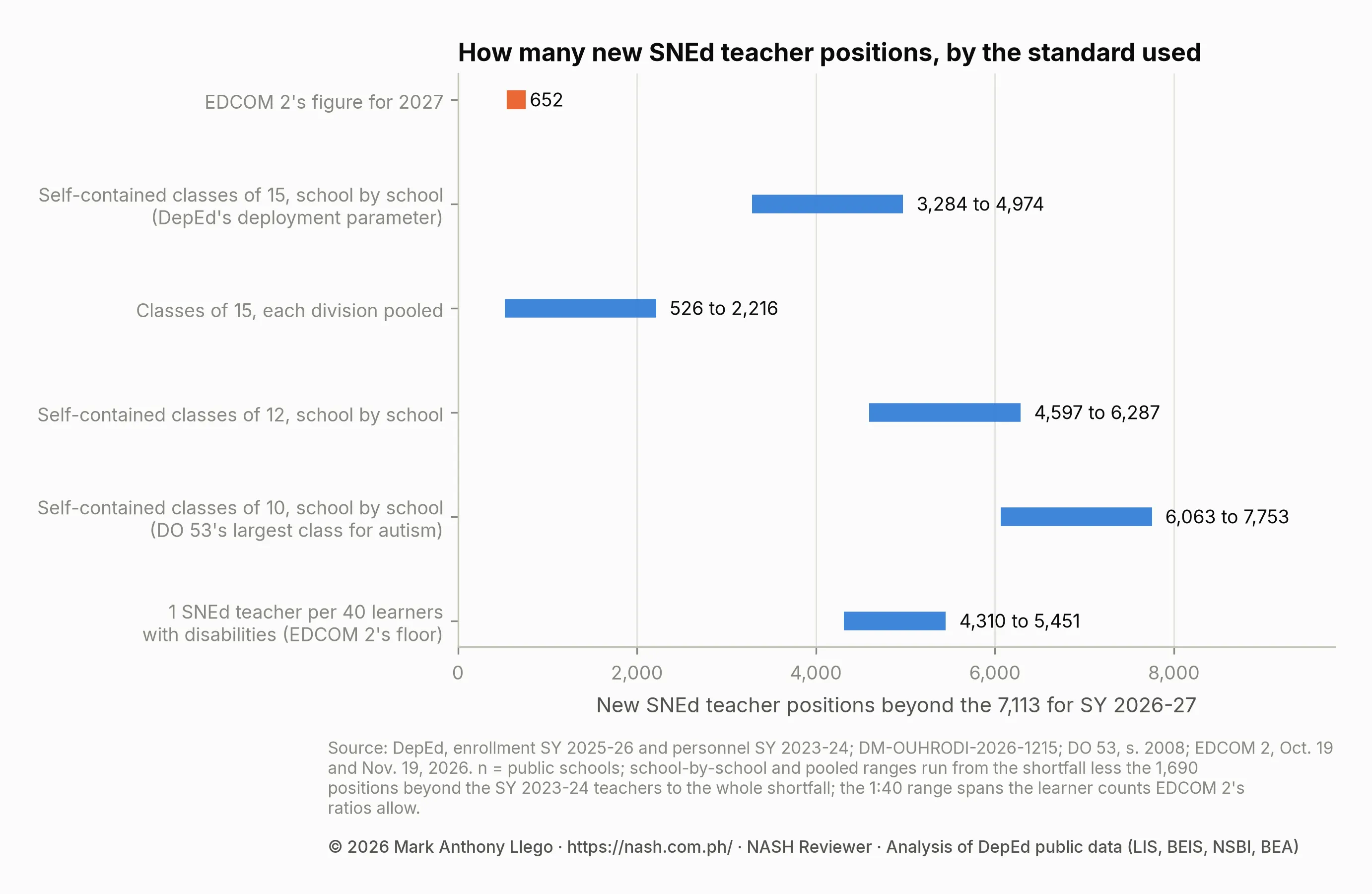
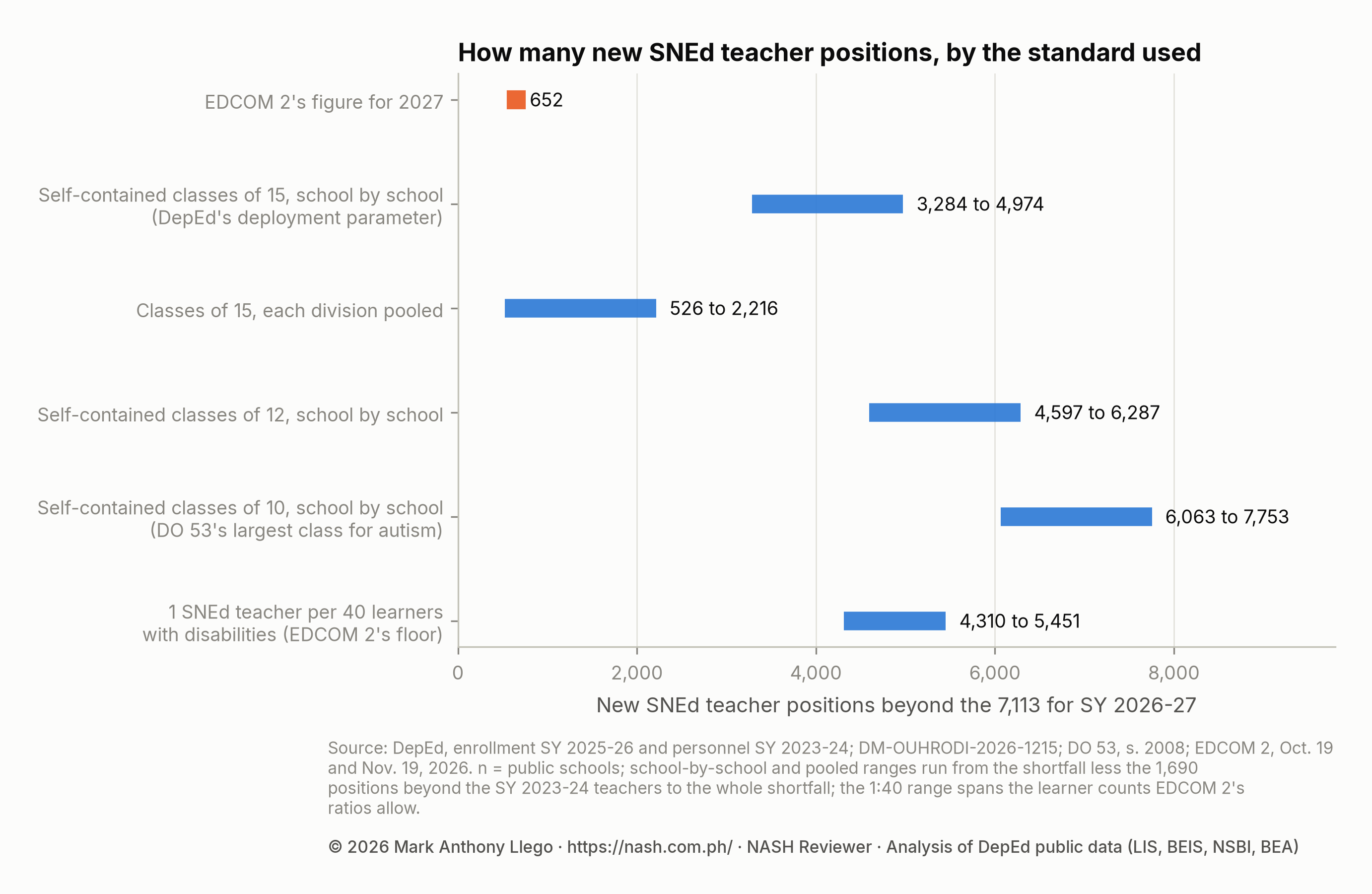
| Standard | New positions | First-year basic salary at 2026 rates |
|---|---|---|
| EDCOM 2’s figure | 652 | ₱303.3 million |
| Classes of 15, school by school (DepEd’s parameter) | 3,284 to 4,974 | ₱1.53 to ₱2.31 billion |
| Classes of 15, each division pooled | 526 to 2,216 | ₱0.24 to ₱1.03 billion |
| Classes of 12, school by school | 4,597 to 6,287 | ₱2.14 to ₱2.92 billion |
| Classes of 10, school by school | 6,063 to 7,753 | ₱2.82 to ₱3.61 billion |
| 1:40, every learner with disabilities | 4,310 to 5,451 | ₱2.00 to ₱2.54 billion |
| 1:15, every learner with disabilities | 23,348 to 26,390 | ₱10.86 to ₱12.28 billion |
Table: new positions under each standard and their basic salary for twelve months at Salary Grade 14, Step 1 (₱38,764 a month in 2026), as EDCOM 2 costs its figure. Allowances, bonuses, government contributions and the 2027 salary rates would add to each amount.
The self-contained rows are the floor of the need: they give no time to the learners with disabilities in regular classes. The 1:40 row is counted nationally; with the 20 divisions in EDCOM 2’s table counted one by one and the rest of the country pooled, it is 4,320 to 5,461.
Other estimates run in the same range. Senator Win Gatchalian put the shortfall at 7,651 SNEd teachers for SY 2023-2024, with 5,147 SNEd teachers and 323,344 learners with disabilities aged 2 to 17, without stating the ratio (Gatchalian, December 9, 2024). EDCOM 2’s study with IDinsight found that only 32% of enrolled learners with disabilities had a SNEd teacher in their school, and that filling all 772 vacant positions of August 2024 where they were most needed would raise that to 51% (EDCOM 2 and IDinsight, November 2025, pp. 6-7).
The 2027 National Expenditure Program funds none of these. It gives the Special Needs Education Program ₱849,980,000, all of it for maintenance and other operating expenses, against ₱1.04 billion in 2026 (House CPBRD, September 2026). Its ₱801,583,000 for the creation of new positions pays for 1,800 School Counselor Associate I and 221 School Division Counselor positions, and its target for newly created teaching positions filled in 2027 is zero (DepEd’s 2027 Budget). DepEd asked Congress for ₱541.57 million more for the program (DepEd’s FY 2027 budget presentation to the House), which Secretary Sonny Angara described as “to train some of the teachers given the systemic lack of personnel and capacity building for 622 school heads, supervisors, and multidisciplinary teams” (Philippine Daily Inquirer, September 7, 2026). The House of Representatives added ₱75 million to the program in its version of the budget (House of Representatives, October 9, 2026).
How these numbers were made
The counts cover every public school and division, not a sample, so they carry no sampling error. What can move them is the date of each file and the standard chosen, and those are shown as ranges.
- Learners. Non-graded elementary and junior high learners in each public school, from DepEd’s enrollment files, SY 2017-2018 to SY 2025-2026. Each school’s learners and teachers are added up under the schools division the SY 2025-2026 file gives it; the 42 teachers at schools with no SY 2025-2026 row stay in their SY 2023-2024 division.
- Teachers. SPED/SNEd Teacher I to V in each public school, by level, from DepEd’s SY 2023-2024 school personnel file. 25 schools with 891 self-contained learners in SY 2025-2026 have no row in that file and count as having no SNEd teacher.
- Positions. 6,613 authorized in February 2026 (EDCOM 2) and 500 approved in May 2026 (DepEd), about 7,113 in all. The ranges of new positions run from each shortfall less the 1,690 positions beyond the 5,423 teachers of SY 2023-2024, vacancies and new positions together, to the whole shortfall.
- Teachers needed. For each school and level, the learners divided by the class size and rounded up; a shortfall is counted only where a school and level has fewer teachers than it needs. The division-pooled count does the same for each division’s total.
- The count of all learners with disabilities. EDCOM 2’s ratios, 71 and 155 (each read as 70.5 to 71.5 and 154.5 to 155.5), times the filled positions, with the junior high share of the 5,896 filled positions between the 491 of SY 2023-2024 and 964 (all positions filled since in junior high). The middle figure splits the teachers as in SY 2023-2024.
- EDCOM 2’s table. Each of the 20 rows recomputed from its printed learners and ratio, with the 1:40 need rounded up.
- The fitted line. A Poisson regression of each division’s teachers on the logarithm of its self-contained learners, with heteroskedasticity-robust (HC1) standard errors, checked by 4,000 bootstrap resamples of the divisions (0.76 to 0.91). A negative binomial model, which allows for more spread, gives a slope of 0.77 (0.70 to 0.83). The interval describes how widely divisions scatter around the line; the divisions are all there are, not a sample.
- Tools. Python with pandas, Polars, NumPy, SciPy and statsmodels; the charts in matplotlib.
The data cannot show three things. They do not say which disability each learner in a self-contained class has, so the class size is one number for every class. They do not count the learners with disabilities in regular classes by division, so the 1:40 and 1:15 rows are national. And a non-graded class with learners of several ages works like DO 53’s multi-grade classes, whose limits (2 to 10 learners) would raise every number in the self-contained rows.
What this means for school heads
A school head cannot create a SNEd position, but the numbers that decide where positions go start in the school.
- Tag learners with disabilities correctly in the LIS, with a diagnosis or with manifestations, as DO 023, s. 2022 requires. EDCOM 2 counted learners from the LIS SNED database; a learner who is not tagged is missing from counts such as EDCOM 2’s, which inform the case for new positions.
- Report self-contained classes as non-graded enrollment. DepEd’s deployment count starts from each school’s non-graded learners; a school that reports them as graded learners hides its class from that count.
- Ask the Schools Division Office for SNEd support with the numbers: the learners in self-contained classes by level, the learners with disabilities in regular classes, and the teachers who serve them. DO 044, s. 2021 asks the school head to “Ensure that a teacher with SPED item shall be assigned to teach learners with disabilities in the mainstream or self-contained classes” and to “Plan with the Schools Division Office (SDO) on how SPED teachers can be mobilized to support general education teachers in other schools with no SPED teachers” (Sec. VIII.A.2.1 and 2.11).
- Keep a resource room. “All schools with LWDs enrollment shall have a resource room except those with or served by ILRCs” (DO 044, s. 2021, Sec. VI.A.5). Inclusive Learning Environment: DepEd Rules for School Heads sets out the rest of the school head’s duties to learners with disabilities.
The PPSSH asks a school head at Career Stage 1 to “demonstrate knowledge and understanding of laws, policies, guidelines and issuances on managing school staff” (indicator 2.4.1, Domain 2) and to “demonstrate knowledge and understanding of inclusive practices” (indicator 5.3.1, Domain 5). Knowing how SNEd positions are counted, and what a school’s own data do to that count, serves both.
Frequently asked questions
How many SNEd (SPED) teachers are there in the Philippines?
DepEd had 6,613 authorized SNEd teacher positions on February 11, 2026, 5,896 of them filled and 717 vacant, and DBM approved 500 more in May 2026 for SY 2026-2027 (EDCOM 2, October 19, 2026; DepEd, May 18, 2026). DepEd’s SY 2023-2024 personnel file counts 5,423 SNEd teachers in public schools, 4,932 in elementary and 491 in junior high.
Is there a shortage of SNEd teachers in the Philippines?
Yes. Counted by DepEd’s deployment parameter of one teacher for each class of up to 15, school by school, the 99,989 learners in self-contained classes in SY 2025-2026 need 9,127 teachers, more than the about 7,113 SNEd positions DepEd has. 2,311 of the 4,116 schools with such learners had no SNEd teacher in SY 2023-2024, and EDCOM 2’s ratios give one filled position for every 71 learners with disabilities in elementary and every 155 in junior high.
Is SPED still the official term?
No. Republic Act No. 11650 says “The term ‘Special Needs Education’ shall replace the term ‘Special Education (SPED)’” (Sec. 4(r)), and the entry position is now Teacher IV (Special Needs Education Teacher I). The word survives in older names, such as SPED Centers awaiting conversion into Inclusive Learning Resource Centers.
What is the class size of a SNEd class in DepEd?
DepEd computes teacher requirements at a maximum of 15 non-graded learners and one teacher a class (DM-OUHRODI-2026-1215). DO 53, s. 2008 sets class sizes by disability: 8 to 15 learners with intellectual disability, 7 to 15 with hearing impairment, 7 to 10 with visual impairment or autism, 3 to 5 with multiple disabilities, and 10 to 15 with physical disabilities and health impairment in one grade level, and fewer in a multi-grade class (Encl., item A.2).
How did EDCOM 2 compute the 652 SNED teacher positions?
EDCOM 2 applied a minimum of one SNEd teacher for every 40 learners, and its division table follows that rule: learners divided by 40, less the filled positions, less the vacant ones. Its national total of 652 is smaller than its own top 20 divisions’ 3,349, so it must rest on fewer learners or another method, perhaps only those with a formal diagnosis, as its November 3, 2026 ratios did; EDCOM 2 has not said.
Download the data
- Every division (CSV): all 231 schools divisions with their non-graded learners by level in SY 2025-2026 and in total for SY 2023-2024 and SY 2024-2025, their schools with such learners and how many had no SPED teacher, their SPED/SNEd teachers by level (SY 2023-2024), and the teachers needed and short at 10, 12 and 15 learners a class, school by school and pooled. Source: DepEd, enrollment and school personnel.
- EDCOM 2’s table rebuilt (CSV): the 20 divisions with EDCOM 2’s learners, ratios and new positions, and the filled positions, need at 1:40, gap and leftover computed from them. Source: EDCOM 2, November 19, 2026.
- Non-graded learners by year (CSV), teachers needed by class size (CSV), divisions’ learners and teachers (CSV) and new positions by standard (CSV): the data of Figures 1 to 4.
The CSVs and charts may be reused only with written permission: ask through our contact form. The enrollment and personnel data are DepEd’s, released in cleaned form in Download Cleaned DepEd School Data, and EDCOM 2’s figures are in its releases, which you can cite directly.
Sources
Laws and DepEd issuances
- Republic Act No. 11650, An Act Instituting a Policy of Inclusion and Services for Learners with Disabilities in Support of Inclusive Education, March 11, 2022, Secs. 4(r) and 6; DepEd’s copy in DepEd Memorandum No. 020, s. 2022, March 25, 2022.
- Implementing Rules and Regulations of Republic Act No. 11650, published December 12, 2024, in effect January 11, 2025, Sec. 5(aa); disseminated by DepEd Memorandum No. 043, s. 2025, May 9, 2025.
- DepEd Order No. 53, s. 2008, Maximization of Trained Teachers and Administrators in Special Education, July 5, 2008, Encl., items A.2 and A.3.
- DepEd Order No. 77, s. 2010, Guidelines on the Allocation/Deployment of New Teaching, Teaching-Related and Non-Teaching Positions for FY 2010, June 4, 2010, item 2.a.1.d; revised by DepEd Order No. 93, s. 2010, July 26, 2010.
- DepEd Order No. 45, s. 2017, Guidelines on Updating the Basic Education Statistics for the Beginning of School Year 2017-2018 in the LIS and EBEIS, August 11, 2017, Table 7, note 1.
- DepEd Order No. 011, s. 2019, Implementation of the NEAP Transformation, May 30, 2019, Table 5-1.
- DepEd Order No. 044, s. 2021, Policy Guidelines on the Provision of Educational Programs and Services for Learners with Disabilities in the K to 12 Basic Education Program, November 2, 2021, Secs. VI.A.5, VI.A.7.3, VI.A.8 and VIII.A.2.
- DepEd Order No. 023, s. 2022, Child Find Policy for Learners with Disabilities Towards Inclusive Education, May 25, 2022, Sec. VI.
- DepEd Order No. 020, s. 2024, Guidelines on the Recruitment, Selection, and Appointment to Higher Teaching Positions, December 20, 2024, Annex A.
- DepEd Order No. 021, s. 2024, Amendments to DepEd Order No. 007, s. 2023, December 23, 2024, item 4.a.iv, note 2.
- DepEd Order No. 024, s. 2025, Guidelines on the Implementation of the Expanded Career Progression System for Teachers and School Heads in the Department of Education, August 28, 2025, Annex A-2.
- DepEd Order No. 022, s. 2026, Enhanced Minimum Performance Standards and Specifications for DepEd School Infrastructure and School Furniture, September 24, 2026.
- DM-OUHROD-2024-0952, Advance Information on the Creation and Deployment of New Teaching Items and School-Based Administrative Officer II Items for SY 2024-2025, May 16, 2024, Encl. A, II.2 (enclosed in DepEd Region VIII’s Regional Memorandum No. 579, s. 2024).
- DM-OUHRODI-2026-1215, Advance Information on the Creation and Deployment of New Teaching Items for SY 2026-2027 and Conduct of Online Orientation, April 21, 2026, Encl., II.2 (enclosed in DepEd Region VIII’s Regional Memorandum No. 541, s. 2026).
- DM-OUHRODI-2026-2591, Interim Measures on the Hiring and Deployment of Special Needs Education Teachers (SNET) and Special Science Teachers (SST) Pending the Approval and Issuance of the Revised Qualification Standards, July 23, 2026 (enclosed in DepEd Region I’s Regional Memorandum No. 928, s. 2026).
- DM-OUHRODI-2026-3573, Resumption of the Hiring and Deployment of SNETs and SSTs, September 2, 2026, Secs. II and III.1 (enclosed in DepEd Region VIII’s Regional Memorandum No. 1207, s. 2026).
- DBM National Budget Circular No. 601, s. 2026, January 22, 2026, Annex A (Salary Grade 14, Step 1).
Reports and releases
- EDCOM 2, At least 652 SNED teacher positions urgently needed in 2027, November 19, 2026.
- EDCOM 2, EDCOM 2 calls for additional plantilla positions for SNED teachers, November 3, 2026.
- EDCOM 2, EDCOM 2 flags shortages in Special Needs Education teachers nationwide, October 19, 2026.
- EDCOM 2 and IDinsight, Accelerating Support for Learners with Disabilities, November 2025, pp. 6-7.
- EDCOM II, Final Report, Year Three, 2026, pp. 470-471.
- DepEd, Higit 32K bagong teaching positions, nakuha ni Angara para sa mga pampublikong paaralan, May 18, 2026.
- Senate of the Philippines, Bam Aquino: Urgent action needed for 5M students with special education needs, October 21, 2026.
- House of Representatives, Education remains top budget priority; health sector gets key funding increase in 2027 HGAB, press release No. 10308, October 9, 2026.
- House of Representatives, Congressional Policy and Budget Research Department (CPBRD), Budgetary Issues and Concerns, FY 2027, ABN 2026-30, September 2026.
- DepEd, FY 2027 Budget Presentation to the House of Representatives, September 2026, slide 10.
- Win Gatchalian, Gatchalian flags shortage of more than 7,000 ‘special needs education’ teachers, December 9, 2024.
- Philippine Daily Inquirer, DepEd seeks additional P500-M funding for special needs program, September 7, 2026.
- DBM, National Expenditure Program FY 2027, Department of Education, Special Needs Education Program and Performance Information (printed pp. 598 and 600).
Data
- DepEd, enrollment, SY 2017-2018 to SY 2025-2026, and school personnel, SY 2023-2024 (public schools), in the cleaned release described in Download Cleaned DepEd School Data.
Written by Mark Anthony Llego for NASH Reviewer. Sources: DepEd enrollment and school personnel data; RA 11650 and its IRR; DO 53, s. 2008; DO 044, s. 2021; DM-OUHRODI-2026-1215; EDCOM 2 releases of October 19, November 3 and November 19, 2026; NEP FY 2027. Charts may be reused only with written permission; ask through our contact form.