

On DepEd’s own data, 7,978 of the 48,126 public schools that enrolled learners in school year (SY) 2025–26 meet at least one of the tests of congestion in Republic Act No. 12327, the Basic Education Voucher Assistance Act. That is 16.6% of public schools, and they enroll 8.75 million learners, 39.6% of all public school learners. Of the 7,978, 7,354 have more learners than their classrooms hold at DepEd’s learner-classroom ratios, with two Kindergarten classes a room, and 2,037 held classes in two or more shifts in SY 2024–25; 1,413 meet both tests.
The count matters because the Act puts learners who “Attended public schools identified by the DepEd as congested” first in line for private school vouchers (Sec. 5(a)(1)). DepEd has not yet identified them. Its implementing rules are due within 60 days of the law taking effect (Sec. 19), and its online map of classroom congestion within a year (Sec. 9). The figures here estimate the result from the data DepEd already holds, school by school. They use SY 2025–26 enrollment, the classrooms schools reported in 2023 and the SY 2024–25 shift data, and they apply the learner-classroom ratios in DepEd’s School Report Card, the only ones a DepEd issuance prints by grade, with Kindergarten’s two daily classes of 25 sharing a room.
Key findings
- 7,978 public schools meet a test, 16.6% of the 48,126. They hold 8,745,530 learners, 39.6% of the 22,078,460 in public schools in SY 2025–26. The median congested school has 540 learners; the median of the rest has 190.
- Rooms decide most of the count. 5,941 schools are over the room standard but not on shifts, 1,413 are over it and on shifts, and 624 are on shifts only. Seven in ten schools on shifts (69.4%) are also over the room standard.
- The standard moves the count by 3,373 schools. At 40 learners a room, 9,478 schools are congested; at EDCOM 2’s line of 50, 6,105. Counting one Kindergarten class a room instead of two raises the count from 7,978 to 9,376 (DO 44, s. 2015; DO 022, s. 2026; EDCOM 2).
- NCR is the most congested region. 592 of its 828 public schools (71.5%) meet a test, with 83.4% of its learners. Region IV-A has the most congested schools, 1,000 (27.8%), and BARMM 956 (43.8%), almost all on rooms alone. 33.1% of urban schools and 11.8% of rural schools are congested.
- In 33 of the 231 divisions, at least half the public schools are congested. Among divisions with 50 or more schools, the City of San Jose del Monte leads with 53 of 59 (89.8%), then Caloocan City (78.7%), Taguig City and Pateros (77.4%), Valenzuela City (72.9%) and Manila (72.4%).
- 1,293 congested schools (16.2%) have no private school of their crowded level in their city or municipality. All but 165 of them are rural. Their learners could use a voucher only at a private school in another city or municipality, and schools like these are what Section 9(c) asks DepEd to map as “Congested and isolated” (RA 12327, Secs. 6 and 9(c)).
- Learners in congested schools dwarf the first vouchers. Congested schools enroll 4,211,239 learners in Kindergarten to Grade 6. DepEd’s budget proposal for the first year of elementary vouchers covers about 292,000, roughly one in fourteen of them (DepEd, September 23, 2026).
What counts as a congested school under RA 12327
The Act gives three tests, and meeting one is enough: “congestion shall refer to a situation where enrollment exceeds classroom capacity based on the standards of the DepEd for student-to-classroom ratio, or when the school has resorted to holding multiple shifts or alternative delivery modes” (Sec. 5(a)(1)). Basic Education Voucher Assistance Act (RA 12327) Explained sets out the law.
DepEd’s own voucher rules already define congestion in nearly the same words, “a state where student enrollment exceeds classroom capacity based on the DepEd’s standards for student-to-classroom ratios”, without the shift and alternative delivery mode tests, and give learners from congested public schools priority for ESC grants and senior high vouchers “at the SDO level”, without naming the ratios (DepEd Order No. 011, s. 2026, Secs. 4(h), 8 and 33).
Two of the three tests can be measured with DepEd’s data:
- The room test. The Act’s map is to show schools above DepEd’s ratios “for Kindergarten to Grade 3, Grades 4 to 6, and Grades 7 to 12” (Sec. 9(b)), but as of November 21, 2026 no DepEd issuance sets ratios on those three key stages. The learner-classroom ratios DepEd does print by grade are in the School Report Card: “Kinder (25:1)”, “Grades 1 & 2 (40:1)”, “Grades 3 to 10 (45:1)” and “SHS (40:1)” (DepEd Order No. 44, s. 2015, Annex 11, item 15). Every school compares itself against them each year.
- The shift test. DepEd’s school profile records, for each level, the highest number of shifts a school runs; a shift is “time schedules corresponding to different sets of classes”, and “Night classes are not considered a shifting schedule” (DepEd Order No. 027, s. 2019, school profile forms, Table 8 (elementary) and Table 4 (secondary)).
- The third test, alternative delivery modes, cannot be counted. DepEd’s data do not record which schools use alternative delivery modes because they lack rooms, and DepEd repealed its own definitions of the term in June 2026 (DepEd Order No. 014, s. 2026, Sec. III.6(d)). The counts here are a floor for that reason.
Kindergarten needs one more rule. Its classes are of 25: “The organization of Kindergarten class in public schools is prescribed to be at 1:25 teacher-pupil ratio and classroom pupil ratio” (DepEd Order No. 47, s. 2016, Sec. 13.C.iii). But a Kindergarten class meets for about three hours, and a room takes two of them a day. A Kindergarten class or session runs “180 minutes”, “3 hours”, and a school with enough teachers may let each teacher “handle one session” (DepEd Order No. 010, s. 2024, Annex 1, item 5.1 and Table 4). DepEd’s 2020 planning parameters for classrooms count “25 learners in a class max of 30; double shift; 1 classroom per 2 classes” for Kindergarten (DepEd, Office of the Undersecretary for Administration, June 2, 2020, p. 4). The count here therefore gives a Kindergarten room two classes of 25, 50 learners a day; one class a room is shown beside it.
A school’s classrooms are not split by grade in the data, so the room test is applied by level. For an elementary school, the classrooms its learners need are its Kindergarten learners divided by 50, plus its Grades 1 and 2 learners divided by 40, plus its Grades 3 to 6 learners divided by 45. The level is over the standard when that need is larger than its instructional classrooms. Junior high (Grades 7 to 10) uses 45 and senior high 40.
How many public schools are congested
| Result | Schools | Share of schools | Learners |
|---|---|---|---|
| Over the room standard and on shifts | 1,413 | 2.9% | 3,564,068 |
| Over the room standard only | 5,941 | 12.3% | 4,279,310 |
| On shifts only | 624 | 1.3% | 902,152 |
| Congested (any test) | 7,978 | 16.6% | 8,745,530 |
| Neither | 38,306 | 79.6% | 12,875,641 |
| No usable room count, and no shifts | 1,842 | 3.8% | 457,289 |
| All public schools with learners | 48,126 | 100.0% | 22,078,460 |
Congestion is a matter of size as much as of place. The median congested school has 540 learners, 2.8 times the median of 190 in the rest, and 1,283 congested schools are 10 or more classrooms short of the standard. The largest gaps on these data are in the biggest city high schools: Batasan Hills National High School in Quezon City, with 14,052 learners, is 187 classrooms short of the standard, and Parañaque National High School’s main campus, with 16,256, is 151 short.
By level, the share over the standard rises with the grade. The median elementary school has 24.0 learners per instructional classroom, junior high 32.5 and senior high 29.7, but the high schools that are crowded are crowded at scale:
| Level | Schools with a usable room count | Over the standard | Share | Learners at that level in them | Classrooms short |
|---|---|---|---|---|---|
| Elementary (Kindergarten to Grade 6) | 38,019 | 4,511 | 11.9% | 3,517,445 | 25,045 |
| Junior high (Grades 7 to 10) | 9,346 | 2,172 | 23.2% | 2,521,984 | 17,001 |
| Senior high (Grades 11 and 12) | 7,362 | 1,880 | 25.5% | 961,401 | 7,175 |
| All levels | 7,354 schools | 49,221 |
The 49,221 classrooms are what it would take to bring every school that is over the standard down to it, school by school and level by level, with 2023 rooms. They do not count the classrooms needed to end shifts in schools that are within the standard, or rooms that need replacing.
The standard decides the count
The Act leaves the number to “the standards of the DepEd”, and DepEd uses several. The School Report Card ratios are one set. DepEd’s building standards design a 63-square-meter instructional room for “≤ 40 learners” and say such a room “can accommodate 40–45 learners” (DepEd Order No. 022, s. 2026, Encl., Table 1.0 and Sec. VI.A.2). DepEd’s double-shift policy of 2004 counted the classroom backlog “based on a class size of 45” (DepEd Order No. 62, s. 2004, item 2). EDCOM 2 counts the classrooms needed “to address congestion” in schools “with more than 50 learners per classroom” (EDCOM 2, October 20, 2026).
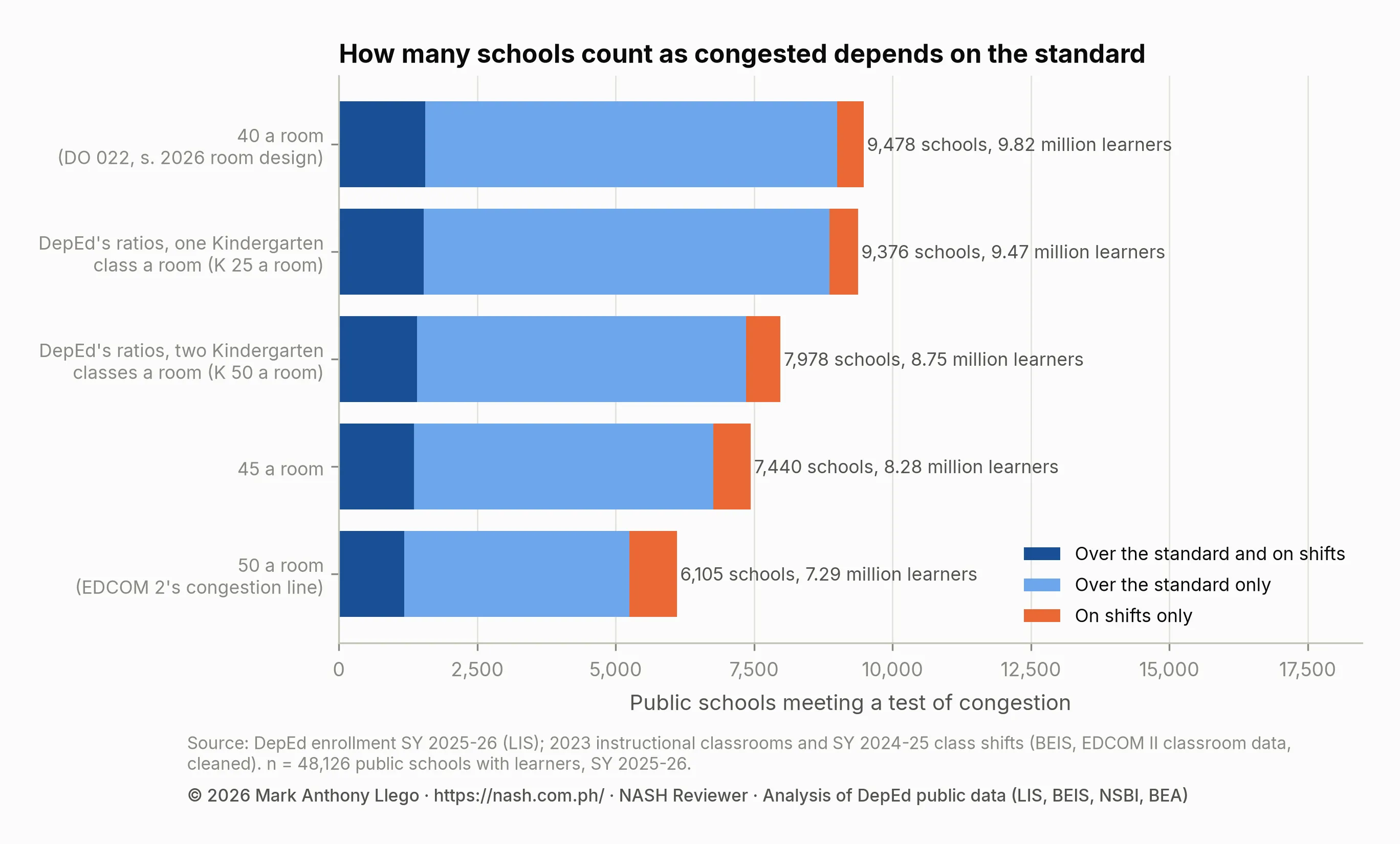
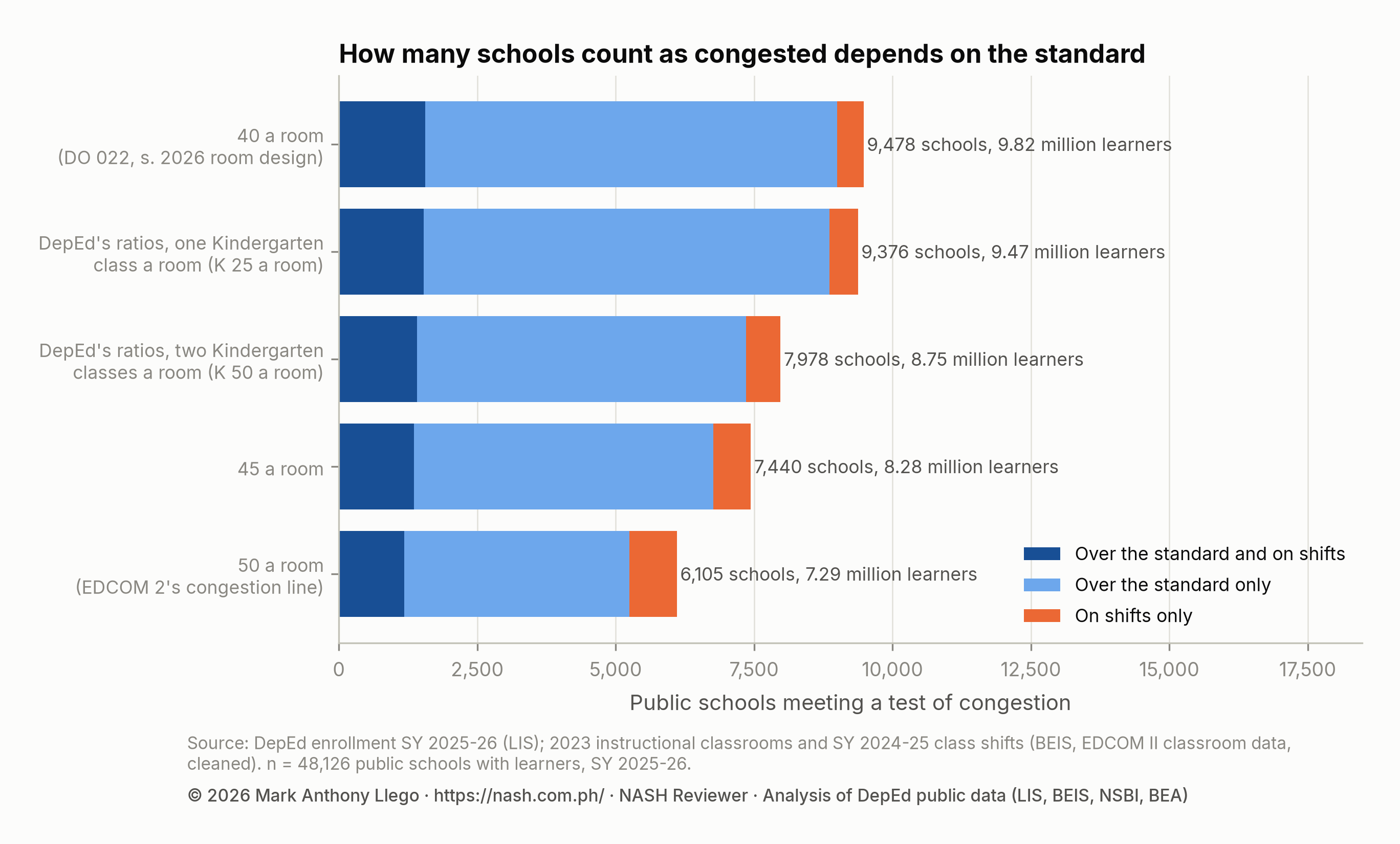
The range runs from 6,105 schools to 9,478. Between DepEd’s own two readings, the Kindergarten rule alone moves 1,398 schools: read literally, the School Report Card’s “Kinder (25:1)” can put a school with two Kindergarten classes in one room over the standard, though DepEd’s 2020 planning parameters count rooms that way. Stricter numbers are also on record: the same parameters set “30/40 learners in a class max of 35/45 (Grades 1-3/ Grade 4-6)”. Applied to those grades on the same data, with the other grades as above, they would put 10,714 schools in the count, or 8,895 at their maxima of 35 and 45.
The figure below draws the two tests as circles to scale. The shift circle stays the same; the room circle grows and shrinks with the standard.
RA 12327, Sec. 5(a)(1) · 48,126 public schools, SY 2025–26
Which standard decides the count
Pick a standard. The left circle is the schools over it at some level; the right one, the schools on shifts. Both are drawn to scale, so the circles show how much the choice of standard moves the count. Nothing you choose is kept or sent anywhere.
- Congested schools
- 7,978 of 48,126 (16.6%)
- Learners in them
- 8.75 million (39.6% of public school learners)
- Over the standard, by level
- 4,511 elementary · 2,172 junior high · 1,880 senior high
- Classrooms short
- 49,221 to bring every school over it down to the standard
DO 44, s. 2015, Annex 11, item 15 (Grades 1 & 2 40:1, Grades 3 to 10 45:1, SHS 40:1); Kindergarten at 25 a class (DO 47, s. 2016), two classes a room, as DepEd’s planning parameters count it.
- Congested schools
- 9,376 of 48,126 (19.5%)
- Learners in them
- 9.47 million (42.9% of public school learners)
- Over the standard, by level
- 6,052 elementary · 2,172 junior high · 1,880 senior high
- Classrooms short
- 60,786 to bring every school over it down to the standard
DO 44, s. 2015, Annex 11, item 15, read literally: Kinder 25:1, Grades 1 & 2 40:1, Grades 3 to 10 45:1, SHS 40:1.
- Congested schools
- 9,478 of 48,126 (19.7%)
- Learners in them
- 9.82 million (44.5% of public school learners)
- Over the standard, by level
- 5,709 elementary · 2,931 junior high · 1,880 senior high
- Classrooms short
- 67,230 to bring every school over it down to the standard
DO 022, s. 2026, Table 1.0: a 63-square-meter instructional room for 40 learners or fewer.
- Congested schools
- 7,440 of 48,126 (15.5%)
- Learners in them
- 8.28 million (37.5% of public school learners)
- Over the standard, by level
- 4,232 elementary · 2,172 junior high · 1,354 senior high
- Classrooms short
- 44,829 to bring every school over it down to the standard
The class size DO 62, s. 2004 used to count the classroom backlog.
- Congested schools
- 6,105 of 48,126 (12.7%)
- Learners in them
- 7.29 million (33.0% of public school learners)
- Over the standard, by level
- 3,251 elementary · 1,703 junior high · 1,009 senior high
- Classrooms short
- 30,782 to bring every school over it down to the standard
The line EDCOM 2 uses for congestion.
Congested public schools by region
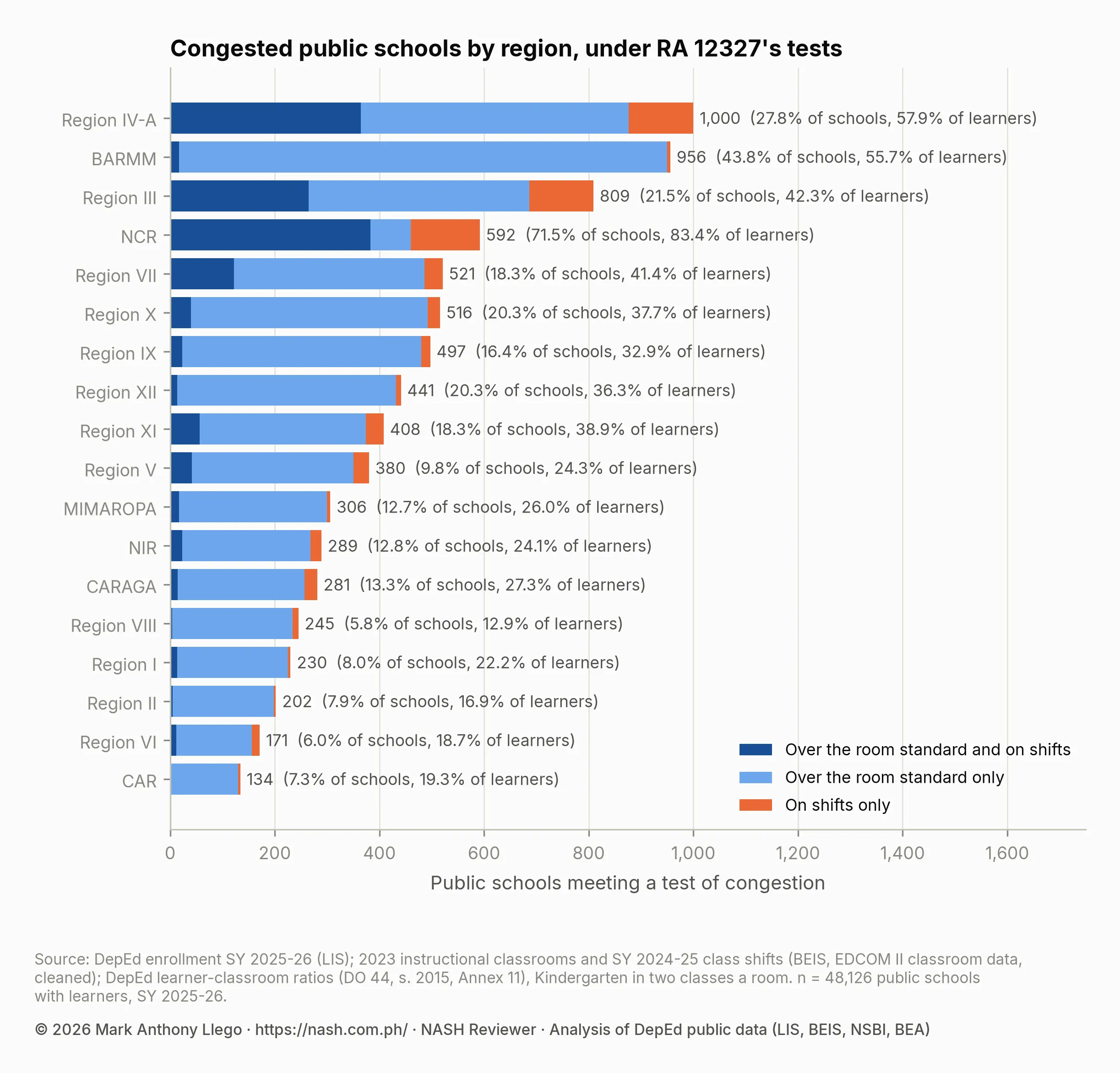
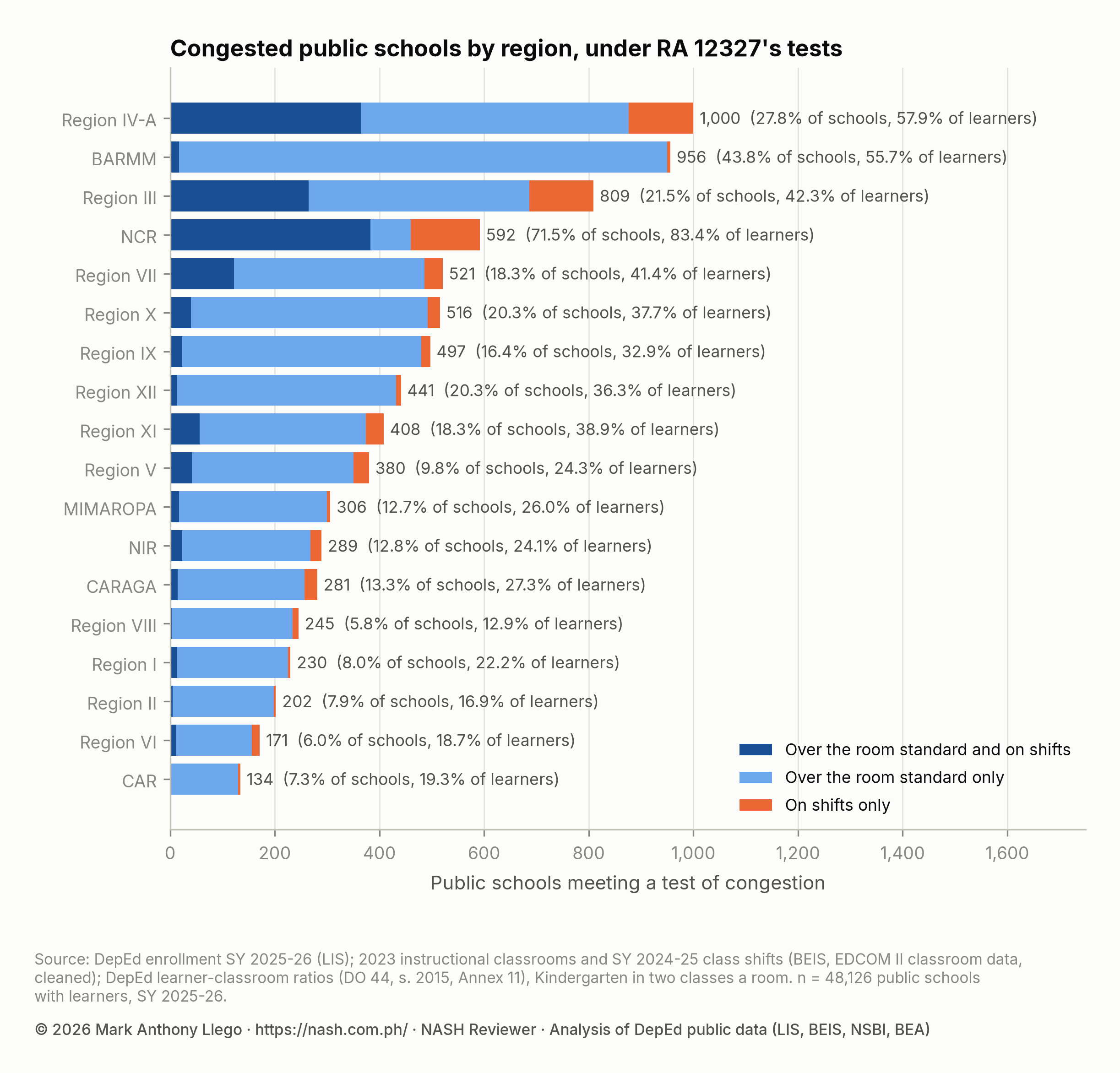
Three regions stand apart. NCR has the highest share by far: 592 of its 828 public schools (71.5%), with 83.4% of its learners, and 515 of its schools run shifts. Region IV-A and Region III, the growth belt around Metro Manila, have 1,000 and 809 congested schools, with 57.9% and 42.3% of their learners. These are the regions where shifts are common: 364 schools in Region IV-A and 265 in Region III are over the standard and on shifts.
BARMM has 956 congested schools, 43.8% of its public schools, but almost all of them (933) are over the room standard without shifts. Its median elementary school has 43.0 learners per classroom, against 24.0 nationally, which matches its classroom shortage, the highest per learner of any region (Classroom Shortage in BARMM). Sulu is counted in Region IX, where DepEd placed it in October 2026.
At the other end, Region VIII (5.8%), Region VI (6.0%) and CAR (7.3%) have the smallest shares. 33.1% of urban schools (3,598 of 10,878) and 11.8% of rural schools (4,284 of 36,451) are congested. Last Mile Schools are less often congested (10.3%) than other schools (18.1%).
Congested schools in each division
In 33 of the 231 schools divisions, at least half the public schools meet a test. Among divisions with 50 or more public schools, the highest shares are:
| Division | Region | Public schools | Congested | Share of schools | Share of learners |
|---|---|---|---|---|---|
| City of San Jose del Monte | Region III | 59 | 53 | 89.8% | 93.3% |
| Caloocan City | NCR | 89 | 70 | 78.7% | 89.8% |
| Taguig City and Pateros | NCR | 62 | 48 | 77.4% | 92.2% |
| Valenzuela City | NCR | 70 | 51 | 72.9% | 82.7% |
| Manila | NCR | 105 | 76 | 72.4% | 83.7% |
| Antipolo City | Region IV-A | 68 | 45 | 66.2% | 88.6% |
| Calamba City | Region IV-A | 73 | 46 | 63.0% | 72.5% |
| Mabalacat City | Region III | 55 | 34 | 61.8% | 71.7% |
The largest numbers are in big provincial divisions: Lanao del Sur II (192), Sulu (186), Lanao del Sur I (176), Cebu (173) and North Cotabato (160). Four divisions have no congested school on these data: Laoag City, Batanes, Borongan City and Tangub City. Pick a region below to see its divisions.
RA 12327, Sec. 5(a)(1) · 231 schools divisions
Congested schools in each division
Pick a region. Its divisions are listed from the largest share of congested schools down, under DepEd’s learner-classroom ratios with two Kindergarten classes a room. Nothing you choose is kept or sent anywhere.
NCR: 592 of 828 public schools congested (71.5%), with 83.4% of the region’s public school learners; 11,303 classrooms short of the standard.
- Navotas25 of 25 (100.0%)17 both · 0 rooms only · 8 shifts only · 0 unknown · 100.0% of learners · 355 rooms short
- Malabon City38 of 42 (90.5%)30 both · 5 rooms only · 3 shifts only · 0 unknown · 98.3% of learners · 483 rooms short
- Las Piñas City36 of 40 (90.0%)32 both · 1 rooms only · 3 shifts only · 1 unknown · 97.3% of learners · 775 rooms short
- Paranaque City37 of 43 (86.0%)28 both · 1 rooms only · 8 shifts only · 0 unknown · 92.7% of learners · 669 rooms short
- Muntinlupa City24 of 28 (85.7%)19 both · 0 rooms only · 5 shifts only · 0 unknown · 83.0% of learners · 437 rooms short
- Caloocan City70 of 89 (78.7%)27 both · 36 rooms only · 7 shifts only · 1 unknown · 89.8% of learners · 2,020 rooms short
- Makati City18 of 23 (78.3%)9 both · 0 rooms only · 9 shifts only · 4 unknown · 82.4% of learners · 56 rooms short
- Taguig City and Pateros48 of 62 (77.4%)37 both · 0 rooms only · 11 shifts only · 0 unknown · 92.2% of learners · 1,158 rooms short
- Valenzuela City51 of 70 (72.9%)40 both · 4 rooms only · 7 shifts only · 0 unknown · 82.7% of learners · 836 rooms short
- Manila76 of 105 (72.4%)31 both · 4 rooms only · 41 shifts only · 1 unknown · 83.7% of learners · 546 rooms short · 3 with no private school of that level in the city or municipality
- Marikina City23 of 33 (69.7%)16 both · 1 rooms only · 6 shifts only · 1 unknown · 84.1% of learners · 333 rooms short
- Quezon City97 of 158 (61.4%)67 both · 16 rooms only · 14 shifts only · 2 unknown · 82.6% of learners · 2,737 rooms short
- Pasay City16 of 29 (55.2%)9 both · 4 rooms only · 3 shifts only · 0 unknown · 72.7% of learners · 308 rooms short
- Mandaluyong City13 of 24 (54.2%)9 both · 0 rooms only · 4 shifts only · 0 unknown · 64.1% of learners · 99 rooms short
- Pasig City18 of 44 (40.9%)11 both · 4 rooms only · 3 shifts only · 2 unknown · 50.6% of learners · 482 rooms short
- City of San Juan2 of 13 (15.4%)1 both · 1 rooms only · 0 shifts only · 2 unknown · 36.1% of learners · 9 rooms short
CAR: 134 of 1,843 public schools congested (7.3%), with 19.3% of the region’s public school learners; 352 classrooms short of the standard.
- Baguio City14 of 68 (20.6%)0 both · 12 rooms only · 2 shifts only · 4 unknown · 22.6% of learners · 46 rooms short
- Kalinga26 of 193 (13.5%)0 both · 26 rooms only · 0 shifts only · 25 unknown · 23.4% of learners · 49 rooms short · 14 with no private school of that level in the city or municipality
- Mt. Province26 of 266 (9.8%)0 both · 26 rooms only · 0 shifts only · 30 unknown · 16.7% of learners · 42 rooms short · 10 with no private school of that level in the city or municipality
- Tabuk City9 of 103 (8.7%)0 both · 9 rooms only · 0 shifts only · 1 unknown · 28.3% of learners · 51 rooms short
- Benguet25 of 430 (5.8%)1 both · 24 rooms only · 0 shifts only · 22 unknown · 20.3% of learners · 89 rooms short · 6 with no private school of that level in the city or municipality
- Ifugao14 of 266 (5.3%)0 both · 14 rooms only · 0 shifts only · 8 unknown · 7.4% of learners · 20 rooms short · 12 with no private school of that level in the city or municipality
- Abra15 of 317 (4.7%)0 both · 14 rooms only · 1 shifts only · 14 unknown · 26.0% of learners · 49 rooms short · 1 with no private school of that level in the city or municipality
- Apayao5 of 200 (2.5%)0 both · 4 rooms only · 1 shifts only · 11 unknown · 6.1% of learners · 6 rooms short · 4 with no private school of that level in the city or municipality
Region I: 230 of 2,866 public schools congested (8.0%), with 22.2% of the region’s public school learners; 861 classrooms short of the standard.
- San Fernando City7 of 33 (21.2%)1 both · 4 rooms only · 2 shifts only · 0 unknown · 62.4% of learners · 38 rooms short
- San Carlos City14 of 76 (18.4%)0 both · 14 rooms only · 0 shifts only · 0 unknown · 22.8% of learners · 47 rooms short
- Dagupan City6 of 39 (15.4%)2 both · 3 rooms only · 1 shifts only · 0 unknown · 38.8% of learners · 20 rooms short
- Vigan City3 of 21 (14.3%)1 both · 2 rooms only · 0 shifts only · 0 unknown · 61.6% of learners · 6 rooms short
- Pangasinan I, Lingayen75 of 662 (11.3%)3 both · 71 rooms only · 1 shifts only · 11 unknown · 26.0% of learners · 330 rooms short · 4 with no private school of that level in the city or municipality
- La Union37 of 386 (9.6%)4 both · 32 rooms only · 1 shifts only · 5 unknown · 25.3% of learners · 160 rooms short · 2 with no private school of that level in the city or municipality
- Batac City3 of 33 (9.1%)0 both · 3 rooms only · 0 shifts only · 0 unknown · 28.5% of learners · 14 rooms short
- Pangasinan II, Binalonan49 of 561 (8.7%)1 both · 48 rooms only · 0 shifts only · 14 unknown · 19.4% of learners · 146 rooms short
- Urdaneta City5 of 64 (7.8%)0 both · 5 rooms only · 0 shifts only · 1 unknown · 10.6% of learners · 12 rooms short
- Candon City2 of 34 (5.9%)0 both · 2 rooms only · 0 shifts only · 1 unknown · 2.1% of learners · 2 rooms short
- Ilocos Sur25 of 507 (4.9%)0 both · 25 rooms only · 0 shifts only · 12 unknown · 18.8% of learners · 59 rooms short · 6 with no private school of that level in the city or municipality
- Alaminos City1 of 46 (2.2%)1 both · 0 rooms only · 0 shifts only · 0 unknown · 25.9% of learners · 13 rooms short
- Ilocos Norte3 of 364 (0.8%)0 both · 3 rooms only · 0 shifts only · 2 unknown · 2.4% of learners · 14 rooms short · 1 with no private school of that level in the city or municipality
- Laoag City0 of 40 (0.0%)0 both · 0 rooms only · 0 shifts only · 1 unknown · 0.0% of learners · 0 rooms short
Region II: 202 of 2,547 public schools congested (7.9%), with 16.9% of the region’s public school learners; 490 classrooms short of the standard.
- Santiago City14 of 41 (34.1%)0 both · 12 rooms only · 2 shifts only · 0 unknown · 43.7% of learners · 41 rooms short
- Tuguegarao City8 of 35 (22.9%)1 both · 7 rooms only · 0 shifts only · 0 unknown · 24.3% of learners · 19 rooms short
- Isabela88 of 884 (10.0%)0 both · 88 rooms only · 0 shifts only · 17 unknown · 15.7% of learners · 178 rooms short · 18 with no private school of that level in the city or municipality
- Cauayan City6 of 80 (7.5%)1 both · 5 rooms only · 0 shifts only · 0 unknown · 34.1% of learners · 37 rooms short
- City of Ilagan7 of 98 (7.1%)0 both · 6 rooms only · 1 shifts only · 0 unknown · 12.6% of learners · 17 rooms short
- Nueva Vizcaya25 of 385 (6.5%)2 both · 23 rooms only · 0 shifts only · 7 unknown · 24.5% of learners · 88 rooms short · 11 with no private school of that level in the city or municipality
- Cagayan44 of 810 (5.4%)1 both · 43 rooms only · 0 shifts only · 13 unknown · 10.4% of learners · 97 rooms short · 4 with no private school of that level in the city or municipality
- Quirino10 of 187 (5.3%)0 both · 9 rooms only · 1 shifts only · 4 unknown · 6.7% of learners · 13 rooms short · 4 with no private school of that level in the city or municipality
- Batanes0 of 27 (0.0%)0 both · 0 rooms only · 0 shifts only · 5 unknown · 0.0% of learners · 0 rooms short
Region III: 809 of 3,760 public schools congested (21.5%), with 42.3% of the region’s public school learners; 4,410 classrooms short of the standard.
- City of San Jose Del Monte53 of 59 (89.8%)39 both · 1 rooms only · 13 shifts only · 1 unknown · 93.3% of learners · 614 rooms short
- Mabalacat City34 of 55 (61.8%)18 both · 8 rooms only · 8 shifts only · 2 unknown · 71.7% of learners · 176 rooms short
- Angeles City32 of 52 (61.5%)25 both · 0 rooms only · 7 shifts only · 0 unknown · 75.8% of learners · 328 rooms short
- San Fernando City24 of 46 (52.2%)13 both · 8 rooms only · 3 shifts only · 1 unknown · 76.3% of learners · 167 rooms short
- Olongapo City19 of 40 (47.5%)5 both · 4 rooms only · 10 shifts only · 1 unknown · 61.6% of learners · 51 rooms short
- Meycauayan City14 of 31 (45.2%)7 both · 6 rooms only · 1 shifts only · 1 unknown · 77.1% of learners · 156 rooms short
- City of Baliwag12 of 30 (40.0%)2 both · 8 rooms only · 2 shifts only · 1 unknown · 56.6% of learners · 40 rooms short
- Cabanatuan City23 of 65 (35.4%)10 both · 5 rooms only · 8 shifts only · 1 unknown · 57.5% of learners · 70 rooms short
- Malolos City20 of 57 (35.1%)8 both · 6 rooms only · 6 shifts only · 0 unknown · 64.9% of learners · 76 rooms short
- Bulacan152 of 512 (29.7%)55 both · 78 rooms only · 19 shifts only · 9 unknown · 51.9% of learners · 1,116 rooms short
- Gapan City12 of 41 (29.3%)5 both · 7 rooms only · 0 shifts only · 0 unknown · 53.2% of learners · 58 rooms short
- Pampanga127 of 571 (22.2%)32 both · 77 rooms only · 18 shifts only · 24 unknown · 36.3% of learners · 613 rooms short
- Tarlac98 of 509 (19.3%)15 both · 77 rooms only · 6 shifts only · 8 unknown · 35.3% of learners · 382 rooms short · 3 with no private school of that level in the city or municipality
- Bataan39 of 215 (18.1%)10 both · 18 rooms only · 11 shifts only · 1 unknown · 24.9% of learners · 106 rooms short
- Tarlac City16 of 99 (16.2%)2 both · 11 rooms only · 3 shifts only · 2 unknown · 34.5% of learners · 90 rooms short
- San Jose City9 of 61 (14.8%)0 both · 8 rooms only · 1 shifts only · 3 unknown · 14.7% of learners · 32 rooms short
- Zambales43 of 316 (13.6%)14 both · 26 rooms only · 3 shifts only · 14 unknown · 27.1% of learners · 137 rooms short
- Balanga City3 of 24 (12.5%)1 both · 2 rooms only · 0 shifts only · 2 unknown · 30.6% of learners · 43 rooms short
- Nueva Ecija71 of 763 (9.3%)3 both · 64 rooms only · 4 shifts only · 14 unknown · 13.3% of learners · 127 rooms short
- Aurora7 of 176 (4.0%)0 both · 7 rooms only · 0 shifts only · 1 unknown · 9.7% of learners · 27 rooms short · 1 with no private school of that level in the city or municipality
- Science City of Muñoz1 of 38 (2.6%)1 both · 0 rooms only · 0 shifts only · 4 unknown · 3.4% of learners · 1 rooms short
Region IV-A: 1,000 of 3,592 public schools congested (27.8%), with 57.9% of the region’s public school learners; 11,277 classrooms short of the standard.
- General Trias City32 of 41 (78.0%)16 both · 10 rooms only · 6 shifts only · 5 unknown · 89.9% of learners · 488 rooms short
- Sta. Rosa City21 of 28 (75.0%)13 both · 4 rooms only · 4 shifts only · 1 unknown · 79.6% of learners · 357 rooms short
- Dasmarinas City33 of 45 (73.3%)17 both · 13 rooms only · 3 shifts only · 2 unknown · 83.3% of learners · 612 rooms short
- Binan City30 of 41 (73.2%)10 both · 13 rooms only · 7 shifts only · 2 unknown · 83.9% of learners · 263 rooms short
- Antipolo City45 of 68 (66.2%)37 both · 3 rooms only · 5 shifts only · 1 unknown · 88.6% of learners · 1,378 rooms short
- Imus City25 of 38 (65.8%)9 both · 10 rooms only · 6 shifts only · 2 unknown · 79.7% of learners · 451 rooms short
- Cabuyao City19 of 29 (65.5%)9 both · 7 rooms only · 3 shifts only · 1 unknown · 82.0% of learners · 251 rooms short
- San Pedro City18 of 28 (64.3%)11 both · 6 rooms only · 1 shifts only · 0 unknown · 72.0% of learners · 260 rooms short
- Bacoor City28 of 44 (63.6%)20 both · 1 rooms only · 7 shifts only · 1 unknown · 86.4% of learners · 515 rooms short
- Calamba City46 of 73 (63.0%)26 both · 9 rooms only · 11 shifts only · 2 unknown · 72.5% of learners · 360 rooms short
- Carmona City6 of 11 (54.5%)1 both · 4 rooms only · 1 shifts only · 0 unknown · 62.6% of learners · 23 rooms short
- Rizal146 of 308 (47.4%)54 both · 81 rooms only · 11 shifts only · 13 unknown · 71.2% of learners · 2,558 rooms short
- Cavite City7 of 15 (46.7%)2 both · 0 rooms only · 5 shifts only · 1 unknown · 73.5% of learners · 11 rooms short
- Cavite148 of 323 (45.8%)52 both · 76 rooms only · 20 shifts only · 11 unknown · 74.3% of learners · 1,651 rooms short · 5 with no private school of that level in the city or municipality
- Tayabas City15 of 35 (42.9%)2 both · 12 rooms only · 1 shifts only · 5 unknown · 74.6% of learners · 95 rooms short
- Lucena City23 of 54 (42.6%)6 both · 13 rooms only · 4 shifts only · 2 unknown · 54.1% of learners · 75 rooms short
- Sto. Tomas City13 of 32 (40.6%)5 both · 8 rooms only · 0 shifts only · 1 unknown · 65.7% of learners · 151 rooms short
- San Pablo City22 of 81 (27.2%)7 both · 12 rooms only · 3 shifts only · 0 unknown · 40.4% of learners · 104 rooms short
- Laguna72 of 346 (20.8%)25 both · 35 rooms only · 12 shifts only · 11 unknown · 36.4% of learners · 405 rooms short · 2 with no private school of that level in the city or municipality
- Lipa City15 of 85 (17.6%)7 both · 4 rooms only · 4 shifts only · 0 unknown · 34.5% of learners · 90 rooms short
- Tanauan City9 of 59 (15.3%)0 both · 8 rooms only · 1 shifts only · 0 unknown · 25.6% of learners · 33 rooms short
- Quezon134 of 958 (14.0%)14 both · 117 rooms only · 3 shifts only · 14 unknown · 30.1% of learners · 622 rooms short · 6 with no private school of that level in the city or municipality
- Batangas81 of 702 (11.5%)16 both · 60 rooms only · 5 shifts only · 16 unknown · 23.2% of learners · 482 rooms short · 2 with no private school of that level in the city or municipality
- Batangas City9 of 110 (8.2%)4 both · 5 rooms only · 0 shifts only · 2 unknown · 26.4% of learners · 39 rooms short
- Calaca City3 of 38 (7.9%)1 both · 1 rooms only · 1 shifts only · 1 unknown · 20.1% of learners · 3 rooms short
MIMAROPA: 306 of 2,415 public schools congested (12.7%), with 26.0% of the region’s public school learners; 1,075 classrooms short of the standard.
- Occidental Mindoro72 of 366 (19.7%)3 both · 68 rooms only · 1 shifts only · 11 unknown · 34.7% of learners · 270 rooms short · 9 with no private school of that level in the city or municipality
- Puerto Princesa City17 of 101 (16.8%)7 both · 10 rooms only · 0 shifts only · 4 unknown · 51.4% of learners · 212 rooms short
- Palawan138 of 840 (16.4%)1 both · 137 rooms only · 0 shifts only · 41 unknown · 25.5% of learners · 374 rooms short · 36 with no private school of that level in the city or municipality
- Romblon22 of 271 (8.1%)4 both · 13 rooms only · 5 shifts only · 12 unknown · 20.8% of learners · 54 rooms short · 13 with no private school of that level in the city or municipality
- Oriental Mindoro39 of 549 (7.1%)0 both · 39 rooms only · 0 shifts only · 35 unknown · 12.7% of learners · 109 rooms short · 3 with no private school of that level in the city or municipality
- Calapan City4 of 59 (6.8%)1 both · 3 rooms only · 0 shifts only · 1 unknown · 30.1% of learners · 22 rooms short
- Marinduque14 of 229 (6.1%)1 both · 13 rooms only · 0 shifts only · 4 unknown · 21.6% of learners · 34 rooms short
Region V: 380 of 3,884 public schools congested (9.8%), with 24.3% of the region’s public school learners; 1,603 classrooms short of the standard.
- Naga City11 of 45 (24.4%)2 both · 7 rooms only · 2 shifts only · 3 unknown · 46.5% of learners · 114 rooms short
- Legaspi City14 of 58 (24.1%)5 both · 7 rooms only · 2 shifts only · 9 unknown · 41.7% of learners · 95 rooms short
- Masbate City8 of 46 (17.4%)1 both · 7 rooms only · 0 shifts only · 2 unknown · 38.2% of learners · 17 rooms short
- Camarines Sur152 of 1,102 (13.8%)11 both · 134 rooms only · 7 shifts only · 21 unknown · 26.9% of learners · 572 rooms short · 12 with no private school of that level in the city or municipality
- Sorsogon City9 of 83 (10.8%)2 both · 5 rooms only · 2 shifts only · 1 unknown · 38.7% of learners · 56 rooms short
- Camarines Norte28 of 319 (8.8%)5 both · 20 rooms only · 3 shifts only · 2 unknown · 26.3% of learners · 173 rooms short · 5 with no private school of that level in the city or municipality
- Masbate62 of 707 (8.8%)2 both · 56 rooms only · 4 shifts only · 23 unknown · 16.0% of learners · 149 rooms short · 10 with no private school of that level in the city or municipality
- Iriga City4 of 51 (7.8%)1 both · 3 rooms only · 0 shifts only · 2 unknown · 17.3% of learners · 10 rooms short
- Tabaco City4 of 51 (7.8%)0 both · 3 rooms only · 1 shifts only · 1 unknown · 35.3% of learners · 8 rooms short
- Albay39 of 556 (7.0%)5 both · 30 rooms only · 4 shifts only · 6 unknown · 24.4% of learners · 225 rooms short · 6 with no private school of that level in the city or municipality
- Sorsogon33 of 531 (6.2%)5 both · 24 rooms only · 4 shifts only · 9 unknown · 12.7% of learners · 89 rooms short · 8 with no private school of that level in the city or municipality
- Ligao City4 of 67 (6.0%)1 both · 3 rooms only · 0 shifts only · 0 unknown · 27.3% of learners · 57 rooms short
- Catanduanes12 of 268 (4.5%)1 both · 10 rooms only · 1 shifts only · 2 unknown · 10.6% of learners · 38 rooms short · 5 with no private school of that level in the city or municipality
Region VI: 171 of 2,841 public schools congested (6.0%), with 18.7% of the region’s public school learners; 578 classrooms short of the standard.
- Iloilo City12 of 66 (18.2%)2 both · 8 rooms only · 2 shifts only · 0 unknown · 30.7% of learners · 56 rooms short
- Roxas City9 of 50 (18.0%)2 both · 4 rooms only · 3 shifts only · 3 unknown · 29.7% of learners · 35 rooms short
- Passi City8 of 46 (17.4%)0 both · 8 rooms only · 0 shifts only · 1 unknown · 17.6% of learners · 20 rooms short
- Iloilo78 of 1,174 (6.6%)1 both · 75 rooms only · 2 shifts only · 16 unknown · 16.2% of learners · 259 rooms short · 16 with no private school of that level in the city or municipality
- Aklan24 of 380 (6.3%)3 both · 21 rooms only · 0 shifts only · 6 unknown · 21.6% of learners · 100 rooms short · 2 with no private school of that level in the city or municipality
- Guimaras6 of 116 (5.2%)0 both · 6 rooms only · 0 shifts only · 6 unknown · 14.0% of learners · 14 rooms short · 1 with no private school of that level in the city or municipality
- Capiz17 of 471 (3.6%)2 both · 9 rooms only · 6 shifts only · 3 unknown · 18.8% of learners · 40 rooms short · 6 with no private school of that level in the city or municipality
- Antique17 of 538 (3.2%)2 both · 13 rooms only · 2 shifts only · 12 unknown · 16.3% of learners · 54 rooms short · 2 with no private school of that level in the city or municipality
NIR: 289 of 2,253 public schools congested (12.8%), with 24.1% of the region’s public school learners; 1,083 classrooms short of the standard.
- Bacolod City26 of 70 (37.1%)10 both · 14 rooms only · 2 shifts only · 2 unknown · 44.1% of learners · 198 rooms short
- Dumaguete City9 of 26 (34.6%)2 both · 6 rooms only · 1 shifts only · 3 unknown · 35.5% of learners · 80 rooms short
- Canlaon City12 of 38 (31.6%)0 both · 12 rooms only · 0 shifts only · 4 unknown · 38.5% of learners · 47 rooms short
- Escalante City9 of 42 (21.4%)0 both · 9 rooms only · 0 shifts only · 1 unknown · 39.5% of learners · 37 rooms short
- Himamaylan City11 of 57 (19.3%)2 both · 9 rooms only · 0 shifts only · 4 unknown · 43.5% of learners · 67 rooms short
- Cadiz City13 of 69 (18.8%)1 both · 11 rooms only · 1 shifts only · 4 unknown · 39.1% of learners · 78 rooms short
- Bayawan City17 of 105 (16.2%)1 both · 14 rooms only · 2 shifts only · 12 unknown · 30.2% of learners · 35 rooms short · 2 with no private school of that level in the city or municipality
- Kabankalan City15 of 95 (15.8%)1 both · 14 rooms only · 0 shifts only · 5 unknown · 15.8% of learners · 49 rooms short
- Victorias City4 of 26 (15.4%)0 both · 3 rooms only · 1 shifts only · 1 unknown · 13.6% of learners · 3 rooms short
- Guihulngan City15 of 104 (14.4%)1 both · 14 rooms only · 0 shifts only · 19 unknown · 12.4% of learners · 34 rooms short · 2 with no private school of that level in the city or municipality
- Negros Oriental69 of 516 (13.4%)2 both · 59 rooms only · 8 shifts only · 9 unknown · 27.1% of learners · 183 rooms short · 14 with no private school of that level in the city or municipality
- Bais City7 of 57 (12.3%)0 both · 7 rooms only · 0 shifts only · 0 unknown · 10.1% of learners · 12 rooms short
- Sipalay City5 of 49 (10.2%)0 both · 5 rooms only · 0 shifts only · 4 unknown · 13.6% of learners · 15 rooms short
- Silay City4 of 40 (10.0%)0 both · 4 rooms only · 0 shifts only · 2 unknown · 8.2% of learners · 4 rooms short
- Negros Occidental53 of 576 (9.2%)0 both · 50 rooms only · 3 shifts only · 3 unknown · 21.5% of learners · 198 rooms short · 3 with no private school of that level in the city or municipality
- Siquijor5 of 78 (6.4%)1 both · 4 rooms only · 0 shifts only · 6 unknown · 10.4% of learners · 11 rooms short
- San Carlos City4 of 65 (6.2%)1 both · 1 rooms only · 2 shifts only · 1 unknown · 22.7% of learners · 11 rooms short
- Sagay City4 of 67 (6.0%)1 both · 3 rooms only · 0 shifts only · 3 unknown · 12.1% of learners · 9 rooms short
- Tanjay City5 of 95 (5.3%)0 both · 5 rooms only · 0 shifts only · 3 unknown · 11.7% of learners · 11 rooms short · 1 with no private school of that level in the city or municipality
- La Carlota City1 of 31 (3.2%)0 both · 1 rooms only · 0 shifts only · 2 unknown · 5.6% of learners · 1 rooms short
- Bago City1 of 47 (2.1%)0 both · 0 rooms only · 1 shifts only · 1 unknown · 0.7% of learners · 0 rooms short
Region VII: 521 of 2,840 public schools congested (18.3%), with 41.4% of the region’s public school learners; 3,250 classrooms short of the standard.
- Talisay City33 of 44 (75.0%)23 both · 8 rooms only · 2 shifts only · 1 unknown · 89.0% of learners · 377 rooms short
- Mandaue City28 of 48 (58.3%)14 both · 9 rooms only · 5 shifts only · 3 unknown · 75.5% of learners · 279 rooms short
- Lapu-Lapu City38 of 70 (54.3%)13 both · 22 rooms only · 3 shifts only · 2 unknown · 73.8% of learners · 396 rooms short
- Cebu City51 of 107 (47.7%)16 both · 24 rooms only · 11 shifts only · 1 unknown · 54.0% of learners · 389 rooms short
- Toledo City27 of 67 (40.3%)5 both · 21 rooms only · 1 shifts only · 6 unknown · 54.4% of learners · 182 rooms short
- Danao City20 of 61 (32.8%)0 both · 20 rooms only · 0 shifts only · 2 unknown · 49.4% of learners · 60 rooms short
- Carcar City16 of 50 (32.0%)8 both · 8 rooms only · 0 shifts only · 3 unknown · 50.4% of learners · 126 rooms short
- Tagbilaran City7 of 26 (26.9%)3 both · 4 rooms only · 0 shifts only · 2 unknown · 21.9% of learners · 32 rooms short
- City of Naga, Cebu12 of 55 (21.8%)3 both · 8 rooms only · 1 shifts only · 10 unknown · 30.0% of learners · 38 rooms short
- Bogo City7 of 38 (18.4%)0 both · 7 rooms only · 0 shifts only · 0 unknown · 26.2% of learners · 36 rooms short
- Cebu173 of 1,143 (15.1%)35 both · 129 rooms only · 9 shifts only · 41 unknown · 34.4% of learners · 1,085 rooms short · 12 with no private school of that level in the city or municipality
- Bohol109 of 1,131 (9.6%)2 both · 104 rooms only · 3 shifts only · 40 unknown · 16.5% of learners · 250 rooms short · 13 with no private school of that level in the city or municipality
Region VIII: 245 of 4,197 public schools congested (5.8%), with 12.9% of the region’s public school learners; 678 classrooms short of the standard.
- Catbalogan City10 of 58 (17.2%)0 both · 10 rooms only · 0 shifts only · 1 unknown · 50.1% of learners · 77 rooms short
- Ormoc City12 of 98 (12.2%)0 both · 12 rooms only · 0 shifts only · 0 unknown · 17.5% of learners · 51 rooms short
- Northern Samar65 of 610 (10.7%)1 both · 60 rooms only · 4 shifts only · 27 unknown · 19.8% of learners · 170 rooms short · 45 with no private school of that level in the city or municipality
- Calbayog City16 of 174 (9.2%)0 both · 16 rooms only · 0 shifts only · 6 unknown · 26.6% of learners · 80 rooms short
- Biliran9 of 143 (6.3%)0 both · 8 rooms only · 1 shifts only · 1 unknown · 12.4% of learners · 36 rooms short · 3 with no private school of that level in the city or municipality
- Samar (Western Samar)41 of 742 (5.5%)1 both · 39 rooms only · 1 shifts only · 20 unknown · 8.9% of learners · 72 rooms short · 33 with no private school of that level in the city or municipality
- Tacloban City3 of 60 (5.0%)0 both · 2 rooms only · 1 shifts only · 1 unknown · 2.9% of learners · 4 rooms short
- Baybay City4 of 82 (4.9%)0 both · 4 rooms only · 0 shifts only · 3 unknown · 13.0% of learners · 16 rooms short
- Leyte59 of 1,287 (4.6%)2 both · 55 rooms only · 2 shifts only · 20 unknown · 12.4% of learners · 136 rooms short · 16 with no private school of that level in the city or municipality
- Maasin City3 of 76 (3.9%)0 both · 3 rooms only · 0 shifts only · 4 unknown · 15.4% of learners · 5 rooms short
- Southern Leyte11 of 343 (3.2%)0 both · 11 rooms only · 0 shifts only · 8 unknown · 4.9% of learners · 16 rooms short · 2 with no private school of that level in the city or municipality
- Eastern Samar12 of 466 (2.6%)0 both · 10 rooms only · 2 shifts only · 14 unknown · 2.6% of learners · 15 rooms short · 7 with no private school of that level in the city or municipality
- Borongan City0 of 58 (0.0%)0 both · 0 rooms only · 0 shifts only · 2 unknown · 0.0% of learners · 0 rooms short
Region IX: 497 of 3,025 public schools congested (16.4%), with 32.9% of the region’s public school learners; 2,213 classrooms short of the standard.
- Sulu186 of 460 (40.4%)3 both · 179 rooms only · 4 shifts only · 82 unknown · 58.3% of learners · 768 rooms short · 130 with no private school of that level in the city or municipality
- Zamboanga City65 of 222 (29.3%)14 both · 48 rooms only · 3 shifts only · 13 unknown · 56.3% of learners · 747 rooms short
- Pagadian City20 of 82 (24.4%)3 both · 16 rooms only · 1 shifts only · 4 unknown · 29.2% of learners · 78 rooms short
- Isabela City15 of 66 (22.7%)0 both · 15 rooms only · 0 shifts only · 3 unknown · 46.6% of learners · 53 rooms short
- Dapitan City10 of 61 (16.4%)0 both · 10 rooms only · 0 shifts only · 5 unknown · 34.2% of learners · 21 rooms short
- Zamboanga Sibugay71 of 508 (14.0%)0 both · 71 rooms only · 0 shifts only · 7 unknown · 24.1% of learners · 225 rooms short · 19 with no private school of that level in the city or municipality
- Dipolog City5 of 49 (10.2%)1 both · 3 rooms only · 1 shifts only · 0 unknown · 20.6% of learners · 22 rooms short
- Zamboanga del Norte76 of 766 (9.9%)1 both · 68 rooms only · 7 shifts only · 23 unknown · 16.8% of learners · 197 rooms short · 36 with no private school of that level in the city or municipality
- Zamboanga del Sur49 of 811 (6.0%)1 both · 47 rooms only · 1 shifts only · 15 unknown · 10.5% of learners · 102 rooms short · 12 with no private school of that level in the city or municipality
Region X: 516 of 2,540 public schools congested (20.3%), with 37.7% of the region’s public school learners; 2,230 classrooms short of the standard.
- Valencia City22 of 65 (33.8%)1 both · 21 rooms only · 0 shifts only · 5 unknown · 49.9% of learners · 147 rooms short
- Cagayan de Oro City38 of 115 (33.0%)13 both · 17 rooms only · 8 shifts only · 2 unknown · 45.5% of learners · 223 rooms short
- El Salvador7 of 24 (29.2%)2 both · 4 rooms only · 1 shifts only · 0 unknown · 18.8% of learners · 19 rooms short
- Bukidnon158 of 654 (24.2%)7 both · 145 rooms only · 6 shifts only · 37 unknown · 42.1% of learners · 659 rooms short · 23 with no private school of that level in the city or municipality
- Lanao del Norte88 of 385 (22.9%)0 both · 88 rooms only · 0 shifts only · 31 unknown · 31.5% of learners · 219 rooms short · 43 with no private school of that level in the city or municipality
- Camiguin15 of 66 (22.7%)0 both · 15 rooms only · 0 shifts only · 3 unknown · 19.6% of learners · 26 rooms short · 3 with no private school of that level in the city or municipality
- Iligan City25 of 113 (22.1%)0 both · 23 rooms only · 2 shifts only · 7 unknown · 43.5% of learners · 147 rooms short
- Misamis Oriental93 of 422 (22.0%)12 both · 76 rooms only · 5 shifts only · 15 unknown · 42.9% of learners · 484 rooms short · 12 with no private school of that level in the city or municipality
- Malaybalay City19 of 87 (21.8%)3 both · 16 rooms only · 0 shifts only · 5 unknown · 44.1% of learners · 121 rooms short
- Gingoog City19 of 97 (19.6%)2 both · 17 rooms only · 0 shifts only · 3 unknown · 49.5% of learners · 116 rooms short
- Misamis Occidental27 of 338 (8.0%)0 both · 25 rooms only · 2 shifts only · 6 unknown · 13.8% of learners · 51 rooms short · 8 with no private school of that level in the city or municipality
- Ozamis City3 of 58 (5.2%)0 both · 3 rooms only · 0 shifts only · 0 unknown · 5.5% of learners · 6 rooms short
- Oroquieta City2 of 51 (3.9%)0 both · 2 rooms only · 0 shifts only · 0 unknown · 11.5% of learners · 12 rooms short
- Tangub City0 of 65 (0.0%)0 both · 0 rooms only · 0 shifts only · 0 unknown · 0.0% of learners · 0 rooms short
Region XI: 408 of 2,233 public schools congested (18.3%), with 38.9% of the region’s public school learners; 2,179 classrooms short of the standard.
- Digos City18 of 48 (37.5%)2 both · 16 rooms only · 0 shifts only · 19 unknown · 56.4% of learners · 137 rooms short
- Panabo City22 of 62 (35.5%)1 both · 20 rooms only · 1 shifts only · 0 unknown · 51.7% of learners · 138 rooms short
- Davao City145 of 439 (33.0%)49 both · 65 rooms only · 31 shifts only · 30 unknown · 65.1% of learners · 1,142 rooms short
- Tagum City10 of 39 (25.6%)0 both · 10 rooms only · 0 shifts only · 1 unknown · 44.7% of learners · 83 rooms short
- Island Garden City of Samal13 of 75 (17.3%)1 both · 12 rooms only · 0 shifts only · 2 unknown · 25.9% of learners · 54 rooms short
- Davao del Norte44 of 264 (16.7%)0 both · 44 rooms only · 0 shifts only · 3 unknown · 27.3% of learners · 127 rooms short · 12 with no private school of that level in the city or municipality
- Mati City12 of 72 (16.7%)1 both · 11 rooms only · 0 shifts only · 1 unknown · 17.9% of learners · 52 rooms short
- Davao Occidental32 of 219 (14.6%)1 both · 31 rooms only · 0 shifts only · 19 unknown · 19.7% of learners · 122 rooms short · 10 with no private school of that level in the city or municipality
- Davao De Oro51 of 419 (12.2%)0 both · 51 rooms only · 0 shifts only · 7 unknown · 20.9% of learners · 141 rooms short · 2 with no private school of that level in the city or municipality
- Davao del Sur29 of 263 (11.0%)1 both · 26 rooms only · 2 shifts only · 22 unknown · 23.3% of learners · 98 rooms short
- Davao Oriental32 of 333 (9.6%)0 both · 32 rooms only · 0 shifts only · 17 unknown · 16.5% of learners · 85 rooms short · 6 with no private school of that level in the city or municipality
Region XII: 441 of 2,171 public schools congested (20.3%), with 36.3% of the region’s public school learners; 1,705 classrooms short of the standard.
- General Santos City39 of 106 (36.8%)4 both · 35 rooms only · 0 shifts only · 2 unknown · 60.6% of learners · 358 rooms short
- Kidapawan City25 of 76 (32.9%)3 both · 21 rooms only · 1 shifts only · 7 unknown · 53.4% of learners · 93 rooms short
- Koronadal City16 of 55 (29.1%)3 both · 12 rooms only · 1 shifts only · 5 unknown · 53.9% of learners · 106 rooms short
- Sarangani76 of 327 (23.2%)0 both · 76 rooms only · 0 shifts only · 37 unknown · 38.2% of learners · 267 rooms short · 7 with no private school of that level in the city or municipality
- North Cotabato160 of 784 (20.4%)2 both · 154 rooms only · 4 shifts only · 66 unknown · 30.7% of learners · 469 rooms short · 16 with no private school of that level in the city or municipality
- South Cotabato59 of 384 (15.4%)0 both · 57 rooms only · 2 shifts only · 12 unknown · 25.7% of learners · 209 rooms short · 2 with no private school of that level in the city or municipality
- Sultan Kudarat62 of 408 (15.2%)0 both · 61 rooms only · 1 shifts only · 27 unknown · 25.3% of learners · 160 rooms short · 17 with no private school of that level in the city or municipality
- Tacurong City4 of 31 (12.9%)1 both · 3 rooms only · 0 shifts only · 0 unknown · 31.2% of learners · 43 rooms short
CARAGA: 281 of 2,107 public schools congested (13.3%), with 27.3% of the region’s public school learners; 761 classrooms short of the standard.
- Tandag City11 of 32 (34.4%)2 both · 7 rooms only · 2 shifts only · 2 unknown · 62.2% of learners · 45 rooms short
- Butuan City38 of 139 (27.3%)6 both · 31 rooms only · 1 shifts only · 3 unknown · 48.3% of learners · 196 rooms short
- Cabadbaran City9 of 35 (25.7%)1 both · 7 rooms only · 1 shifts only · 1 unknown · 44.2% of learners · 38 rooms short
- Surigao City19 of 87 (21.8%)0 both · 16 rooms only · 3 shifts only · 1 unknown · 41.1% of learners · 36 rooms short
- Surigao del Sur75 of 453 (16.6%)2 both · 68 rooms only · 5 shifts only · 14 unknown · 28.2% of learners · 161 rooms short · 21 with no private school of that level in the city or municipality
- Agusan del Sur69 of 520 (13.3%)2 both · 61 rooms only · 6 shifts only · 21 unknown · 24.5% of learners · 156 rooms short · 23 with no private school of that level in the city or municipality
- Bayugan City6 of 71 (8.5%)0 both · 5 rooms only · 1 shifts only · 1 unknown · 29.1% of learners · 16 rooms short
- Dinagat Island12 of 144 (8.3%)0 both · 10 rooms only · 2 shifts only · 3 unknown · 15.5% of learners · 17 rooms short · 11 with no private school of that level in the city or municipality
- Siargao12 of 145 (8.3%)0 both · 11 rooms only · 1 shifts only · 7 unknown · 13.1% of learners · 23 rooms short · 2 with no private school of that level in the city or municipality
- Agusan del Norte16 of 209 (7.7%)1 both · 14 rooms only · 1 shifts only · 5 unknown · 13.7% of learners · 35 rooms short · 5 with no private school of that level in the city or municipality
- Surigao del Norte12 of 202 (5.9%)0 both · 12 rooms only · 0 shifts only · 1 unknown · 15.6% of learners · 34 rooms short · 4 with no private school of that level in the city or municipality
- Bislig City2 of 70 (2.9%)0 both · 1 rooms only · 1 shifts only · 1 unknown · 12.1% of learners · 4 rooms short
BARMM: 956 of 2,184 public schools congested (43.8%), with 55.7% of the region’s public school learners; 3,173 classrooms short of the standard.
- Cotabato City23 of 45 (51.1%)6 both · 17 rooms only · 0 shifts only · 2 unknown · 60.9% of learners · 168 rooms short
- Lanao del Sur - II192 of 392 (49.0%)1 both · 191 rooms only · 0 shifts only · 68 unknown · 56.7% of learners · 588 rooms short · 104 with no private school of that level in the city or municipality
- Basilan86 of 180 (47.8%)3 both · 82 rooms only · 1 shifts only · 21 unknown · 60.7% of learners · 275 rooms short · 58 with no private school of that level in the city or municipality
- Maguindanao II151 of 321 (47.0%)1 both · 149 rooms only · 1 shifts only · 31 unknown · 57.8% of learners · 542 rooms short · 67 with no private school of that level in the city or municipality
- Maguindanao I159 of 340 (46.8%)2 both · 157 rooms only · 0 shifts only · 80 unknown · 58.6% of learners · 637 rooms short · 65 with no private school of that level in the city or municipality
- Marawi City22 of 51 (43.1%)1 both · 21 rooms only · 0 shifts only · 5 unknown · 65.5% of learners · 70 rooms short
- Lanao del Sur - I176 of 416 (42.3%)1 both · 173 rooms only · 2 shifts only · 31 unknown · 52.2% of learners · 517 rooms short · 77 with no private school of that level in the city or municipality
- Tawi-Tawi100 of 266 (37.6%)1 both · 97 rooms only · 2 shifts only · 32 unknown · 54.4% of learners · 253 rooms short · 59 with no private school of that level in the city or municipality
- Special Geographic Area Division34 of 117 (29.1%)1 both · 33 rooms only · 0 shifts only · 17 unknown · 37.8% of learners · 87 rooms short · 33 with no private school of that level in the city or municipality
- Lamitan City13 of 56 (23.2%)0 both · 13 rooms only · 0 shifts only · 3 unknown · 40.1% of learners · 36 rooms short
Schools on shifts
In SY 2024–25, 2,041 public schools held classes in two or more shifts at some level; 2,037 of them enrolled learners again in SY 2025–26. EDCOM 2 counted 1,889 schools “on double or triple shifts” in the same school year (EDCOM 2, November 20, 2026); the two counts come from different extracts and definitions, as Class Shifts and Crowded Classrooms explains.
Shifts and crowded rooms go together. Of the 2,037 schools on shifts, 1,413 (69.4%) are also over the room standard with all their learners counted against their rooms. The other 624 are within it on paper, which is what shifts are for: splitting the day lets the same rooms hold more learners. Under the Act, those 624 are congested all the same.
Where vouchers can help, and where they cannot
Vouchers move learners into private schools that have room for them. Two counts show the limits.
The first is distance. RA 12327 lets a learner choose a participating private school within a 3-kilometer walk of home, “or if none, the next nearest private school” (Sec. 6). Private schools’ locations are not in DepEd’s data, but their city or municipality is. In SY 2025–26, 1,293 congested schools (16.2%), with 248,153 learners in Kindergarten to Grade 6, had no private school enrolling learners at their crowded level anywhere in their city or municipality. Of them, 1,128 are rural. Schools like these are the closest the data come to the ones Section 9 asks DepEd to list as “Congested and isolated public schools, with no nearby private schools that could help decongest the school through the Program”. Their learners could use a voucher only at “the next nearest private school”, in another city or municipality (Sec. 6).
The second is scale. Congested schools enroll 4,211,239 learners in Kindergarten to Grade 6, the grades the Act opens to vouchers in SY 2027–2028 (Sec. 18). DepEd’s budget proposal for that first year covers “mahigit 292,000 mag-aaral sa elementarya” (more than 292,000 elementary learners) in 2,632 participating private schools (DepEd, September 23, 2026), about one in fourteen. Within the first priority group, the income ceiling (Sec. 3), the priority for poor and low-income households (Sec. 5(a)) and the seats private schools have will decide who gets the first vouchers. EDCOM 2 estimated that private schools with free seats could take 22.5% of the 536,057 surplus elementary learners in overcrowded schools of NCR, Region III and Region IV-A, and 9.4% if only schools in the Educational Service Contracting program took part (EDCOM 2 Year Two Report, p. 132).
Find your school
The finder below applies the same rules to each school. Pick your division, type part of the school’s name or its six-digit School ID, and the figure shows its learners and rooms by level, the classrooms its learners need at DepEd’s ratios, whether it ran shifts, and whether a private school enrolled learners at its crowded level in the same city or municipality. The division’s list loads only when you pick it.
One school at a time · SY 2025–26 learners, 2023 rooms
Find your school
Pick a division, then type part of the school’s name or its School ID. The figure loads that division’s list only when you pick it, and keeps nothing.
The finder needs JavaScript. Every school’s figures are also in the school table (CSV).
If your school’s rooms are wrong in the finder, because rooms were built after 2023, a condemned room is still counted, or a count is missing, the record to fix is the school’s own data in DepEd’s systems.
What this means for school heads
- Work out your own result before DepEd’s map does. Divide each grade band’s learners by its standard (Kindergarten 25 a class, two classes a room, so 50; Grades 1 and 2 40; Grades 3 to 10 45; senior high 40), add the bands up for each level, and set the total against the level’s instructional classrooms. A school can average under 45 learners a room and still be over the standard when many of its learners are in Grades 1 and 2. The finder above does this with the data DepEd holds.
- Check the record the result rests on. The rooms are the school’s own count, and the shift data its own profile. “The head of the school shall sign the forms certifying to the correctness of the data, and shall be responsible and accountable for any inaccuracy or false data/information reported” (DO 027, s. 2019, school profile forms, instructions). A condemned room still listed, a room built since 2023 not yet listed, or a shift left unreported will all misstate the school on the map. So will the reverse: a room reported that is not used for classes.
- Put the shortfall in the school improvement plan. The classrooms short at the standard, by level, are a planning number, and the situational analysis of the School Improvement Plan is where they belong, with the remedies: rooms from the division’s building program, the local school board’s Special Education Fund, partners through the Adopt-a-School Program, and in time vouchers for some learners.
- Know which of your learners the Act puts first. In a school DepEd identifies as congested, every Filipino learner of a middle-middle-income household or below is in the first priority group, with learners of poor and low-income households first within it (RA 12327, Secs. 3 and 5(a)). In a school that is congested only by its shifts, the learners are in that group too.
- If no private school nearby offers your crowded level, say so. A congested school with no private school in its city or municipality is close to the kind Section 9 lists separately, and its learners could use vouchers only in another town. That strengthens its case for new classrooms.
These are Domain 2 tasks of the PPSSH, records management (2.1) and school facilities (2.3) (PPSSH Domain 2), and planning with data, strand 1.2 (PPSSH Domain 1).
How the NASH may test this
The items below are original practice items, scored 3 (Relational), 2 (Multistructural), 1 (Unistructural) or 0 (Prestructural). An option that breaks a rule scores 0.
Question 1
Indicator 2.3.1, School facilities and equipment. Career Stage 1, Conceptual, Moderate.
Across Grades 1 to 6, an elementary school averages 42 learners per instructional classroom, under the 45 that DepEd’s School Report Card sets for Grades 3 to 10. Which statement best explains why the school may still be over DepEd’s standard?
- A. The standard differs by grade, so the school must work out a ratio for each grade band before it can compare its own average with the 45 learners for Grades 3 to 10.
- B. A school is over the standard only when it holds classes in shifts, so its average of learners per room does not decide whether it is over the standard.
- C. The standard for Grades 1 and 2 is 40 learners a room, lower than 45, so a school with many learners in those grades needs more rooms than its average shows.
- D. The ratio uses the classrooms in the school’s last report, so rooms built after that report make the school look more crowded than it is in its own records.
Answer and explanation: Question 1
Best answer: C. Points: A = 2, B = 0, C = 3, D = 1.
- A (2 points, Multistructural). It sees that the standard differs by grade, but stops at a procedure and never says why the average misleads: the early grades need more rooms per learner.
- B (0 points, Prestructural). RA 12327 makes a school congested when enrollment exceeds its classroom capacity at DepEd’s standard or when it holds shifts (Sec. 5(a)(1)); shifts are one test, not the only one.
- C (3 points, Relational). It ties the lower standard of Grades 1 and 2 to the rooms those grades need, which is why a school with many young learners can be over the standard at an average under 45.
- D (1 point, Unistructural). A late room count is a real limit of the data, but it explains a school looking more crowded than it is, not one being over the standard at a low average.
Why. This aligns with Career Stage 1 expectations because indicator 2.3.1 asks for an understanding of the policies on managing school facilities, and a classroom standard is one. DepEd’s School Report Card compares learners per classroom against “Grades 1 & 2 (40:1)” and “Grades 3 to 10 (45:1)” (DO 44, s. 2015, Annex 11, item 15), so each grade band needs its own rooms. The option that calls for a ratio per band has the method but not the reason.
Indicator 2.3.1: Demonstrate knowledge and understanding of policies, guidelines and issuances on acquisition, recording, utilization, repair and maintenance, storage, and disposal in managing school facilities and equipment.
Sources: DepEd Order No. 44, s. 2015, Annex 11, item 15; Republic Act No. 12327, Sec. 5(a)(1); DepEd Order No. 024, s. 2020.
Question 2
Indicator 1.2.2, School planning and implementation. Career Stage 2, Situational, Moderate.
You are the school head of a large elementary school that does not hold shifts. Its School Report Card shows 52 learners per classroom in Grades 1 and 2 and 47 in Grades 3 to 6. Your planning team is updating the School Improvement Plan, and one member suggests reporting the library and the computer room as classrooms so the school will not look congested on DepEd’s new map. What is the most appropriate action?
- A. Ask the division office to include the school in the next classroom construction list, since the School Report Card already shows how crowded its rooms have become.
- B. Report the rooms and enrollment as they are, work out with the team the classrooms each grade band needs at DepEd’s standards, and put the shortfall and its remedies in the plan.
- C. Report the library and computer room as instructional classrooms in the school’s data, though no classes will be held there, so the ratio falls within the standard.
- D. Work out with the team the classrooms each grade band needs at DepEd’s standards, and send the result to the division office while keeping the plan’s current priorities as they are.
Answer and explanation: Question 2
Best answer: B. Points: A = 1, B = 3, C = 0, D = 2.
- A (1 point, Unistructural). Asking for classrooms is right, but it skips the planning the request should come from and leaves the team’s plan unchanged.
- B (3 points, Relational). It keeps the school’s data true, turns the crowding into a number of classrooms by grade band, and makes that number and its remedies part of the plan the team carries out.
- C (0 points, Prestructural). Reporting rooms as classrooms when no classes are held there is false data; the school head “shall be responsible and accountable for any inaccuracy or false data/information reported” (DO 027, s. 2019).
- D (2 points, Multistructural). It works the shortfall out correctly and reports it, but leaves it out of the plan, so nothing in the school’s own priorities answers it.
Why. This aligns with Career Stage 2 expectations because indicator 1.2.2 asks a school head to develop and implement school plans with the planning team, aligned with policies. RA 12327 counts a school as congested when “enrollment exceeds classroom capacity based on the standards of the DepEd for student-to-classroom ratio” (Sec. 5(a)(1)), and the School Report Card’s standards put Grades 1 and 2 at 40 and Grades 3 to 10 at 45 (DO 44, s. 2015, Annex 11). The option that reports the shortfall but keeps the plan’s priorities leaves the plan blind to it.
Indicator 1.2.2: Develop and implement with the planning team school plans aligned with institutional goals and policies.
Sources: Republic Act No. 12327, Sec. 5(a)(1); DepEd Order No. 44, s. 2015, Annex 11; DepEd Order No. 027, s. 2019; DepEd Order No. 024, s. 2020.
Nothing in this guide reproduces or predicts examination content.
How these numbers were made
Data. Enrollment by grade for SY 2025–26 is DepEd’s Learner Information System file as cleaned for Download Cleaned DepEd School Data: 48,126 public schools with learners. Instructional classrooms by level (2023), the highest number of shifts by level (SY 2024–25), urban or rural, Last Mile status and the likely-error flags on learners per classroom come from the cleaned EDCOM II classroom data (How the EDCOM Classroom Data Was Cleaned), joined by School ID; 47,803 schools match. Private schools are those of the SY 2025–26 enrollment file with learners, by region, province and city or municipality.
The room test. For each level a school offers with learners, the classrooms needed are the sum of each grade band’s learners divided by its standard (Kindergarten 50, two classes of 25 a room; Grades 1 and 2 40; Grades 3 to 6 and non-graded elementary 45; Grades 7 to 10 and non-graded junior high 45; Grades 11 and 12 40). A level is over when the classrooms needed exceed its instructional classrooms. A level with no room count or no instructional classroom, or whose ratio the cleaned data flag as a likely error (a modified z-score above 3.5), is unknown. A school is over when any level is over. Classrooms short at a level are the classrooms needed, rounded up, minus the classrooms it has.
The shift test. A school is on shifts when any level recorded two or more shifts in SY 2024–25.
Results. A school is congested when it is over the room standard or on shifts. A school with no usable room count at any level and no shifts is unknown; one with some levels known and others unknown is judged on the levels known. The other standard sets apply the same rules with their own numbers. The same rules, written in the figures’ code, reproduce every division’s counts exactly.
No private school nearby. A congested school has none when no private school in its city or municipality enrolled learners in SY 2025–26 at a level where the school is over the standard (for a school on shifts only, at any level it offers). Whether a private school will take part in the voucher program is not in the data.
Limits
- The years differ. Learners are from SY 2025–26, classrooms from 2023 and shifts from SY 2024–25. A school that built rooms after 2023 looks more crowded than it is; one that lost rooms to disaster or condemnation looks less. With SY 2024–25 learners instead, 8,274 of 47,971 schools are congested.
- Rooms are not split by grade. The room test is by level, so a school whose Kindergarten rooms are full while its Grade 6 rooms are not is judged on the level as a whole.
- The map’s standards are not yet set. DepEd may use other ratios, other years, or a third test the data cannot count.
- 1,842 schools have no usable room count and no shifts, and are counted as unknown, not as uncongested.
- This is not DepEd’s list. Only DepEd identifies congested schools under the Act (Sec. 5(a)(1)).
Frequently asked questions
What is a congested public school?
Under RA 12327, a public school is congested when its enrollment exceeds its classroom capacity at DepEd’s student-to-classroom standards, or when it has resorted to multiple shifts or alternative delivery modes (Sec. 5(a)(1)). Learners who attended a school DepEd identifies as congested are the first priority group for private school vouchers.
How many public schools in the Philippines are congested?
On DepEd’s own data, 7,978 of 48,126 public schools (16.6%) meet one of the tests that can be measured, with 8.75 million learners, under DepEd’s learner-classroom ratios with two Kindergarten classes a room. The count runs from 6,105 to 9,478 under the five standards compared here. DepEd’s official map is due within a year of RA 12327 taking effect (Sec. 9).
What is DepEd’s standard number of learners per classroom?
The School Report Card compares a school’s learners per classroom against 25 for Kindergarten, 40 for Grades 1 and 2, 45 for Grades 3 to 10 and 40 for senior high school (DO 44, s. 2015, Annex 11, item 15); a Kindergarten room takes two classes of 25 a day in DepEd’s 2020 planning parameters. DepEd’s building standards design a 63-square-meter room for 40 learners or fewer (DO 022, s. 2026, Table 1.0). No DepEd issuance yet sets the ratios by key stage that RA 12327’s map asks for.
What are aisle learners?
EDCOM 2 uses the term for learners “in excess of the ideal number of 25 to 45 learners in a classroom”, and counted “over 5.1 million” of them among 24 million public school learners (EDCOM 2 Year Two Report, p. 127). On the data and standards used here, the learners beyond what their schools’ rooms hold come to about 1.96 million; the two figures use different methods and years.
Is my school on DepEd’s list of congested schools?
No list has been published as of November 21, 2026. The finder above shows how your school fares on the data DepEd already holds; DepEd’s implementing rules (Sec. 19) and its map (Sec. 9) are still to come.
Download the data
- cps-schools.csv: every public school with learners in SY 2025–26, with its learners, rooms and learners per room by level, whether each level is over DepEd’s ratios (two Kindergarten classes a room), its classrooms short, whether it ran shifts in SY 2024–25, and its result. From DepEd’s enrollment and school data, as cleaned.
- cps-divisions.csv: the same by schools division, with learners in congested schools and congested schools without a private school of their crowded level in their city or municipality.
- cps-regions.csv and cps-standards.csv: the data behind Figures 2 and 1.
The CSVs and charts may be reused only with written permission: ask through our contact form. The rules themselves come from DepEd’s issuances, which you can cite directly. The cleaned data behind these files are described in Download Cleaned DepEd School Data.
Sources
Laws
- Republic Act No. 12327, Basic Education Voucher Assistance Act, approved November 12, 2026. Secs. 3, 5(a), 6, 9, 18 and 19.
DepEd issuances
- DepEd Order No. 44, s. 2015, Guidelines on the Enhanced School Improvement Planning (SIP) Process and the School Report Card (SRC), September 29, 2015. SIP Guidebook, Annex 11, item 15.
- DepEd Order No. 027, s. 2019, Guidelines on the Yearly Collection of Data/Information Requirements and Validation Processes, September 20, 2019. School profile forms.
- DepEd Order No. 022, s. 2026, Enhanced Minimum Performance Standards and Specifications for DepEd School Infrastructure and School Furniture, September 24, 2026. Encl., Sec. VI.A.2 and Table 1.0.
- DepEd Order No. 62, s. 2004, Adoption of Double Shift Policy in Public Schools to Address Classroom Shortage, December 13, 2004. Item 2.
- DepEd Order No. 014, s. 2026, Guidelines on Learning Continuity in Emergencies, June 4, 2026. Sec. III.6(d).
- DepEd Order No. 47, s. 2016, Omnibus Policy on Kindergarten Education, June 28, 2016. Sec. 13.C.iii.
- DepEd Order No. 010, s. 2024, Policy Guidelines on the Implementation of the MATATAG Curriculum, July 23, 2024. Annex 1, item 5.1 and Table 4.
- DepEd Order No. 011, s. 2026, Revised Guidelines on the Implementation of Expanded Government Assistance to Students and Teachers in Private Education (E-GASTPE) in the Department of Education, April 30, 2026. Secs. 4(h), 8, 19 and 33.
- DepEd Order No. 024, s. 2020, National Adoption and Implementation of the Philippine Professional Standards for School Heads, September 7, 2020.
Reports and statements
- DepEd, Office of the Undersecretary for Administration, Accelerating the Implementation of the School Building Program, aide memoire, June 2, 2020. P. 4, standard planning parameters.
- EDCOM 2, Put classrooms where they’re needed most, EDCOM 2 tells DepEd, October 20, 2026.
- Second Congressional Commission on Education (EDCOM 2), Landmark Basic Education Voucher Act signed to ease public school congestion, November 20, 2026.
- EDCOM 2, Fixing the Foundations, Year Two Report, January 2025. Pp. 127 and 132.
- DepEd, Angara: Batas sa pinalawak na K to 12 voucher, kaagapay sa mga reporma ng DepEd sa subsidiya sa pribadong paaralan, September 23, 2026.
Data
- Department of Education, enrollment by school and grade, SY 2024–25 and SY 2025–26 (Learner Information System), public and private schools, as cleaned and released in Download Cleaned DepEd School Data.
- EDCOM II classroom construction dashboard data: 2023 facilities (instructional classrooms by level), SY 2024–25 class shifts, school classification, as cleaned in How the EDCOM Classroom Data Was Cleaned (Llego, 2026).
Written by Mark Anthony Llego for NASH Reviewer. Sources: RA 12327; DepEd Orders No. 44, s. 2015, No. 47, s. 2016, No. 010, s. 2024, No. 011, s. 2026, No. 027, s. 2019, No. 022, s. 2026, No. 62, s. 2004 and No. 014, s. 2026; EDCOM 2; DepEd enrollment and school data, SY 2024–25 and SY 2025–26. Charts may be reused only with written permission; ask through our contact form.