DepEd’s SY 2023-2024 personnel data show which public schools have a principal, which are led by head teachers and which report no school head position. Of 47,813 public schools, 43.4% report at least one School Principal position, 27.7% report head teachers only and 28.5% report no school leadership position at all. How big a school is, and whether it is an elementary school, explain almost all of the difference.
The personnel file lists, school by school, the School Principal, Assistant School Principal and Head Teacher positions each public school reports. The counts below cover the 47,813 public schools with learners and personnel data. Two other figures set them in context. The Second Congressional Commission on Education (EDCOM II) found that 18,576 schools, 48%, had no principal plantilla item in SY 2024-2025. The National Education Plan sets a target of a principal item for every DepEd-managed school by 2028.
Republic Act No. 9155 defines a school head as “a person responsible for the administrative and instructional supervision of the school or cluster of schools” and gives that person twelve functions. It does not say the person must hold a principal’s plantilla item, and in most public schools in the country they do not.
Key findings
- 43.4% of public schools report a principal, and 28.5% report no school head position. 20,741 schools report at least one School Principal position, 13,261 report head teachers only and 13,605 report no school leadership position.
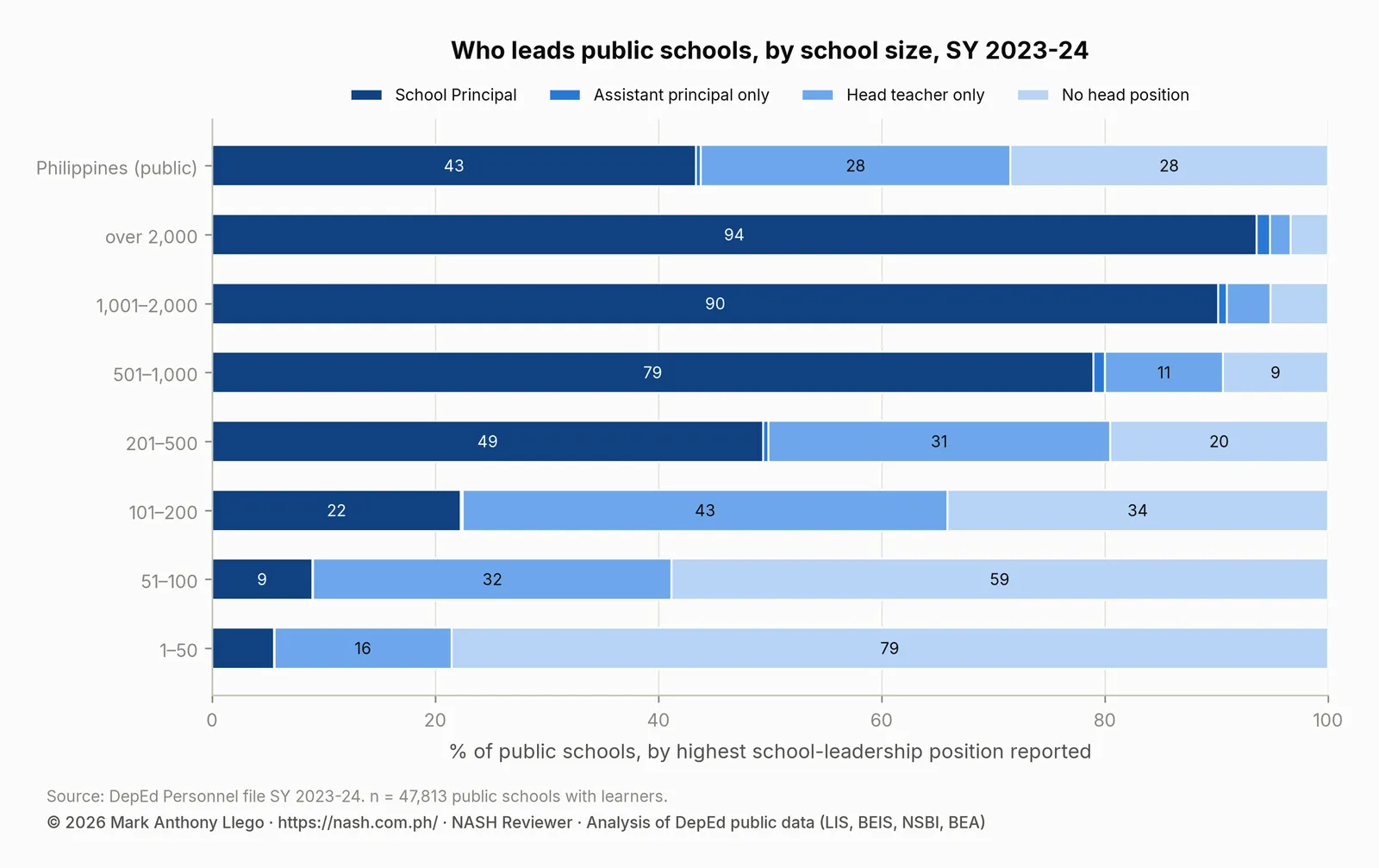
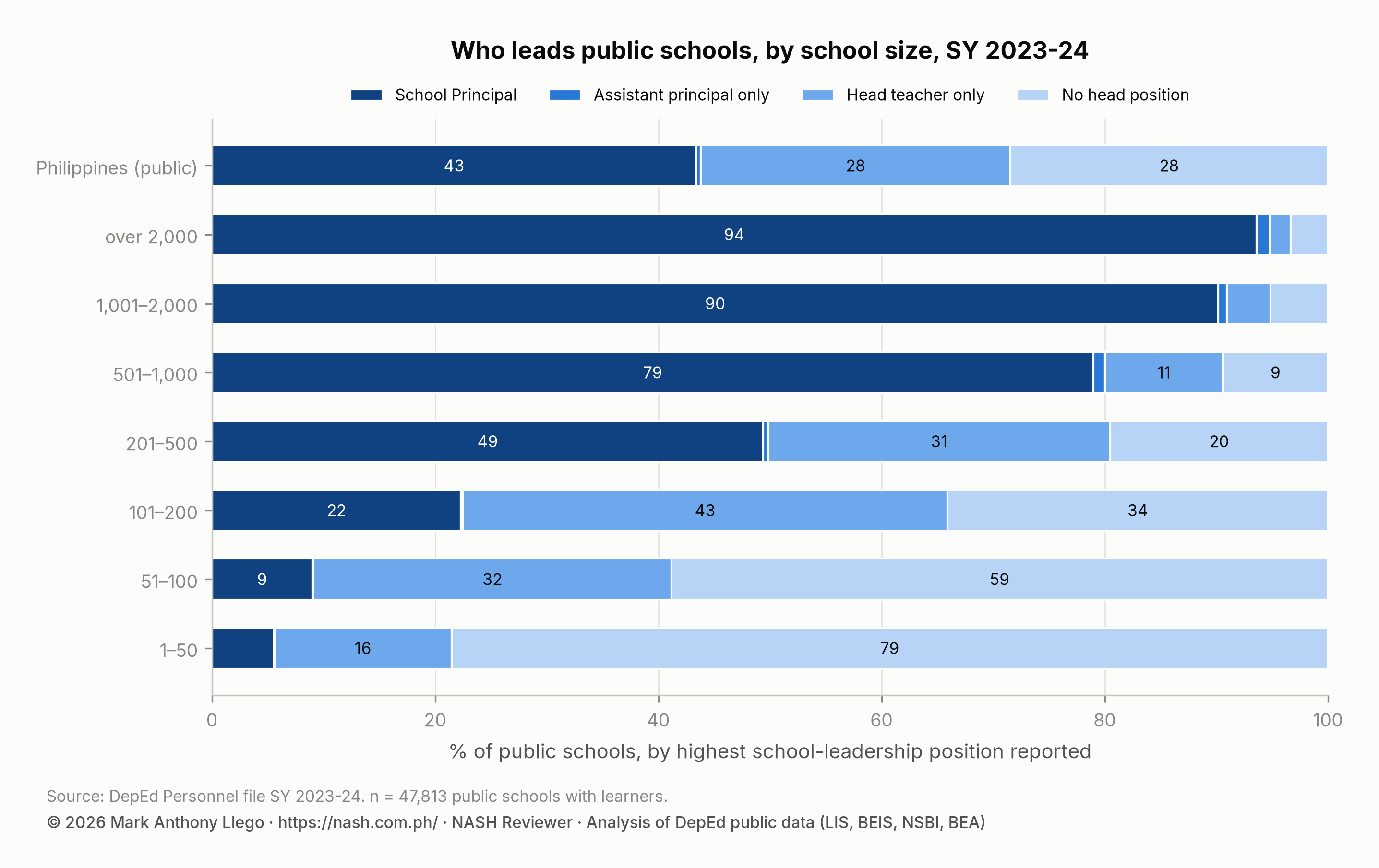
- School size decides. Among schools with 50 learners or fewer, 5.6% have a principal. Among schools with more than 2,000 learners, 93.6% do.
- Elementary-only schools are the least likely to have a principal. 39.5% of the 37,005 elementary-only schools report one, against 57.4% of secondary-only schools.
- Head teachers outnumber principals. The file reports 26,068 head teacher positions against 20,968 principal positions, and 14,760 of the head teachers are in schools with no principal.
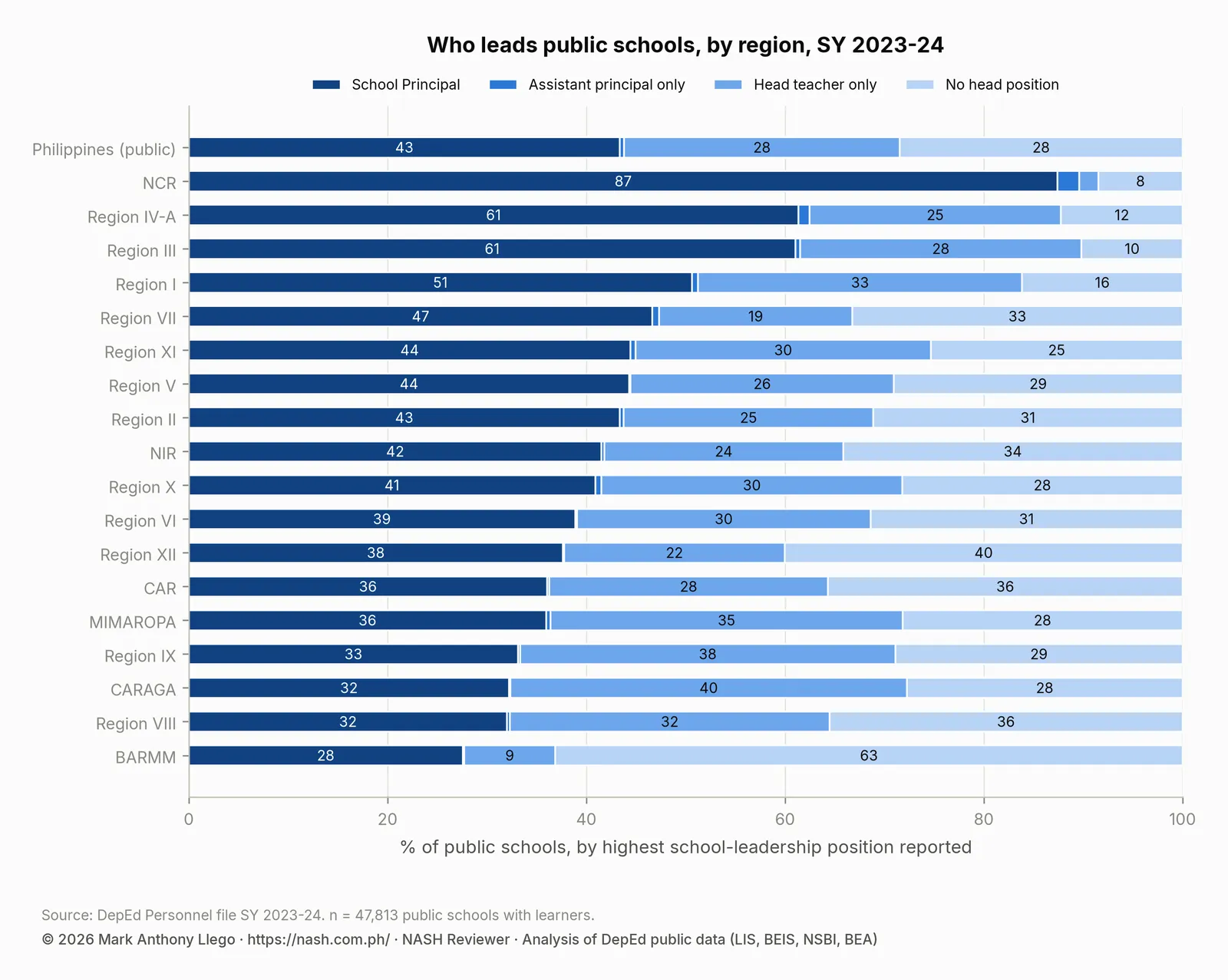
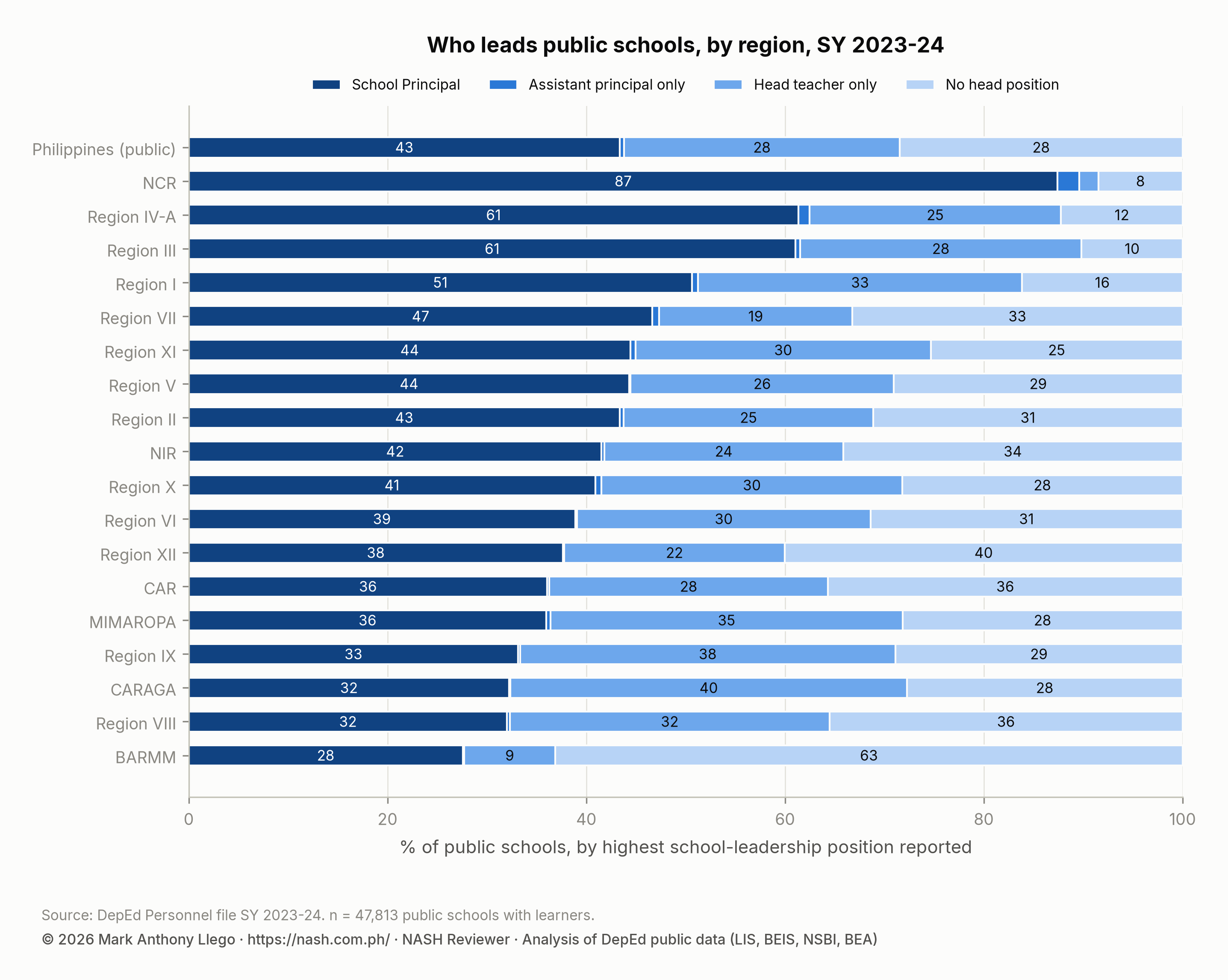
- NCR has a principal in 87.4% of its public schools, BARMM in 27.6%. Region III (61.1%) and Region IV-A (61.3%) are the only other regions above half.
Public schools by highest leadership position and region
In detail, 20,741 public schools (43.4%) report at least one School Principal position. Another 206 (0.4%) report an assistant principal without a principal. 13,261 schools (27.7%) report head teachers only. The remaining 13,605 (28.5%) report no school leadership position at all, which means a teacher-in-charge or officer-in-charge runs them.
| Region | School Principal | Assistant principal only | Head teacher only | No head position | Schools | Learners |
|---|---|---|---|---|---|---|
| BARMM | 27.6% | 0.1% | 9.2% | 63.1% | 2,155 | 769,022 |
| CAR | 36.1% | 0.2% | 28.0% | 35.7% | 1,844 | 358,204 |
| CARAGA | 32.2% | 0.1% | 39.9% | 27.7% | 2,098 | 700,194 |
| MIMAROPA | 36.0% | 0.4% | 35.4% | 28.2% | 2,382 | 817,395 |
| NCR | 87.4% | 2.2% | 1.9% | 8.5% | 827 | 2,101,985 |
| NIR | 41.5% | 0.3% | 24.0% | 34.2% | 2,231 | 1,134,333 |
| Region I | 50.6% | 0.6% | 32.6% | 16.1% | 2,861 | 1,101,162 |
| Region II | 43.4% | 0.4% | 25.1% | 31.1% | 2,539 | 809,342 |
| Region III | 61.1% | 0.5% | 28.3% | 10.2% | 3,729 | 2,478,610 |
| Region IV-A | 61.3% | 1.1% | 25.3% | 12.2% | 3,564 | 3,188,202 |
| Region IX | 33.1% | 0.2% | 37.8% | 28.9% | 2,993 | 1,106,260 |
| Region V | 44.3% | 0.1% | 26.5% | 29.1% | 3,862 | 1,581,329 |
| Region VI | 38.9% | 0.2% | 29.6% | 31.4% | 2,835 | 1,040,714 |
| Region VII | 46.7% | 0.7% | 19.4% | 33.2% | 2,810 | 1,456,462 |
| Region VIII | 32.0% | 0.3% | 32.2% | 35.5% | 4,179 | 1,141,816 |
| Region X | 40.9% | 0.6% | 30.3% | 28.2% | 2,531 | 1,159,212 |
| Region XI | 44.5% | 0.5% | 29.7% | 25.3% | 2,218 | 1,218,778 |
| Region XII | 37.6% | 0.1% | 22.2% | 40.0% | 2,155 | 1,062,105 |
| Philippines (public) | 43.4% | 0.4% | 27.7% | 28.5% | 47,813 | 23,225,125 |
The file counts the positions each school reports in the Basic Education Information System (BEIS), not plantilla items in the Government Manpower Information System. It is also a year earlier than EDCOM II’s count. Its 20,968 principal positions in 20,741 schools are fewer than EDCOM II’s 22,320 filled items in June 2025. The difference is consistent with a year of item creation and filling in between. The ranking of regions is not in doubt.
NCR has a principal in 87.4% of its public schools and no head position in 8.5%. BARMM has a principal in 27.6% and no head position in 63.1%. Region III (61.1%) and Region IV-A (61.3%) are the only other regions where more than half of the schools have a principal. Region VIII has 4,179 public schools, the most of any region; it has a principal in 32.0% of them and no head position in 35.5%.
Counted by learners, the gap is smaller, because the schools without a principal are small. Schools that report a principal hold 74.6% of public school learners. Schools with no head position hold a far smaller share of learners than their 28.5% of schools.
Schools with a principal, by school size
| Learners per school | School Principal | Assistant principal only | Head teacher only | No head position | Schools | Learners |
|---|---|---|---|---|---|---|
| 1–50 | 5.6% | 0.0% | 15.9% | 78.5% | 2,628 | 87,517 |
| 51–100 | 9.0% | 0.1% | 32.1% | 58.8% | 5,902 | 452,684 |
| 101–200 | 22.3% | 0.2% | 43.5% | 34.1% | 12,528 | 1,848,183 |
| 201–500 | 49.4% | 0.4% | 30.6% | 19.5% | 15,288 | 4,849,403 |
| 501–1,000 | 79.0% | 1.0% | 10.6% | 9.4% | 6,185 | 4,278,461 |
| 1,001–2,000 | 90.2% | 0.8% | 3.9% | 5.1% | 3,248 | 4,494,332 |
| over 2,000 | 93.6% | 1.2% | 1.9% | 3.3% | 2,034 | 7,214,545 |
| Philippines (public) | 43.4% | 0.4% | 27.7% | 28.5% | 47,813 | 23,225,125 |
Among schools with 50 learners or fewer, 5.6% report a principal and 78.5% report no head position. Among schools with 101 to 200 learners, 22.3% have a principal and 34.1% have none. The principal share reaches nearly half (49.4%) at 201 to 500 learners, the band that holds the most public schools. It is 79.0% at 501 to 1,000 learners and 93.6% above 2,000. Since 44% of public schools have 200 learners or fewer, this size pattern alone produces most of the national gap.
Rank follows size too. The 20,968 principal positions are 11,439 Principal I, 5,319 Principal II, 2,349 Principal III and 1,861 Principal IV. Among schools with more than 2,000 learners, 61.5% have a Principal III or IV. Among schools with 201 to 500 learners, 5.1% do, and among those with 101 to 200, 1.2% do. A first principalship is, almost by definition, a Principal I item in a school of a few hundred learners.
| Learners in school | Public schools | School Principal I | School Principal II | School Principal III | School Principal IV | Head Teacher I | Head Teacher II | Head Teacher III | Head Teacher IV | Head Teacher V | Head Teacher VI | Highest rank is Principal III or IV |
|---|---|---|---|---|---|---|---|---|---|---|---|---|
| 1–100 | 8,530 | 5.9% | 1.6% | 0.3% | 0.2% | 13.6% | 3.9% | 9.6% | 0.4% | 0.0% | 0.0% | 0.5% |
| 101–200 | 12,528 | 16.9% | 4.2% | 0.9% | 0.3% | 17.1% | 5.9% | 20.1% | 0.9% | 0.2% | 0.1% | 1.2% |
| 201–500 | 15,288 | 32.8% | 11.7% | 3.7% | 1.4% | 12.3% | 4.5% | 16.3% | 0.9% | 0.2% | 0.2% | 5.1% |
| 501–1,000 | 6,185 | 40.7% | 23.4% | 10.3% | 5.5% | 9.6% | 3.1% | 12.5% | 0.9% | 0.4% | 0.3% | 15.8% |
| 1,001–2,000 | 3,248 | 30.9% | 30.4% | 17.0% | 14.0% | 16.3% | 6.3% | 20.5% | 2.2% | 1.4% | 1.8% | 30.8% |
| over 2,000 | 2,034 | 13.7% | 21.4% | 22.5% | 39.4% | 24.2% | 14.6% | 38.8% | 10.3% | 5.8% | 13.6% | 61.5% |
Schools with a principal, by level and annex status
| Level offered | School Principal | Assistant principal only | Head teacher only | No head position | Schools | Learners |
|---|---|---|---|---|---|---|
| Elementary and secondary | 54.3% | 0.4% | 28.4% | 17.0% | 2,335 | 1,401,614 |
| Elementary only | 39.5% | 0.0% | 30.4% | 30.1% | 37,005 | 13,158,482 |
| Secondary only | 57.4% | 2.3% | 15.9% | 24.4% | 8,473 | 8,665,029 |
| Philippines (public) | 43.4% | 0.4% | 27.7% | 28.5% | 47,813 | 23,225,125 |
Elementary-only schools, 37,005 of the 47,813, are the least likely to have a principal. Only 39.5% report one, and 30.1% have no head position. Secondary-only schools have a principal in 57.4% of cases and integrated schools in 54.3%. Assistant principals are a secondary school position. Of 881 assistant principal positions in 694 schools, 847 are in secondary-only schools, 34 in integrated schools and none in elementary-only schools. Annex and extension schools are led from the mother school: 59% report no head position of their own.
| Annex status | School Principal | Assistant principal only | Head teacher only | No head position | Schools | Learners |
|---|---|---|---|---|---|---|
| Annex/Extension School | 17.6% | 1.3% | 22.2% | 58.8% | 760 | 316,221 |
| Mother School | 63.3% | 0.5% | 14.7% | 21.5% | 1,440 | 1,695,295 |
| Standalone School | 43.2% | 0.4% | 28.2% | 28.2% | 45,606 | 21,212,410 |
| Philippines (public) | 43.4% | 0.4% | 27.7% | 28.5% | 47,813 | 23,225,125 |
Head teacher positions: more than principal positions
| Position | Elementary | Junior high | Senior high | Total |
|---|---|---|---|---|
| School Principal I | 9,231 | 2,049 | 159 | 11,439 |
| School Principal II | 3,991 | 1,091 | 237 | 5,319 |
| School Principal III | 1,617 | 683 | 49 | 2,349 |
| School Principal IV | 993 | 817 | 51 | 1,861 |
| Assistant Principal I | 0 | 35 | 52 | 87 |
| Assistant Principal II | 0 | 135 | 637 | 772 |
| Assistant Principal III | 0 | 12 | 10 | 22 |
| Head Teacher I | 4,911 | 3,437 | 277 | 8,625 |
| Head Teacher II | 1,697 | 1,166 | 142 | 3,005 |
| Head Teacher III | 5,989 | 5,521 | 370 | 11,880 |
| Head Teacher IV | 246 | 603 | 20 | 869 |
| Head Teacher V | 50 | 284 | 27 | 361 |
| Head Teacher VI | 16 | 1,244 | 68 | 1,328 |
Head teachers outnumber principals. The file reports 26,068 Head Teacher I to VI positions in 16,572 schools, against 20,968 principal positions. Head Teacher III is the most common leadership rank in the country, with 11,880 positions, ahead of Principal I.
Of the 26,068 head teachers, 14,760 are in schools with no principal. In those schools, the senior head teacher is the school head in all but title. In 3,264 schools, both a principal and at least one head teacher are reported. In a large school this is the department head structure; in a small one it is usually a principal with a head teacher for the other level offered. Only 225 schools report two or more principal positions, most of them integrated schools with a principal for each level.
For an aspiring school head, two numbers matter here. The 13,605 schools with no head position and the 13,261 schools led by head teachers are the schools the National Education Plan’s new principal items are meant for. The head teachers in them are the people the National Assessment for School Heads (NASH) is meant to qualify.
What the National Education Plan promises
The EDCOM II Final Report counts 18,576 schools (48%) with no principal item. It also counts 12,057 schools with a head item that does not follow DepEd’s 1997 deployment policy. The National Education Plan 2026-2035 turns this finding into Recommendation 6.1.2. In June 2025, 23,661 schools (52%) had Principal I to IV items. DepEd is to create 6,000 items in 2026, 8,000 in 2027 and 8,124 in 2028, reaching 45,785, one per DepEd-managed school. It is to keep occupancy, 94.35% in 2025, at 100%. It is also to bring a third of principals to school-based management competency by 2028, through a Principals Academy under the National Educators Academy of the Philippines (NEAP).
The Final Report’s teacher education chapter adds three more measures: an Instructional Leadership Framework, an Office Performance Commitment and Review Form (OPCRF) rebuilt around classroom observation and coaching, and staffing standards to replace the 1997 guidelines.
The supply of qualified candidates is the constraint. The fiscal year (FY) 2025 NASH had 11,308 and 23,848 takers complete its two batches. Of them, 2,899 and 6,180 met the Philippine Professional Standards for School Heads (PPSSH) standards in four domains, and 1,509 and 2,591 met them in three. That makes 13,179 prospective candidates for 22,124 new items and for the vacancies that occur in the 23,661 existing ones. The principal shortage guide on the app follows these numbers, and the NASH results page follows the memoranda.
What the file cannot say
- It counts the positions a school reports, not plantilla items, vacancies or who occupies them. A school that reports a principal position whose incumbent has retired still counts as having one. A teacher-in-charge appears nowhere, because the designation is not a position.
- It is one file, for SY 2023-2024. The items created in the 2025 budget are not in it.
- Annex schools report their own positions. A principal in the mother school who oversees three annexes is counted once.
What this means for aspiring school heads
Your first school will most likely be an elementary school of 100 to 500 learners in a province. Today it is led by a Head Teacher III or a teacher-in-charge, and a Principal I item will be created for it between 2026 and 2028. Career Stage 1 of the PPSSH describes exactly that moment: a person who “has acquired the prerequisite qualifications for the school head position” and demonstrates “basic knowledge and understanding of the authority, responsibility, and accountability expected of school heads”. In such a school, four strands will be tested first. Strand 1.2 covers school planning. Strand 2.2 covers financial management of a small budget for Maintenance and Other Operating Expenses (MOOE). Strand 2.4 covers managing a staff of six to twelve teachers, and Strand 5.5 covers engaging a community that has never had a principal. The EDCOM II guide for aspiring school heads and the PPSSH Domain 4 guide cover the leadership development strands from here.
Frequently asked questions
How many DepEd public schools have a principal in SY 2023-2024?
In SY 2023-2024, 20,741 of 47,813 public schools with learners and personnel data (43.4%) reported at least one School Principal position. These schools hold 74.6% of public school learners. Another 13,261 schools (27.7%) reported head teachers only, and 13,605 (28.5%) reported no school leadership position.
Which DepEd public schools are least likely to have a principal?
Small schools and elementary schools. Among schools with 50 learners or fewer, 5.6% have a principal. Among elementary-only schools the share is 39.5%, and among schools in BARMM it is 27.6%. Among schools with more than 2,000 learners, 93.6% have one.
How does this compare with EDCOM II’s finding that 48% of schools have no principal?
EDCOM II counts 18,576 schools (48%) with no principal plantilla item, based on SY 2024-2025 DepEd data. This file counts the positions each school reported a year earlier. Its 56.6% of schools without a principal position includes schools led by head teachers, which EDCOM II counts separately as having the wrong head item. The two agree on the pattern and on the scale.
Download the data
The cleaned, harmonized DepEd files behind this series are free to download in CSV and Parquet, with a codebook and checksums, under the terms of use set out in the release. Download Cleaned DepEd School Data, SY 2017-18 to 2025-26 documents every file and column. The files themselves are at data.nash.com.ph, starting with the README, the SY 2023-24 school master file (CSV, 8.0 MB) and the nine-year enrollment panel (Parquet, 17.2 MB).
More in this series
- DepEd School Counselors, Nurses, Librarians, SY 2023-2024
- LGU-Funded Teachers and Staff in DepEd Schools, SY 2023-2024
- DepEd Teachers and School Personnel Data, SY 2023-2024
- DepEd Schools per District Supervisor, SY 2023-2024
- National Education Plan 2026-2035: Guide for School Heads
- DepEd Data for Aspiring School Heads: Where to Start
- For aspiring school heads: the NASH guide and the principal shortage on the app, and the full report, Philippine basic education in numbers
Analysis and charts by Mark Anthony Llego for NASH Reviewer. Data: Department of Education personnel and learner datasets SY 2023-24 (public datasets); EDCOM II Final Report, January 2026; DepEd Memoranda No. 097, s. 2025 and No. 044, s. 2026. Charts may be reused only with written permission from support@nash.com.ph.