The CRLA results for SY 2025-26 in Region XIII (Caraga) stand out less for reading than for what surrounds it. Almost every barangay in Caraga has a child development center (CDC): only 37 of 1,312 barangays lack one, 2.8% against 10.9% nationally. Its schools are far less often led by a principal (28.7%, against 40.7%), and stunting is well above the national 4.3% in Dinagat Islands (10.1%); Surigao del Norte (9.6%).
On reading itself, Caraga sits close to the country: 10.1% of its 159,091 public school learners in Grades 1–3 were struggling readers on the Comprehensive Rapid Literacy Assessment (CRLA) at the end of the school year, against 10.0% nationally. Inside the region, school resources line up with reading in their own way: schools without a functional toilet have more struggling readers than others in the same division, which the national model does not show.
Key findings
- Only 37 of Caraga’s 1,312 barangays (2.8%) lack a child development center, against 10.9% of barangays nationally.
- 28.7% of Caraga’s schools report a School Principal position, against 40.7% nationally, and 27.2% report no head position at all.
- Stunting among children aged 0–2 is 4.7%, near the national 4.3%, but Dinagat Islands (10.1%); Surigao del Norte (9.6%) are at least one and a half times the national share.
- In Caraga’s own model, 4 school inputs have an odds ratio whose 95% interval excludes 1: learners per teacher, school size, internet and a missing toilet.
- Schools with no functional toilet have more struggling readers than other schools in the same division, unlike the national model, where the interval for this input includes 1.
- Caraga’s share struggling (10.1%) is close to the national 10.0%, and its divisions run only from 8.0% to 11.8%, with none beyond the national funnel’s 95% limits.
- Grade 3 English is the block furthest above the national share at grade level, by +2.5 points, and Grade 2 Filipino the furthest below, at -1.4.
CRLA reading levels by grade and language in Caraga
Each row of the table is a grade-and-language block, followed by all of Caraga and the Philippines, and each column a CRLA level. The struggling readers are the learners placed at the two Emerging levels.
| Grade and language | Learners | Low Emerging | High Emerging | Developing | Transitioning | At Grade Level | Struggling |
|---|---|---|---|---|---|---|---|
| Grade 1 Mother Tongue | 48,223 | 9.7% | 5.1% | 13.6% | 25.4% | 46.2% | 14.8% |
| Grade 2 Mother Tongue | 51,049 | 6.3% | 2.3% | 11.7% | 31.3% | 48.4% | 8.6% |
| Grade 2 Filipino | 53,666 | 6.3% | 2.3% | 11.6% | 34.1% | 45.7% | 8.6% |
| Grade 3 Filipino | 57,096 | 4.1% | 1.5% | 7.0% | 36.5% | 51.0% | 5.6% |
| Grade 3 English | 57,202 | 5.5% | 2.1% | 8.0% | 31.9% | 52.5% | 7.5% |
| Caraga, all learners | 159,091 | 7.0% | 3.0% | 10.9% | 30.7% | 48.3% | 10.1% |
| Philippines, all learners | 5,127,670 | 6.9% | 3.1% | 10.4% | 32.0% | 47.6% | 10.0% |
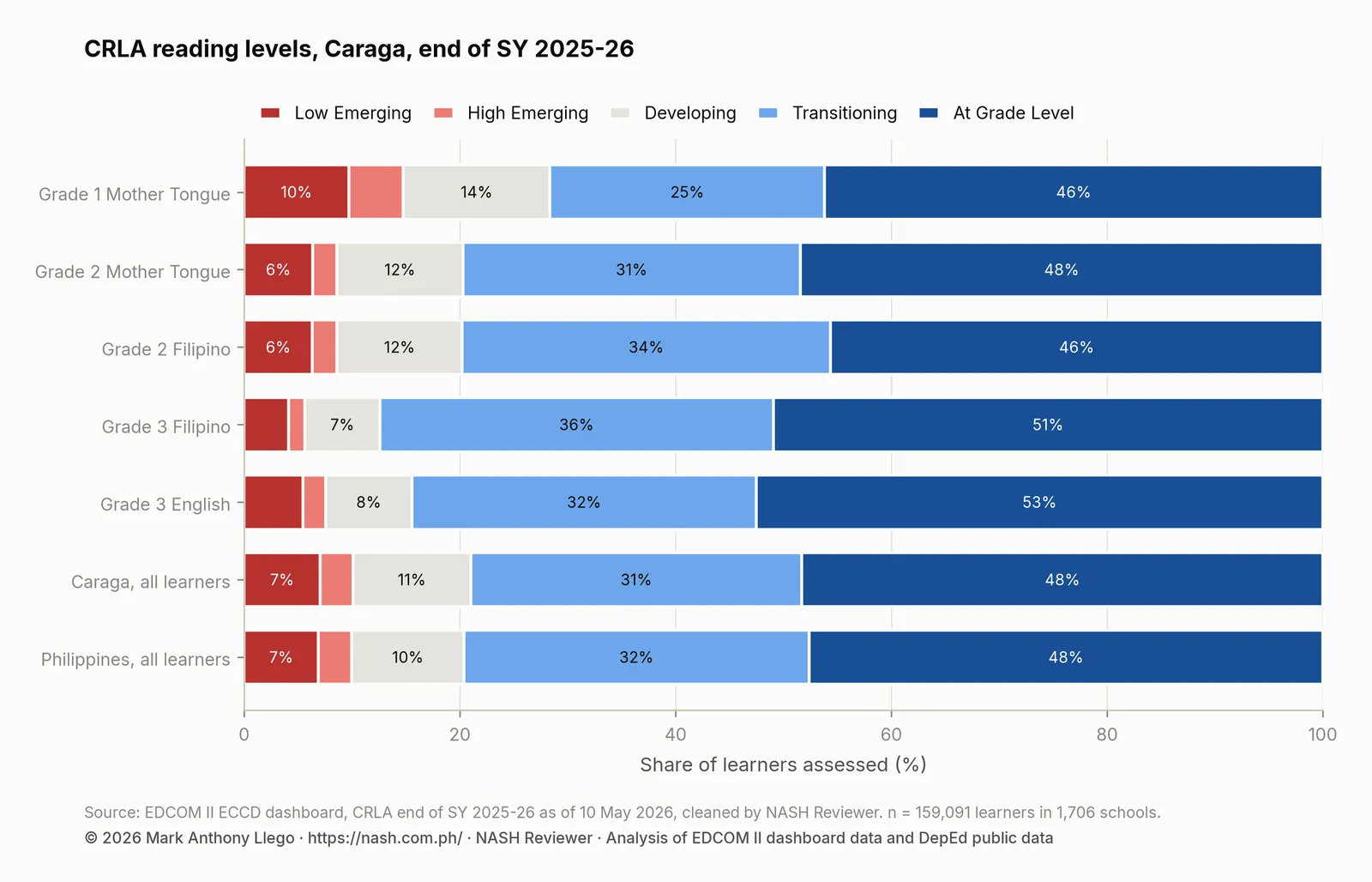
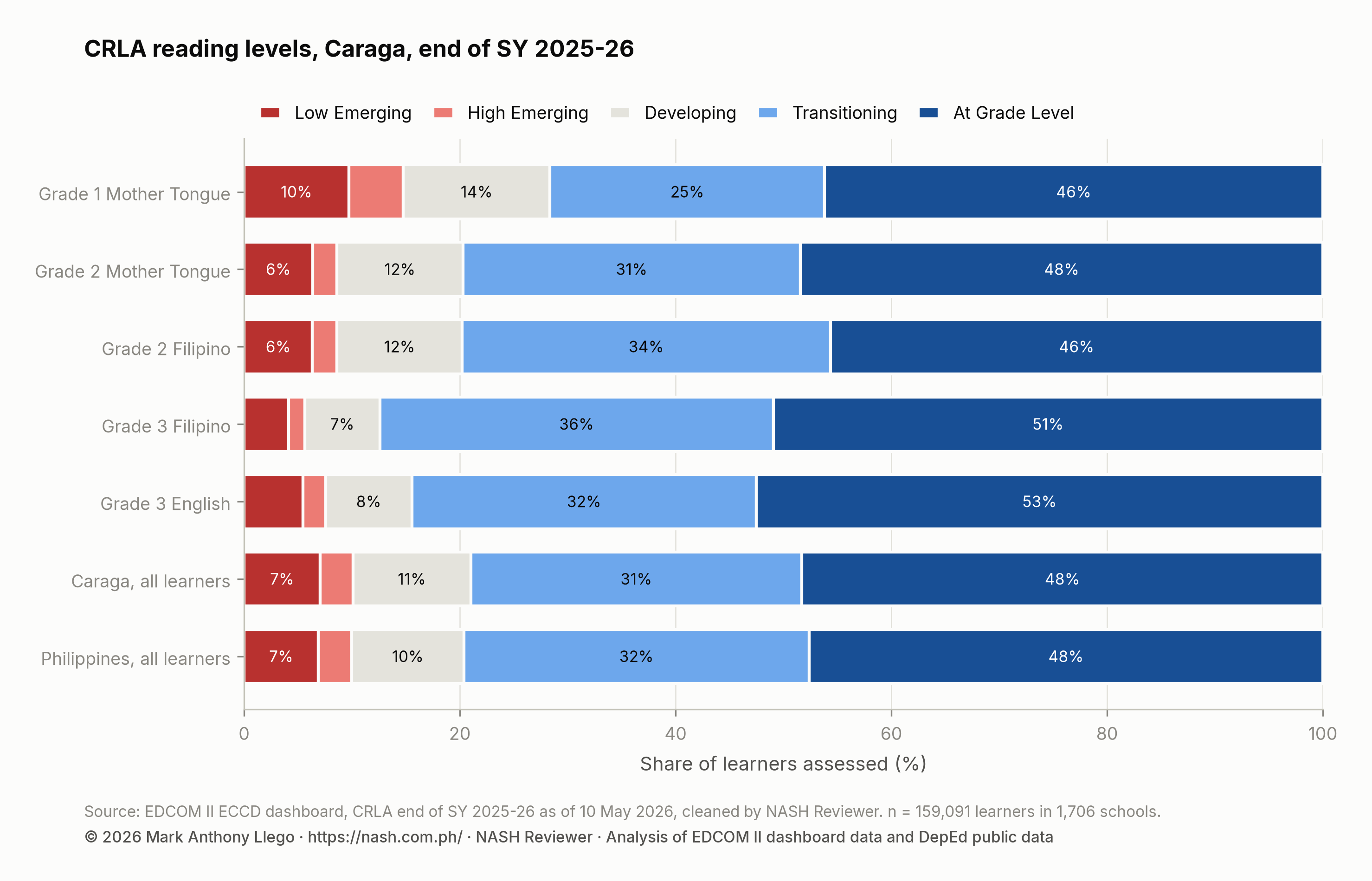
Every block is within a few points of the national figure. Grade 1 Mother Tongue has the highest share of struggling readers, as in every region: 14.8%, against 14.4% nationally. Caraga’s clearest lead is Grade 3 English, where 52.5% read at grade level, +2.5 points above the national share. Its weakest block against the country is Grade 2 Filipino, at 45.7%.
English results in Grade 3 are also more spread out than Filipino results. More learners reach grade level in English (52.5% against 51.0%), yet more also struggle in English (7.5% against 5.6%).
Schools divisions in Caraga
Each division’s estimate blends its own share with the national rate and gives the national rate more weight when the division is small. This empirical Bayes approach keeps a small division’s figure from swinging to an extreme by chance. The national funnel then asks whether a division sits further from the national rate than divisions of its size usually do; the 95% limits mark that usual range.
| Division | Schools | Learners | Struggling readers | Share struggling | Estimate (95% interval) | National rank of 232 (95% interval) | National funnel |
|---|---|---|---|---|---|---|---|
| Agusan del Norte | 166 | 16,687 | 1,977 | 11.8% | 11.8% (11.4%–12.3%) | 175 (168–182) | within limits |
| Agusan del Sur | 425 | 38,870 | 4,293 | 11.0% | 11.0% (10.7%–11.4%) | 162 (157–168) | within limits |
| Bayugan City | 57 | 5,841 | 567 | 9.7% | 9.7% (9.0%–10.5%) | 141 (124–154) | within limits |
| Bislig City | 51 | 5,471 | 439 | 8.0% | 8.0% (7.3%–8.7%) | 95 (78–116) | within limits |
| Butuan City | 106 | 18,798 | 1,646 | 8.8% | 8.8% (8.4%–9.2%) | 116 (104–128) | within limits |
| Cabadbaran City | 27 | 4,245 | 495 | 11.7% | 11.7% (10.7%–12.6%) | 171 (158–186) | within limits |
| Dinagat Island | 109 | 6,158 | 527 | 8.6% | 8.6% (7.9%–9.3%) | 109 (91–132) | within limits |
| Siargao | 120 | 8,633 | 780 | 9.0% | 9.0% (8.4%–9.6%) | 126 (106–140) | within limits |
| Surigao City | 65 | 8,660 | 746 | 8.6% | 8.6% (8.0%–9.2%) | 112 (95–130) | within limits |
| Surigao del Norte | 164 | 12,452 | 1,095 | 8.8% | 8.8% (8.3%–9.3%) | 118 (103–132) | within limits |
| Surigao del Sur | 388 | 29,634 | 3,073 | 10.4% | 10.4% (10.0%–10.7%) | 153 (147–158) | within limits |
| Tandag City | 28 | 3,642 | 406 | 11.1% | 11.1% (10.2%–12.2%) | 165 (150–179) | within limits |
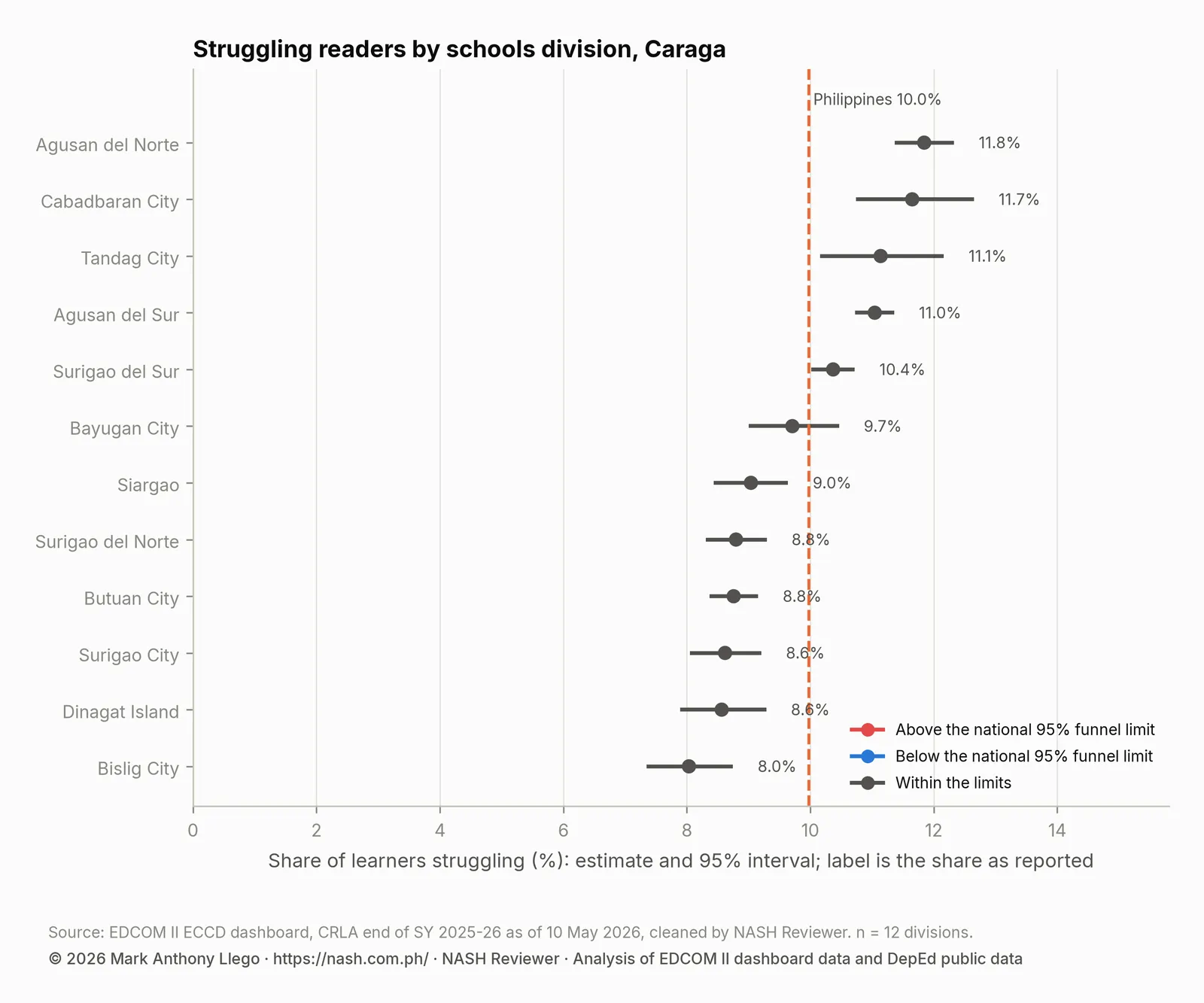
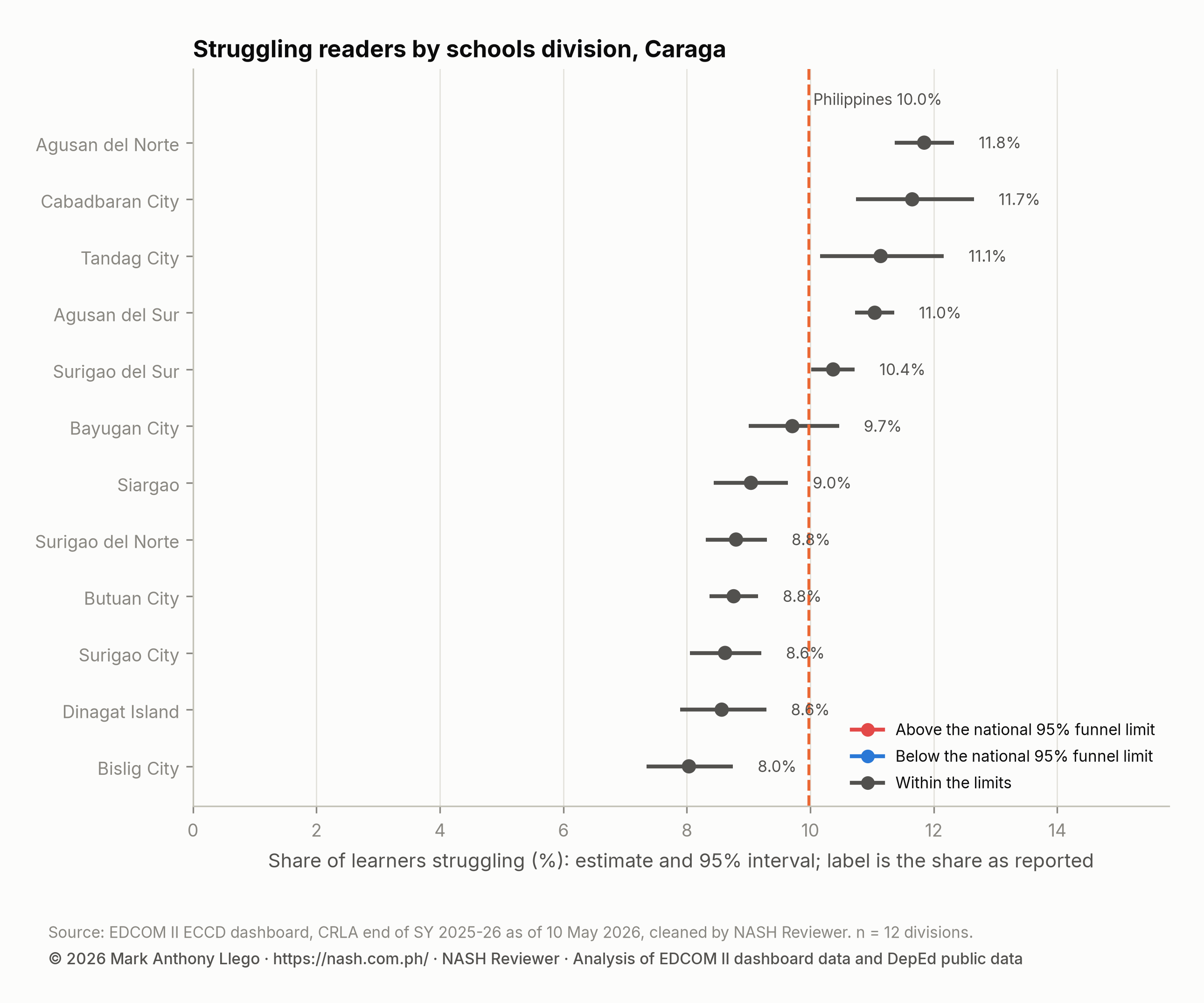
Caraga’s 12 divisions are closely bunched, from Bislig City (8.0%) to Agusan del Norte (11.8%). None lies beyond the national funnel’s limits, so none is further from the national rate than the normal spread between divisions would produce. The most struggling readers are in Agusan del Sur (4,293 struggling readers), the largest division by learners.
Languages of instruction
Most schools report Sinugbuanong Binisaya (77% of schools) as their language of instruction, followed by Surigaonon.
| Language of instruction | Schools | Learners | Share struggling | At Grade Level |
|---|---|---|---|---|
| Sinugbuanong Binisaya | 1,310 | 126,467 | 10.3% | 47.8% |
| Surigaonon | 364 | 30,211 | 9.1% | 50.6% |
| Tagalog | 19 | 1,667 | 10.1% | 46.4% |
Surigaonon schools have a slightly lower share struggling than Sinugbuanong Binisaya schools, though the two also differ in location.
Caraga’s Grade 2 learners were assessed twice, once in the Mother Tongue and once in Filipino. In Caraga, the share at grade level in Filipino is -2.5 points from the Mother Tongue share, a wider gap than the national -0.8, which fits Grade 2 Filipino being the region’s weakest block. With RA 12027 of 2024 ending the mother tongue as the medium of instruction in Kindergarten to Grade 3 outside monolingual classes that meet the law’s requirements, the Filipino results are worth watching.
Where struggling readers are concentrated in Caraga
Caraga’s 73 municipalities and cities appear on the map in the national seven-class shading for estimated share struggling.
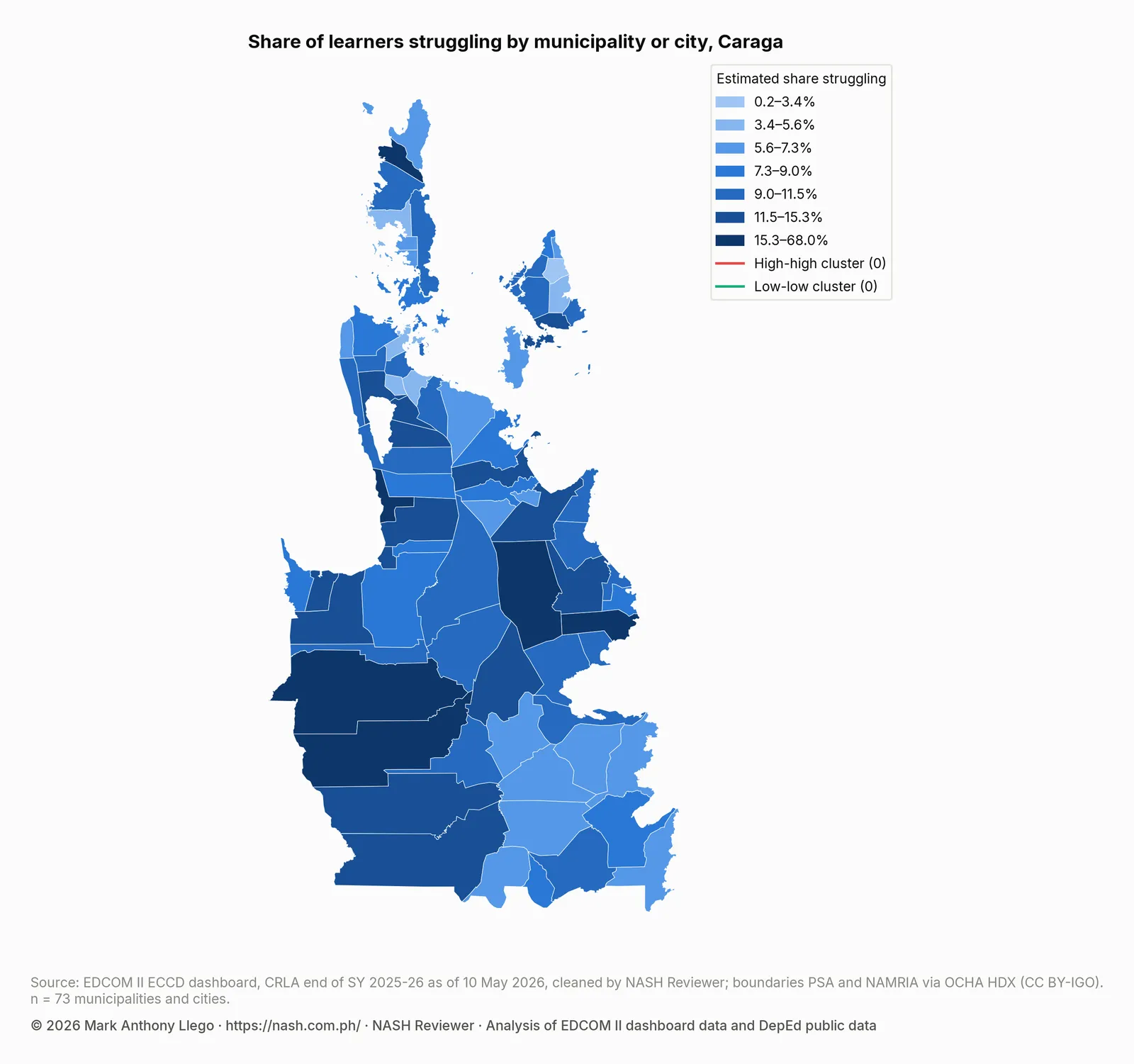
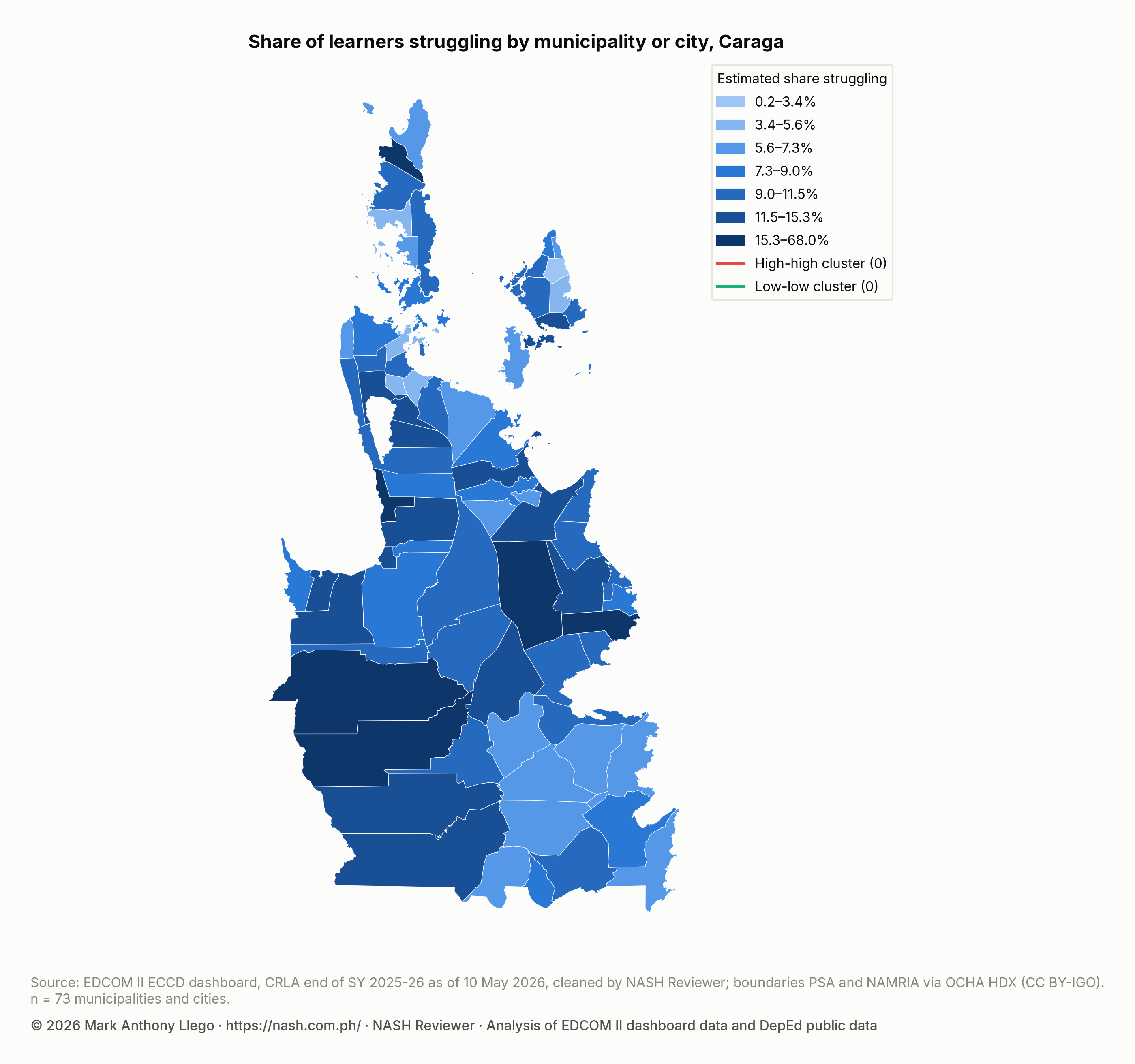
A cluster test (9,999 permutations, FDR 5%) looks for places with high or low shares surrounded by neighbors like them. Caraga has 0 high-high and 0 low-low clusters: shares vary from town to town without gathering in one part of the region.
The most struggling readers are in Butuan City (Capital), Agusan del Norte (1,646); Surigao City (Capital), Surigao del Norte (746); Prosperidad (Capital), Agusan del Sur (721); Esperanza, Agusan del Sur (691); City of Bayugan, Agusan del Sur (567), led by Butuan City. Estimated shares are highest in Tubay, Agusan del Norte (19.3%); Esperanza, Agusan del Sur (17.4%); San Miguel, Surigao del Sur (16.4%); Tubajon, Dinagat Islands (16.2%); San Luis, Agusan del Sur (15.5%). Both lists describe municipalities, not the children in them.
| Municipality or city | Province | Struggling readers | Learners | Estimated share struggling | Cluster |
|---|---|---|---|---|---|
| Butuan City (Capital) | Agusan del Norte | 1,646 | 18,798 | 8.8% | No cluster |
| Surigao City (Capital) | Surigao del Norte | 746 | 8,660 | 8.6% | No cluster |
| Prosperidad (Capital) | Agusan del Sur | 721 | 5,248 | 13.7% | No cluster |
| Esperanza | Agusan del Sur | 691 | 3,972 | 17.4% | No cluster |
| City of Bayugan | Agusan del Sur | 567 | 5,841 | 9.7% | No cluster |
Early childhood: stunting and day care centers
A child development center is the barangay day care center for children before Kindergarten. The DILG community-based monitoring list, shown on the EDCOM II dashboard, names the barangays without one. Caraga’s 2.8% is a fraction of the national 10.9%; Surigao del Norte has the most barangays still without a center.
| Province or highly urbanized city | Children 0–2 measured | Stunted | Barangays without a CDC | Learners struggling |
|---|---|---|---|---|
| Agusan del Norte | 23,769 | 1.3% | 6 of 253 | 10.4% |
| Agusan del Sur | 23,868 | 3.8% | 5 of 314 | 10.9% |
| Dinagat Islands | 2,681 | 10.1% | 4 of 100 | 8.6% |
| Surigao del Norte | 13,236 | 9.6% | 15 of 335 | 8.8% |
| Surigao del Sur | 17,509 | 6.2% | 7 of 310 | 10.1% |
Children who are too short for their age are counted as stunted, a sign of long-term undernutrition. Operation Timbang Plus 2025 measured 81,063 children aged 0–2 in Caraga, and 4.7% were stunted. That figure hides a split: Dinagat Islands (10.1%); Surigao del Norte (9.6%) are at least one and a half times the national share, while Agusan del Norte is far below it.
Both high-stunting provinces have shares of struggling readers below Caraga’s overall share: the toddlers measured in 2025 are not the learners in Grades 1–3, and provincial averages describe places, not children. How the two measures relate to reading across the country is covered in Stunting, Day Care Centers and Early Reading.
School resources
Caraga’s school inputs come from DepEd’s SY 2023-24 school files, two school years older than the reading results. Ratios in the table are for the median elementary school and the other rows are shares of schools, each set beside the national figure.
| School input (SY 2023-24) | Caraga | Philippines |
|---|---|---|
| Learners per teacher (elementary) | 21.3 | 22.8 |
| Learners per classroom (elementary) | 25.6 | 25.8 |
| Schools with internet | 81.9% | 76.3% |
| Schools with electricity | 97.6% | 97.6% |
| Schools with a water supply | 97.9% | 97.8% |
| Schools with no functional toilet | 2.2% | 2.3% |
| Schools with multigrade classes | 20.7% | 15.3% |
Caraga is close to the country on most inputs. More of its schools have internet (81.9% against 76.3%) and more offer multigrade classes (20.7% against 15.3%).
The region’s own model compares schools only with others in the same division and gives an odds ratio for each input: above 1 means more struggling readers, below 1 fewer. Its intervals are quasi-binomial, stretched beyond binomial ones by how much more Caraga’s schools vary than chance alone would make them. Caraga’s model finds 4 inputs whose 95% interval excludes 1: learners per teacher: odds ratio 1.25 (1.13–1.38); school size: odds ratio 0.72 (0.66–0.78); internet: odds ratio 0.71 (0.62–0.82); no functional toilet: odds ratio 1.99 (1.31–3.03).
Learners per teacher, school size and internet match the national model in direction: more learners per teacher goes with more struggling readers, and larger schools and internet with fewer. The exception is no functional toilet: Caraga’s schools without a functional toilet have more struggling readers than their division neighbors, while the national interval for this input includes 1. A missing toilet may mark other disadvantages the model cannot separate. Caraga’s results can be set against the nationwide estimates in School Resources and CRLA Reading Results.
School heads
The principal share is one of Caraga’s sharpest differences from the country. In DepEd’s SY 2023-24 personnel file, 28.7% of its schools report a School Principal position, against 40.7% nationally; 27.2% report no head position and are run by a teacher-in-charge, and the rest have a head teacher or assistant principal.
As reported, without adjustment, 8.4% of learners are struggling in schools with a principal and 12.1% in schools without one. Small schools often do not qualify for a principal, and Caraga has many multigrade schools, so this gap probably reflects size in part. How the gap looks once similar schools are compared is in CRLA Results in Schools With and Without a Principal.
Programs recorded in Caraga
The EDCOM II dashboard lists 6 partner programs in Caraga (6.0% of the list), above the region’s 3.1% share of the country’s struggling readers. By category they are Nutrition (3); Literacy (3); by type, Supplementary Feeding (0-2yo) (1); Reading Remediation (Grades 1-3) (1); Nutrition Counseling for Mothers (1); Literacy Tutoring Program (1); Book/Reading Material Donation (1); Growth Monitoring & Weighing (1). The list is what NGOs and corporate foundations reported, not a census or an evaluation. Literacy and Nutrition Programs Compared With Need puts Caraga’s share of the list beside every other region’s.
What this means for school heads in Caraga
Many Caraga schools are led by head teachers or teachers-in-charge who also teach, so district coaching and shared reading routines matter more than plans that assume a full-time head.
The barangay CDC is a ready partner: Kindergarten and Grade 1 teachers can share reading-readiness activities with child development workers. In Dinagat Islands and Surigao del Norte, nutrition work with barangay health workers belongs in the school plan.
Schools without a functional toilet deserve a closer look, not because a toilet has been shown to raise reading, but because in Caraga these schools have more struggling readers than other schools in their division. Grade 2 Filipino is the block to watch.
How these numbers were made
Caraga’s reading figures come from the EDCOM II early-childhood (ECCD) dashboard: public school CRLA results for the end of SY 2025-26, as of 10 May 2026. Each learner counts once, through Grade 1 Mother Tongue, Grade 2 Filipino or Grade 3 English; Low Emerging plus High Emerging make up the struggling readers. Because they come from close to a full count of learners, Caraga’s shares are shown without sampling intervals. The division and school estimates are explained in How to Read a School’s CRLA Results Fairly and CRLA End-of-Year Results SY 2025-26: All 18 Regions.
Limits
Each comparison here is an association, and the school inputs and heads are two school years older than the CRLA. Stunting in small provinces rests on fewer children. Caraga has 313 schools reporting no struggling readers, close to the 302 expected from normal variation between schools (a ratio of 1.03), so the count of zero reports gives no sign of a recording problem.
Frequently asked questions
How do Caraga’s CRLA results compare with the national results?
Closely. 10.1% of Caraga’s learners in Grades 1–3 were struggling readers at the end of SY 2025-26, against 10.0% nationally, and 48.3% read at grade level, against 47.6%.
Which division in Caraga has the most struggling readers?
By number, Agusan del Sur (4,293 struggling readers). By share, Agusan del Norte (11.8%) is highest, and no division is beyond the national funnel’s limits.
How many schools in Caraga have a principal?
28.7% of Caraga’s schools reported a School Principal position in SY 2023-24, against 40.7% nationally. The rest are led by an assistant principal, a head teacher or a teacher-in-charge.
Do schools without a toilet in Caraga have more struggling readers?
Yes: within the same division, schools with no functional toilet have more struggling readers, and the 95% interval excludes 1. It is an association, not proof that toilets affect reading, and the national model does not show it.
Download the data
The cleaned EDCOM II dashboard data behind this series are free to download for personal study; to reuse them, email support@nash.com.ph for written permission first. How the EDCOM Dashboard Data Was Cleaned explains every table and cleaning rule. The files are at data.nash.com.ph: start with the README, then the school table with CRLA results and school inputs (Parquet), the school estimates (CSV), the division estimates (CSV) and the municipal table (CSV). The DepEd school files used for school inputs are described in Download Cleaned DepEd School Data.
Every file, with its rows, columns and checksum, is listed on the EDCOM II CRLA data page. To cite the data: Llego, M. A. (2026). EDCOM II early-childhood dashboard data, cleaned, version 1. NASH Reviewer. https://nash.com.ph/edcom-data
More in this series
- CRLA End-of-Year Results SY 2025-26: All 18 Regions
- CRLA Start vs End of SY 2025-26 in the Same Schools
- CRLA by Language: Mother Tongue, Filipino and English
- How to Read a School’s CRLA Results Fairly
- CRLA Variation: School, Division or Region?
- Where Struggling Readers Are Concentrated
- School Resources and CRLA Reading Results
- CRLA Results in Schools With and Without a Principal
- Action Research and Thesis Topics on Reading (CRLA)
- CRLA Reading Hotspots: A Map of Struggling Readers
- Stunting, Day Care Centers and Early Reading
- Literacy and Nutrition Programs Compared With Need
- CRLA Schools With No Struggling Readers: A Data Check
- How the EDCOM Dashboard Data Was Cleaned
- Regional reports: NCR, CAR, Region I, Region II, Region III, Region IV-A, MIMAROPA, Region V, Region VI, NIR, Region VII, Region VIII, Region IX, Region X, Region XI, Region XII, Caraga, BARMM
- Earlier reports: CRLA Results SY 2025-2026 (DepEd’s selected-school file), Do the Same DepEd Schools Lag on the ELLNA, NAT and CRLA?, DepEd School Inputs vs Test Results, EDCOM II Final Report: Guide for Aspiring School Heads, DepEd Data for Aspiring School Heads: Where to Start
Analysis and charts by Mark Anthony Llego for NASH Reviewer. Data: EDCOM II early-childhood dashboard and Department of Education public datasets. NASH Reviewer is not affiliated with EDCOM II or DepEd. Charts may be reused only with written permission from support@nash.com.ph.